Thoracotomy is indicated in all the following conditions except:
What is the characteristic of a lacerated wound over a bony surface due to blunt trauma without excessive skin crushing?
Match the following weapons with their corresponding injury types: Weapons: A. Axe B. RTA (Road Traffic Accident) C. Blade D. Lathi Injury Types: 5. Incised wound 6. Tram track bruise 7. Grazed abrasion 8. Chop wound
In blunt trauma abdomen, maximum injury to the small bowel occurs at:
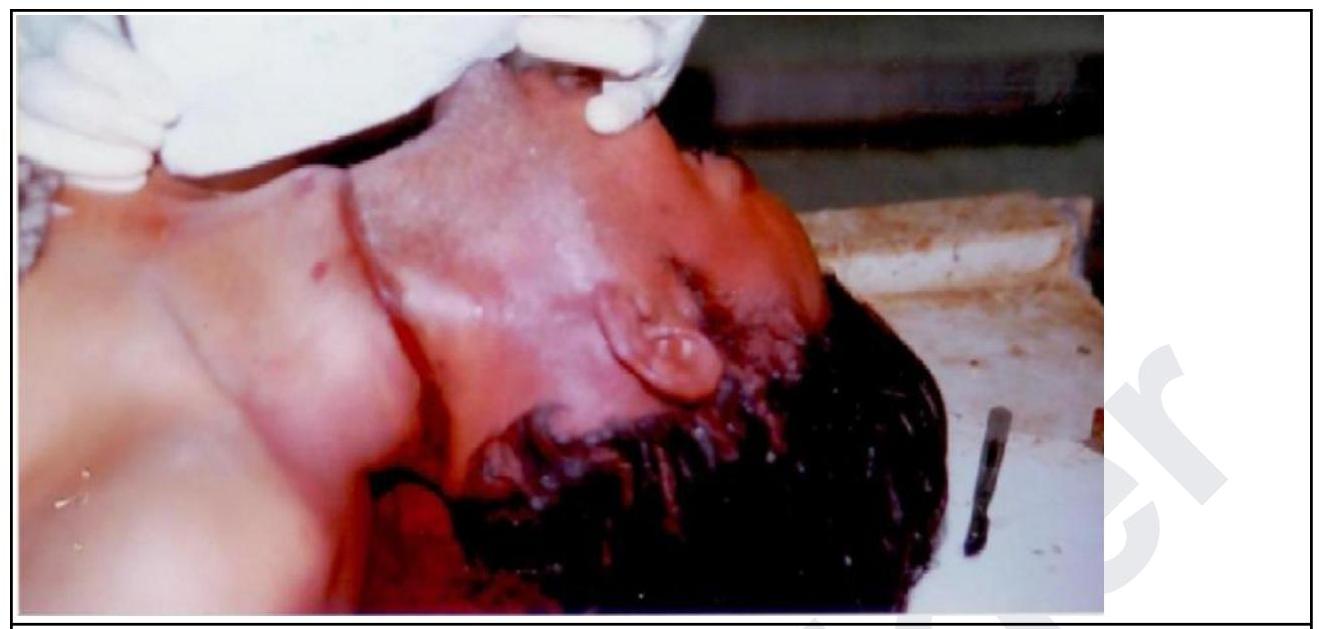
Identify the pattern of abrasion shown in the image below.
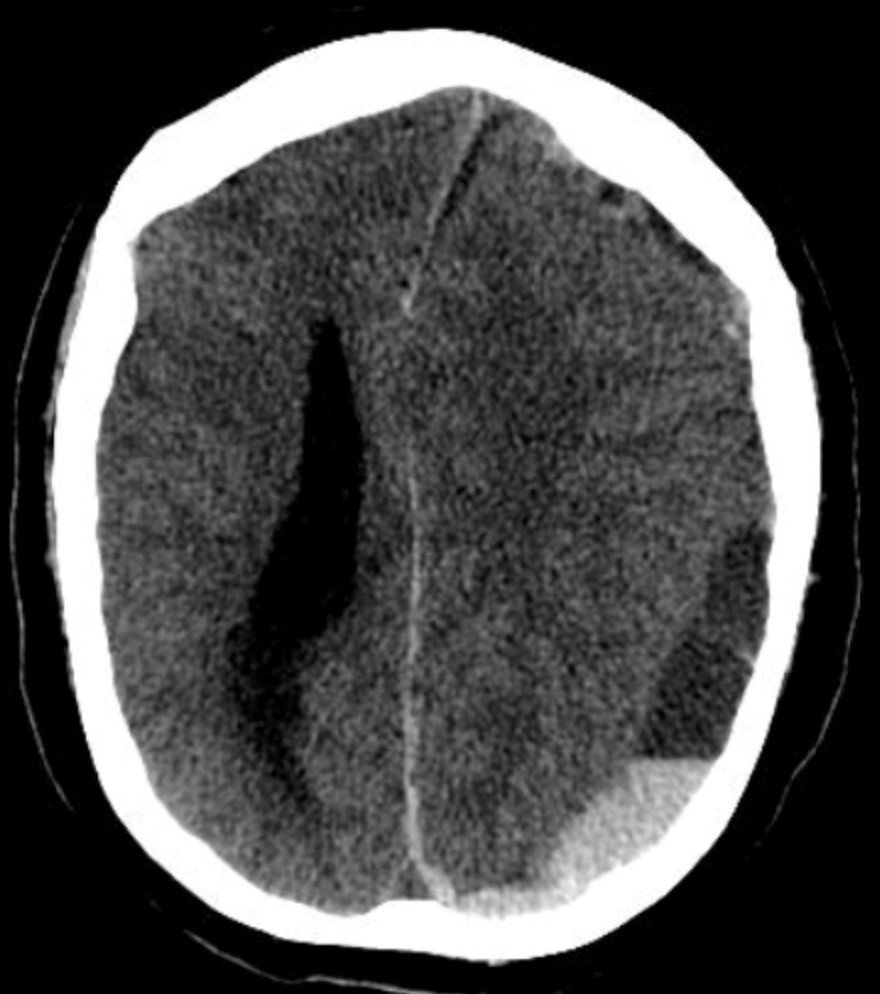
A polytrauma patient's CT brain shows a crescent-shaped extra-axial collection with a concave inner margin. What is the most likely diagnosis?
Which is an ominous sign in case of severe head injury?
If a fracture gives the pattern of the striking surface of the weapon it is called
In a vehicular accident, extensive contusions of brain due to acceleration and deceleration injury indicate what kind of injury?
A dead body is found to have marks like branching of a tree on the front of the chest. The most likely cause of death could be due to:
Explanation: ***Pulmonary contusion*** - **Pulmonary contusion** is a bruise of the lung parenchyma that typically resolves with **supportive care** (oxygen, fluid management, analgesia, respiratory support) [1]. - It is generally *not* an indication for thoracotomy and is managed **conservatively** in most cases [1]. - Surgical intervention is only considered if complicated by other issues such as **uncontrolled hemorrhage**, massive hemothorax, or other injuries requiring exploration. *Penetrating chest injuries* - While approximately **85% of penetrating chest injuries** are managed conservatively with tube thoracostomy alone, **selective indications** for thoracotomy include: - **Cardiac tamponade** or suspected cardiac injury - **Great vessel injury** with hemodynamic instability - **Massive initial hemothorax** (>1500 mL) or persistent bleeding (>200 mL/hr) - **Trans-mediastinal trajectory** with suspected esophageal or major vascular injury - The key is that *specific criteria* determine need for thoracotomy, not the penetrating injury itself. *Rapidly accumulating haemothorax* - A **rapidly accumulating haemothorax** with **>1500 mL initial output** or **>200 mL/hour for 2-4 consecutive hours** indicates significant ongoing intrathoracic bleeding. - This is an **absolute indication** for thoracotomy for **source identification and hemorrhage control** [2]. - Without surgical intervention, such bleeding leads to **hemodynamic instability**, shock, and death. *Massive air leak* - A **massive persistent air leak** from chest tube, unresponsive to initial management, suggests a large **tracheobronchial injury** or major lung parenchymal disruption [3]. - This persistent leak prevents **lung re-expansion** and adequate ventilation. - Thoracotomy is indicated for **surgical repair** of the damaged bronchus, major airway, or extensive lung laceration [2].
Explanation: ***Regular sharp margins*** - A **lacerated wound** on a bony surface from **blunt trauma** without significant crushing often has margins that appear regular and sharp due to the skin tearing over the underlying bone. - The **tensile strength** of the skin leads to a clean tear rather than an irregular rip when stretched over a hard surface. *Irregular margins* - **Irregular margins** are typically found in lacerations caused by a glancing or tearing force, or when there is significant **crushing** of the tissue. - This results in a more jagged and uneven wound edge due to varied tissue resistance. *Tearing* - While a laceration is a form of tearing, simply stating "tearing" doesn't sufficiently describe the **morphology of the wound margins** when occurring over a bony surface. - The term "tearing" is broad and does not emphasize the specific characteristic of the wound edges in this particular scenario. *Flaying* - **Flaying** refers to the severe separation of a large section of skin and subcutaneous tissue from the underlying fascia and muscle. - This is a more extensive injury than a simple laceration and typically involves a significant shearing force that lifts the skin.
Explanation: ***A-8 (Axe - Chop wound), B-7 (RTA - Grazed abrasion), C-5 (Blade - Incised wound), D-6 (Lathi - Tram track bruise)*** - An **axe** is a heavy cutting tool that typically causes a **chop wound**, characterized by a combination of cutting and crushing. - A **Road Traffic Accident (RTA)** frequently results in **grazed abrasions** due to friction and shearing forces as the body slides against rough surfaces. - A **blade** (like a knife or razor) is designed to cut, producing an **incised wound** with clean, sharp edges. - A **lathi** (a heavy stick or baton) delivers blunt force trauma, often causing a **tram track bruise** due to the skin being crushed between the impactor and underlying bone, leading to parallel lines of bruising. *A-5, B-6, C-8, D-7* - This option incorrectly associates an **axe** with an **incised wound** (which is caused by a blade) and a **blade** with a **chop wound** (caused by an axe). - It also misattributes **RTA** to a **tram track bruise** and a **lathi** to a **grazed abrasion**, which are not the most typical injury patterns for these respective weapons/mechanisms. *A-6, B-8, C-7, D-5* - This pairing mistakenly links an **axe** with a **tram track bruise** and a **blade** with a **grazed abrasion**. - It also incorrectly associates an **RTA** with a **chop wound** and a **lathi** with an **incised wound**. *A-7, B-5, C-6, D-8* - This option incorrectly matches an **axe** with a **grazed abrasion** and a **lathi** with a **chop wound**. - It also inaccurately connects an **RTA** with an **incised wound** and a **blade** with a **tram track bruise**.
Explanation: ***Proximal jejunum*** - The **proximal jejunum** is particularly vulnerable to blunt abdominal trauma due to its relatively fixed position at the **ligament of Treitz** and its proximity to the impact forces. - The rapid change in momentum during deceleration can cause tearing or shearing injuries at this point of relative immobility. *Ileocecal junction* - While the ileocecal junction is another relatively fixed point, it is less commonly injured in blunt abdominal trauma compared to the proximal jejunum. - Its anatomical position often shields it from the direct impact and shearing forces that typically affect the more superior small bowel. *Mid ileum* - The **mid ileum** is generally more mobile within the abdominal cavity, making it less susceptible to the shearing forces that affect fixed segments. - Injuries to this region are usually associated with more severe, widespread trauma or direct crushing mechanisms, rather than a specific point of maximum vulnerability. *Proximal ileum* - Similar to the mid ileum, the **proximal ileum** also has considerable mobility, reducing its risk of injury from acceleration-deceleration forces. - The more common sites of injury in the small bowel are those with relative fixation points, such as the jejunum near the ligament of Treitz.
Explanation: ***Ligature mark*** - The image clearly displays a **linear impression** on the neck, consistent with a **ligature mark**, which is an abrasion caused by a constricting object. - This type of abrasion is often seen in cases of **strangulation or hanging**, where a cord or similar item tightens around the neck. *Pressure abrasion* - Pressure abrasions are typically caused by **blunt forceful contact** with a surface, resulting in a scraped or grazed appearance, which differs from the distinct linear mark shown. - They are usually broad and irregular, not forming a clear, thin line as seen in the image. *Graze abrasion* - Graze abrasions, also known as scrapes, involve the **superficial removal of the epidermis** due to friction against a rough surface. - They tend to be spread out and irregular, lacking the deep, circumscribed linear pattern characteristic of a ligature mark. *Imprint abrasion* - Imprint abrasions reflect the **exact pattern of the impacting object** (e.g., tire track, weapon pattern), which is not evident in the image. - While a ligature itself can leave an imprint, the term "imprint abrasion" is usually reserved for more complex patterns than a simple linear groove.
Explanation: ***SDH*** - The image shows a **crescent-shaped collection** of hemorrhage with a concave inner margin, consistent with a **subdural hematoma** (SDH). - SDHs result from the tearing of **bridging veins** and typically conform to the brain's surface, crossing suture lines but not limited by bony sutures. *EDH* - An **epidural hematoma (EDH)** characteristically appears as a **lenticular** or **biconvex** shape on CT, not crescent-shaped. - EDHs are typically caused by arterial bleeding, often from the **middle meningeal artery**, and are limited by cranial sutures. *Contusion* - A **contusion** is brain tissue bruising that appears as **heterogeneous areas** of hemorrhage and edema within the brain parenchyma itself. - It would not manifest as a distinct extra-axial collection with a smooth, concave margin. *Diffuse axonal injury* - **Diffuse axonal injury (DAI)** involves widespread microscopic damage to axons, often at the gray-white matter junction. - It may appear as *punctate hemorrhages* or **small lesions** at these junctions on CT, but often the CT can be normal, and it would not present as a large extra-axial collection.
Explanation: ***Anisocoria*** - **Anisocoria** (unequal pupil size) in the setting of severe head injury indicates uncal herniation, a life-threatening condition where the temporal lobe compresses the **oculomotor nerve (CN III)**. - This compression leads to ipsilateral pupillary dilation that is **non-reactive to light**, signifying severe brainstem compromise and poor prognosis. *Depressed skull fracture* - A **depressed skull fracture** is a significant injury but does not inherently indicate immediate life-threatening brainstem compression or herniation. - While it can lead to neurological deficits or infection, it is usually amenable to surgical intervention and does not carry the same immediate ominous prognosis as anisocoria. *Development of diabetes insipidus* - **Diabetes insipidus** can occur due to damage to the posterior pituitary or hypothalamus affecting **ADH secretion**, but it typically develops days after the injury. - While a serious complication indicating **hypothalamic-pituitary axis damage**, it is not an immediate sign of impending brain herniation or brainstem failure like anisocoria. *New focal deficit* - A **new focal deficit** (e.g., hemiparesis) signifies localized brain injury or worsening intracranial pathology (like hematoma expansion). - While concerning and requiring urgent evaluation, it is generally less immediately ominous than anisocoria, which specifically points to **brainstem compression and herniation**, often indicating an irreversible process if not promptly treated.
Explanation: ***Signature fracture*** - A **signature fracture** is a term used when the bone fracture pattern directly reflects or reproduces the shape of the imparting object or weapon. - This type of fracture provides crucial forensic evidence, directly linking the injury to a specific weapon. *Pond fracture* - A **pond fracture** is a type of depressed skull fracture, typically seen in infants, where the bone is indented without complete disruption, resembling an indentation in a flexible surface. - It does not involve the replication of the weapon's striking surface but rather a localized depression. *Ring fracture* - A **ring fracture** (or foramen magnum fracture) is a fracture around the base of the skull, specifically encircling the foramen magnum. - These fractures are usually caused by an axial load impact (e.g., a fall on the head or feet) or hyperextension/hyperflexion injuries, not by replicating an object's surface. *Comminuted fracture* - A **comminuted fracture** is characterized by the bone breaking into several fragments, often three or more pieces, at the site of injury. - While it indicates high-energy trauma, it describes the number of bone fragments and not the pattern reflecting the striking object.
Explanation: ***Coup-Countercoup Injury*** - This type of injury occurs due to rapid **acceleration and deceleration** of the head, causing the brain to strike the skull at the initial point of impact (**coup**) and then rebound to strike the opposite side of the skull (**contrecoup**). - Extensive contusions, often seen in vehicular accidents, are characteristic of this shearing and compressive force on the brain tissue. *Second Impact Syndrome* - This refers to a rare but severe condition where a second concussion occurs before the symptoms of a previous concussion have resolved. - It typically results in rapid and severe brain swelling, which is distinct from the extensive contusions described in the question. *Penetrating Injury* - A penetrating injury involves an object breaking through the skull and entering the brain tissue. - This type of injury is characterized by a focal wound and direct tissue damage, not extensive contusions from acceleration/deceleration forces. *Crush injury* - A crush injury involves significant force directly compressing the head or brain, leading to deformation and local tissue destruction. - While it can cause contusions, the key mechanism of "acceleration and deceleration" described in the question points more specifically to coup-contrecoup.
Explanation: ***Lightning injury*** - The branching, tree-like marks described are known as **Lichtenberg figures**, which are characteristic cutaneous patterns caused by the passage of high-voltage electrical current, such as during a **lightning strike**. - These transient patterns are believed to be due to dilation of capillaries or arborizing superficial burns, sometimes referred to as ferning. *Road traffic accident* - Injuries from a **road traffic accident** typically include blunt force trauma, lacerations, fractures, and internal organ damage, but they do not produce branching, tree-like skin marks. - The pattern of injury is usually widespread and indicative of impact, shearing, or crushing forces, which is distinct from the described branching marks. *Injuries due to bomb blast* - **Bomb blast injuries** are usually categorized as primary (blast wave), secondary (projectiles), tertiary (body displacement), and quaternary (miscellaneous, e.g., burns, toxic inhalation). They would not typically produce the specific Lichtenberg figures. - While burns can occur, they are usually thermal or chemical burns, not the characteristic superficial dendritic branching marks seen with lightning. *Firearm* - **Firearm injuries** result from projectiles (bullets), leading to entrance wounds, exit wounds (if applicable), and internal organ damage along the bullet's path. - The markings associated with firearms do not include branching, tree-like patterns on the skin; instead, they might show tattooing, stippling, or muzzle imprint with close-range shots.
Get full access to all questions, explanations, and performance tracking.
Start For Free