Most common fractured facial bone
What is the characteristic of a lacerated wound over a bony surface due to blunt trauma without excessive skin crushing?
Which of the following conditions is associated with postmortem caloricity?
Burst Fracture of spine is a -
Which feature differentiates antemortem bruises from postmortem bruises?
Which of the following conditions is MOST likely to cause postmortem caloricity?
Which of the following statements about exit wounds of a bullet in bone is correct?
In a vehicular accident, extensive contusions of brain due to acceleration and deceleration injury indicate what kind of injury?
Preauricular sulcus is useful for determination of:
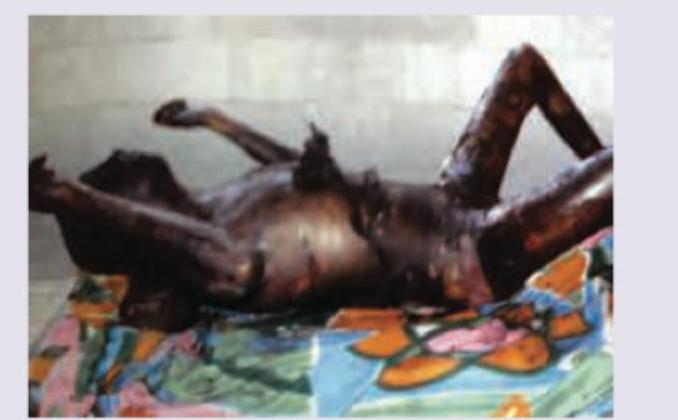
What is the phenomenon shown in the image?
Explanation: ***Nasal bone*** - The **nasal bone** is the **most commonly fractured facial bone** due to its prominent and anterior position on the face. - Its relatively thin and delicate structure makes it highly susceptible to direct trauma, especially during sports injuries, falls, or assaults. *Nasoethmoid bone* - Fractures of the **nasoethmoid complex** are serious but less frequent than isolated nasal bone fractures, often resulting from high-impact trauma. - These fractures typically involve the **nasal bones**, **ethmoid sinuses**, and sometimes the medial orbital walls, leading to complex midfacial injuries. *Zygomatic bone* - The **zygomatic bone (cheekbone)** is the second most commonly fractured facial bone, but not the first. - Zygomatic fractures often occur from direct blows to the cheek but require more force than nasal bone fractures due to its sturdier structure. *Mandible* - The **mandible (jawbone)** is a robust bone, and while mandibular fractures are common facial injuries, they are secondary to nasal bone fractures in terms of frequency. - Mandibular fractures often result from significant force, such as motor vehicle accidents or direct blows to the jaw.
Explanation: ***Regular sharp margins*** - A **lacerated wound** on a bony surface from **blunt trauma** without significant crushing often has margins that appear regular and sharp due to the skin tearing over the underlying bone. - The **tensile strength** of the skin leads to a clean tear rather than an irregular rip when stretched over a hard surface. *Irregular margins* - **Irregular margins** are typically found in lacerations caused by a glancing or tearing force, or when there is significant **crushing** of the tissue. - This results in a more jagged and uneven wound edge due to varied tissue resistance. *Tearing* - While a laceration is a form of tearing, simply stating "tearing" doesn't sufficiently describe the **morphology of the wound margins** when occurring over a bony surface. - The term "tearing" is broad and does not emphasize the specific characteristic of the wound edges in this particular scenario. *Flaying* - **Flaying** refers to the severe separation of a large section of skin and subcutaneous tissue from the underlying fascia and muscle. - This is a more extensive injury than a simple laceration and typically involves a significant shearing force that lifts the skin.
Explanation: ***Sepsis/severe infection as a cause of postmortem caloricity*** - **Sepsis and severe infections** are the **most characteristic cause** of postmortem caloricity in forensic medicine - **Bacterial metabolism continues postmortem**, generating heat through ongoing biochemical processes - The **inflammatory cascade** and bacterial toxins create a hypermetabolic state that persists after death - This is considered the **classic and most frequently encountered** cause in forensic practice - Temperature rise can be **substantial and sustained** (up to 2-3°C elevation) *Salicylate poisoning as a cause of postmortem caloricity* - Salicylates cause **uncoupling of oxidative phosphorylation**, leading to heat production - While this can cause postmortem caloricity, it is **less commonly encountered** than sepsis in forensic practice - The effect is present but **less pronounced and sustained** compared to ongoing bacterial metabolism *Strychnine poisoning as a cause of postmortem caloricity* - Strychnine causes **violent muscular contractions and convulsions** that generate significant heat before death - Can contribute to postmortem caloricity, but is **less characteristic** than sepsis - The primary forensic finding is **intense rigor mortis** rather than sustained temperature elevation - **Less frequently seen** as the predominant cause compared to infectious processes *Hyperthyroidism as a cause of postmortem caloricity* - Hyperthyroidism increases basal metabolic rate, but **metabolic processes cease rapidly** after death - **Thyroid storm** may cause extreme hyperthermia pre-mortem, but does not typically produce **active postmortem temperature rise** - **Not a recognized cause** of true postmortem caloricity in standard forensic medicine literature
Explanation: ***Compression Fracture*** - A **burst fracture** is a type of **spinal compression fracture** where the vertebral body is compressed and fragments, extending into the spinal canal. - This typically results from a high-energy axial load, causing the vertebral body to "burst" outwards and posteriorly. *Flexion - rotation* - Flexion-rotation injuries often lead to **fracture-dislocations** or **chance fractures**, involving ligamentous and bony disruption with vertebral displacement. - While there may be some **flexion** involved, **rotation** is not the primary mechanism distinguishing a burst fracture from other injuries. *Direct injury* - **Direct injury** generally refers to a blow or impact directly to the spine, which can cause various types of fractures but doesn't specifically define a burst fracture's mechanics. - Burst fractures typically result from an **axial loading force** transmitted through the spine, rather than a direct perpendicular impact. *Extension injury* - **Extension injuries** of the spine involve hyperextension, which can lead to fractures of the posterior elements (e.g., spinous process fractures, lamina fractures). - This mechanism is opposite to the **axial compression** that causes a burst fracture, making it an unlikely cause.
Explanation: ***Presence of yellow color*** - **Yellow coloration** indicates the breakdown of hemoglobin into **bilirubin** and occurs due to vital reactions in antemortem bruises. - This change is a sign of **healing and metabolism**, which cannot happen in a postmortem state. *Well-defined margins* - The definition of margins in a bruise is not a reliable differentiator, as both antemortem and postmortem bruises can have varying margin characteristics depending on the force and tissue type. - **Well-defined margins** can be seen in both, especially in cases of direct impact or specific tissue types. *Capillary rupture with extravasation of blood* - This is a fundamental characteristic of **all bruises**, whether antemortem or postmortem, as it describes the underlying mechanism of blood leaking from damaged vessels. - The difference lies in the body's reaction to this extravasation, not the initial event itself. *Gaping* - Gaping is typically associated with **lacerations or incisions** where the tissue is separated, rather than just a bruise. - While significant trauma can accompany bruising, gaping is not a defining characteristic that differentiates purely antemortem from postmortem bruises.
Explanation: ***Septicemia*** - Septicemia is the **MOST common cause** of postmortem caloricity in forensic medicine - **Bacterial multiplication** continues after death, producing exothermic reactions that generate heat - **Bacterial toxins and metabolic processes** cause ongoing heat production postmortem - Body temperature may rise **1-2°C above normal** even hours after death - Well-documented in standard forensic texts as the classic cause of postmortem caloricity *Tetanus* - Tetanus can cause postmortem caloricity due to **intense muscle spasms and rigidity** - Muscle contractions generate heat that may persist briefly after death - However, once muscle activity ceases postmortem, heat generation stops - Less pronounced than septicemia where bacterial processes continue *Sunstroke* - Sunstroke causes **ante-mortem hyperthermia** (high temperature before death) - The elevated temperature may **delay cooling** but does not typically rise further postmortem - No ongoing metabolic processes to generate additional heat after death - Different from true postmortem caloricity where temperature increases after death *Burns* - Burns cause **tissue destruction** and elevated body temperature at the time of death - Do **NOT cause postmortem caloricity** in the forensic sense - No ongoing metabolic or bacterial processes in burned tissue to generate heat postmortem - The body follows normal cooling patterns after death
Explanation: ***Bevelled*** - Beveling (internal beveling) is the **characteristic feature** of exit wounds in bone, particularly in skull fractures - The exit wound shows a **cone-shaped defect** with the **wider opening on the exit side** and the narrow end toward the entry side - This "coning effect" occurs because bone fragments are **pushed outward** as the bullet exits, creating a larger, more irregular defect - **Definitive forensic finding** for distinguishing entry from exit wounds in bone *Smaller than entry wound* - This is **incorrect** for bone wounds - Exit wounds in bone are typically **larger and more irregular** than entry wounds, not smaller - The entry wound in bone appears as a small, punched-in defect with **external beveling** (narrow on outside, wider on inside) - Exit wounds are larger due to the bullet's tumbling and fragmentation, plus outward force creating the beveling *Abrasion collar* - An **abrasion collar** (marginal abrasion) is characteristic of **entry wounds in skin**, not bone - Occurs when skin is pressed inward and abraded by the bullet at entry - **Not present** around exit wounds because skin is pushed outward, causing irregular tearing - This feature applies to soft tissue, not bone wound characteristics *Presence of COHb* - **Carboxyhemoglobin (COHb)** indicates a **close-range gunshot entry wound** - Results from carbon monoxide in gunpowder gases deposited in the wound tract - Associated with **entry wounds only**, particularly at close range or contact wounds - Not relevant to exit wound characteristics
Explanation: ***Coup-Countercoup Injury*** - This type of injury occurs due to rapid **acceleration and deceleration** of the head, causing the brain to strike the skull at the initial point of impact (**coup**) and then rebound to strike the opposite side of the skull (**contrecoup**). - Extensive contusions, often seen in vehicular accidents, are characteristic of this shearing and compressive force on the brain tissue. *Second Impact Syndrome* - This refers to a rare but severe condition where a second concussion occurs before the symptoms of a previous concussion have resolved. - It typically results in rapid and severe brain swelling, which is distinct from the extensive contusions described in the question. *Penetrating Injury* - A penetrating injury involves an object breaking through the skull and entering the brain tissue. - This type of injury is characterized by a focal wound and direct tissue damage, not extensive contusions from acceleration/deceleration forces. *Crush injury* - A crush injury involves significant force directly compressing the head or brain, leading to deformation and local tissue destruction. - While it can cause contusions, the key mechanism of "acceleration and deceleration" described in the question points more specifically to coup-contrecoup.
Explanation: ***Sex*** - The **preauricular sulcus**, also known as the sulcus preauricularis, is a groove found on the ilium near the sacroiliac joint. - This feature is generally more pronounced and frequently present in **females**, particularly those who have given birth, making it a useful indicator for **sex determination** in skeletal remains. *Stature* - **Stature estimation** typically involves measuring the lengths of long bones (e.g., femur, tibia, humerus) and applying population-specific regression formulas. - The preauricular sulcus is a morphological feature of the pelvic bone and does not directly correlate with an individual's overall height. *Age* - **Age estimation** in adults often relies on degenerative changes in joints, sternal rib ends, pubic symphysis morphology, or dental wear. - While the presence of a preauricular sulcus is more common in females and can be associated with childbearing, it is not a primary or reliable indicator for estimating an individual's chronological age. *Race* - **Racial (ancestral) determination** in forensic anthropology is primarily based on craniofacial features, such as nasal aperture shape, orbital morphology, and facial prognathism. - The preauricular sulcus is not recognized as a distinguishing characteristic for differentiating between various ancestral groups.
Explanation: ***Pugilistic attitude*** - The image shows a body in a **"pugilistic attitude"** or **"boxer's pose"**, characterized by **flexion of the elbows, knees, and hips**, with clenched fists resembling a boxer's fighting stance. - This posture is due to **heat-induced coagulation and shortening of muscles** during exposure to high temperatures, such as in fires. - It occurs because **flexor muscles are stronger than extensor muscles**, and when heated, they contract more forcefully, pulling limbs into this characteristic flexed position. - This is a **postmortem phenomenon** that occurs regardless of whether the person was alive or dead when exposed to fire. *Seen in antemortem burns* - While the person may have sustained antemortem burns, the **pugilistic attitude itself is a postmortem change** that develops due to heat stiffening of muscles after death. - Antemortem burns show **vital reactions** such as blistering with protein-rich fluid, surrounding inflammation, soot in airways, and elevated carboxyhemoglobin levels - features not indicated by this posture alone. *Seen in postmortem burns* - While this statement is true (pugilistic attitude does occur in postmortem burns), the question asks for the specific **name of the phenomenon** shown in the image. - The posture results from **muscle protein denaturation and dehydration** when the body is exposed to temperatures above 65-70°C, causing muscle contraction and shortening. *All are correct* - This option is incorrect because "Seen in antemortem burns" is not an accurate description of the pugilistic attitude, which is specifically a **postmortem heat-related change**.
Get full access to all questions, explanations, and performance tracking.
Start For Free