True statement about the skull shown below:
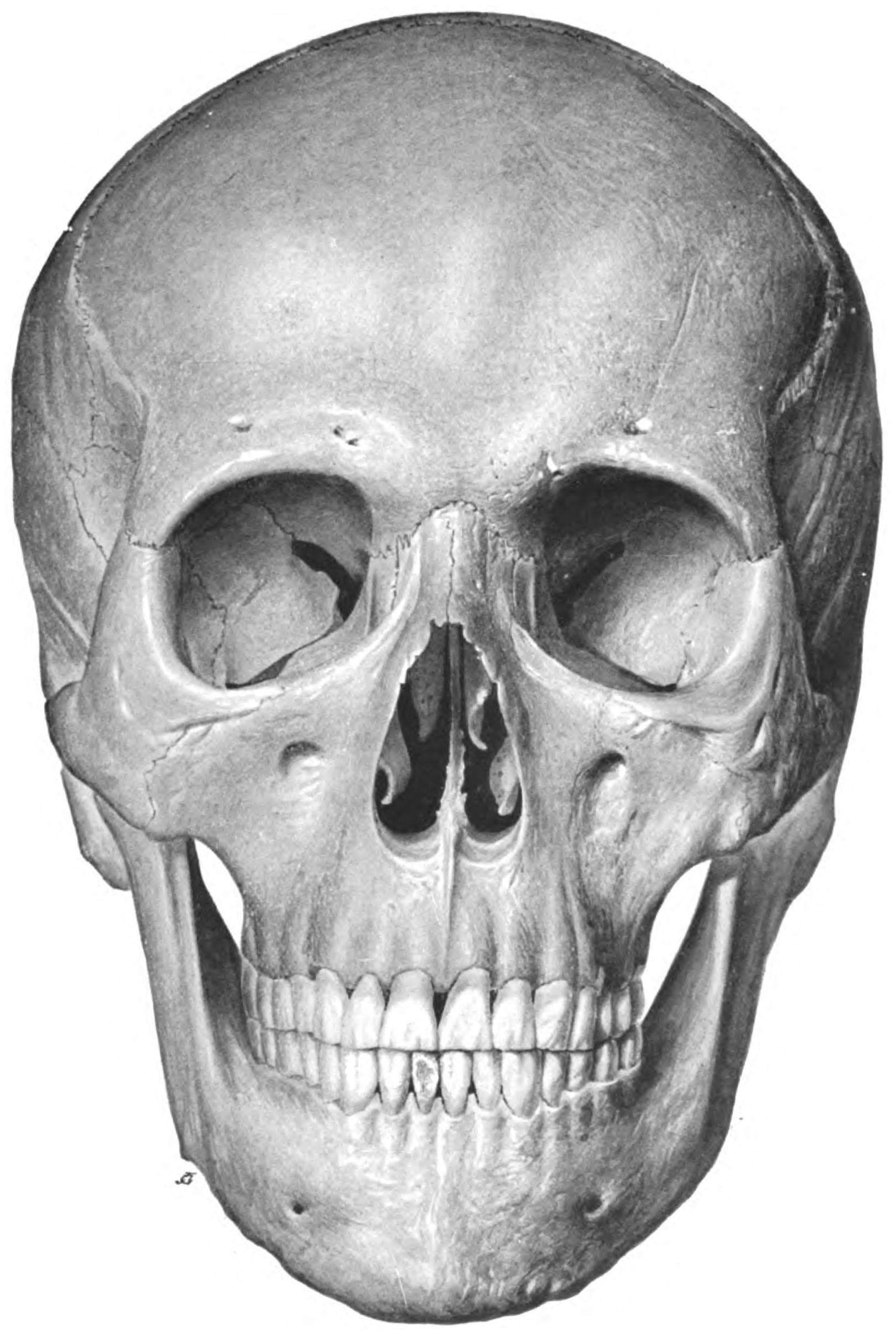
What is the typical number of bones present at birth?
Deformity is most commonly seen in primary osteoarthritis of the knee joint -
A skull is classified as dolichocephalic when the cephalic index is
The study of human diseases and their impact on society is known as?
A radiograph is obtained from a child with scoliosis. What is the name of the angle used to measure spinal curvature?
What condition is suggested by atrophic dry nasal mucosa, extensive encrustations, and a woody hard external nose?
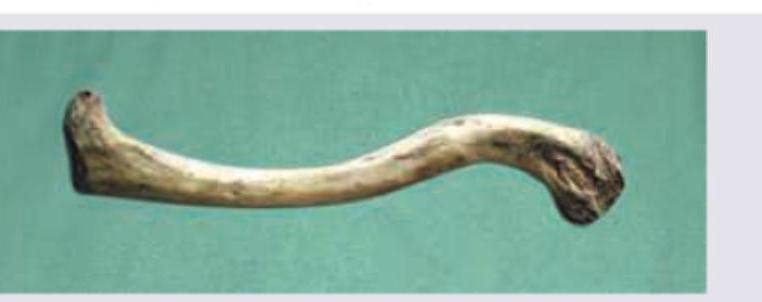
Estimate the stature of the person whose following bone was provided to you:
Ancestry determination in forensic anthropology primarily uses which of the following indices:
With respect to the dating of a bone, a bone more than 100 years old contains?
Explanation: ***Prominent supraorbital ridges, prominent glabella, square chin, acute fronto-nasal angle - Male*** - The image displays features typical of a **male skull**, including a pronounced **supraorbital ridge** (brow ridge), a prominent **glabella** (area between the eyebrows), a more **square and robust chin**, and an **acute fronto-nasal angle**. - These characteristics reflect the usually heavier and denser bone structure in males, adapted for stronger muscle attachments. *Round shaped orbit, prominent frontal eminences - Female* - **Female skulls generally have rounder orbits** and more prominent frontal eminences, giving the forehead a fuller, more rounded appearance. - The skull in the image does not exhibit these characteristics; the orbits are squarer, and the frontal eminences are not particularly prominent. *Prominent supraorbital ridges, prominent glabella, square chin, acute fronto-nasal angle - Female* - This statement incorrectly attributes features typically found in **male skulls** to a female skull. - Female skulls are generally smoother and less rugged, lacking the prominently developed ridges and angles seen in the image. *Round shaped orbit, prominent frontal eminences - Male* - This statement incorrectly attributes features typical of **female skulls** to a male skull. - Male skulls usually have squarer orbits and less prominent frontal eminences, with a more sloping forehead compared to females.
Explanation: 270 - At birth, humans have approximately **270 bones**, many of which are composed of cartilage. - Over time, these **cartilaginous structures ossify** [1] and some bones fuse together. 206 - The adult human skeleton typically consists of **206 bones** [2] after most of the fusion processes are complete. - This number is achieved as many of the smaller bones and cartilage structures present at birth **fuse** to form larger, single bones. 250 - This number is **lower** than the typical number of bones at birth and **higher** than the adult number, making it an inaccurate estimate for either stage. - It does not represent a specific developmental stage of the human skeleton. 350 - While newborns do have a higher number of individual bony elements and cartilaginous precursors, **350 is generally considered too high** for the typical number of distinct bones at birth. - The average is closer to 270, with some individual variation.
Explanation: ***Genu varus*** - **Genu varus** (bow-legged deformity) is the most common angular deformity seen in **primary osteoarthritis of the knee**, particularly due to greater wear in the medial compartment. - This deformity places increased stress on the medial compartment, exacerbating the progression of osteoarthritis in that region. *Genu valgum* - **Genu valgum** (knock-knee deformity) is less common in primary knee osteoarthritis compared to genu varus. - It typically results from greater involvement of the **lateral compartment** of the knee joint. *Genu recurvatum* - **Genu recurvatum** is characterized by hyperextension of the knee joint. - This deformity is often associated with ligamentous laxity or neuromuscular conditions, rather than being the primary or most common deformity in knee osteoarthritis. *Flexion contracture* - A **flexion contracture** refers to the inability to fully extend the knee, causing the knee to be perpetually bent. - While common in advanced knee osteoarthritis due to pain, muscle spasm, and joint space narrowing, it is a contracture, not an angular deformity like genu varus or valgus.
Explanation: ***Below 75*** - A **cephalic index below 75** signifies a **dolichocephalic skull**, which is characterized by a relatively **long and narrow head**. - This classification is derived from the ratio of the maximum breadth to the maximum length of the skull (breadth/length × 100). - Dolichocephalic individuals have a **cranial index < 75**, indicating the skull is longer than it is wide. *75-80* - A cephalic index between 75 and 80 signifies a skull classification of **mesocephalic**, meaning a head of **medium breadth and length**. - This is considered the average or intermediate head shape. - This range represents the transition between dolichocephalic and brachycephalic skull types. *Above 80* - A cephalic index above 80 indicates a **brachycephalic skull**, characterized by a relatively **short and broad head**. - This is on the opposite end of the spectrum from dolichocephalic skulls. - Brachycephalic skulls are wider relative to their length. *None of the options* - This option is incorrect because one of the provided options correctly defines a dolichocephalic skull. - The cephalic index below 75 is the accepted criterion for dolichocephaly in anatomical classification.
Explanation: ***Epidemiology*** - **Epidemiology** is defined as the study of the distribution, determinants, patterns, and frequency of health and disease conditions in defined populations, including their **impact on society**. - It is the fundamental science of **public health** that specifically studies how diseases affect populations and society through systematic investigation using statistical and analytical methods. - Epidemiological studies directly examine disease burden, mortality, morbidity, and societal impact, making it the most precise answer for studying diseases and their societal consequences. - Key epidemiological measures (incidence, prevalence, DALYs) quantify the **societal impact** of diseases. *Public health* - **Public health** is the broader applied field that uses epidemiological findings to implement programs, policies, and interventions. - While public health addresses disease impact, it is primarily an **action-oriented discipline** focused on prevention and health promotion, not just the study of diseases. - Public health encompasses multiple disciplines including epidemiology, health education, environmental health, and health policy. *Health sociology* - **Health sociology** (or medical sociology) examines social factors, behaviors, and structures that influence health outcomes and healthcare access. - It focuses on social determinants, health inequalities, and illness behavior from a **sociological perspective**, rather than the scientific study of disease distribution and patterns. *Medical anthropology* - **Medical anthropology** studies health, illness, and healing through a **cultural and ethnographic lens**. - It examines how different cultures understand disease, healing practices, and medical systems, rather than studying disease patterns and their population-level impact.
Explanation: **Cobb's Angle** - **Cobb's angle** is the primary method for measuring the severity of **scoliosis** on radiographs. - It is measured by drawing lines parallel to the superior endplate of the most tilted superior vertebra and the inferior endplate of the most tilted inferior vertebra of the curve; the angle between these two lines (or their perpendiculars) is the Cobb angle. *Bohler's Angle* - **Bohler's angle** is used in the assessment of **calcaneus fractures** and is measured on a lateral foot radiograph. - A decrease in this angle is indicative of a calcaneal fracture. *Ferguson's Angle* - **Ferguson's angle**, also known as the lumbosacral angle, measures the inclination of the sacrum relative to the horizontal in the standing position. - It is primarily used in the assessment of **spondylolisthesis** and other lumbosacral conditions. *Pauwels' Angle* - **Pauwels' angle** is used to classify **femoral neck fractures** based on the angle of the fracture line relative to the horizontal. - It helps determine the severity and stability of femoral neck fractures, guiding treatment decisions.
Explanation: ***Rhinoscleroma*** - **Rhinoscleroma** characteristically presents with **atrophic, dry nasal mucosa**, extensive **encrustations**, and the distinctive **"woody hard" external nose** due to granulomatous infiltration. - Caused by **Klebsiella rhinoscleromatis** (*Klebsiella pneumoniae* subspecies *rhinoscleromatis*). - Characterized by **Mikulicz cells** (foamy macrophages containing bacilli) on histopathology. - It progresses through stages (atrophic, granulomatous/nodular, and sclerotic), with the infiltrative stage leading to the hard, fixed lesions, and ultimately to nasal obstruction and deformity. *Sarcoidosis* - While sarcoidosis can affect the nasal mucosa, it typically presents with **granulomatous inflammation**, but less commonly with the severe encrustations and characteristic "woody hard" consistency seen in rhinoscleroma. - Nasal involvement in sarcoidosis often includes **papules, nodules**, or **ulceration**, rather than widespread atrophy and crusting. *Allergic rhinitis* - Allergic rhinitis is characterized by **nasal congestion, rhinorrhea, itching**, and sneezing, primarily due to **IgE-mediated inflammatory responses** to allergens. - It does not cause atrophic nasal mucosa, extensive encrustations, or the development of a "woody hard" external nose. *Wegener's granulomatosis* - **Wegener's granulomatosis** (now known as **Granulomatosis with Polyangiitis**) is a systemic vasculitis that can significantly impact the nose, causing **crusting, ulceration, saddle nose deformity**, and epistaxis. - However, it typically involves destructive inflammation and necrosis rather than the firm, "woody" induration and widespread atrophy described, and it is associated with **c-ANCA (PR3-ANCA) antibodies**.
Explanation: ***Length of bone X 11.1*** - This multiplication factor appears in some **older forensic medicine references** for clavicular stature estimation, though it represents a **rough approximation** rather than precise methodology. - Among the given options, this provides the most reasonable estimate, though **modern forensic anthropology** strongly prefers **regression equations** over simple multiplication factors. - Standard regression formulas: Stature = **(4.62 × clavicular length + 105.35 cm)** for males and **(3.55 × clavicular length + 116.25 cm)** for females, with population-specific variations. *Length of bone X 5* - This multiplication factor is appropriate for **long bones of the lower limb**, particularly the **femur** (the longest bone in the body). - The **clavicle** is much shorter relative to body height and requires a **higher multiplication factor** for stature estimation. - Using this factor would result in significant **underestimation** of stature from clavicular measurements. *Length of bone X 8* - This factor is more suitable for **mid-length long bones** like the **humerus** or **tibia** in certain population groups. - Still **inadequate for clavicular estimation**, as the clavicle represents a much smaller proportion of total body height compared to these bones. - Would produce underestimated stature values when applied to clavicle length. *Length of bone X 20* - This factor would produce **grossly overestimated** stature measurements that exceed realistic human proportions. - **No established forensic anthropology method** uses such high multiplication factors for any skeletal element including the clavicle. - Modern practice uses precise **population-specific regression equations** with accuracy of ±4-5 cm rather than crude multiplication factors.
Explanation: ***Cephalic index*** - The **cephalic index** (or cranial index) is a ratio of the maximum width of the head to its maximum length, multiplied by 100. - This index is a classic anthropometric measurement used in forensic anthropology to help determine **ancestry** by categorizing head shapes (e.g., dolichocephalic, brachycephalic). *Corporo Basal index* - This index is not a recognized or commonly used term in forensic anthropology for **ancestry determination**. - While other indices use body measurements, this specific term does not correlate to established methods for identifying ancestry. *Medullary index* - The **medullary index** is primarily used in the analysis of hair to determine if the hair is human or animal in origin. - It measures the ratio of the diameter of the medulla to the diameter of the hair shaft and is not used for **ancestry determination** within humans. *Ischiopubic index* - The **ischiopubic index** is a measurement derived from the pelvis, primarily used in forensic anthropology for **sex determination**. - It reflects the relative lengths of the ischium and pubis and is not a direct indicator of **ancestry**.
Explanation: **Explanation:** The dating of skeletal remains in forensic anthropology often relies on the analysis of **amino acid content**, which degrades predictably over time. Fresh bone typically contains a full complement of approximately 20 amino acids. As the bone ages and undergoes decomposition, these proteins break down, and the variety of detectable amino acids decreases. **Why Option A is Correct:** According to established forensic standards (Knight’s Forensic Pathology), bones that are **more than 100 years old** typically show a significant reduction in protein content, leaving only **7 specific amino acids** detectable. These usually include glycine, alanine, valine, leucine, isoleucine, proline, and hydroxyproline. This serves as a critical biochemical marker to differentiate relatively modern remains from those of historical or archaeological significance. **Analysis of Incorrect Options:** * **Option B (9 amino acids):** This number is associated with bones that are relatively "fresher," typically less than 50 to 100 years old. * **Options C and D (6 and 8 amino acids):** These do not correspond to the standard forensic benchmarks used for the century-mark threshold in bone dating. **High-Yield Clinical Pearls for NEET-PG:** * **Nitrogen Content:** Fresh bone contains about 4–5% nitrogen. If nitrogen content is **<2.5%**, the bone is likely more than 350 years old. * **Benzidine Test:** A positive benzidine test (indicating blood pigments) usually suggests the bone is less than 100–150 years old. * **Fluorescence:** Fresh bones show a bluish-white fluorescence under UV light. This property is lost from the periphery inward as the bone ages (usually lost after 100 years). * **Immunological Activity:** Specific serum proteins (like albumin) are generally not detectable in bones older than 50–100 years.
Get full access to all questions, explanations, and performance tracking.
Start For Free