Transverse tear in the intima of carotid arteries may be seen in which of the following causes of death?
A person incapacitated by drug, disease, alcohol, etc., lying with the upper portion of the body lower than the rest, causes what?
In drowning, all of the following are seen EXCEPT?
What type of fracture is typically seen in judicial hanging?
Which of the following is not a cause of death due to suffocation?
Sexual asphyxia is:
What is the minimum force required to cause tracheal occlusion in hanging?
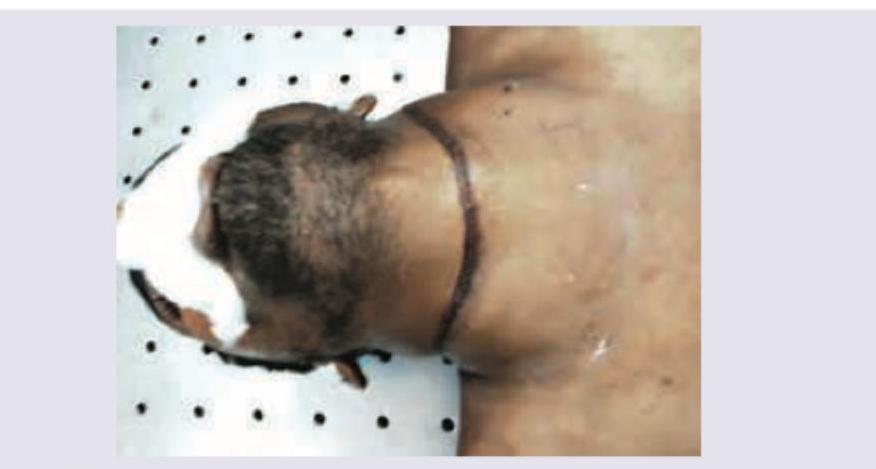
The following is a type of:

A young man with a known history of heroin addiction is brought to the emergency department in an unconscious state by his friends. On examination, his pupils are pinpoint. What is the treatment of choice?
Any circumstances that prevent breathing by obstruction of the nose and mouth causes which of the following?
Explanation: **Explanation:** The correct answer is **Judicial hanging**. This specific finding is known as **Amussat’s sign**. In judicial hanging, the body is dropped from a height (usually 5 to 7 feet), leading to a sudden, violent deceleration and hyperextension of the neck. This mechanical force causes the relatively inelastic **tunica intima** of the carotid arteries to stretch and tear transversely. This is distinct from typical suicidal hanging, where the force is usually insufficient to cause such vascular damage. **Analysis of Options:** * **Fall from height:** While blunt trauma can cause vascular injury, it typically presents as generalized internal organ damage or skeletal fractures (e.g., deceleration injuries) rather than the specific transverse intimal tears seen in the neck. * **Bandhola:** This is a form of ligature strangulation (often using a bamboo stick) where the pressure is steady and horizontal. It lacks the vertical "drop" and traction required to tear the intima. * **Garroting:** This involves sudden tightening of a ligature from behind. While it causes rapid asphyxia and localized bruising, it does not involve the long-drop mechanism necessary for Amussat’s sign. **High-Yield Facts for NEET-PG:** * **Amussat’s Sign:** Transverse tear of the intima of the common carotid artery (seen in ~20% of judicial hangings). * **Martin’s Sign:** Transverse tears in the adventitia of the carotid artery. * **Fracture-Dislocation:** Judicial hanging typically causes a fracture of the **C2-C3 or C3-C4 vertebrae** (Hangman’s fracture), leading to death by brainstem injury. * **Simon’s Sign:** Hemorrhages in the anterior longitudinal ligament of the lumbar spine (seen in hanging).
Explanation: **Explanation:** **Postural Asphyxia (Positional Asphyxia)** occurs when the body's position interferes with respiration, leading to hypoxia. It typically happens when the upper portion of the body is lower than the rest or in a restricted position (e.g., head-down or jack-knife position). In this state, the weight of the abdominal viscera pushes against the diaphragm, and the neck may be acutely flexed, obstructing the airway. A conscious, healthy individual would simply change their position; however, individuals incapacitated by **alcohol, drugs, head injury, or neurological disease** lack the motor control or consciousness to rectify their posture, leading to death. **Why other options are incorrect:** * **Traumatic Asphyxia:** This results from intense **external compression** of the chest and abdomen by a heavy weight (e.g., a collapsed building or stampede), preventing chest expansion. It is characterized by "Masque Ecchymotique" (facial congestion and petechiae). * **Sexual Asphyxia:** A form of auto-erotic death where hypoxia is deliberately induced (usually by hanging or ligatures) to enhance sexual gratification. It is typically solitary and involves complex props or pornography. * **Burking:** A method of homicidal asphyxia involving a combination of **smothering** (closing the nose/mouth) and **traumatic asphyxia** (kneeling on the chest). Historically associated with the murderers Burke and Hare. **High-Yield Clinical Pearls for NEET-PG:** * **Postural Asphyxia** is a common cause of death in "drunkards" found in drains or narrow spaces. * **Crucifixion** is a classical historical example of postural asphyxia. * **Key Autopsy Finding:** Intense visceral congestion and signs of asphyxia without external marks of violence on the neck or face.
Explanation: In drowning, the pupils typically undergo **Mydriasis** (dilation) rather than Miosis. This occurs due to severe cerebral hypoxia and the sympathetic surge during the "struggle phase" of drowning. ### **Explanation of Options:** * **B. Miosis (Correct Answer):** In cases of drowning, the pupils are usually **dilated (Mydriasis)**. Miosis is not a feature of drowning; it is more commonly associated with opioid poisoning, organophosphate poisoning, or pontine hemorrhage. * **A. Wet voluminous lung:** Also known as **Emphysema Aquosum**. The lungs are heavy, boggy, and enlarged because they are saturated with water and trapped air. They often meet in the midline and show "Paltauf’s spots" (subpleural hemorrhages). * **C. Fine foam at the mouth:** This is a **pathognomonic sign** of ante-mortem drowning. It is a tenacious, lathery, white/pinkish froth produced by the mixing of water, mucus, and surfactant during terminal gasping. * **D. Cutis anserina:** Also known as "Gooseflesh." It is caused by the contraction of *arrector pili* muscles due to cold water or rigor mortis. While not exclusive to drowning, it is a common finding in bodies recovered from water. ### **NEET-PG High-Yield Pearls:** 1. **Gettler Test:** Measures chloride content in the heart chambers (now largely obsolete but historically significant). 2. **Diatom Test:** The most reliable laboratory evidence for ante-mortem drowning. Diatoms must be found in **closed organs** (bone marrow, brain) to be significant. 3. **Cadaveric Spasm:** Often seen in drowning victims, where they are found clutching weeds, sand, or mud (confirms the person was alive when they entered the water). 4. **Hydrostatic Test:** Used to differentiate stillbirth from live birth, but in drowning, it is used to show that lungs are heavy and sink (unlike in emphysema).
Explanation: **Explanation:** In **Judicial Hanging**, the mechanism of death is typically a combination of spinal cord concussion and sudden distraction. The drop results in a forceful hyperextension and distraction of the head. This leads to a **Hangman’s Fracture**, which is a bilateral fracture of the **pedicles or pars interarticularis of the C2 (axis) vertebra**. This fracture often results in the separation of the second and third cervical vertebrae, causing immediate death due to compression of the brainstem or upper spinal cord. **Analysis of Options:** * **Hangman’s Fracture (Correct):** Specifically associated with high-velocity distraction-hyperextension injuries, as seen in judicial hanging. * **Jefferson’s Fracture:** This is a burst fracture of the **C1 (atlas) vertebra**, typically caused by a vertical compression (axial loading) force on the top of the head (e.g., diving into shallow water). * **Boxer’s Fracture:** A fracture of the neck of the **5th metacarpal** (sometimes the 4th), usually caused by striking a hard object with a closed fist. * **Greenstick Fracture:** An incomplete fracture where the bone bends and cracks, seen almost exclusively in **children** due to their flexible, poorly calcified bones. **High-Yield Pearls for NEET-PG:** * **Fracture Site:** In judicial hanging, the fracture occurs at C2-C3; in accidental or suicidal hanging, fractures are rare but usually involve the **Hyoid bone** (greater horn) or **Thyroid cartilage**. * **Hyoid Fracture:** More common in **strangulation** (inward compression) than in hanging (indirect tension). * **Drop Length:** In judicial hanging, the "long drop" is calculated based on the prisoner's weight to ensure cervical dislocation without decapitation.
Explanation: **Explanation:** The core concept in forensic medicine is distinguishing between the different mechanisms of mechanical asphyxia. **Suffocation** is a broad category of asphyxial death caused by the deprivation of oxygen due to an obstruction of the **air passages** (nose, mouth, or internal airways) or a lack of oxygen in the environment. **Why Throttling is the Correct Answer:** **Throttling** (manual strangulation) is a form of **strangulation**, not suffocation. In throttling, the neck is compressed using human hands or fingers. The mechanism of death involves the compression of the jugular veins, carotid arteries, and the vagus nerve, rather than just the simple blockage of air entry into the lungs. It is classified under "Pressure on the Neck," distinct from suffocation. **Analysis of Incorrect Options:** * **Smothering:** A form of suffocation caused by the external closure of the mouth and nostrils (e.g., by a hand, pillow, or plastic bag). * **Gagging:** A form of suffocation where a cloth or object is pushed into the mouth, pushing the soft palate upwards and blocking the pharynx. * **Choking:** A form of suffocation caused by the internal obstruction of the air passages (larynx, trachea, or bronchi) by a foreign body (e.g., a bolus of food or a coin). **High-Yield Clinical Pearls for NEET-PG:** * **Burking:** A combination of smothering and traumatic (crush) asphyxia. * **Cafe Coronary:** Sudden death due to choking on a large bolus of food, often mistaken for a heart attack. * **Fracture of Hyoid Bone:** Most common in throttling (inward compression), rare in hanging (outward traction). * **Puppe’s Rule:** Relates to the sequence of skull fractures, but in asphyxia, remember **Tardieu spots** (petechial hemorrhages) are common but not pathognomonic.
Explanation: **Explanation:** **Sexual Asphyxia** (also known as Autoerotic Asphyxia) refers to the practice of deliberately inducing a state of hypoxia to enhance sexual arousal and orgasm during masturbation. **Why Option D is Correct:** The primary intent of the individual is not to die, but to achieve a physiological "high" from cerebral hypoxia. Death occurs when the self-rescue mechanism or release device fails, or the individual loses consciousness before they can release the ligature. Because there is **no intent to die**, the legal and forensic manner of death is classified as **Accidental**. **Why Other Options are Incorrect:** * **A. Suicidal:** Although the act is self-inflicted, the intent is pleasure, not self-destruction. The presence of pornographic material and complex self-rescue mechanisms at the scene usually rules out suicide. * **B. Homicidal:** These acts are typically performed in seclusion. The absence of struggle marks and the presence of elaborate setups point away from foul play. * **C. Natural:** The death is caused by external mechanical interference with respiration (asphyxia), not an underlying disease process. **High-Yield Facts for NEET-PG:** * **Demographics:** Most commonly seen in adolescent or young adult males. * **Scene Findings:** Often involves "atypical" hanging, cross-dressing (transvestism), presence of mirrors, and erotic literature. * **Key Feature:** The victim usually employs **padding** under the ligature to prevent visible bruising or marks on the neck (to hide the practice from others). * **Masochism:** It is considered a form of sexual masochism. * **Legal Importance:** It is a classic "medico-legal trap" where the scene may mimic a suicide or a sexual homicide, but the lack of intent confirms it as an accident.
Explanation: **Explanation:** In cases of hanging, death occurs due to the compression of neck structures by the ligature. The amount of force required to occlude these structures varies significantly based on their anatomical depth and compressibility. **1. Why 15 kg is correct:** The **trachea** is a rigid structure reinforced by cartilaginous rings. To achieve complete airway occlusion (tracheal compression), a significant force of approximately **15 kg** is required. This is the highest pressure threshold among the vital neck structures. **2. Analysis of Incorrect Options:** * **2 kg (Option D):** This is the minimum force required to compress the **Jugular veins**. Because veins are thin-walled and low-pressure, they are the first to be occluded, leading to facial congestion and cyanosis. * **5 kg (Option A):** This is the force required to occlude the **Carotid arteries**. Compression of these vessels leads to cerebral ischemia, which is a primary mechanism of death in hanging. * **20 kg (Option C):** This force is required to completely occlude the **Vertebral arteries**. These arteries are well-protected within the foramina transversaria of the cervical vertebrae, necessitating the highest amount of pressure (nearly the full weight of the head/body) to stop blood flow. **High-Yield Clinical Pearls for NEET-PG:** * **Order of Occlusion:** Jugular Veins (2kg) → Carotid Arteries (5kg) → Trachea (15kg) → Vertebral Arteries (20kg). * **Mechanism of Death:** In judicial hanging, death is usually due to cervical fracture/dislocation (Hangman’s fracture). In typical/suicidal hanging, it is most commonly due to **asphyxia or cerebral ischemia**. * **Ligature Mark:** In hanging, the mark is usually high up in the neck, oblique, non-continuous, and situated above the thyroid cartilage.
Explanation: ***Strangulation*** - Characterized by a **horizontal ligature furrow** around the neck, indicating compression by external force applied around the neck. - Distinguished by the **absence of suspension** and typically shows **circumferential pressure marks** at the level of the thyroid cartilage. *Toure* - This appears to be an **incorrect or irrelevant option** not related to forensic pathology terminology. - Does not represent any recognized **asphyxial death mechanism** in forensic medicine. *Traumatic asphyxia* - Results from **sudden severe compression** of the chest and abdomen, not the neck region. - Characterized by **petechial hemorrhages** in the face, neck, and conjunctiva with **cyanosis of the head and neck**. *Partial hanging* - Shows an **oblique or angled ligature mark** that is typically **incomplete** around the neck circumference. - The ligature mark is usually **higher positioned** and shows a **V-shaped pattern** pointing toward the point of suspension.
Explanation: ### Explanation **Correct Option: B. IV naloxone** The clinical presentation of **unconsciousness, pinpoint pupils (miosis), and a history of heroin addiction** is the classic triad of **Acute Opioid Overdose**. In an emergency setting, the immediate priority is to reverse respiratory depression. **Naloxone** is a potent, competitive opioid antagonist with a high affinity for $\mu$-receptors. It rapidly displaces opioids from their receptors, reversing the life-threatening effects. The **intravenous (IV)** route is preferred in emergencies for its rapid onset of action (1–2 minutes). --- ### Why the other options are incorrect: * **A. Oral Naltrexone:** While naltrexone is an opioid antagonist, it has a slow onset and is primarily used for **maintenance therapy** to prevent relapse in detoxified patients. It is never used in acute overdose. * **C. Oral Diazepam:** Diazepam is a benzodiazepine (sedative-hypnotic). Administering it to an opioid-overdose patient would worsen respiratory depression and potentially lead to death. * **D. Oral Buprenorphine:** This is a partial $\mu$-agonist used in **Opioid Substitution Therapy (OST)**. In an acute overdose, adding a partial agonist would not provide the rapid reversal required and could complicate the clinical picture. --- ### High-Yield Clinical Pearls for NEET-PG: 1. **The Opioid Triad:** Coma, Pinpoint pupils, and Respiratory depression. 2. **Naloxone Duration:** The half-life of naloxone (30–90 mins) is often shorter than the opioid (e.g., methadone). Patients must be monitored for **"re-narcotization"** as the antagonist wears off. 3. **Exception to Miosis:** In cases of **Pethidine** (Meperidine) overdose or terminal hypoxia, pupils may be dilated rather than pinpoint. 4. **Diagnostic Use:** Naloxone can also be used as a diagnostic tool in an unconscious patient where opioid overdose is suspected.
Explanation: **Explanation:** **Smothering** is a form of asphyxia caused by the mechanical occlusion of the external respiratory orifices—the **nose and mouth**—by hands, cloth, plastic, or any other material. This prevents the intake of air into the lungs, leading to hypoxia and hypercapnia. It is the classic definition of external airway obstruction. **Analysis of Incorrect Options:** * **Gagging (A):** This involves the obstruction of the **pharynx** (internal) by a foreign object like a cloth or wad of paper, often held in place by a ligature. While it blocks the airway, it is internal rather than just the nose and mouth. * **Choking (B):** This is the obstruction of the air passage **within the larynx or trachea** by a foreign body (e.g., a bolus of food or a coin). It is an internal obstruction of the air passages. * **Burking (D):** This is a specific method of homicidal asphyxia named after the infamous duo Burke and Hare. It involves a combination of **smothering** (closing the nose/mouth) and **traumatic asphyxia** (kneeling on the chest to prevent respiratory movements). **NEET-PG High-Yield Pearls:** * **Signs of Smothering:** Often leaves minimal external signs. Look for "bruising or abrasions" around the nose and mouth (peri-oral/peri-nasal) and "inner lip lacerations" from being pressed against the teeth. * **Plastic Bag Suffocation:** A form of smothering where no struggle marks are found; autopsy may only show general signs of asphyxia. * **Manner of Death:** Smothering is most commonly **homicidal** (infanticide) or **accidental** (overlaying in infants or "cot death"), while suicidal smothering is rare.
Pathophysiology of Asphyxia
Practice Questions
Hanging
Practice Questions
Strangulation
Practice Questions
Suffocation
Practice Questions
Traumatic Asphyxia
Practice Questions
Drowning
Practice Questions
Choking
Practice Questions
Chemical Asphyxiants
Practice Questions
Positional Asphyxia
Practice Questions
Autoerotic Asphyxia
Practice Questions
Pediatric Asphyxia
Practice Questions
Postmortem Findings in Asphyxia
Practice Questions
Get full access to all questions, explanations, and performance tracking.
Start For Free