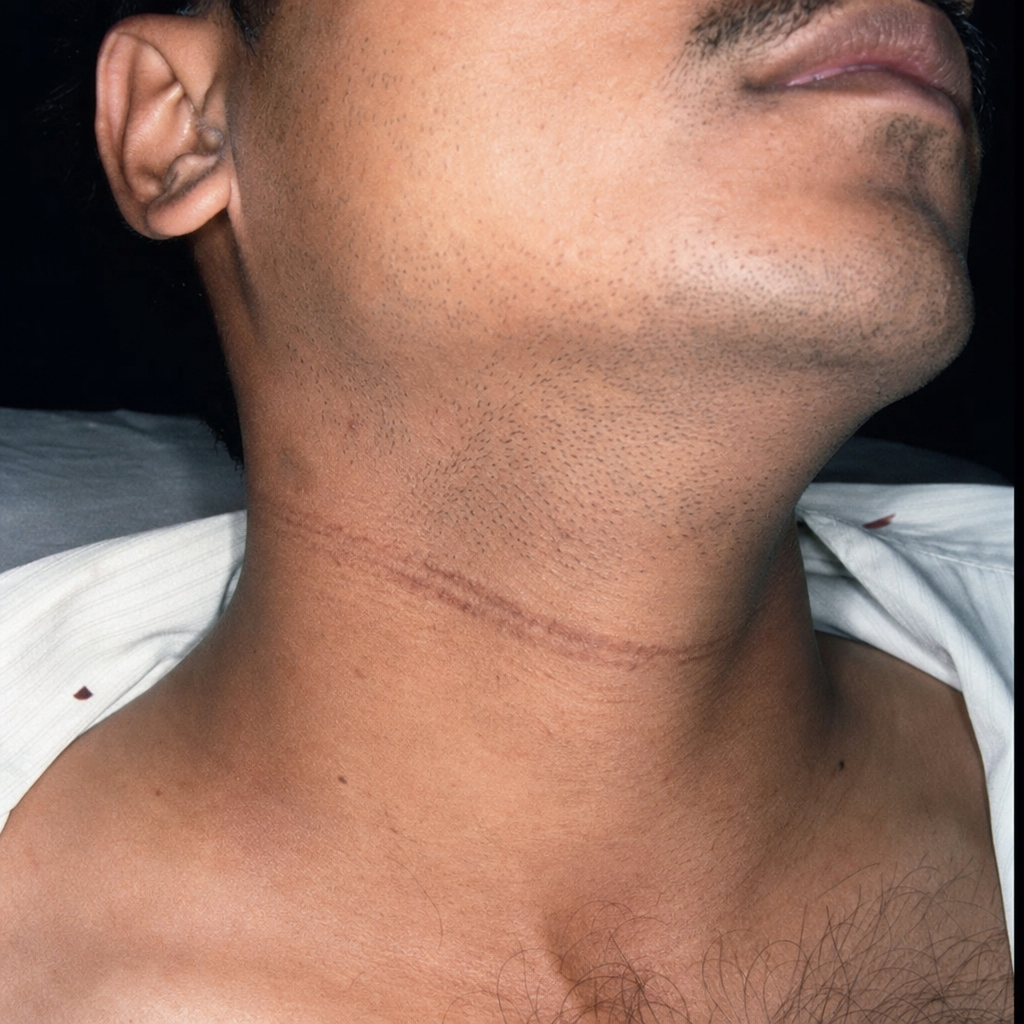
A loop of thin string is thrown around the victim's neck. What is this method of causing death called?
Magnan syndrome is seen in which poisoning?
Extensive bruising of neck muscles or ecchymosis of subcutaneous tissues in the neck is characteristic of:
Isbella Ducan syndrome is associated with which of the following?
What is the most common feature indicative of antemortem drowning?
In postmortem hanging, within how much time will a ligature applied to the neck produce a ligature mark?
What is mugging?
Which of the following findings is diagnostic of ante-mortem drowning?
The mirror test is used to assess which of the following?
On external examination, what is the classical presentation of the body in traumatic asphyxia?
Explanation: **Explanation:** **Garrotting** is a form of strangulation where a ligature (such as a thin string, wire, or cord) is thrown around the victim’s neck from behind and tightened, often by twisting a lever or pulling the ends. The sudden tightening leads to rapid unconsciousness and death due to the compression of the carotid arteries and the airway. **Analysis of Options:** * **Throttling (Manual Strangulation):** This involves the use of hands or fingers to compress the neck. Characteristic findings include crescentic fingernail abrasions and deep bruising of the neck muscles. * **Mugging:** This is a specific type of strangulation where the victim’s neck is compressed within the crook of the assailant’s elbow or forearm. It often results in fracture of the hyoid bone but may leave minimal external skin marks. * **Bansdola:** A form of "bamboo strangulation" where the neck is compressed between two strong wooden poles or bamboo sticks, which are then tied together at both ends. This causes extensive crushing injury to the larynx and trachea. **High-Yield Pearls for NEET-PG:** * **Ligature Mark:** In garrotting, the mark is usually horizontal, continuous, and situated at or below the level of the thyroid cartilage (unlike hanging, where it is oblique and non-continuous). * **Hyoid Bone Fracture:** More common in manual strangulation (throttling) than in ligature strangulation. * **Burking:** A combination of traumatic asphyxia (chest compression) and smothering (closing nose/mouth), famously used by Burke and Hare. * **Spanish Windlass:** A specific type of garrotting where a stick is inserted into the ligature and twisted to tighten it.
Explanation: **Explanation:** **Magnan Syndrome** (also known as **Cocaine Bugs** or Formication) is a classic tactile hallucination associated with chronic **Cocaine** abuse. Patients experience a distressing sensation of insects, spiders, or worms crawling under or on their skin. This leads to compulsive scratching and picking, resulting in characteristic excoriations or "pick sores." **Why Cocaine is Correct:** Cocaine is a potent sympathomimetic that increases synaptic dopamine levels. Chronic use or acute toxicity can trigger "Cocaine Psychosis," of which Magnan syndrome is a pathognomonic feature. The sensation is medically termed **formication**. **Why Other Options are Incorrect:** * **Morphine:** An opioid that typically causes CNS depression, miosis (pinpoint pupils), and constipation. While it can cause itching due to histamine release, it does not cause the specific tactile hallucinations of Magnan syndrome. * **Alcohol:** Chronic use or withdrawal (Delirium Tremens) can cause visual or auditory hallucinations, but Magnan syndrome is specifically linked to stimulants like cocaine. * **Cannabis:** Primarily causes euphoria, altered time perception, and "red eyes" (conjunctival injection). It is not associated with formication. **High-Yield Clinical Pearls for NEET-PG:** * **Body Packer Syndrome:** Ingesting drug packets (often cocaine) for smuggling; rupture can lead to fatal toxicity. * **Snow Lights:** Visual hallucinations (flashing lights) seen in cocaine users. * **Crack Lung:** Acute pulmonary syndrome (hemorrhage/infiltrates) following inhalation of freebase cocaine. * **Adulterant:** Cocaine is often mixed with **Levamisole**, which can cause agranulocytosis and skin necrosis.
Explanation: **Explanation:** The correct answer is **Strangulation** (specifically ligature strangulation). In forensic pathology, the presence of extensive bruising of the neck muscles and ecchymosis of subcutaneous tissues is a hallmark of strangulation because the force applied is typically horizontal, forceful, and persistent. **1. Why Strangulation is Correct:** In ligature strangulation, the force is applied at a level below or at the thyroid cartilage, often with significant violence. This results in the compression of soft tissues against the cervical spine, leading to extensive extravasation of blood (ecchymosis) into the subcutaneous tissues and neck muscles (sternocleidomastoid, platysma). **2. Why other options are incorrect:** * **Hanging:** In typical hanging, the force is the body's own weight, and the ligature mark is usually dry, pale, and parchment-like. Because the vessels are compressed rapidly and the force is directed upwards, extensive deep-tissue bruising is **rarely** seen. * **Throttling:** While throttling (manual strangulation) causes localized bruising (fingerprint bruises) and frequent fractures of the hyoid bone, the term "extensive bruising of neck muscles" is more classically associated with the broad, circumferential pressure of a ligature in strangulation. * **Burking:** This is a combination of traumatic asphyxia (chest compression) and smothering. It does not primarily involve neck compression, so neck muscle bruising is absent. **High-Yield Clinical Pearls for NEET-PG:** * **Hyoid Bone Fracture:** Most common in **Throttling** (>60%), followed by Ligature Strangulation, and least common in Hanging (only in elderly/atypical cases). * **Ligature Mark:** In Hanging, it is oblique, non-continuous, and above the thyroid; in Strangulation, it is horizontal, continuous, and below the thyroid. * **Fracture of Thyroid Cartilage:** More common in strangulation than in hanging.
Explanation: **Explanation:** **Isbella Ducan Syndrome** (also known as the "Isadora Duncan Syndrome") refers to a specific mechanism of **accidental strangulation** caused by long clothing, scarves, or neckties getting entangled in moving machinery or vehicle wheels. 1. **Why Option C is Correct:** The syndrome is named after the famous dancer Isadora Duncan, who died in 1927 when her long silk scarf became entangled in the open-spoked wheels of the car she was traveling in. The rotational force led to sudden, violent traction on the neck, causing a fractured larynx and carotid artery injury, resulting in immediate death. In forensic medicine, this serves as a classic example of **accidental ligature strangulation** involving moving parts. 2. **Why Other Options are Incorrect:** * **Option A (Suicidal Hanging):** Hanging involves a constricting band around the neck where the force is the body's own weight. While it is a form of asphyxia, it does not involve the external mechanical entanglement characteristic of this syndrome. * **Option B (Child Abuse):** While strangulation can occur in child abuse (manual or ligature), it is classified as homicidal, not the specific accidental mechanism described here. * **Option D (Schizophrenia):** There is no clinical or forensic correlation between Isbella Ducan syndrome and psychiatric disorders like schizophrenia. **High-Yield Clinical Pearls for NEET-PG:** * **Ligature Mark:** In accidental strangulation (like this syndrome), the ligature mark is usually **horizontal** and situated **below the thyroid cartilage**, unlike hanging where it is typically oblique and above the cartilage. * **Fractures:** Fractures of the hyoid bone are rare in this syndrome; however, fractures of the **cervical spine** or **laryngeal cartilages** are common due to the high-velocity jerk. * **Other Accidental Strangulations:** Examples include "Garrotting" (though often homicidal) and "Choke-hold" injuries.
Explanation: ### Explanation **Correct Answer: C. Clenched fist** The presence of a **clenched fist** containing objects from the surroundings (such as weeds, mud, sand, or gravel) is the most definitive sign of antemortem drowning. This occurs due to **Cadaveric Spasm** (instantaneous rigor). When a person is drowning, they experience a "struggle for life," during which they instinctively grasp at nearby objects. The vital reaction of the muscles at the moment of death fixes these objects in the hand. Since cadaveric spasm cannot be simulated after death, it is a pathognomonic sign that the person was alive and conscious when they entered the water. **Why the other options are incorrect:** * **A. Washerwoman’s feet:** This refers to the wrinkling and bleaching of the skin due to prolonged immersion (maceration). It is a **sign of immersion**, not drowning. It can occur in both antemortem and postmortem bodies left in water. * **B. Pugilistic attitude:** This is a characteristic posture (resembling a boxer) seen in bodies recovered from **fire/burning**. It is caused by the heat-induced coagulation and contraction of flexor muscles and has no association with drowning. * **D. Cyanosis:** While common in asphyxial deaths, it is a **non-specific finding**. It can be seen in various modes of death (e.g., heart failure, poisoning, or other types of asphyxia) and is not diagnostic of antemortem drowning. **High-Yield Clinical Pearls for NEET-PG:** * **Froth:** Fine, white, leathery, and tenacious froth at the mouth/nose is a very important sign of antemortem drowning (due to surfactant mixing with water and air). * **Diatom Test:** Detection of diatoms in the bone marrow (femur/sternum) is considered the "gold standard" for diagnosing antemortem drowning in putrefied bodies. * **Paltauf’s Hemorrhages:** Subpleural ecchymoses found in the lungs due to the rupture of alveolar walls. * **Hydrostatic Test:** Used to differentiate stillborn from live-born infants, not typically used for drowning diagnosis in adults.
Explanation: ### Explanation **Concept:** The formation of a ligature mark in hanging is primarily a **postmortem phenomenon** caused by the mechanical compression of the skin, which forces fluid out of the dermis and leads to local dehydration (desiccation). This process results in the characteristic dry, pale, and parchment-like appearance of the skin. **Why 2 Hours is Correct:** In cases of **postmortem hanging** (where a body is suspended after death to simulate suicide), the tissues are no longer vital. For a distinct, visible ligature mark to develop through desiccation and compression, the body must remain suspended for a significant period. Forensic literature and standard textbooks (like Reddy’s) establish that it takes approximately **2 hours** of suspension for a clear, parchmentized mark to manifest on a dead body. **Analysis of Incorrect Options:** * **A (5 minutes) & B (30 minutes):** These timeframes are too short for significant desiccation to occur in a non-vital body. While a faint indentation might appear, a definitive "ligature mark" requires more time for the skin to dry and harden. * **C (1 hour):** While some compression may be visible, it is generally insufficient to produce the classic parchment-like mark used for forensic identification. **NEET-PG High-Yield Pearls:** * **Vital Reaction:** The presence of a ligature mark is **not** a sign of hanging being antemortem. Both antemortem and postmortem hanging can produce a mark. * **Antemortem Sign:** To prove hanging was antemortem, look for **microscopic evidence** (extravasation of blood, congestion, or cellular reaction) or **subcutaneous bruising** beneath the mark. * **Parchmentization:** This is the hallmark of a ligature mark, caused by the drying of the skin where the epidermis has been abraded or compressed. * **Ligature Mark in Hanging:** Usually non-continuous, oblique, and situated above the thyroid cartilage.
Explanation: **Explanation:** **Mugging** is a form of strangulation where the victim’s neck is compressed within the **bend of the elbow** (antecubital fossa). This is typically performed from behind, using the forearm and arm to exert pressure. The mechanism of death is usually a combination of asphyxia due to airway compression and cerebral ischemia due to the occlusion of carotid arteries. Because the soft tissues of the arm cushion the impact, external signs of injury (like bruising or abrasions) are often minimal or absent, making it a "clean" method of assault. **Analysis of Incorrect Options:** * **Option B (Throttling):** This refers to manual strangulation where the neck is compressed using human hands. It is characterized by crescentic fingernail abrasions and localized bruising on the neck. * **Option C (Bansdola):** This is a specific form of strangulation practiced in some regions where the neck is compressed between two bamboo sticks or wooden planks, often resulting in extensive damage to the larynx and trachea. * **Option D (Smothering):** This refers to the mechanical occlusion of the external respiratory orifices (nose and mouth) by hands, cloth, or other materials, preventing the intake of air. **NEET-PG High-Yield Pearls:** * **Garrotting:** A method where a ligature is tightened around the neck from behind, often using a stick or lever to twist the cord. * **Burking:** A combination of **smothering** (closing the nose/mouth) and **traumatic asphyxia** (kneeling on the chest), historically used by Burke and Hare. * **Hyoid Bone Fracture:** In mugging, the hyoid bone is rarely fractured compared to throttling, where the incidence of fracture is significantly higher.
Explanation: ### Explanation **Correct Answer: C. Water in the stomach** In forensic pathology, the presence of water in the stomach (and sometimes the proximal small intestine/duodenum) is considered a **diagnostic sign of ante-mortem drowning**. This occurs because a person who is conscious and drowning will involuntarily swallow significant amounts of water during the "struggle phase" before losing consciousness. If a body is thrown into water post-mortem, the passive entry of water into the stomach is generally prevented by the cardiac sphincter's tone and the lack of active deglutition. **Analysis of Incorrect Options:** * **A. Emphysema aquosum:** This refers to the voluminous, heavy, and "doughy" lungs seen in drowning. While highly suggestive, it can be mimicked by other forms of pulmonary edema or post-mortem changes, making it a presumptive rather than a definitive diagnostic sign. * **B. Paltauf’s hemorrhage:** These are sub-pleural ecchymoses (hemorrhages) caused by the rupture of alveolar walls due to increased intrapulmonary pressure. While characteristic of drowning, they are not pathognomonic as they can occur in other forms of rapid asphyxia. * **D. Cutis anserina (Gooseflesh):** This is caused by the contraction of *arrector pili* muscles. It is a sign of exposure to cold water (rigor mortis of the muscles) and can occur both ante-mortem and post-mortem; thus, it is not diagnostic of drowning. **NEET-PG High-Yield Pearls:** * **Diatoms:** The presence of diatoms in **closed organs** (like the bone marrow or brain) is the most reliable legal evidence of ante-mortem drowning. * **Froth:** Fine, white, leathery, and persistent froth at the mouth/nose is a classic sign. * **Wysswyss Sign:** Hemorrhage into the psoas major muscle (rarely asked but specific). * **Getty’s Sign:** Hemorrhage in the mastoid air cells.
Explanation: **Explanation:** The **Mirror Test** (also known as the Winslow’s Test) is a traditional clinical method used to confirm the **cessation of respiration**, which is one of the early signs of death. **1. Why Option A is Correct:** The test relies on the principle of condensation. A cold mirror is held in front of the nostrils or mouth of the individual. If the person is still breathing, the warm water vapor in the exhaled air condenses on the cool surface of the mirror, creating a "fog" or mist. The absence of this condensation indicates that respiration has ceased. However, in modern forensic practice, this is considered unreliable as it can be affected by environmental temperature and humidity. **2. Why Other Options are Incorrect:** * **Option B (Tremors):** Tremors are involuntary muscle contractions. They are assessed clinically through physical examination or electromyography (EMG), not by a mirror. * **Option C (Hypothalamic function):** This is typically assessed through hormonal assays (e.g., TSH, Cortisol) or thermoregulation tests, as the hypothalamus regulates the endocrine system and body temperature. * **Option D (Brain function):** Brain death is confirmed using the apnea test, cranial nerve reflex testing, and confirmatory tests like EEG or Cerebral Angiography. **Clinical Pearls for NEET-PG:** * **Winslow’s Test:** Another name for the mirror test. * **Feather Test:** Another obsolete test for respiration where a feather is held near the nose to check for movement. * **Stethoscope Test:** The most reliable clinical method to confirm the cessation of respiration and circulation (auscultation for at least 5 minutes). * **Magnus Test:** Used to check for the cessation of circulation by tying a ligature around a finger; if circulation is present, the tip becomes cyanosed.
Explanation: ### Explanation **Traumatic Asphyxia** (also known as Perthes’ syndrome) occurs when a heavy weight compresses the chest or upper abdomen (e.g., during a stampede, vehicular accident, or collapse of a building), preventing respiratory excursions. #### Why "Masque Ecchymotique" is Correct: The hallmark of traumatic asphyxia is **Masque ecchymotique** (Ecchymotic mask). When the chest is suddenly and violently compressed, the blood is forced back from the right atrium into the superior vena cava and the veins of the head and neck. Because these veins lack valves, the sudden retrograde hydrostatic pressure causes massive capillary rupture. This results in a characteristic **deep blue-purple discoloration** and intense **petechial hemorrhages** over the face, neck, and upper chest, often accompanied by subconjunctival hemorrhages. #### Why Other Options are Incorrect: * **Facial abrasions (A):** While these may occur due to the nature of the trauma (e.g., a fall), they are non-specific and do not define the clinical syndrome of traumatic asphyxia. * **Contused chest (B) & Depressed chest (D):** Surprisingly, in many cases of traumatic asphyxia, there are **no internal rib fractures or external chest injuries**. The pathology is due to the *sustained pressure* and venous backflow rather than the mechanical destruction of the thoracic cage itself. #### NEET-PG High-Yield Pearls: * **Mechanism:** Retrograde venous pressure due to lack of valves in the jugular veins. * **Classic Triad:** Facial congestion/cyanosis, edema, and petechiae (limited to the area above the level of compression). * **Subconjunctival Hemorrhage:** This is a very common and striking finding in these victims. * **Synonym:** Also called "Crush Asphyxia."
Pathophysiology of Asphyxia
Practice Questions
Hanging
Practice Questions
Strangulation
Practice Questions
Suffocation
Practice Questions
Traumatic Asphyxia
Practice Questions
Drowning
Practice Questions
Choking
Practice Questions
Chemical Asphyxiants
Practice Questions
Positional Asphyxia
Practice Questions
Autoerotic Asphyxia
Practice Questions
Pediatric Asphyxia
Practice Questions
Postmortem Findings in Asphyxia
Practice Questions
Get full access to all questions, explanations, and performance tracking.
Start For Free