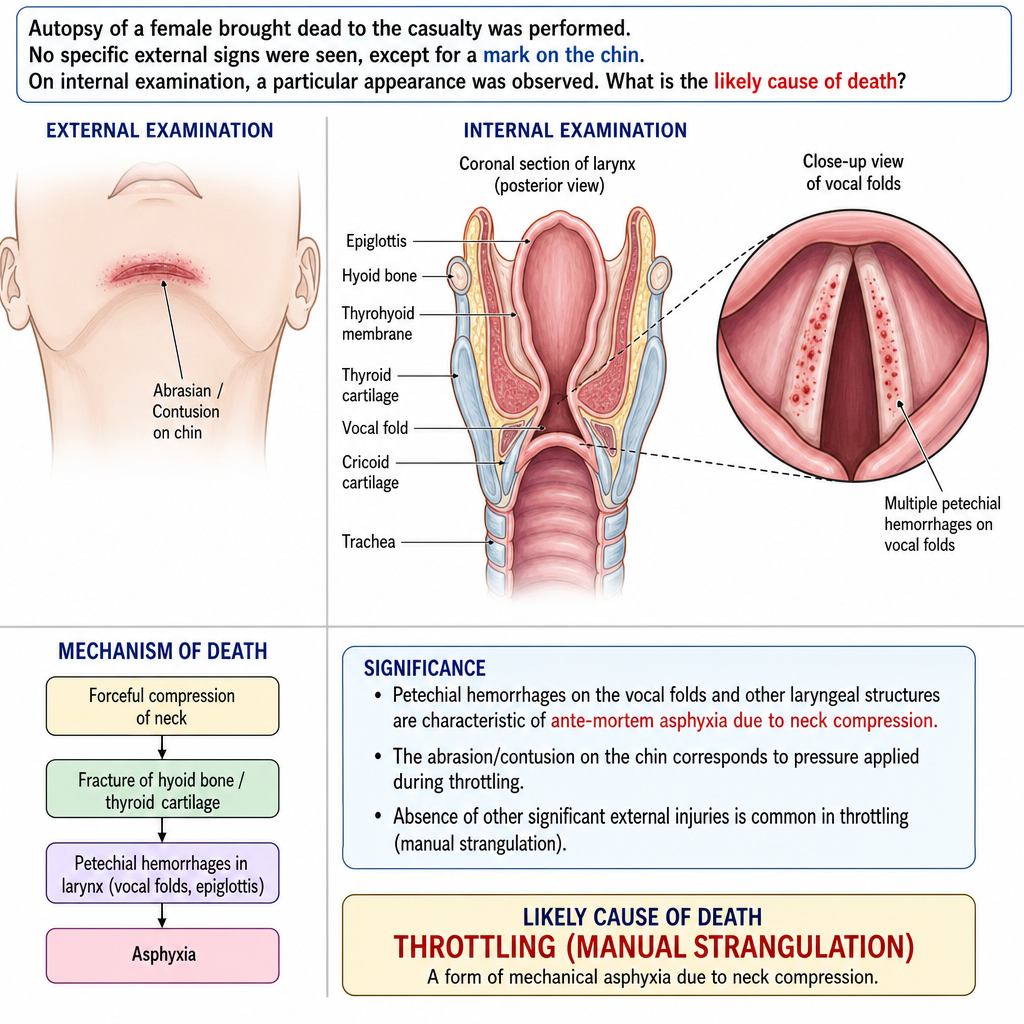
Fracture of the hyoid bone is indicative of which of the following?
Cutis anserine is seen in which of the following conditions?
Which of the following is a sign of ante-mortem hanging?
In hydrocution death, death occurs by which mechanism?
Cafe coronary commonly occurs when a person is:
The fracture characteristically seen in judicial hanging is:
In cases of hanging, postmortem examination shows a tear in the carotid artery. What is this called?
Which of the following is NOT a characteristic of strangulation?
Blocking of the internal air passage by external pressure over the neck and chest is termed as:
In cases of hanging, how should the ligature material be preserved?
Explanation: **Explanation:** **1. Why Throttling is Correct:** Throttling (manual strangulation) is the most common cause of a fractured hyoid bone. During throttling, the perpetrator’s fingers exert direct, inward pressure on the neck. This force often compresses the **greater cornua** of the hyoid bone inward, leading to an **inward compression fracture**. Statistically, hyoid fractures occur in approximately 15–40% of throttling cases, especially in older individuals where the bone has calcified and become brittle. **2. Why Other Options are Incorrect:** * **Hanging:** Hyoid fractures are rare in hanging (less than 15-20%). When they do occur, they are usually **abduction (outward) fractures** due to the upward pull of the ligature. Fracture of the cervical vertebrae (Hangman’s fracture) or thyroid cartilage is more characteristic. * **Mugging:** This refers to "chokehold" or "stranglehold" (often using the forearm). While it can cause laryngeal damage, it typically results in fractures of the **thyroid cartilage** rather than the hyoid bone. * **Ligature Strangulation:** The pressure is applied circumferentially by a cord. While fractures can occur, they are less frequent than in throttling, and the **thyroid cartilage** is more commonly involved due to the lower level of the ligature. **3. NEET-PG High-Yield Pearls:** * **Fracture Type:** Throttling = **Inward** fracture; Hanging = **Outward** (abduction) fracture. * **Age Factor:** Hyoid fractures are rare in victims under age 30-35 because the greater cornua are not yet fused to the body of the bone, making it flexible. * **Most Common Site:** The junction of the outer one-third and inner two-thirds of the greater cornua. * **Antemortem Sign:** The presence of **extravasation of blood** (hematoma) at the fracture site is the definitive sign that the fracture occurred before death.
Explanation: **Explanation:** **Cutis Anserina** (Gooseflesh or Goosebumps) is a characteristic finding in **Drowning**. It occurs due to the contraction of the *arrector pili* muscles at the base of hair follicles. This is primarily a post-mortem phenomenon triggered by **rigor mortis** affecting these tiny muscles, though it can also be caused by the sudden exposure to cold water (cold shock) at the time of death. It results in a granular, "plucked chicken" appearance of the skin, most prominent on the extensor surfaces of the limbs. **Analysis of Options:** * **B. Suffocation:** While a form of asphyxia, it lacks the specific cold-water stimulus or the characteristic skin reaction associated with immersion. * **C. Lust Murder:** This refers to homicides with a sexual motive (often involving mutilation). While skin findings may exist, cutis anserina is not a diagnostic feature. * **D. Electrocution:** The hallmark skin finding here is an **Entry Wound** (Joule burn) or "filigree burns" (in lightning), not cutis anserina. **High-Yield Clinical Pearls for NEET-PG:** * **Specificity:** Cutis anserina is **not** a diagnostic sign of drowning; it is a sign of immersion in cold water. It can occur in a body thrown into water after death. * **Washerwoman’s Hand:** Wrinkling of the skin of palms and soles due to maceration (seen in immersion, usually after 12–24 hours). * **Cadaveric Spasm:** If weeds or mud are clutched in the hand, it is a **sure sign** of ante-mortem drowning. * **Paltauf’s Hemorrhages:** Subpleural ecchymoses found in the lungs of drowning victims due to the rupture of alveolar walls.
Explanation: **Explanation:** In forensic pathology, distinguishing between ante-mortem (before death) and post-mortem (after death) hanging is critical. **1. Why "Dribbling of Saliva" is the Correct Answer:** Dribbling of saliva is considered the **surest sign of ante-mortem hanging**. Saliva is a vital secretion produced by the salivary glands. For dribbling to occur, the person must be alive so that the pressure of the ligature on the glands (usually the parotid or submandibular) triggers secretion. Gravity then causes the saliva to run down the angle of the mouth, often leaving a dried, white, or brownish stain on the chest or clothes. This cannot occur if the body is suspended after death, as secretion ceases. **2. Why the Other Options are Incorrect:** * **B. Ligature Mark:** This is a purely mechanical phenomenon. A mark can be produced post-mortem if a body is suspended shortly after death, as the weight of the body compresses the skin. While specific features (like parchmentization) suggest ante-mortem, the mark itself is not diagnostic. * **C. Fracture of Hyoid Bone:** This occurs due to direct mechanical pressure. It can be produced post-mortem if significant force is applied. Furthermore, it is more common in manual strangulation and is often absent in young individuals due to the flexibility of the bone. * **D. Seminal Emission:** This is a non-specific finding caused by the relaxation of sphincters and post-mortem hypostasis (pooling of blood). It can occur in various types of sudden death and even post-mortem, making it an unreliable indicator of ante-mortem hanging. **High-Yield Clinical Pearls for NEET-PG:** * **Surest sign of hanging:** Dribbling of saliva. * **Most common type of hanging:** Typical Hanging (knot at the occiput). * **Cause of death in hanging:** Most commonly Vagal Inhibition or Asphyxia. * **Fracture of Hyoid:** In hanging, it is usually an **abduction fracture** (greater cornua displaced outwards). In strangulation, it is an **adduction fracture**.
Explanation: **Explanation:** **Hydrocution** (also known as Immersion Syndrome) is a specific type of drowning that occurs due to sudden impact with very cold water. **1. Why Vagal Inhibition is Correct:** When an individual suddenly plunges into cold water, the stimulation of the trigeminal nerve (face) and the vagus nerve (pharynx and larynx) triggers an exaggerated parasympathetic response. This leads to **sudden cardiac arrest** due to **vagal inhibition**. Death is instantaneous, and because the heart stops immediately, the classic signs of drowning (like fine froth or water in the lungs) are typically absent. **2. Why Other Options are Incorrect:** * **Laryngospasm:** This is the mechanism behind **"Dry Drowning."** It occurs when a small amount of water enters the larynx, causing a reflex spasm that prevents water from entering the lungs but also causes asphyxia. * **Encephalopathy:** This is a late complication of near-drowning or hypoxic-ischemic injury; it is not the immediate mechanism of death in hydrocution. * **Loss of Consciousness:** While unconsciousness may occur due to the "cold shock response" or hyperventilation, it is a precursor or a symptom, not the physiological mechanism that causes immediate death in immersion syndrome. **High-Yield Clinical Pearls for NEET-PG:** * **Post-mortem findings:** In hydrocution, the body often looks "pale" (unlike the cyanosis seen in typical drowning). * **Risk Factors:** Consumption of alcohol, a heavy meal, or pre-existing cardiac conditions increases the risk of hydrocution. * **Reflexes:** Remember the **"Diving Reflex"** (bradycardia and peripheral vasoconstriction), which is a physiological attempt to conserve oxygen, whereas hydrocution is a pathological, fatal exaggeration of autonomic reflexes.
Explanation: **Explanation:** **Cafe Coronary** refers to sudden death due to the accidental inhalation of a large bolus of food (typically meat) which obstructs the glottis or larynx, leading to acute upper airway obstruction. **Why Option A is Correct:** The primary underlying mechanism is the **suppression of the gag and cough reflexes**. Alcohol intoxication is the most common predisposing factor because it impairs coordination, reduces the sensitivity of the laryngeal protective reflexes, and often leads to poor mastication (bolting of food). Other risk factors include neurological disorders (Parkinson’s, stroke), senile dementia, or poor-fitting dentures. **Why Other Options are Incorrect:** * **Options B, C, and D:** While "meat" (Option C) is the most common physical substance involved in the choking episode, the *condition* of the person is the clinical focus of the question. Eating fatty food, meat, or fish does not inherently cause a cafe coronary unless the individual’s physiological ability to swallow or protect their airway is compromised. The term "coronary" is used because the sudden collapse mimics a myocardial infarction. **High-Yield Clinical Pearls for NEET-PG:** * **Mechanism of Death:** Usually **Asphyxia**; however, sudden cardiac arrest can occur due to **Vagal Inhibition** (reflex cardiac arrest) from laryngeal stimulation. * **Clinical Presentation:** The victim is unable to speak or cough (Aphonia), turns cyanotic, and collapses suddenly while eating. * **Management:** The immediate treatment of choice is the **Heimlich Maneuver** (subdiaphragmatic abdominal thrusts). * **Autopsy Finding:** A large, unchewed bolus of food is found impacted in the larynx or pharynx. This distinguishes it from a true coronary event.
Explanation: In judicial hanging, the mechanism of death is typically **distraction and hyperextension** of the neck, leading to a specific cervical injury known as the **Hangman’s Fracture**. ### 1. Why Option A is Correct **Spondylolisthesis of C2 over C3** (specifically, a bilateral fracture of the pars interarticularis of the axis) is the hallmark of judicial hanging. When the body drops and the knot (usually submental) jerkily hyperextends the head, the neural arch of C2 snaps. This causes the body of the C2 vertebra to slide forward over C3, resulting in immediate transection of the spinal cord at a high level, leading to instant respiratory and cardiac arrest. ### 2. Why Other Options are Incorrect * **B. Fracture of odontoid process:** This is more commonly associated with hyperflexion or hyperextension injuries in vehicular accidents or falls, rather than the distraction force of a long-drop hanging. * **C. Fracture of transverse process:** These are usually minor stable fractures resulting from direct trauma or lateral bending, not the massive vertical deceleration seen in judicial hanging. * **D. Dislocation of C5:** Lower cervical injuries (C4–C6) are typical of diving accidents or "whiplash" injuries, whereas judicial hanging specifically targets the upper cervical spine (C2-C3). ### 3. High-Yield Pearls for NEET-PG * **Mechanism of Death:** In judicial hanging, it is **asphyxia + spinal cord injury**; in typical (suicidal) hanging, it is usually **asphyxia + venous/arterial occlusion**. * **Fracture of Hyoid Bone:** Rare in judicial hanging (due to the high position of the noose) but common in manual strangulation (inward compression). * **Drop Length:** The "Long Drop" method is calculated based on the victim's weight to ensure cervical dislocation without decapitation. * **Fracture incidence:** Contrary to popular belief, a classic Hangman’s fracture is only found in about 10-15% of suicidal hangings; it is most characteristic of the **judicial** type.
Explanation: **Explanation:** **Amussat’s Sign (Correct Answer):** Amussat’s sign refers to a transverse tear in the **tunica intima** (inner lining) of the common carotid artery, typically seen just below the bifurcation. In cases of hanging, this occurs due to the sudden stretching of the vessel wall caused by the weight of the body and the constriction of the ligature. It is more commonly observed in victims with atherosclerosis, as the vessels are more brittle. While it is a classic sign of hanging, it is only present in about 5–10% of cases. **Analysis of Incorrect Options:** * **Battle Sign:** This refers to postauricular ecchymosis (bruising over the mastoid process) indicating a fracture of the **middle cranial fossa** (base of the skull). * **Nutcracker Sign:** This is a clinical condition (Nutcracker Syndrome) where the **left renal vein** is compressed between the abdominal aorta and the superior mesenteric artery. * **Ring Sign:** In forensic medicine, this refers to a **fracture of the base of the skull** surrounding the foramen magnum, often seen in falls from a height where the victim lands on their feet or head. **High-Yield Clinical Pearls for NEET-PG:** * **Martin’s Sign:** Transverse tears in the adventitia (outer layer) of the carotid artery. * **Lesser’s Sign:** A tear in the inner coat of the external and internal carotid arteries. * **Simon’s Sign:** Hemorrhage in the anterior longitudinal ligament of the lumbar spine (indicative of a struggle or heavy suspension in hanging). * **Browardel’s Sign:** Ecchymosis in the retro-pharyngeal space. * **Fracture in Hanging:** The most common bone fractured is the **Hyoid bone** (greater horn), followed by the thyroid cartilage. In judicial hanging, a **Hangman’s fracture** (C2 vertebra) is characteristic.
Explanation: In forensic medicine, distinguishing between hanging and strangulation is a high-yield topic for NEET-PG. **Why "Saliva running out of mouth" is the correct answer:** Dribbling of saliva is a **specific sign of ante-mortem hanging**. In hanging, the body is suspended, and the pressure of the ligature on the salivary glands (usually the parotid) stimulates secretion. Due to gravity and the tilted position of the head, saliva trickles out of the angle of the mouth. In **strangulation**, the force is usually horizontal, the body is typically recumbent, and there is no prolonged suspension to facilitate gravity-driven salivary flow. **Explanation of Incorrect Options:** * **A. Fracture of thyroid cartilage:** This is common in strangulation (manual or ligature) due to direct pressure on the larynx. In hanging, the hyoid bone is more frequently fractured (especially in older individuals), whereas thyroid fracture is more characteristic of throttling. * **B. Bleeding from nose:** Strangulation involves intense venous congestion of the head and neck due to jugular vein obstruction. This increased hydrostatic pressure can cause the rupture of small capillaries in the nasal mucosa (epistaxis) and ears. * **C. Transverse ligature mark:** In strangulation, the ligature is usually applied **horizontally (transversely)** and completely encircles the neck below the thyroid cartilage. In contrast, the mark in hanging is typically oblique, non-continuous, and situated high in the neck. **NEET-PG High-Yield Pearls:** * **Hanging:** Oblique mark, Hyoid fracture (Greater cornu), Dribbling of saliva (Surest sign of ante-mortem hanging). * **Strangulation:** Transverse mark, Thyroid fracture, Emphysematous bullae on lungs (Prinsloo and Gordon artifact). * **Facial Appearance:** In strangulation, the face is typically bloated, cyanosed, and covered in petechiae (Tardieu spots) due to the violent nature of the act.
Explanation: **Explanation:** **Correct Answer: D. Wedging** Wedging is a specific form of mechanical asphyxia where the body is compressed into a narrow space (like a crevice or between a bed and a wall). The mechanism of death is dual: **external pressure** on the neck and chest restricts respiratory movements (traumatic asphyxia), while the position of the head often causes the chin to be pressed against the chest, **blocking the internal air passage**. This combination of external compression and internal obstruction is the hallmark of wedging. **Analysis of Incorrect Options:** * **A. Gagging:** This is a form of smothering where a cloth or object is pushed into the mouth, blocking the pharynx and pushing the tongue back. It involves internal obstruction but not external pressure on the chest. * **B. Choking:** This refers to the obstruction of air passages from *within* (e.g., a foreign body, food bolus, or blood clot lodged in the larynx or trachea). * **C. Smothering:** This is caused by the closing of external respiratory orifices (mouth and nose) by hand, cloth, or other materials. It does not involve pressure on the chest or neck. **High-Yield Clinical Pearls for NEET-PG:** * **Traumatic Asphyxia:** Also known as *Perthes syndrome*, it occurs due to heavy pressure on the chest/abdomen (e.g., stampedes). It is characterized by "Masque Ecchymotique" (intense cyanosis and petechiae of the face and neck). * **Burking:** A combination of smothering (closing the mouth/nose) and traumatic asphyxia (kneeling on the chest). Historically used by Burke and Hare. * **Cafe Coronary:** A type of choking where a large bolus of food suddenly obstructs the airway, often mistaken for a heart attack.
Explanation: **Explanation:** In forensic practice, the preservation of the ligature material is crucial because the **knot** provides vital evidence regarding the type of hanging (typical vs. atypical), the direction of force, and the skill or intent of the person who tied it. **1. Why Option C is Correct:** The ligature should always be cut **away from the knot**, preferably on the side opposite to it. Once cut, the two free ends should be secured together with a piece of string or wire. This ensures that the original circumference of the loop and the specific configuration of the knot remain intact for further examination and court presentation. **2. Why the other options are incorrect:** * **Option A & B:** Opening the knot or cutting through it destroys the most significant piece of physical evidence. The knot’s structure can indicate whether it was a "running noose" or a "fixed knot," which helps differentiate between suicide and staged hanging. * **Option D:** While the knot itself should not be cut, the ligature *must* be cut to remove it from the deceased’s neck. Attempting to slip the ligature over the head can disturb the friction marks on the skin or alter the knot’s position. **High-Yield Clinical Pearls for NEET-PG:** * **Ligature Mark:** Usually situated above the thyroid cartilage, oblique, non-continuous (interrupted at the knot), and parchment-like. * **La Facies Sympathica:** A rare finding where one eye is open and the pupil dilated (due to cervical sympathetic chain compression). * **Simon’s Sign:** Hemorrhages in the anterior longitudinal ligament of the lumbar spine (seen in active suspension). * **Post-mortem finding:** Saliva trickling from the corner of the mouth (opposite the knot) is a **sure sign of ante-mortem hanging**.
Pathophysiology of Asphyxia
Practice Questions
Hanging
Practice Questions
Strangulation
Practice Questions
Suffocation
Practice Questions
Traumatic Asphyxia
Practice Questions
Drowning
Practice Questions
Choking
Practice Questions
Chemical Asphyxiants
Practice Questions
Positional Asphyxia
Practice Questions
Autoerotic Asphyxia
Practice Questions
Pediatric Asphyxia
Practice Questions
Postmortem Findings in Asphyxia
Practice Questions
Get full access to all questions, explanations, and performance tracking.
Start For Free