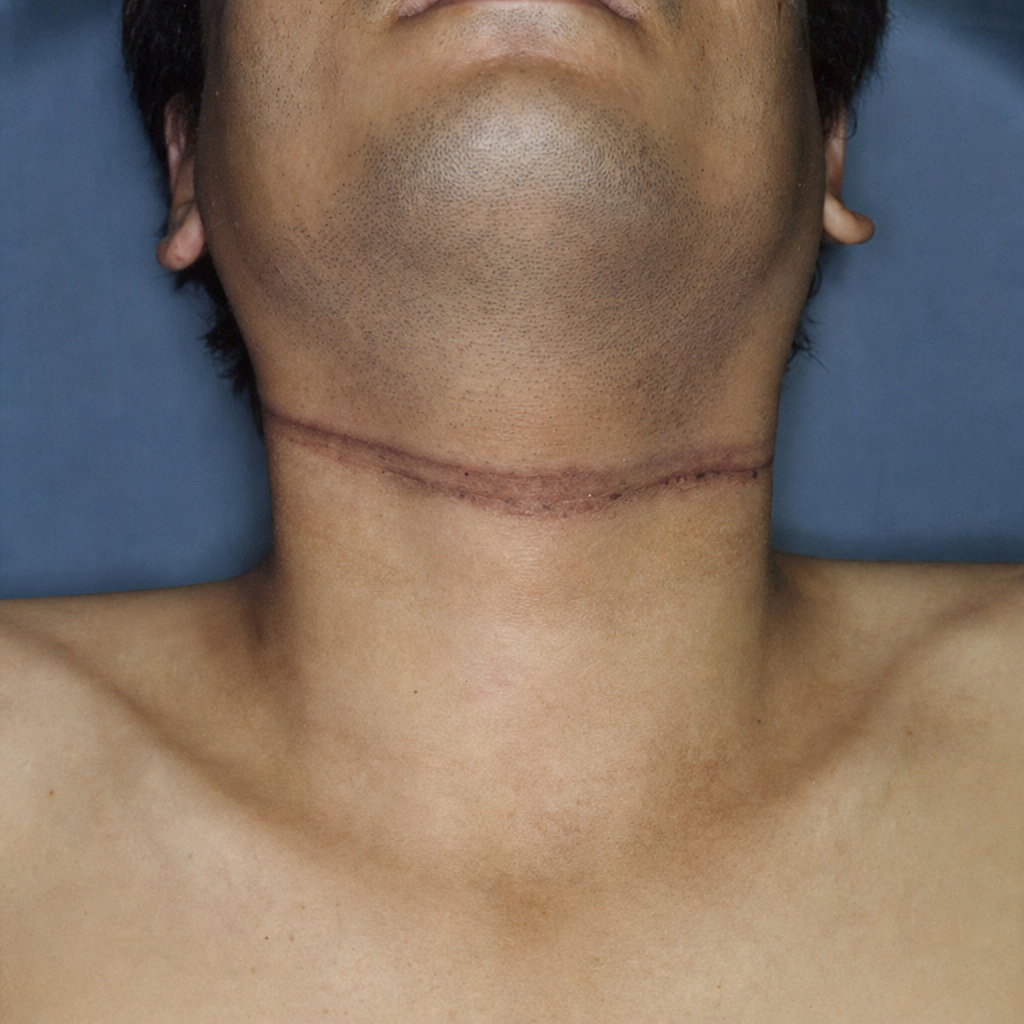
On conducting the autopsy on a victim of hanging, the ligature mark is seen at the lower 1/3rd of the neck. The victim is seen to have a protruded tongue. He was found with his head hanging to his left side with saliva dribbling from the left angle of his mouth. The right pupil appears constricted and there is ptosis (drooping) of the right eyelid. Compression of which of the following structures is the most probable reason for the unilateral ptosis in this case?
What is the situation of the knot of ligature in cases of typical hanging?
In judicial hanging, where is the "knot" typically placed?
In hanging, which knot position most likely indicates homicide?
In cases of strangulation, the marks on the neck are typically described as?
Lynching is a type of:
In a case of hanging, neck ligature marks are an example of:
Identify the pattern of abrasion shown in the image below.
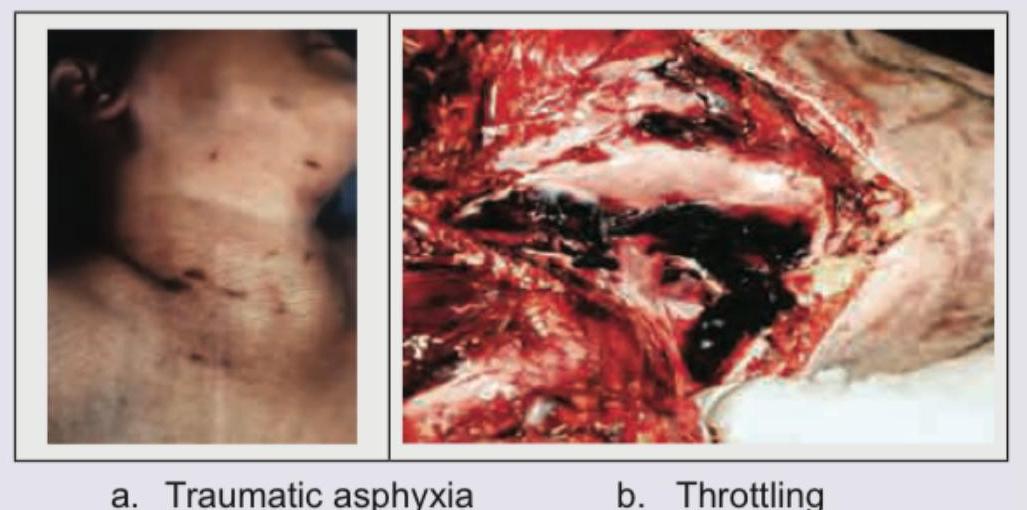
A female was found dead in her bedroom. The room was not locked from inside. Her blood alcohol value was found to be 350 mg/dL. The picture taken at the post mortem is shown below. The diagnosis is? (AIIMS Nov 2018, AIIMS Nov 2017)
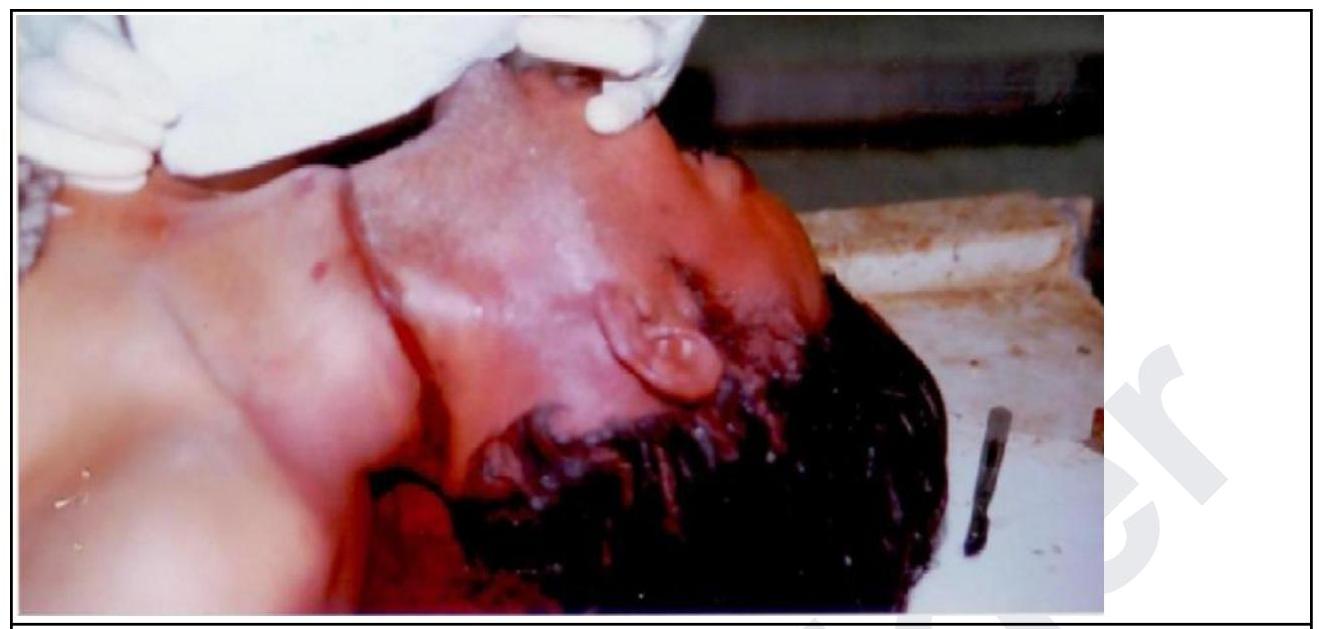
Identify the post mortem lividity of the image: (AIIMS Nov 2018)

Explanation: ***Cervical sympathetic chain*** - The combination of **unilateral ptosis**, **miosis** (constricted pupil), and sometimes **anhidrosis** (lack of sweating) is characteristic of **Horner's syndrome**, which results from damage to the **cervical sympathetic chain**. - Hanging can cause compression or injury to this chain, leading to the observed **Horner's syndrome** on the ipsilateral side of the injury. *Left vagus nerve* - Compression of the **vagus nerve** is associated with cardiac arrhythmias, bradycardia, or gastric disturbances, not directly with ptosis. - The symptoms observed are specific to sympathetic dysfunction, not parasympathetic vagal stimulation. *Right internal jugular vein* - Compression of the **internal jugular vein** would cause venous congestion and edema in the head and neck, not neurological signs like ptosis or miosis. - While it can be injured in hanging, it does not directly explain the specific neurological findings. *Right internal carotid artery* - Compression of the **internal carotid artery** could lead to cerebral ischemia or stroke symptoms, such as weakness or sensory deficits, but not typically isolated ptosis and miosis. - The observed symptoms point to a specific sympathetic pathway disruption rather than arterial occlusion.
Explanation: ***Occiput*** - In cases of **typical complete hanging**, the suspension point is directly above the head, causing the knot to be positioned at the **nape of the neck (occiput)** or slightly to one side. - This posterior knot position allows for maximum compression of the anterior neck structures, including the **carotid arteries, jugular veins, and trachea**, facilitating rapid cerebral anoxia and death. *In front of chin* - A knot in front of the chin is characteristic of **atypical hanging** or **partial suspension**, where the neck is not fully extended, and the force is applied differently. - This position is less common in typical full suspension as it allows for less efficient compression of vital neck structures. *Angle of mandible* - Placing the knot at the angle of the mandible would also signify an **atypical hanging**, where the ligature might not be symmetrically positioned around the neck. - This configuration may lead to an incomplete or prolonged strangulation process compared to the typical scenario. *Mastoid* - A knot located at the mastoid process would indicate an **asymmetric strangulation** effort, likely seen in **atypical hanging** or manual strangulation. - This position might result in uneven pressure distribution, not consistent with the typical goal of rapid and complete occlusion of neck vessels and airway in typical hanging.
Explanation: ***Side of neck*** - The **knot** is typically placed on the **side of the neck** to optimize the chances of a **cervical fracture**, specifically a **hangman's fracture** (bilateral pedicle fracture of C2, with anterior subluxation of C2 on C3). - This placement, combined with a sufficient **drop**, aims to cause a rapid and **painless death** by severance of the **spinal cord** or disruption of brainstem function. *Below the chin* - Placing the knot directly **below the chin** would primarily cause **asphyxia** by compressing the trachea, leading to a slower and more painful death. - This position is less likely to achieve the rapid **cervical fracture** desired for judicial hanging. *Behind the neck* - A knot placed **behind the neck** would push the head forward, potentially compressing the airway and large vessels but less effectively causing a **neck fracture**. - This placement generally results in an inefficient and prolonged death by **strangulation or asphyxiation**. *Front of the neck* - Placing the knot in the **front of the neck** would primarily lead to **compression of the trachea and carotid arteries**, resulting in death by **asphyxia** or **cerebral ischemia**. - This position is not optimal for inducing a **cervical fracture** and would likely lead to a more traumatic or prolonged death.
Explanation: ***Occipital*** - A knot positioned over the **occipital region** (back of the head) is highly suggestive of **homicide**. This position often requires an external force to secure the ligature around the neck after the victim has been incapacitated, making self-suspension nearly impossible. - In suicidal hangings, the knot is typically placed on the side or under the chin to allow for suspension and facilitate constriction by increasing leverage on the carotid arteries and trachea. An occipital knot, however, **distributes pressure differently** and is ergonomically difficult for an individual to tie themselves into a fatal hanging position. *Left lateral* - A knot on the **left lateral side** of the neck is common in **suicidal hangings**. It allows for easy self-placement and leverage for the ligature to constrict vital structures. - While possible in homicide, it doesn't carry the strong suspicious implication that an occipital knot does, as it aligns with typical self-inflicted hanging mechanics. *Right lateral* - Similar to the left lateral position, a knot on the **right lateral side** is frequently observed in **suicidal hangings** due to its ease of self-manipulation and favorable leverage for effective strangulation. - It does not automatically rule out homicide but is not as indicative of external intervention as an occipital knot would be. *Submandibular* - A **submandibular** (under the chin) knot is also characteristic of **suicidal hangings**. This position effectively compresses both the carotid arteries and trachea, leading to rapid unconsciousness and death. - The ease of tying and the physiological effectiveness of this position make it a common choice for self-inflicted hangings, reducing the likelihood of homicide compared to an occipital knot.
Explanation: ***Horizontal marks*** - In cases of strangulation (both ligature and manual), the constricting force is applied directly around the neck in a **circumferential manner** - This results in marks that are **horizontal or nearly horizontal**, running around the neck at roughly the same level - The pattern reflects direct compression rather than suspension, distinguishing it from hanging *Vertical marks* - Vertical marks on the neck are not typical for strangulation - These would be more commonly associated with scratches, other forms of trauma, or defensive injuries - Strangulation specifically involves circumferential compression, not vertical force *Diagonal marks* - Diagonal or oblique marks are characteristic of **hanging**, not strangulation - In hanging, the ligature ascends from the point of constriction toward the suspension point, creating an oblique pattern - The ligature mark is typically incomplete posteriorly (at the knot site) and runs upward and backward *None of the options* - This is incorrect because there is a specific and well-established pattern of marks in strangulation - Horizontal marks are the hallmark finding in strangulation cases
Explanation: ***Homicidal hanging*** - **Lynching** is a form of **extrajudicial punishment** carried out by groups, most commonly involving **hanging** as a method of execution. - This act is driven by **prejudice** or group hatred, aligning with the definition of **homicidal intent** rather than self-inflicted harm or accident. *Suicidal hanging* - **Suicidal hanging** is an individual act where a person intentionally ends their own life by suspension. - It lacks the element of **group violence** and **premeditated murder** by others characteristic of lynching. *Judicial hanging* - **Judicial hanging** is a legal method of execution carried out by the state following due process and a court order. - Lynching, in contrast, is an **illegal** act outside the bounds of the legal system, violating established laws. *Accidental hanging* - **Accidental hanging** occurs when a person inadvertently suspends themselves, often during play or an unfortunate incident. - This type of hanging lacks any **malicious intent**, which is a defining characteristic of lynching.
Explanation: ***Patterned abrasion*** - This is an injury where the **skin is scraped or rubbed off**, leaving a distinct mark that mirrors the object that caused it. - In cases of hanging, the ligature (rope, cord, etc.) creates a **patterned abrasion** on the neck due to friction and pressure. *Contusion (internal bleeding)* - A **contusion** involves bleeding under the skin, resulting in discoloration (a bruise), but it does not remove the skin's superficial layers. - While internal bleeding can occur in hanging, the visible ligature mark on the surface of the neck is primarily an abrasion, not just a contusion. *Irregular laceration* - A **laceration** is an open wound characterized by a **tear or rip in the skin**, typically with ragged or uneven edges, often caused by blunt trauma. - The ligature mark from hanging is usually a uniform, linear mark caused by consistent pressure and friction, not an irregular tear. *Subcutaneous bruise* - A **subcutaneous bruise** is essentially a contusion, indicating bleeding into the tissue beneath the skin. - While bleeding may accompany the ligature mark, the primary, visible surface injury from the ligature itself is an **abrasion** due to the scraping action.
Explanation: ***Ligature mark*** - The image clearly displays a **linear impression** on the neck, consistent with a **ligature mark**, which is an abrasion caused by a constricting object. - This type of abrasion is often seen in cases of **strangulation or hanging**, where a cord or similar item tightens around the neck. *Pressure abrasion* - Pressure abrasions are typically caused by **blunt forceful contact** with a surface, resulting in a scraped or grazed appearance, which differs from the distinct linear mark shown. - They are usually broad and irregular, not forming a clear, thin line as seen in the image. *Graze abrasion* - Graze abrasions, also known as scrapes, involve the **superficial removal of the epidermis** due to friction against a rough surface. - They tend to be spread out and irregular, lacking the deep, circumscribed linear pattern characteristic of a ligature mark. *Imprint abrasion* - Imprint abrasions reflect the **exact pattern of the impacting object** (e.g., tire track, weapon pattern), which is not evident in the image. - While a ligature itself can leave an imprint, the term "imprint abrasion" is usually reserved for more complex patterns than a simple linear groove.
Explanation: ***Throttling*** - The autopsy image shows extensive **internal hemorrhage** and disruption of neck structures, consistent with significant compressive force applied to the neck by hands, as seen in **throttling**. - **Throttling** (manual strangulation) causes deep internal injuries including fractured **hyoid bone**, damaged **thyroid cartilage**, and **strap muscle hemorrhage**, even when external marks may be minimal or absent. - The high blood alcohol level (350 mg/dL - severe intoxication) would have impaired her ability to resist, and the unlocked room suggests **homicidal** intent rather than suicide. - Key autopsy findings: **deep neck muscle hemorrhage**, **laryngeal fractures**, and **torn blood vessels** without a ligature pattern. *Traumatic asphyxia* - Traumatic asphyxia results from severe **chest/thoracic compression** leading to acute venous congestion in the head and neck region. - Classical signs include **petechial hemorrhages** on face and conjunctivae, **cyanosis** above compression level, and relatively **intact neck structures** on autopsy. - The severe internal neck damage shown in the autopsy image is **not characteristic** of traumatic asphyxia, which primarily affects superficial vessels due to back-pressure, not deep structural injury. *Café coronary* - **Café coronary** is sudden death from **food bolus aspiration** causing airway obstruction, commonly occurring in intoxicated individuals who cannot protect their airway. - Autopsy findings would show an **obstructing food bolus in the larynx/trachea** without the extensive neck trauma and hemorrhage depicted in the image. - No manual strangulation injuries would be present. *Bansdola* - **Bansdola** is a traditional method of strangulation using a **bamboo stick or rod** twisted across the neck with a rope, used historically as torture or execution. - It causes a characteristic **linear ligature mark** with underlying soft tissue injury in a horizontal pattern across the neck. - The autopsy findings in the image show **diffuse manual strangulation injury** rather than the specific linear pattern of ligature strangulation seen in Bansdola.
Explanation: ***Suggillation*** - Suggillation refers to the extravasation of blood into the tissues due to crushing pressure or trauma, often seen in cases of severe blunt force injury, leaving **diffuse, purplish discoloration.** - In post-mortem examination, a **suggillation** can be distinguished from common **livor mortis** (lividity) by its darker color and by the fact that it is not blanchable under pressure, indicating **capillary rupture and hemorrhage** rather than just pooling of blood. *Tattooing* - Tattooing involves the insertion of **indelible ink** into the dermis of the skin, creating permanent designs. - Tattoos have distinct, often patterned, appearances and would not resemble the **irregular, deep discoloration** of lividity or hemorrhage. *Putrefaction* - Putrefaction is a later stage of decomposition, characterized by the breakdown of tissues by bacteria, producing **gases, discoloration (greenish-black), and foul odors.** - This process is distinct from the **vascular pooling** or **hemorrhage** that forms suggillation; putrefaction typically starts later (after 24-48 hours) and involves more widespread tissue destruction. *Decomposition* - Decomposition is the broader process of decay of organic matter after death, encompassing various stages like **autolysis, putrefaction, and skeletonization.** - While suggillation occurs post-mortem, it is a specific type of **post-mortem bruising** or lividity, distinct from the generalized tissue breakdown and gaseous changes seen in advanced decomposition.
Get full access to all questions, explanations, and performance tracking.
Start For Free