Hallpike test is done for
Cervical Vestibular Evoked Myogenic Potential (cVEMP) detects lesion of -
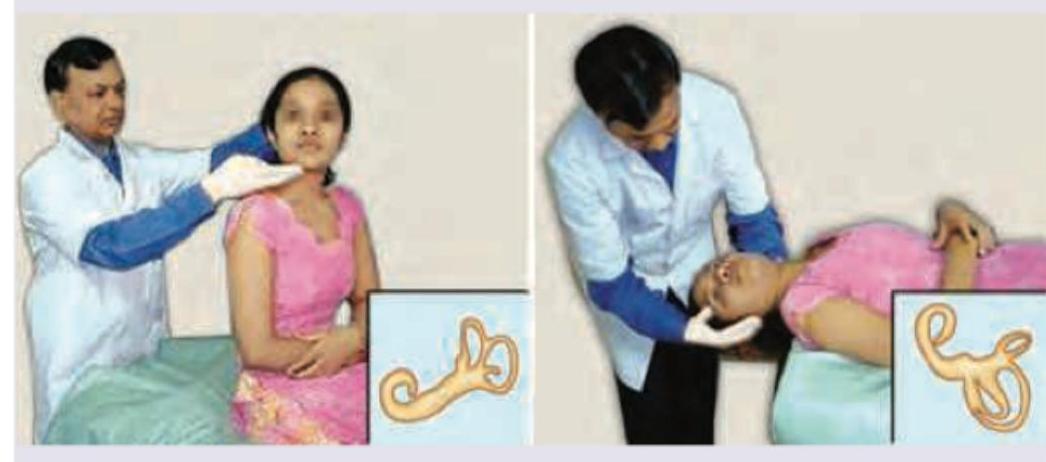
Which of the following test is being performed on the patient?
A patient with cholesteatoma has lateral semicircular canal fistula. The most specific sign is:
All are true about vestibular neuritis EXCEPT:
Following are the laboratory tests for the diagnosis of vestibular dysfunction except -
A false positive fistula test is associated with which of the following conditions?
A 10-year-old boy presented with sensorineural deafness not benefited with a hearing aid. What is the next treatment?
A glomus tumor is invading the visceral part of the carotid canal. It is classified as which type?
Common presenting manifestations of Meniere's disease are all except?
Explanation: ***Vestibular function*** - The **Dix-Hallpike maneuver** is a diagnostic test used to identify **benign paroxysmal positional vertigo (BPPV)**, a disorder of the vestibular system. - It involves specific head and body movements to provoke dizziness and **nystagmus**, indicating otolith displacement in the semicircular canals. *Cochlear function* - **Cochlear function** relates to hearing, which is evaluated by tests like **audiometry** or **otoacoustic emissions**. - The Hallpike test does not assess the ability to perceive sound or the health of the cochlea. *Audiometry* - **Audiometry** is a hearing test that measures a person's ability to hear sounds at different frequencies and intensities, assessing the **degree and type of hearing loss**. - It is unrelated to assessing vertigo or balance disorders caused by semicircular canal pathology. *Eustachian tube function* - **Eustachian tube function** is assessed by tests like **tympanometry** or the **Valsalva maneuver**, which evaluate middle ear pressure equalization. - The Hallpike test does not assess Eustachian tube patency or function.
Explanation: ***Inferior Vestibular Nerve*** - **cVEMP** primarily assesses the function of the **saccule** and its neural pathway via the **inferior vestibular nerve (IVN)**. - The saccule is sensitive to **vertical head movements and linear acceleration** and transmits signals through the IVN to the vestibulospinal pathway. - cVEMP is recorded from the **sternocleidomastoid muscle** and reflects the **vestibulocollic reflex**. *Cochlear Nerve* - The **cochlear nerve** is responsible for **auditory processing** and is assessed by tests like audiometry and ABR, not VEMPs. - While it's part of the vestibulocochlear nerve (CN VIII), its function is distinct from vestibular assessment. *Facial Nerve* - The **facial nerve (CN VII)** controls **facial muscles** and taste sensation, with no direct role in vestibular function. - Lesions are detected through facial movement assessment and electrophysiological tests like electroneuronography (ENoG). *Superior Vestibular Nerve* - The **superior vestibular nerve (SVN)** primarily innervates the **anterior and horizontal semicircular canals** and the **utricle**. - Its function is assessed by **oVEMP (ocular VEMP)**, **caloric reflex test**, or **head impulse test**, rather than cVEMP.
Explanation: ***Dix-Hallpike test*** - The image depicts a patient being moved from an upright sitting position to a supine position with the head turned to one side and extended, which is characteristic of the **Dix-Hallpike maneuver**. - This test is used to diagnose **benign paroxysmal positional vertigo (BPPV)** by provoking vertigo and nystagmus as a result of otoconia displacement in the semicircular canals. *Caloric stimulation test* - This test involves introducing **warm or cold water/air into the ear canal** to induce nystagmus, assessing the vestibular system. - It's typically performed with the patient lying supine with their head elevated at 30 degrees, not involving the specific positional changes shown in the image. *Doll's eye reflex* - Also known as the **oculocephalic reflex**, it assesses brainstem function by rapidly turning the patient's head while observing eye movement. - This reflex is primarily used to evaluate comatose patients and does not involve the complex body and head positioning seen in the image. *Frenzel maneuver* - The Frenzel maneuver is performed during **otoscopy** to check for nystagmus by having the patient gaze through high plus lenses in a dark room. - It is often used to suppress visual fixation and enhance nystagmus, but it does not involve the specific body or head movements depicted.
Explanation: ***Fistula test*** - The **fistula test** (Positive pressure test or Hennebert's test) directly assesses for a communication between the middle ear and the labyrinth by applying positive or negative pressure to the external auditory canal. - A positive result, indicated by **nystagmus** or **vertigo** induced by pressure changes, is the **most specific sign** for a **labyrinthine fistula** in the context of **cholesteatoma**. - The lateral semicircular canal is the most commonly affected site in cholesteatoma-related fistulae. *Hennebert's sign* - **Hennebert's sign** refers to **nystagmus** or **vertigo** induced by pressure changes in the external auditory canal **in the absence of an actual fistula**. - It represents a **false positive fistula test** and is classically associated with **congenital syphilis**, **Meniere's disease**, or other conditions causing increased labyrinthine membrane mobility. - In this case with a **confirmed fistula**, the positive pressure test would be called a **positive fistula test**, not Hennebert's sign. *Head thrust test* - The **head thrust test** evaluates the function of the **vestibulo-ocular reflex (VOR)** and is used to detect **peripheral vestibular hypofunction**. - While cholesteatoma can affect vestibular function, this test is **not specific** for identifying a **labyrinthine fistula**. *Dix-Hallpike test* - The **Dix-Hallpike test** is used to diagnose **Benign Paroxysmal Positional Vertigo (BPPV)** by identifying nystagmus and vertigo triggered by specific head positions. - This test detects **otoconia displacement** in the semicircular canals and is **not relevant** for identifying a **labyrinthine fistula**.
Explanation: ***Vertical nystagmus*** - **Vestibular neuritis** primarily affects the **horizontal semicircular canal** and superior vestibular nerve, leading to **horizontal or rotational nystagmus**, not vertical. - **Vertical nystagmus** is often indicative of a **central lesion** rather than a peripheral vestibular disorder like neuritis. *Horizontal nystagmus* - This is a characteristic finding in **vestibular neuritis**, where the **nystagmus is usually horizontal or rotatory** and beats away from the affected side. - The nystagmus typically **increases in intensity** when looking in the direction of the fast phase. *Positive head thrust* - A **positive head thrust test** (or **head impulse test**) is a hallmark of **peripheral vestibular dysfunction**, including vestibular neuritis. - It demonstrates a **saccadic corrective eye movement** when the head is quickly turned towards the affected side, indicating impaired vestibulo-ocular reflex. *Normal hearing* - **Vestibular neuritis** specifically involves inflammation of the **vestibular nerve**, sparing the cochlear nerve. - Therefore, patients with vestibular neuritis typically **maintain normal hearing**, differentiating it from labyrinthitis.
Explanation: ***Gelle's test*** - **Gelle's test** is used to evaluate the mobility of the **tympanic membrane** and the integrity of the **ossicular chain**, primarily in the diagnosis of **otosclerosis**. - It does not directly assess the function of the **vestibular system** or its pathways. *Galvanic test* - The Galvanic test involves applying an electrical current to the mastoid process to stimulate the **vestibular nerve** directly. - It assesses the function of the **semicircular canals** and their connections to the brainstem. *Electronystagmography* - **Electronystagmography (ENG)** records eye movements during various maneuvers to evaluate the function of the **vestibular-ocular reflex (VOR)**. - It helps detect nystagmus and other eye movement abnormalities indicative of **vestibular dysfunction**. *Optokinetic test* - The **optokinetic test** assesses the ability of the eyes to follow moving targets, evaluating the **central vestibular pathways** and their interaction with the visual system. - It can help differentiate between peripheral and central **vestibular disorders**.
Explanation: **Explanation:** The **Fistula Test** is used to identify an abnormal communication (fistula) between the inner and middle ear. A positive result occurs when pressure changes in the external auditory canal (via a Siegle’s speculum) induce nystagmus and vertigo. **1. Why Congenital Syphilis is correct:** In **Congenital Syphilis**, a "False Positive" fistula test occurs, also known as **Hennebert’s Sign**. It is considered "false" because there is no actual bony fistula present. Instead, the nystagmus is caused by: * **Fibrous adhesions** between the stapes footplate and the membranous labyrinth. * An abnormally **hypermobile stapes** footplate. Pressure is transmitted directly to the saccule, triggering the vestibular response despite an intact bony labyrinth. **2. Analysis of Incorrect Options:** * **Perilymph Fistula:** This is a **True Positive**. There is an actual breach in the oval or round window membrane, allowing pressure to affect the perilymph. * **Cholesteatoma:** This is the most common cause of a **True Positive** fistula test, typically due to erosion of the **Horizontal Semicircular Canal**. * **Malignant Sclerosis:** This is not a standard clinical term related to fistula testing. (Otosclerosis, however, usually results in a negative test unless complicated by other factors). **3. NEET-PG High-Yield Pearls:** * **Hennebert’s Sign:** Specifically refers to the false-positive fistula test in Congenital Syphilis or Meniere’s disease (due to fibrosis). * **Tullio Phenomenon:** Vertigo/nystagmus induced by **loud sounds**. Seen in Congenital Syphilis, Meniere’s, and Superior Semicircular Canal Dehiscence (SSCD). * **False Negative Test:** Occurs if the fistula is plugged by cholesteatoma/granulations or if the labyrinth is "dead" (non-functional).
Explanation: **Explanation:** The patient is a 10-year-old child with **Sensorineural Hearing Loss (SNHL)** who has failed to benefit from conventional hearing aids. In cases of severe-to-profound SNHL where the auditory nerve is intact but the hair cells in the cochlea are non-functional, a **Cochlear Implant** is the gold standard treatment. It bypasses the damaged hair cells and directly stimulates the auditory nerve fibers electrically. **Analysis of Options:** * **A. Cochlear Implant (Correct):** Indicated for bilateral severe-to-profound SNHL when hearing aids provide inadequate benefit. In children, early implantation is crucial for speech and language development. * **B. Fenestromy:** This is an obsolete surgical procedure formerly used for otosclerosis (conductive hearing loss) to create a new window in the labyrinth. It has no role in treating SNHL. * **C. Stapedectomy:** This is the treatment of choice for **Otosclerosis**, which presents as **Conductive Hearing Loss (CHL)** due to stapes fixation. It involves replacing the stapes with a prosthesis and is contraindicated in SNHL. * **D. Stapes Fixation:** This is a pathological condition (clinical finding in otosclerosis), not a treatment modality. **High-Yield Clinical Pearls for NEET-PG:** * **Ideal Age for Implantation:** The earlier, the better (usually >12 months) to utilize the brain's neuroplasticity for language acquisition. * **Prerequisite:** A patent cochlea and a functional **Cochlear Nerve (CN VIII)** must be present (confirmed via MRI). * **Auditory Brainstem Implant (ABI):** Indicated if the cochlear nerve is absent or destroyed (e.g., Bilateral Acoustic Neuroma/NF2). * **Hennebert’s Sign:** False positive fistula test seen in Meniere’s or Congenital Syphilis; do not confuse with surgical indications.
Explanation: This question tests your knowledge of the **Fisch Classification** for Glomus tumors (Paragangliomas), which is the gold standard for determining surgical approach based on anatomical extension. ### **Explanation of the Correct Answer** The Fisch classification categorizes tumors based on their involvement of the temporal bone and skull base. **Type C** tumors specifically involve the **infralabyrinthine compartment** and extend along the **carotid canal**. * **Type C1:** Destroys the bone of the carotid foramen but does not involve the carotid artery itself. * **Type C2:** Invades the **vertical (visceral) portion** of the carotid canal. * **Type C3:** Extends along the **horizontal portion** of the carotid canal. Since the question specifies invasion of the visceral (vertical) part of the carotid canal, **Type C2** is the correct classification. ### **Analysis of Incorrect Options** * **Type B:** These tumors are limited to the tympanomastoid area without involvement of the infralabyrinthine compartment or the carotid canal. * **Type C1:** This involves only the entrance (foramen) of the carotid canal, not the canal's vertical segment. * **Type D:** These tumors have **intracranial extension**. D1 involves extension <2cm, while D2 involves extension >2cm. ### **Clinical Pearls for NEET-PG** * **Glomus Jugulare:** Arises from the dome of the jugular bulb (Fisch Type C/D). * **Glomus Tympanicum:** Arises from the promontory (Fisch Type A). * **Phelp’s Sign:** Loss of the bony plate between the carotid canal and the jugular foramen on CT (indicative of Glomus Jugulare). * **Brown’s Sign:** Pulsatile blanching of the tympanic membrane on positive pressure with a Siegel’s speculum (Pathognomonic). * **Aquino’s Sign:** Blanching of the mass on carotid artery compression.
Explanation: **Explanation:** Meniere’s disease (Endolymphatic Hydrops) is a disorder of the inner ear characterized by an increase in the volume of endolymph. The classic presentation involves a specific **diagnostic triad** of symptoms. **Why "Loss of Consciousness" is the correct answer:** Meniere’s disease affects the peripheral vestibular system and the cochlea. While the vertigo can be severe enough to cause a "drop attack" (Tumarkin’s otolithic crisis) where the patient falls suddenly without warning, **consciousness is always preserved.** Loss of consciousness (syncope) suggests a central nervous system pathology or a cardiovascular issue, rather than a peripheral inner ear disorder. **Analysis of other options:** * **Vertigo (Option B):** Episodic, true objective vertigo is a hallmark. Attacks typically last 20 minutes to several hours and are often accompanied by nausea and vomiting. * **Sensorineural Deafness (Option C):** Characteristically **fluctuating** and **low-frequency** SNHL. In early stages, hearing returns to normal between attacks, but eventually becomes permanent. * **Tinnitus (Option A):** Usually low-pitched and described as "roaring" or "seashell" sound. It often worsens during acute attacks. **High-Yield Clinical Pearls for NEET-PG:** * **Pathology:** Distension of the endolymphatic system (Endolymphatic Hydrops), most commonly affecting the **scala media** and saccule. * **Audiometry:** Shows low-frequency SNHL; **Recruitment phenomenon** is positive (indicates cochlear pathology). * **Glycerol Test:** Used for diagnosis; oral glycerol (osmotic diuretic) temporarily improves hearing by reducing endolymphatic pressure. * **Management:** Low salt diet, diuretics (Acetazolamide), and Betahistine for maintenance; Intratympanic Gentamicin or Labyrinthectomy for refractory cases.
Get full access to all questions, explanations, and performance tracking.
Start For Free