What is the typical sound intensity heard during normal conversation at a distance of 1 meter?
Which of the following is FALSE regarding Gradenigo syndrome?
All of the following are tuning fork tests except?
Conductive hearing loss is seen in all of the following conditions EXCEPT:
Cartilaginous part of external auditory canal is which part?
Which of the following is NOT a test for detecting damage to the cochlea?
What is the earliest ocular finding in acoustic neuroma?
Bell's palsy is paralysis of which nerve?
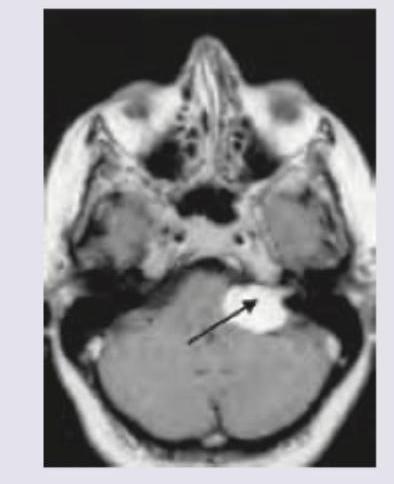
A 55-year-old female presents with tinnitus, dizziness, and a history of progressive deafness. What is the most likely differential diagnosis?
Which anatomical structure is most closely related to the sinus tympani, a difficult site for cholesteatoma removal?
Explanation: **Explanation:** The intensity of sound is measured on a logarithmic scale in **decibels (dB)**. In the field of Audiology and ENT, understanding the standard sound pressure levels (SPL) of environmental sounds is crucial for interpreting audiograms and diagnosing hearing loss. **1. Why 60 dB is correct:** Normal human conversation at a distance of approximately 1 meter typically falls within the range of **60 to 65 dB**. This level is considered the baseline for "comfortable" hearing. In clinical practice, this corresponds to the "Speech Reception Threshold" (SRT) in individuals with normal hearing. **2. Analysis of Incorrect Options:** * **80 dB:** This represents loud noise, such as a shouting voice, a busy street, or a vacuum cleaner. Prolonged exposure to levels above 85 dB is the threshold for potential **Noise-Induced Hearing Loss (NIHL)**. * **90 dB:** This is the level of heavy city traffic or a lawnmower. According to OSHA standards, 90 dB is the maximum permissible exposure limit for an 8-hour workday. * **1200 dB:** This value is physically impossible in Earth's atmosphere. For context, **120-130 dB** is the **Threshold of Pain**, often associated with a jet engine or a gunshot nearby. **Clinical Pearls for NEET-PG:** * **Whisper:** 20–30 dB. * **Threshold of Hearing:** 0 dB (this does not mean absence of sound, but the reference level for human hearing). * **Speech Frequency Range:** Most speech sounds fall between **500 Hz and 2000 Hz** (the "speech banana" on an audiogram). * **NIHL:** Typically presents with a characteristic "notch" at **4000 Hz** (Acoustic Notch) on pure-tone audiometry.
Explanation: **Gradenigo Syndrome** (also known as Gradenigo-Lannois syndrome) is a classic clinical triad resulting from **apical petrositis**—a complication where infection from the middle ear spreads to the petrous apex of the temporal bone. ### Why "Facial Palsy" is the Correct Answer (The False Statement) The classic triad of Gradenigo syndrome consists of: 1. **Otorrhea** (due to persistent Otitis Media) 2. **Retrobulbar pain** (due to involvement of the Trigeminal nerve/Gasserian ganglion) 3. **Abducens (6th) nerve palsy** (leading to diplopia) While the facial nerve (CN VII) passes through the temporal bone, it is **not** part of the classic Gradenigo triad. Facial palsy occurs in other temporal bone complications (like Bell’s palsy or Ramsay Hunt syndrome) but is not a defining feature here. ### Analysis of Other Options * **A. Retrobulbar pain:** This is **True**. Inflammation at the petrous apex irritates the **Trigeminal nerve (CN V)**, specifically the Gasserian ganglion, causing deep-seated pain behind the eye. * **B. Otitis Media:** This is **True**. The syndrome is typically a complication of chronic or acute suppurative otitis media (ASOM/CSOM). * **D. Petrositis:** This is **True**. Gradenigo syndrome is essentially the clinical manifestation of apical petrositis. ### NEET-PG High-Yield Pearls * **Dorello’s Canal:** This is the anatomical site where the **6th Cranial Nerve** is compressed under the petrosphenoid ligament (Gruber’s ligament) due to edema from petrositis. * **Investigation of Choice:** **Contrast-enhanced MRI** is superior for visualizing the petrous apex, though CT shows bone destruction. * **Treatment:** Aggressive intravenous antibiotics and surgical drainage (e.g., cortical mastoidectomy with tracking of air cell tracts to the apex). * **Mnemonic:** Remember **"6-5-Ear"** (6th nerve palsy, 5th nerve pain, Ear discharge).
Explanation: **Explanation:** The correct answer is **B. Stenger’s test**. **Why Stenger’s test is the correct answer:** Stenger’s test is not a tuning fork test; it is a **behavioral test** performed using an **audiometer**. It is based on the **Stenger principle**, which states that if two identical tones are presented to both ears simultaneously, the brain only perceives the sound in the ear where it is louder. This test is the gold standard for detecting **unilateral functional hearing loss (malingering)**. If a patient claims deafness in one ear but fails to hear the loud tone in that ear because they are "faking," they will stop responding altogether, indicating a positive Stenger result. **Why the other options are incorrect:** * **A. Schwabach test:** A tuning fork test that compares the bone conduction of the patient with that of the examiner (assuming the examiner has normal hearing). It is "prolonged" in conductive hearing loss and "shortened" in sensorineural hearing loss. * **C. Rinne test:** The most common tuning fork test used to compare air conduction (AC) and bone conduction (BC) in the same ear. * **D. Weber test:** A tuning fork test used for lateralization. The sound lateralizes to the poorer ear in conductive loss and the better ear in sensorineural loss. **Clinical Pearls for NEET-PG:** * **Tuning Fork Frequency:** The **512 Hz** fork is preferred for routine clinical testing as it provides a good balance between bone conduction vibration and decay time. * **Gelle’s Test:** Another tuning fork test used to check the mobility of the ossicles (specifically the stapes in Otosclerosis). * **ABC (Absolute Bone Conduction) Test:** A modification of the Schwabach test where the external auditory canal is occluded to eliminate ambient noise.
Explanation: **Explanation:** The core concept in this question is differentiating between **Conductive Hearing Loss (CHL)** and **Sensorineural Hearing Loss (SNHL)**. CHL occurs when sound waves are blocked from reaching the inner ear due to pathology in the external or middle ear. SNHL occurs due to damage to the cochlea (hair cells) or the vestibulocochlear nerve (CN VIII). **Why Presbycusis is the Correct Answer:** **Presbycusis** is age-related hearing loss. It is a progressive, bilateral, symmetrical **Sensorineural Hearing Loss** caused by the degeneration of hair cells in the Organ of Corti, stria vascularis, or spiral ganglion cells. Since it involves the inner ear/neural pathway, it does not cause conductive loss. **Analysis of Incorrect Options (Causes of CHL):** * **CSOM (Chronic Suppurative Otitis Media):** Involves a permanent perforation of the tympanic membrane and/or ossicular chain destruction, preventing efficient sound conduction to the oval window. * **ASOM (Acute Suppurative Otitis Media):** The accumulation of inflammatory pus in the middle ear increases the stiffness of the tympanic membrane and ossicles, leading to CHL. * **Middle Ear Effusion (Otitis Media with Effusion):** The presence of sterile fluid in the middle ear (common in children) creates a "glue ear" effect, significantly dampening sound vibration. **NEET-PG High-Yield Pearls:** 1. **Presbycusis** typically starts with high-frequency sounds (difficulty hearing in noisy environments). 2. **Otosclerosis** is a classic cause of CHL where the stapes footplate becomes fixed; look for **Carhart’s Notch** (dip at 2000 Hz in bone conduction) on audiometry. 3. In CHL, **Rinne’s test** is negative (BC > AC) and **Weber’s test** lateralizes to the poorer ear. 4. In SNHL, **Rinne’s test** is positive (AC > BC) and **Weber’s test** lateralizes to the better ear.
Explanation: ### Explanation The external auditory canal (EAC) is an S-shaped passage approximately **24 mm** long in adults. It is divided into two distinct anatomical segments based on the underlying framework: **1. The Correct Answer: Lateral 1/3 (Cartilaginous Part)** The outer or lateral **1/3 (approx. 8 mm)** of the EAC is cartilaginous. This part is a continuation of the auricular cartilage. It is directed upwards, backwards, and medially. * **Key Feature:** The skin here is thick and contains hair follicles, sebaceous glands, and ceruminous glands. This is the only site where **furuncles** (staphylococcal abscesses of hair follicles) occur. **2. Analysis of Incorrect Options:** * **Medial 2/3 (Bony Part):** This constitutes the inner **2/3 (approx. 16 mm)** of the canal. The skin here is very thin, lacks subcutaneous tissue, and is devoid of hair follicles and glands. Therefore, furuncles never occur in the medial 2/3. * **Medial 1/3 and Lateral 2/3:** These options are anatomically incorrect proportions for the division of the EAC. --- ### High-Yield Clinical Pearls for NEET-PG: * **Foramina of Huschke:** Dehiscent areas in the anteroinferior aspect of the **bony** part, seen in children (potential route for infection to the parotid). * **Fissures of Santorinii:** Deficiencies in the **cartilaginous** part that allow infections/parotid tumors to spread between the EAC and the parotid gland or superficial tissues. * **Narrowest Part:** The **isthmus** is the narrowest part of the EAC, located about 6 mm lateral to the tympanic membrane (within the bony part). Foreign bodies lodged medial to the isthmus are difficult to remove. * **Nerve Supply:** Primarily the Auriculotemporal nerve (V3) and Arnold’s nerve (Vagus - X). Stimulation of Arnold's nerve during ear cleaning can trigger a **cough reflex**.
Explanation: To understand this question, one must distinguish between the two primary functions of the inner ear (Labyrinth): **Hearing** (Cochlea) and **Balance** (Vestibular system). ### **Why Caloric Test is the Correct Answer** The **Caloric test** (part of the Fitzgerald-Hallpike maneuver) is a specific test of the **vestibular system**, specifically the **lateral semicircular canal** and the superior vestibular nerve. By irrigating the ear with warm or cold water/air, we induce convection currents in the endolymph to evaluate the Vestibulo-Ocular Reflex (VOR). It has no role in assessing hearing or cochlear function. ### **Analysis of Incorrect Options (Tests for Cochlea)** * **Weber Test:** A tuning fork test (512 Hz) that uses bone conduction to detect lateralization. It helps differentiate between conductive and sensorineural hearing loss (SNHL). In SNHL, the sound lateralizes to the better-functioning cochlea. * **Rinne Test:** Compares Air Conduction (AC) to Bone Conduction (BC). A "True Negative" Rinne (BC > AC) or a "Positive" Rinne (AC > BC) helps clinicians screen for middle ear or cochlear pathology. * **Audiometry (ABC):** Pure Tone Audiometry is the gold standard for quantifying hearing loss. It directly measures the threshold of the cochlea's ability to perceive different frequencies. ### **Clinical Pearls for NEET-PG** * **COWS Mnemonic:** For the Caloric test, **C**old **O**pposite, **W**arm **S**ame (refers to the direction of the fast phase of nystagmus). * **Dead Labyrinth:** A total loss of both cochlear and vestibular function will result in an absent caloric response and profound SNHL. * **High-Yield Fact:** The **Gelle’s test** is used for otosclerosis (stapes fixation), while the **Bing test** evaluates the occlusion effect; both are tuning fork tests related to hearing, not balance.
Explanation: **Explanation:** Acoustic neuroma (Vestibular Schwannoma) is a benign tumor arising from the Schwann cells of the vestibular nerve. As the tumor expands within the cerebellopontine (CP) angle, it sequentially involves adjacent cranial nerves. **Why "Loss of corneal sensation" is correct:** The **Trigeminal nerve (CN V)** is the most common cranial nerve involved after the VIIIth nerve. As the tumor grows superiorly, it compresses the trigeminal nerve, specifically affecting the ophthalmic division (V1). The **loss of corneal reflex** (due to decreased corneal sensation) is the **earliest clinical sign** of trigeminal nerve involvement and, consequently, the earliest ocular finding. It often precedes any subjective facial numbness or motor weakness. **Analysis of Incorrect Options:** * **Diplopia (A):** This occurs due to involvement of the Abducens nerve (CN VI). This is a late feature, occurring only when the tumor is large enough to cause significant brainstem displacement. * **Ptosis (B):** This would indicate Oculomotor nerve (CN III) or sympathetic involvement, which is extremely rare and occurs only in terminal stages of massive tumors. * **Papilloedema (D):** This is a sign of increased intracranial pressure (ICP) due to obstructive hydrocephalus. It is a late manifestation seen in very large tumors that compress the fourth ventricle. **High-Yield Clinical Pearls for NEET-PG:** * **Hitselberger’s Sign:** Hypesthesia of the posterior meatal wall (due to CN VII sensory fiber involvement); often an early sign. * **Order of Nerve Involvement:** CN VIII → CN V (Corneal reflex) → CN VII → CN IX, X, XI → CN VI. * **Gold Standard Investigation:** Gadolinium-enhanced MRI of the Internal Auditory Canal (IAC). * **Bilateral Acoustic Neuromas:** Pathognomonic for Neurofibromatosis Type 2 (NF2).
Explanation: ### Explanation **Bell’s palsy** is defined as an isolated, idiopathic, acute-onset **Lower Motor Neuron (LMN)** paralysis of the **VII cranial nerve (Facial nerve)**. It is the most common cause of unilateral facial paralysis worldwide. #### Why Option D is Correct: In an LMN lesion of the facial nerve, the pathology occurs at or distal to the facial nerve nucleus in the pons. This results in paralysis of **all muscles of facial expression** on the ipsilateral (same) side. This includes the inability to wrinkle the forehead, close the eye (lagophthalmos), and a drooping of the angle of the mouth. #### Why Other Options are Incorrect: * **Options A & C (V Nerve):** The V cranial nerve (Trigeminal nerve) provides sensory innervation to the face and motor innervation to the muscles of mastication. It does not control facial expression; therefore, its paralysis does not cause Bell’s palsy. * **Option B (UMN VII Nerve):** In an Upper Motor Neuron lesion (e.g., Stroke), the **forehead is spared**. This is because the part of the facial nucleus supplying the forehead receives bilateral cortical representation (innervation from both cerebral hemispheres). Since Bell's palsy involves the forehead, it cannot be a UMN lesion. #### High-Yield Clinical Pearls for NEET-PG: * **Etiology:** Likely viral prodrome (Herpes Simplex Virus is the most implicated). * **Clinical Sign:** **Bell’s Phenomenon** – Upward and outward rolling of the eyeball when the patient attempts to close the eyelid. * **Treatment:** Oral **Corticosteroids** (Prednisolone) are the mainstay of treatment and should be started within 72 hours. * **Prognosis:** Approximately 85% of patients show recovery within 3 weeks. * **Schirmer’s Test:** Used to localise the lesion; if reduced lacrimation is present, the lesion is at or proximal to the geniculate ganglion.
Explanation: **Explanation** The clinical triad of **tinnitus, dizziness, and progressive deafness** typically points toward a lesion affecting the vestibulocochlear nerve or the inner ear. While several conditions share these symptoms, **Histiocytosis-X** (specifically Langerhans Cell Histiocytosis) is a recognized cause of progressive sensorineural hearing loss and vestibular dysfunction when it involves the temporal bone. In the context of this specific question (often derived from classic ENT question banks), Histiocytosis-X is highlighted because it can cause extensive destruction of the bony labyrinth and internal auditory canal, mimicking the symptoms of a retrocochlear lesion but often with more rapid progression or associated systemic/radiological findings. **Analysis of Incorrect Options:** * **Acoustic Neuroma (Vestibular Schwannoma):** While this is the most common cause of unilateral progressive deafness and tinnitus, dizziness is often mild or absent due to slow growth allowing for central compensation. It remains a top differential, but in many standardized formats, Histiocytosis is chosen to test the student's knowledge of infiltrative temporal bone pathologies. * **Endolymphatic Hydrops (Meniere’s Disease):** This presents with episodic vertigo rather than continuous dizziness, and the hearing loss is typically fluctuant in the early stages, not purely progressive. * **Meningioma:** These can occur in the cerebellopontine angle and mimic acoustic neuroma, but they are statistically less common causes of this specific triad compared to primary nerve tumors or infiltrative processes. **NEET-PG High-Yield Pearls:** * **Histiocytosis-X (LCH):** Look for the "punched-out" lytic lesions on a skull X-ray. It is a common cause of a "floating tooth" appearance if the mandible is involved. * **Temporal Bone Involvement:** LCH is the most common granulomatous disease to affect the temporal bone in children/young adults, often presenting with refractory otitis externa or chronic ear discharge. * **Diagnostic Triad:** For Meniere’s, remember: Vertigo, Tinnitus, and SNHL (usually low-frequency). For Acoustic Neuroma: Unilateral SNHL + Tinnitus + Absent corneal reflex (early sign).
Explanation: **Explanation:** The **sinus tympani** is a deep recess located in the posterior wall of the middle ear (mesotympanum). It is clinically significant because it is a "hidden area" where cholesteatoma often hides, making complete surgical clearance difficult. **Why Option B is correct:** The sinus tympani is anatomically bounded: * **Medially:** The promontory and the bony labyrinth (vestibule). * **Laterally:** The **mastoid (vertical) segment of the facial nerve**. * **Superiorly:** The ponticulus (a ridge of bone). * **Inferiorly:** The subiculum. Because the mastoid segment of the facial nerve forms the lateral boundary, surgeons must be extremely cautious when instrumenting this area to avoid nerve injury. **Analysis of Incorrect Options:** * **A. Tympanic segment of the facial nerve:** This segment runs horizontally above the oval window, superior to the sinus tympani. * **C. Epitympanum:** This is the upper part of the middle ear (attic) containing the head of the malleus and body of the incus. The sinus tympani is located in the mesotympanum. * **D. Hypotympanum:** This is the floor of the middle ear, located inferior to the sinus tympani. **High-Yield NEET-PG Pearls:** 1. **Boundaries:** Remember the "3 P's" and "1 S" for the sinus tympani: **P**romontory (medial), **P**onticulus (superior), **P**yramid (posterior), and **S**ubiculum (inferior). 2. **Surgical Access:** The sinus tympani cannot be visualized directly via a standard mastoidectomy; it requires an endoscope or a "retrofacial" approach. 3. **Facial Recess vs. Sinus Tympani:** The facial recess is lateral to the facial nerve, while the sinus tympani is **medial** to the facial nerve.
Vestibular System Anatomy and Physiology
Practice Questions
Vestibular Testing
Practice Questions
Benign Paroxysmal Positional Vertigo
Practice Questions
Ménière's Disease
Practice Questions
Vestibular Neuritis
Practice Questions
Labyrinthitis
Practice Questions
Acoustic Neuroma
Practice Questions
Other Cerebellopontine Angle Tumors
Practice Questions
Facial Nerve Disorders
Practice Questions
Skull Base Surgery
Practice Questions
Cochlear Implantation
Practice Questions
Vestibular Schwannoma Management
Practice Questions
Get full access to all questions, explanations, and performance tracking.
Start For Free