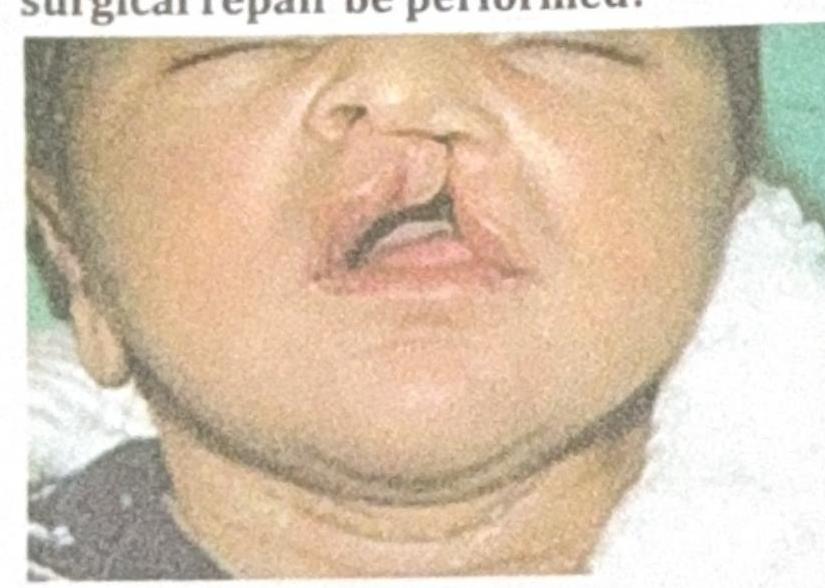
Which index is used to score the outcome of treatment in patients with cleft lip and palate?
A patient complains of loss of visual acuity, deafness, and enlargement of the maxilla.
Millard repair is used for treatment of:
Hynes pharyngoplasty is used to improve a child's?
What is the primary challenge in constructing a complete denture for a patient with Bell's palsy?
A midline cleft lip results from failure of fusion between which structures?
Repair of cleft lip should be undertaken at:
A neonate with micrognathia has episodes of cyanosis. Best initial management is:
Statement 1 - A 59-year-old patient presents with flaccid bullae. Histopathology shows a suprabasal acantholytic split. Statement 2 - The row of tombstones appearance is diagnostic of Pemphigus vulgaris.
Unilateral cleft lip is repaired at what age?
Explanation: ***Goslon Yardstick*** - The **Goslon Yardstick** is a widely accepted and validated index specifically designed to assess the **outcome of surgical treatment** in patients with **cleft lip and palate**. - It provides a **five-point scale** for evaluating dental arch relationships and occlusion based on study models, reflecting the severity of the **dental malocclusion** and the success of surgical intervention. *Index of Orthodontic Treatment Complexity (IOTC)* - The IOTC is used to estimate the **inherent difficulty** of orthodontic cases and the likely complexity of treatment, not as an outcome measure for cleft lip and palate. - It considers factors like **malocclusion severity**, presence of multiple anomalies, and anchorage requirements. *Index of Complexity, Outcome and Need (ICON)* - The ICON is a broad-ranging index used to assess the **need for orthodontic treatment** and to measure the complexity and outcome of general orthodontic cases. - While it can be applied to many orthodontic patients, it is **not specific** for the unique treatment outcomes of cleft lip and palate. *Summer's Index* - This likely refers to the **Handicapping Malocclusion Assessment Record (HMAR)**, sometimes associated with Summer, which quantifies the severity of **malocclusion** for public health screening and determining eligibility for publicly funded orthodontic treatment. - It is a general measure of malocclusion severity and **not specific** for the surgical outcomes in cleft lip and palate patients.
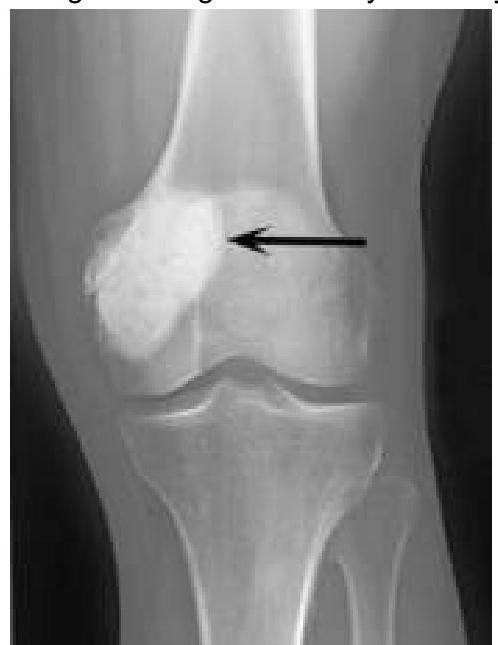
Explanation: ***Paget's disease*** [1] - Characterized by abnormal **bone remodeling**, leading to an increase in bone size and deformity, particularly in the **maxilla**, causing enlargement [1]. - Associated with complications such as **loss of visual acuity** (due to involvement of the skull) and **deafness** from auditory canal changes [1][2], making this the most fitting diagnosis. *Fibrous dysplasia* - Typically presents with **fibrous replacement** of bone, not specifically causing deafness or visual acuity loss. - Customarily involves the **classic "ground glass" appearance** on imaging, not the structural enlargement seen in Paget's disease. *Osteogenesis imperfecta* - Mainly causes **brittle bones** and frequent fractures, not associated with **maxillary enlargement** or changes in auditory function. - Rarely causes visual acuity loss, which is not a feature of this condition. *Osteomalacia* - Primarily characterized by **softening of bones** due to vitamin D deficiency, leading to weakness rather than structural changes like maxillary enlargement. - Symptoms like **bone pain** or **muscle weakness** occur, but not specifically loss of auditory function or visual acuity. **References:** [1] Kumar V, Abbas AK, et al.. Robbins and Cotran Pathologic Basis of Disease. 9th ed. Bones, Joints, and Soft Tissue Tumors, pp. 1192-1194. [2] Cross SS. Underwood's Pathology: A Clinical Approach. 6th ed. Common Clinical Problems From Osteoarticular And Connective Tissue Disease, pp. 669-670.
Explanation: ***Cleft lip*** - **Millard repair** is a widely used surgical technique for the correction of a **unilateral cleft lip**. - It involves a **rotation-advancement flap** principle to reconstruct the cupid's bow, philtral columns, and nasal sill. *Cleft palate* - Surgical repair of a cleft palate typically involves procedures like the **von Langenbeck technique** or **two-flap palatoplasty**, aiming to close the palatal defect and restore speech function. - Unlike cleft lip, these techniques focus on repairing the hard and soft palate and do not involve rotation-advancement flaps specific to the lip. *Meningocele* - A meningocele is a type of **spina bifida** where the meninges protrude through a spinal defect. Its repair involves neurosurgical closure of the defect and excision of the sac. - This condition is a **neural tube defect** and is entirely unrelated to facial congenital anomalies or their repair techniques. *Saddle nose* - **Saddle nose deformity** involves a collapsed nasal bridge, often due to trauma or inflammatory conditions, and is corrected through rhinoplasty using **cartilage grafts** or other reconstructive methods. - This is an acquired or congenital nasal deformity, distinct from a cleft lip, and its correction does not involve Millard's technique.
Explanation: ***Speech*** - Hynes pharyngoplasty is a surgical procedure specifically designed to correct **velopharyngeal insufficiency (VPI)**, which is a common cause of **hypernasal speech**. - By reshaping the soft palate and pharynx, it helps create a better seal during speech, thus improving **oral resonance** and reducing air escaping through the nose. *Teething* - **Teething** refers to the process of teeth erupting through the gums, which is a normal developmental stage in infants. - Surgical intervention like Hynes pharyngoplasty is unrelated to the **eruption of teeth**. *Feeding* - While velopharyngeal insufficiency can sometimes contribute to **feeding difficulties** (e.g., nasal regurgitation), Hynes pharyngoplasty's primary goal is not to improve overall feeding mechanics. - Surgical interventions for feeding issues often address different anatomical structures or neurological deficits impacting **swallowing** or suck-swallow-breathe coordination. *Appearance* - Although some craniofacial anomalies that lead to VPI might also affect appearance (e.g., cleft palate), Hynes pharyngoplasty is solely focused on **functional improvement of speech**. - It does not significantly alter the **external facial appearance** of the child.
Explanation: ***Instability of jaw relations due to asymmetric muscle function*** - **Bell's palsy** causes unilateral facial muscle paralysis, disrupting the **balanced muscle support** essential for stable jaw relations in edentulous patients. - This asymmetry leads to difficulty in accurately recording and maintaining the **centric relation** and other occlusal records during denture fabrication. *Impression taking difficulties due to altered muscle tone* - While altered muscle tone can affect impression taking, especially in achieving proper border extensions, it is a secondary challenge compared to the fundamental instability of jaw relations. - **Neuromuscular control** over the oral structures is compromised, but careful impression techniques can often mitigate these issues. *Difficulties in border moulding due to facial asymmetry* - **Facial asymmetry** and muscle paralysis indeed complicate border moulding, making it hard to create a stable peripheral seal for the denture. - However, successful border moulding still relies on reproducible jaw positions, which are inherently unstable due to the primary issue of asymmetric muscle function affecting jaw relations. *Challenges in teeth setting due to muscle asymmetry* - **Teeth setting** is influenced by jaw relations and aesthetics, and while facial asymmetry from Bell's palsy complicates achieving a symmetrical arrangement, the root cause is the unreliable foundation of the jaw relationship itself. - Correct teeth setting depends on accurate occlusal records, which are the primary challenge to obtain due to muscle imbalance.
Explanation: ***Medial nasal processes*** - A **midline cleft lip** results from the incomplete fusion of the two **medial nasal processes**, which normally merge to form the central part of the upper lip and primary palate. - Failure of this fusion leads to a gap along the midline of the upper lip, as the tissues derived from these processes do not unite properly. *Mandibular processes (lower jaw)* - The **mandibular processes** fuse to form the lower jaw and lower lip, and their failure of fusion results in a **cleft chin** or **lower lip cleft**, not a midline upper lip cleft. - Anomalies of the mandibular processes are distinctly different from those affecting the upper lip and palate development. *Medial and lateral nasal processes (related anomalies)* - While the **medial and lateral nasal processes** are involved in facial development, their specific fusion defects primarily lead to broader facial clefts or **naso-lacrimal duct anomalies**, not a solitary midline cleft lip. - The lateral nasal processes form the alae of the nose, and issues between these and the medial nasal processes would affect nasal structure more broadly. *Medial nasal and maxillary processes (upper lip formation)* - Fusion between the **medial nasal processes** and the **maxillary processes** is crucial for the formation of the **philtrum** and the lateral parts of the upper lip [1]. - Failure of this specific fusion typically results in a more common **unilateral or bilateral cleft lip and palate**, which is lateral to the midline, rather than a midline cleft lip [2].
Explanation: ***10 weeks*** - The "rule of 10s" is a widely accepted guideline for cleft lip repair, recommending surgery when the infant is at least **10 weeks old**. - This guideline also states that the infant should weigh at least **10 pounds** and have a **hemoglobin of 10 g/dL** to ensure adequate physiological maturity and reduced surgical risk. *4 weeks* - Repair at 4 weeks is generally considered **too early** as the infant's physiological systems are still immature, increasing surgical risks. - Complications such as anesthetic risks and poor tissue healing are higher in very young infants. *6 weeks* - While closer to the recommended timing, 6 weeks still generally falls short of the **"rule of 10s" guidelines** for optimal surgical safety. - Operating significantly before 10 weeks may not allow sufficient **growth and development** to mitigate surgical risks. *8 weeks* - At 8 weeks, the infant is typically still below the recommended age criterion of **10 weeks** for cleft lip repair according to the "rule of 10s." - Delaying until 10 weeks allows for further **weight gain**, cardiopulmonary maturation, and a more robust immune system, reducing operative risks.
Explanation: ***Prone positioning*** - Placing the neonate in the **prone position** allows the tongue to fall forward by gravity, thereby relieving airway obstruction caused by **micrognathia**. - This is a simple, non-invasive, and often effective initial management strategy for improving breathing during feeding in infants with **Pierre Robin sequence**. *Tracheostomy* - **Tracheostomy** is an invasive surgical procedure reserved for severe, persistent airway obstruction unresponsive to less invasive measures. - It carries significant risks and complications and is not the initial best management given the efficacy of prone positioning for many cases of **micrognathia**. *Tongue-lip adhesion* - **Tongue-lip adhesion** is a surgical procedure where the tongue is sutured to the lower lip to pull it forward, preventing obstruction. - While it can be effective for severe cases, it is a surgical intervention and generally considered after less invasive measures like prone positioning have failed or if obstruction is severe. *CPAP* - **Continuous Positive Airway Pressure (CPAP)** can help maintain an open airway by delivering positive pressure, but it can be challenging to administer effectively in neonates with **micrognathia** during feeding. - It might be used for respiratory support during sleep or sustained obstruction, but **prone positioning** is usually the first line for feeding-related cyanosis due to mild-to-moderate airway obstruction.
Explanation: ***Correct: Statements 1 & 2 are correct, 2 is not explaining 1*** **Analysis of Statement 1:** - A 59-year-old patient with **flaccid bullae** and **suprabasal acantholytic split** on histopathology is the classic presentation of **Pemphigus vulgaris** - The flaccid (easily ruptured) nature of bullae distinguishes it from tense bullae seen in bullous pemphigoid - The suprabasal location of the split (just above the basal layer) with acantholysis (loss of cell-to-cell adhesion) is pathognomonic - **Statement 1 is CORRECT** ✓ **Analysis of Statement 2:** - The **"row of tombstones" or "tombstone appearance"** is indeed a diagnostic histopathological feature of Pemphigus vulgaris - This appearance results from basal keratinocytes remaining attached to the basement membrane while suprabasal cells separate due to acantholysis - The intact basal cells standing upright resemble a row of tombstones - **Statement 2 is CORRECT** ✓ **Does Statement 2 explain Statement 1?** - Statement 2 describes a **histopathological appearance** (tombstone pattern) that is a **consequence** of the suprabasal split - However, it does NOT explain the **underlying cause** of the flaccid bullae or the suprabasal split - The true explanation involves **IgG autoantibodies against desmoglein 3 (and desmoglein 1)**, which attack intercellular adhesion structures (desmosomes), causing **acantholysis** - Therefore, **Statement 2 does NOT explain Statement 1** ✗ *Incorrect: Statement 2 is the correct explanation for Statement 1* - While both statements describe features of Pemphigus vulgaris, the tombstone appearance is a descriptive finding, not an explanatory mechanism *Incorrect: Statements 1 and 2 are incorrect* - Both statements are medically accurate descriptions of Pemphigus vulgaris features *Incorrect: Statement 1 is incorrect* - Statement 1 correctly describes the cardinal clinical and histopathological features of Pemphigus vulgaris
Explanation: ***3-6 months*** - Unilateral cleft lip repair is typically performed between **3 and 6 months of age**, following the rule of **10s** (10 pounds weight, 10 weeks old, 10 g/dL hemoglobin). - This timing allows for adequate **growth of facial structures** while still completing the repair before the child develops significant speech patterns. *1-3 months* - While some surgeons might consider earlier repair, this window is generally considered a bit **too early** given the child's small size and potential for respiratory compromise during anesthesia. - The **rule of 10s** is often not fully met by 1-3 months, which can increase surgical risks. *6-9 months* - This period is generally considered **too late** for initial cleft lip repair, as waiting longer can lead to more pronounced **psychosocial impact** and may interfere with early speech development. - Early muscle activity in an uncorrected cleft can also lead to more significant **nasal deformity**. *9-12 months* - Performing cleft lip repair this late is **not recommended** as it can negatively impact feeding, speech, and potential **social interaction** and bonding. - The optimal window for **cleft palate repair** is typically between 9 and 12 months, not cleft lip.
Get full access to all questions, explanations, and performance tracking.
Start For Free