A 50-year-old male with a long smoking history presents with a 2-month history of hoarseness, ear pain, and hemoptysis. Laryngoscopy reveals a mass on the vocal cords, and a chest X-ray shows a suspicious nodule. What is the most likely diagnosis?
Treatment of choice for carcinoma larynx T1N0M0 stage -
Trotter's syndrome involves:
All the following statements about laryngeal carcinoma are true except:
Stage IVa with thyroid cartilage invasion in laryngeal carcinoma is treated with:
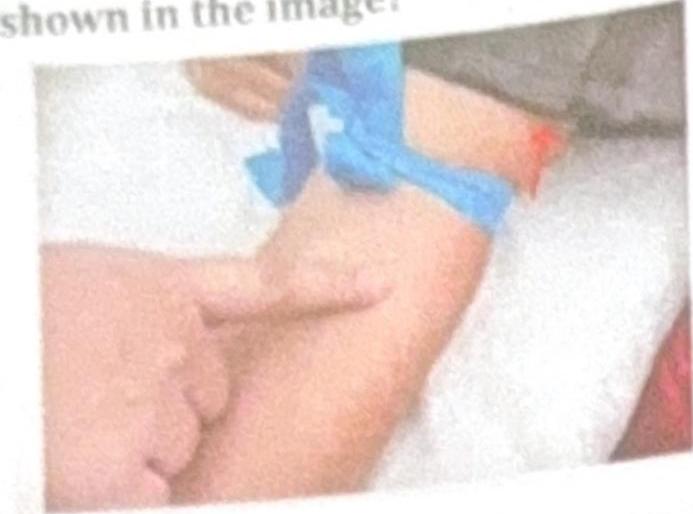
What is the name of the nerve block technique shown in the image?
A 45-year-old patient presents with persistent hoarseness for 3 months. Which finding on indirect laryngoscopy is most concerning for malignancy?
Chimney Sweeper cancer is the other name for
Lymph node metastasis in neck is almost never seen with:
High tracheostomy is done in which one of the following conditions?
Explanation: ***Laryngeal carcinoma*** - The combination of **hoarseness, ear pain, and hemoptysis** in a patient with a **long smoking history** is highly suggestive of **laryngeal carcinoma**. - **Hoarseness** is the cardinal symptom of glottic laryngeal cancer, while **ear pain** (referred otalgia via Arnold's nerve) suggests advanced disease. - **Laryngoscopy identifying a vocal cord mass** provides direct visualization of the tumor. - The **suspicious nodule on chest X-ray** may represent a **synchronous primary lung cancer** (both share smoking as a major risk factor), **distant metastasis**, or requires further evaluation. Smokers are at high risk for multiple aerodigestive tract malignancies. *Tuberculosis* - While **hemoptysis** and a **suspicious nodule on chest X-ray** can be seen in tuberculosis, **hoarseness** and **ear pain** are not typical primary symptoms. - Laryngeal tuberculosis is rare and usually secondary to pulmonary TB with **constitutional symptoms** like fever, night sweats, and weight loss, which are not mentioned. - A **vocal cord mass** would be unusual for TB without systemic features. *Pneumonia* - **Pneumonia** typically presents with acute symptoms such as **cough, fever, dyspnea, and chills**. - **Hoarseness** and **ear pain** are not characteristic features of uncomplicated pneumonia. - A **mass on the vocal cords** is not associated with pneumonia, and the **2-month duration** is too prolonged for typical bacterial pneumonia. *Chronic bronchitis* - **Chronic bronchitis** is defined by a **chronic productive cough** for at least three months a year for two consecutive years. - While common in smokers, it typically does not cause **ear pain, hemoptysis**, or a **vocal cord mass**. - Chronic bronchitis does not produce discrete masses on laryngoscopy, differentiating it from a malignant process.
Explanation: ***External beam radiotherapy*** - For **early-stage laryngeal cancer (T1N0M0)**, both **radiotherapy and surgery are considered equally effective first-line treatments** with excellent local control rates (>90%). - EBRT offers the advantage of being **completely non-invasive** while preserving vocal function and avoiding surgical risks. - Treatment duration is typically **6-7 weeks**, requiring patient compliance with daily fractions. - Preferred when patient prefers non-invasive approach or has comorbidities making surgery high-risk. *Surgery* - **Transoral laser microsurgery (TLS)** or endoscopic **cordectomy** are equally effective surgical options for T1 glottic cancer with cure rates comparable to radiotherapy. - Modern laser techniques provide excellent **voice preservation** with minimal morbidity. - Advantages include **shorter treatment time** (single procedure), obtaining tissue for histopathology, and preserving radiotherapy as salvage option. - Both **surgery and radiotherapy are Category 1 recommendations** for T1N0M0 disease; choice depends on institutional expertise, patient preference, and individual factors. *Radioactive implants* - **Brachytherapy (radioactive implants)** can be used for early-stage glottic cancer at specialized centers. - However, **external beam radiotherapy** is more commonly employed due to greater accessibility and extensive outcome data. *Surgery & radiotherapy* - **Combined modality treatment** is indicated for **locally advanced disease** (T3-T4) or **node-positive disease** (N+). - For **T1N0M0 disease**, single modality (either surgery OR radiotherapy) is sufficient and preferred to minimize treatment-related morbidity.
Explanation: ***Nasopharynx*** - **Trotter's syndrome** is a classic triad of symptoms (unilateral conductive hearing loss, trigeminal neuralgia, and soft palate paralysis) associated with malignant tumors of the **nasopharynx** [1]. - The syndrome arises from the tumor's invasion of critical structures surrounding the **nasopharynx**, including the Eustachian tube, trigeminal nerve, and cranial nerves IX, X, XI [1]. *Oropharynx* - Malignancies of the **oropharynx** typically present with symptoms such as dysphagia, odynophagia, globus sensation, and referred otalgia to the ear, rather than the specific triad of Trotter's syndrome. - While oropharyngeal tumors can metastasize, they do not directly cause the unique combination of symptoms seen in Trotter's syndrome due to their anatomical location. *Pharynx* - The **pharynx** is a broader anatomical region encompassing the nasopharynx, oropharynx, and hypopharynx. While Trotter's syndrome involves a part of the pharynx (the nasopharynx), simply stating "Pharynx" is too general and lacks the specificity required for this syndrome. - The specific symptoms of Trotter's syndrome are linked to tumor involvement in a very particular area of the pharynx, not the entire structure. *Larynx* - Tumors of the **larynx** primarily cause symptoms related to voice changes (hoarseness), stridor, and difficulty breathing or swallowing. - The anatomical position of the larynx is distinct from the nasopharynx, and therefore, laryngeal pathologies do not lead to the specific neurological and auditory symptoms characterizing Trotter's syndrome.
Explanation: ***Laryngeal carcinoma has a poor prognosis.*** - While prognosis depends on stage and treatment, laryngeal carcinoma, especially when detected early, often has a **relatively good prognosis** compared to other head and neck cancers, with overall survival rates exceeding 50-60%. - Many patients, particularly those with early-stage disease, can be cured with **surgery or radiation therapy** while preserving laryngeal function. *Laryngeal carcinoma is more common in males.* - **Laryngeal carcinoma** demonstrates a significant **male predominance**, with incidence rates typically 4 to 5 times higher in men than in women. - This disparity is largely attributable to historically higher rates of **smoking and alcohol consumption** among men. *Laryngeal carcinoma is associated with smoking.* - **Smoking** is the most significant and well-established **risk factor** for laryngeal carcinoma, with the risk directly correlated to the intensity and duration of tobacco use. - Exposure to **carcinogens in tobacco smoke** directly damages laryngeal epithelial cells, leading to dysplasia and eventual malignant transformation. *Laryngeal carcinoma is more common in individuals over 40 years of age.* - The incidence of **laryngeal carcinoma** significantly increases with age, with the majority of cases diagnosed in individuals **over the age of 50 or 60 years**. - This age distribution reflects the cumulative exposure to **environmental carcinogens** like tobacco and alcohol over a longer lifespan.
Explanation: ***Total laryngectomy with radiotherapy*** - **Stage IVa laryngeal carcinoma** with **thyroid cartilage invasion** is considered advanced disease requiring aggressive treatment. - **Multimodal therapy** combining surgical resection (total laryngectomy) to remove the tumor and adjuvant radiotherapy to address microscopic disease and reduce recurrence is the standard of care. *Total laryngectomy* - While a **total laryngectomy** is necessary to remove the primary tumor with cartilage invasion, it often requires additional (adjuvant) therapy like radiation to improve local control and survival rates. - Relying solely on surgery for **Stage IVa disease** may not adequately address potential microscopic spread, leading to higher recurrence rates. *Radiotherapy* - **Radiotherapy alone** is typically reserved for early-stage laryngeal cancers or as a palliative measure for advanced, unresectable disease. - In Stage IVa with **thyroid cartilage invasion**, radiation alone is insufficient due to the bulk of the disease and high risk of local recurrence. *Hemilaryngectomy* - A **hemilaryngectomy** is a partial removal of the larynx, suitable for much smaller, early-stage tumors that are confined to one side of the larynx, without cartilage invasion. - It is inadequate for **Stage IVa disease** with cartilage invasion due to the extensive nature of the tumor.
Explanation: ***Intra-arterial anesthesia*** - The image shows a **cannula inserted directly into an artery**, indicated by the blood reflux and the context of anesthesia, suggesting direct drug delivery into the arterial system. - This method is used for specific types of regional pain management or diagnostic procedures where direct arterial access is required for **localized drug distribution**. *Bier's block* - A Bier's block, or **intravenous regional anesthesia**, involves injecting local anesthetic into a **vein** in an extremity after it has been exsanguinated and isolated by a tourniquet. - The image clearly shows a **bright red blood flash**, characteristic of arterial cannulation, not venous. *Regional anesthesia* - This is a broad term referring to the **anesthesia of a specific region** of the body and encompasses various techniques. - While intra-arterial anesthesia is a type of regional anesthesia, "regional anesthesia" itself is too general to specifically describe the technique shown. *Axillary block* - An **axillary block** is a type of peripheral nerve block targeting the brachial plexus in the axilla to anesthetize the arm. - The image does not depict the axillary region or the characteristic needle placement for an axillary block; instead, it shows direct vascular access.
Explanation: ***Unilateral cord paralysis*** - **Unilateral cord paralysis** can be an indicator of an underlying malignancy impinging on the **recurrent laryngeal nerve**, which innervates the vocal cords. - The **persistent hoarseness** for 3 months, combined with paralysis, raises significant concern for a malignant process in the head, neck, or chest. *Reinke's edema* - **Reinke's edema** is typically associated with **chronic irritation** like smoking and presents as a swollen, gelatinous fluid collection in the superficial lamina propria. - While it causes hoarseness, it is a **benign condition** and not directly indicative of malignancy. *Bilateral polyps* - **Vocal cord polyps** are typically **benign lesions** often caused by vocal trauma or abuse, and while they can cause hoarseness, they are not usually a direct sign of malignancy, especially when bilateral. - While requiring management, polyps themselves do **not raise immediate concern for cancer** compared to paralysis. *Vocal cord nodules* - **Vocal cord nodules** (singer's nodules) are benign, bilateral lesions caused by **vocal abuse** and are a common cause of hoarseness. - They are a benign condition and do not suggest an underlying malignancy at their core.
Explanation: ***Carcinoma scrotum*** - **Chimney sweepers' cancer** is a historical term for **squamous cell carcinoma of the scrotum**, first described by Percivall Pott in 1775. - It was linked to prolonged exposure to **soot**, a known carcinogen, in young chimney sweeps. *Carcinoma testis* - This is a cancer of the **testicles**, not typically associated with occupational exposure to soot or referred to as "chimney sweeper cancer." - It commonly presents as a **painless lump** in the testis. *Carcinoma lung* - While lung cancer can be linked to occupational exposures (e.g., asbestos, smoking), it is not called "chimney sweeper cancer." - It primarily affects the **respiratory system**. *Carcinoma skin* - Skin cancer can be caused by various factors, including **UV radiation**, but the term "chimney sweeper cancer" specifically refers to scrotal carcinoma due to soot exposure. - It can occur on any skin surface, unlike the specific scrotal location.
Explanation: ***Carcinoma vocal cords*** - The **vocal cords** are relatively poor in lymphatic drainage, which significantly reduces the likelihood of regional lymph node metastasis. - Due to this sparse lymphatic network, spread to cervical lymph nodes is rare, especially in early-stage disease. *Supraglottic carcinoma* - **Supraglottic** regions have a rich lymphatic network, leading to a high incidence of cervical lymph node metastasis, even in early stages. - Bilateral lymphatic drainage further increases the risk of nodal involvement. *Carcinoma of tonsil* - The **tonsils** are richly supplied with lymphatic vessels, making them prone to early and frequent metastasis to cervical lymph nodes. - Metastasis is often seen in levels II, III, and IV of the neck. *Papillary carcinoma thyroid* - **Papillary thyroid carcinoma** commonly metastasizes to regional lymph nodes, with documented rates as high as 30-80%. - Nodal metastasis can occur in the central compartment (level VI) and lateral neck (levels II-V).
Explanation: ***Tracheal stenosis*** - A **high tracheostomy** is performed when there is **lower tracheal stenosis** or obstruction, requiring placement of the tracheostomy stoma **above the stenotic segment**. - This approach ensures that the **tracheostomy tube** bypasses the narrowed portion of the trachea and provides a patent airway. - The level of tracheostomy is chosen based on the location of the pathology - high tracheostomy for lower pathology, and vice versa. *Laryngeal cancer* - In **laryngeal cancer**, a **low tracheostomy** is typically preferred, not a high one. - A high tracheostomy in laryngeal malignancy is generally **contraindicated** due to the risk of tumor seeding and interference with surgical planning. - The tracheostomy should be placed **away from the tumor site** and below the pathology, especially if laryngectomy is planned. *Severe asthma exacerbation* - **Severe asthma exacerbation** rarely requires a tracheostomy; endotracheal intubation and mechanical ventilation are the standard initial management. - If prolonged ventilatory support is needed, a **standard tracheostomy** (not high) would be performed. - There is no specific indication for high tracheostomy placement in asthma. *Vocal cord dysfunction* - **Vocal cord dysfunction (VCD)** involves paradoxical vocal cord movement and is typically managed with **conservative measures** including speech therapy and breathing exercises. - VCD does not cause structural obstruction requiring surgical airway intervention. - Tracheostomy, especially high tracheostomy, has no role in the management of VCD.
Get full access to all questions, explanations, and performance tracking.
Start For Free