A patient presented with 2 days history of fever. On examination there was a swelling in the neck and one side tonsil was pushed to midline. What is the most likely diagnosis:-
Acute tonsillitis affects which nerve:
A 21-year-old college student presents with hot potato voice and trismus. Clinical diagnosis is?
What is the most common cause of acute tonsillitis?
A 12-year-old boy develops a sore throat of 4-day duration. On examination, a yellow-grayish patch is seen over both tonsils, and a foul smell is coming from his mouth. Which non-suppurative complication is most commonly associated with streptococcal throat infections?
A patient presents with fever and dysphagia. An image shows a tonsil that is pushed medially. What is the most likely diagnosis?
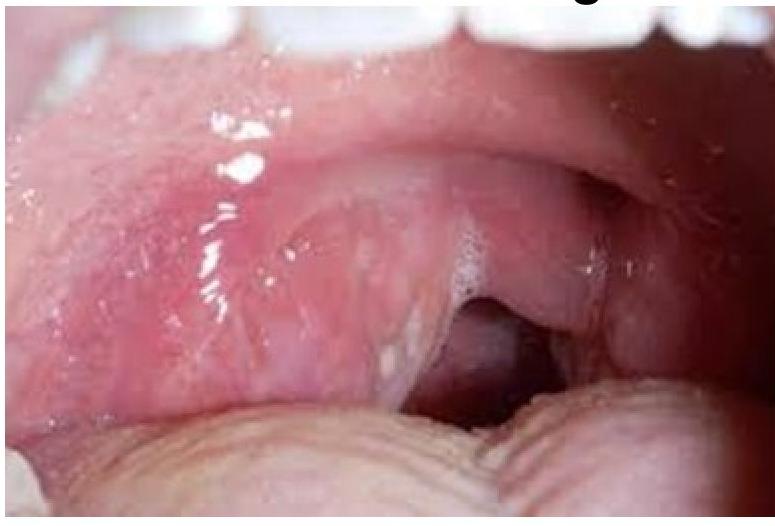
A 3-year-old boy presents with fever, throat pain, and difficulty swallowing. On examination, there is unilateral tonsillar swelling with deviation of the uvula. What is the most likely diagnosis?
A 15 years old Male presented with history of fever since 2 days, unable to swallow the food with muffled voice. On examination it is noted right tonsil is shifted to midline. What is the diagnosis:
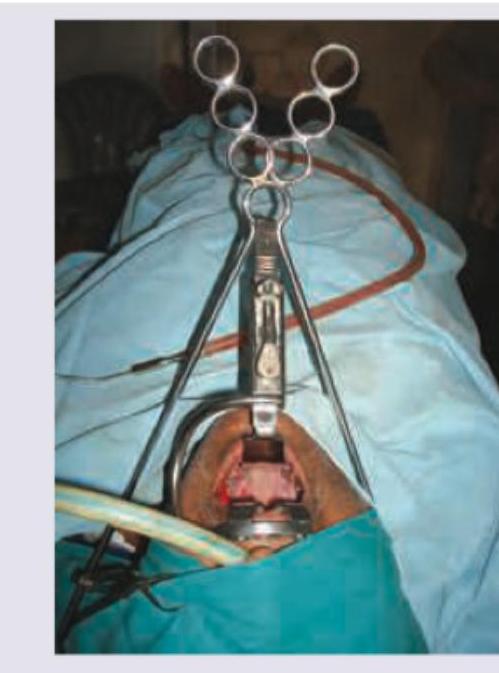
Which is incorrect about the instrument shown?
All of the following are true regarding Zenker's diverticulum EXCEPT?
Explanation: ***Quinsy (Peritonsillar abscess)*** - **Quinsy** is a **peritonsillar abscess** that presents with fever, severe throat pain, and the pathognomonic sign of **unilateral tonsil pushed toward the midline**. - The abscess forms in the **peritonsillar space** (between the tonsillar capsule and superior constrictor muscle), causing **medial displacement of the tonsil** and **bulging of the soft palate**. - Patients typically have **trismus, dysphagia, "hot potato voice"** and may have visible neck swelling. - This clinical presentation exactly matches the description: tonsil pushed to midline is the **classic finding for peritonsillar abscess**. *Parapharyngeal abscess* - A **parapharyngeal abscess** involves the deep parapharyngeal space lateral to the pharynx. - While it can cause neck swelling and fever, it typically causes **fullness and induration of the lateral pharyngeal wall** rather than prominent medial displacement of the tonsil itself. - The **tonsil is usually NOT pushed to the midline** in parapharyngeal abscess; instead, there is lateral pharyngeal wall bulging. - Often presents with more prominent external neck swelling below the angle of mandible. *Retropharyngeal abscess* - A **retropharyngeal abscess** occurs in the retropharyngeal space behind the posterior pharyngeal wall. - Presents with **posterior pharyngeal wall bulge**, neck stiffness, and dysphagia. - Does **NOT cause medial displacement of the tonsil** as the abscess is posterior, not lateral to the tonsil. *Tonsillitis* - **Acute tonsillitis** causes bilateral tonsillar inflammation with erythema and exudates. - While both tonsils may be enlarged, there is **no unilateral medial displacement** of one tonsil. - Less likely to cause significant neck swelling compared to deep space infections.
Explanation: ***Correct: Glossopharyngeal Nerve*** - The **glossopharyngeal nerve (CN IX)** provides the **primary sensory innervation** to the palatine tonsils - This innervation is responsible for the sensation of **sore throat** and **referred otalgia** (ear pain) commonly experienced during acute tonsillitis - The tonsillar branch of CN IX specifically innervates the tonsillar region *Incorrect: Facial Nerve* - The **facial nerve (CN VII)** is primarily responsible for **facial expression**, taste sensation from the anterior two-thirds of the tongue, and innervation of tear and salivary glands - It has no direct sensory or motor innervation of the tonsils *Incorrect: Trigeminal Nerve* - The **trigeminal nerve (CN V)** provides sensory innervation to the **face**, sinuses, and teeth, and motor innervation to the muscles of mastication - It does not directly innervate the tonsils *Incorrect: Vagus Nerve* - The **vagus nerve (CN X)** innervates structures in the pharynx, larynx, and abdominal organs through the pharyngeal plexus - While it contributes to pharyngeal sensation, the **glossopharyngeal nerve** is the primary sensory innervation for the tonsils themselves in acute tonsillitis
Explanation: ***Quinsy*** - **Quinsy**, or **peritonsillar abscess**, is characterized by a "hot potato" or muffled voice and **trismus** (difficulty opening the mouth) due to inflammation and muscle spasm. - The abscess typically forms adjacent to the palatine tonsil, causing severe unilateral throat pain and difficulty swallowing. *Chronic Tonsillitis* - **Chronic tonsillitis** is characterized by recurrent episodes of throat pain, fever, and enlarged tonsils, but does not typically present with acute **trismus** or a "hot potato" voice. - It results from persistent or repeated bacterial infections of the tonsils, often without significant abscess formation. *Epiglottitis* - **Epiglottitis** presents with rapid onset of severe sore throat, **dysphagia**, drooling, and inspiratory stridor, and can be life-threatening due to airway obstruction. - While it causes significant throat pain and difficulty swallowing, it does not typically present with a "hot potato" voice or **trismus**, but rather a muffled voice and tripod positioning. *Infectious mononucleosis* - **Infectious mononucleosis** leads to swollen tonsils with exudates, fatigue, and lymphadenopathy, but usually does not cause **trismus** or the distinctive "hot potato" voice. - It is caused by the **Epstein-Barr virus** and can lead to significant pharyngitis, but is not associated with peritonsillar abscess formation.
Explanation: ***Group A beta-hemolytic streptococci*** - **Group A Streptococcus (GAS)**, specifically *Streptococcus pyogenes*, is the most frequent bacterial cause of **acute tonsillitis** and pharyngitis, especially in school-aged children. - Infection can lead to complications such as **rheumatic fever** and **post-streptococcal glomerulonephritis** if not appropriately treated. *Streptococcus pneumoniae* - While *S. pneumoniae* is a common cause of **otitis media**, **sinusitis**, and **pneumonia**, it is less commonly the primary cause of acute tonsillitis. - It typically causes respiratory infections involving the lower airways or adjacent structures rather than primarily tonsillar inflammation. *H. Influenza* - *Haemophilus influenzae* is a significant pathogen for **otitis media**, **epiglottitis**, and **meningitis**, particularly in unvaccinated children. - It is not a common primary cause of acute tonsillitis, which is predominantly bacterial or viral. *Staphylococcus aureus* - *Staphylococcus aureus* is often associated with **skin and soft tissue infections**, as well as more serious conditions like **sepsis** and **endocarditis**. - Although it can cause pharyngeal infections, it is an infrequent cause of acute tonsillitis compared to Group A Streptococcus.
Explanation: ***Acute rheumatic fever*** - **Acute rheumatic fever (ARF)** is a serious **non-suppurative complication** of streptococcal pharyngitis, primarily caused by **Group A Streptococcus (GAS)** [1]. - It involves **inflammatory lesions** of the heart, joints, brain, and subcutaneous tissues [2]. *Acute glomerulonephritis* - This is also a **non-suppurative complication** of streptococcal infection but is typically less common than acute rheumatic fever following pharyngitis. - **Acute post-streptococcal glomerulonephritis** is more frequently associated with **streptococcal skin infections (impetigo)** than pharyngeal infections. *Scarlet fever* - **Scarlet fever** is a **toxin-mediated disease** that is a direct manifestation of a streptococcal infection, not a non-suppurative complication. - It presents with a characteristic **rash**, **strawberry tongue**, and fever, making it a different category of streptococcal sequela. *Both acute rheumatic fever and acute glomerulonephritis* - While both can be non-suppurative complications, **acute rheumatic fever** is the **most commonly associated** non-suppurative complication specifically with **streptococcal throat infections** [1]. - **Acute glomerulonephritis** has a stronger association with **skin infections** and is less common after pharyngitis compared to acute rheumatic fever.
Explanation: ***Peritonsillar abscess*** - The image clearly shows **unilateral bulging** of the soft palate and displacement of the tonsil medially, consistent with a peritonsillar abscess. - Patients typically present with **fever**, **dysphagia**, severe sore throat, and a "hot potato" voice. *Parapharyngeal abscess* - A parapharyngeal abscess involves the **deep neck spaces** lateral to the pharynx, often presenting with neck swelling, trismus, and systemic symptoms. - While it can cause pharyngeal bulging, the classic **medial displacement of the tonsil** is more indicative of a peritonsillar abscess. *Retropharyngeal abscess* - This involves the space behind the posterior pharyngeal wall, usually presenting with **dysphagia**, **neck stiffness**, and fever. - Imaging would reveal a **prevertebral soft tissue swelling**, not primarily a medially displaced tonsil. *Ludwig's angina* - Ludwig's angina is a **rapidly spreading cellulitis** of the submandibular and sublingual spaces, typically arising from an odontogenic infection. - It presents with **woody induration** of the neck and floor of the mouth, elevation of the tongue, and potential airway compromise, but not primarily a medially displaced tonsil.
Explanation: ***Peritonsillar abscess*** - This is the most common deep neck infection and typically presents with **unilateral tonsillar swelling**, **uvular deviation**, fever, and severe sore throat with difficulty swallowing (dysphagia) or speaking (muffled voice). - It usually develops as a complication of **acute tonsillitis**, where infection spreads from the tonsil into the peritonsillar space. *Parapharyngeal abscess* - While it can cause fever and severe throat pain, it typically presents with **trismus**, neck swelling below the angle of the mandible, and medial displacement of the lateral pharyngeal wall, rather than direct uvula deviation. - This type of abscess is located in the **parapharyngeal space**, which is lateral to the pharynx, and causes more diffuse swelling. *Ludwig's angina* - This is a rapidly spreading cellulitis of the **submandibular** and **sublingual spaces** and does not primarily involve the tonsils or cause uvular deviation. - Patients typically present with **symmetrical submental swelling**, painful swallowing, and tongue elevation, which can lead to airway obstruction. *Retropharyngeal abscess* - This abscess forms in the space behind the posterior pharyngeal wall and is more common in young children. - It often causes **neck stiffness**, muffled voice, stridor, and difficulty breathing, but less commonly presents with unilateral tonsillar swelling and uvular deviation.
Explanation: ***Quincy (Peritonsillar abscess)*** - This patient's presentation with **fever**, **dysphagia**, **muffled voice** (hot potato voice), and **tonsil shifted to the midline** is classic for a **peritonsillar abscess (Quincy)**. - The affected tonsil is pushed **medially toward the midline** by the collection of pus between the tonsillar capsule and the superior constrictor muscle. - The uvula is typically deviated to the **contralateral side**, and patients often have **trismus** and difficulty opening the mouth. - This is the **most common deep neck space infection** and typically follows acute tonsillitis. *Parapharyngeal abscess* - A **parapharyngeal abscess** would present with **severe trismus**, **neck swelling**, **torticollis**, and **bulging of the lateral pharyngeal wall**. - While it can push the tonsil medially, it more characteristically causes **anterolateral displacement** of the entire pharyngeal wall rather than isolated tonsillar displacement. - Patients typically have more pronounced **systemic toxicity** and **neck involvement** than seen with peritonsillar abscess. *Acute tonsillitis* - **Acute tonsillitis** presents with **bilateral tonsillar enlargement**, exudates, and pharyngeal erythema. - It does not cause **displacement of the tonsil to the midline** or significant **muffled voice**. - While fever and dysphagia are present, the physical examination finding of tonsillar shift indicates a suppurative complication (abscess formation). *Acute retropharyngeal abscess* - An **acute retropharyngeal abscess** occurs in the retropharyngeal space behind the posterior pharyngeal wall. - It presents with **neck stiffness**, **stridor**, **drooling**, **bulging of the posterior pharyngeal wall**, and **reluctance to extend the neck**. - It would **not cause visible displacement of the tonsil to the midline** as the abscess is in a different anatomical space. - More common in **young children** (under 5 years) than adolescents.
Explanation: ***Uses a draffin bipod stand*** - The image shows a **Boyle-Davis mouth gag** being used, which is typically self-retaining and **does not require an additional stand** such as a Draffin bipod. - The Draffin bipod stand is primarily used with a **Draffin mouth gag** or similar instruments to provide stability and hands-free retraction. *Boyle Davis gag* - The instrument shown suspending the tongue and keeping the mouth open is indeed a **Boyle-Davis self-retaining mouth gag**, commonly used in tonsillectomies and other oral cavity procedures. - Its design includes a central part that keeps the jaws apart and a tongue blade to depress the tongue. *Used in uvulopalatopharyngoplasty* - The Boyle-Davis mouth gag provides excellent exposure of the **oropharynx**, making it suitable for procedures like **uvulopalatopharyngoplasty (UPPP)**, which aims to improve breathing by reshaping the soft palate and uvula. - It allows for clear visualization and access to the surgical area in the back of the throat. *Used to perform procedures on the tongue* - While its primary function is to retract the tongue and keep the mouth open, it also provides good access for procedures directly on the tongue, such as **tongue base reduction** or biopsy. - The tongue blade component directly depresses the tongue, facilitating its manipulation for surgical access.
Explanation: **Explanation:** Zenker’s diverticulum is a **pulsion diverticulum** caused by the herniation of the pharyngeal mucosa through a site of weakness in the muscular wall. 1. **Why Option B is the correct answer (False statement):** Zenker’s diverticulum is a disease of the **elderly**, typically occurring in the 7th or 8th decade of life. It is almost never seen in children because it is an acquired condition resulting from long-term incoordination of the cricopharyngeal muscle and increased intraluminal pressure. 2. **Why Option A is wrong (True statement):** It is a **false diverticulum** because it consists only of the mucosa and submucosa. A "true" diverticulum would involve all layers of the visceral wall, including the muscularis. 3. **Why Option C is wrong (True statement):** It is a **pulsion diverticulum** (pushed out by pressure) and it occurs **posteriorly** in the midline of the pharynx. 4. **Why Option D is wrong (True statement):** The anatomical site of herniation is **Killian’s dehiscence**, a triangular area of weakness between the thyropharyngeus and cricopharyngeus parts of the inferior constrictor muscle. **High-Yield Clinical Pearls for NEET-PG:** * **Clinical Presentation:** Regurgitation of undigested food, halitosis (foul breath due to stagnant food), dysphagia, and a gurgling sound in the neck (Boyce’s sign). * **Diagnosis:** The investigation of choice is a **Barium Swallow**, which shows a pouch behind the esophagus. * **Management:** Endoscopic Dohlman’s procedure (stapling the party wall) or open diverticulectomy with cricopharyngeal myotomy. * **Complication:** Aspiration pneumonia is the most common serious complication.
Get full access to all questions, explanations, and performance tracking.
Start For Free