Treatment of choice for carcinoma larynx T1N0M0 stage -
65 year old man with carcinoma of tongue of > 4 cm size and multiple lymph nodes of > 6 cm noted. What is the AJCC staging?
Field carcinogenesis theory is commonly seen in
A 21-year-old college student presents with hot potato voice and trismus. Clinical diagnosis is?
A 50-year-old smoker presents with hoarseness, dysphagia, and weight loss. Flexible laryngoscopy shows a mass on the vocal cords. What is the next best step?
Type of speech seen in nasopharyngeal carcinoma -
Which of the following is the PRIMARY risk factor for cervical carcinoma?
True about tongue cancer:
Which of the following cancers do not present with cervical lymph node involvement?
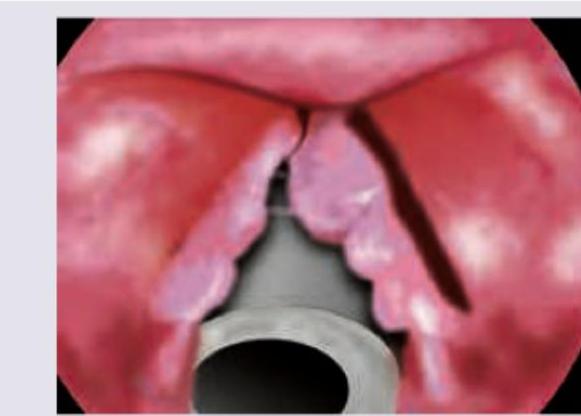
The following image shows:
Explanation: ***External beam radiotherapy*** - For **early-stage laryngeal cancer (T1N0M0)**, both **radiotherapy and surgery are considered equally effective first-line treatments** with excellent local control rates (>90%). - EBRT offers the advantage of being **completely non-invasive** while preserving vocal function and avoiding surgical risks. - Treatment duration is typically **6-7 weeks**, requiring patient compliance with daily fractions. - Preferred when patient prefers non-invasive approach or has comorbidities making surgery high-risk. *Surgery* - **Transoral laser microsurgery (TLS)** or endoscopic **cordectomy** are equally effective surgical options for T1 glottic cancer with cure rates comparable to radiotherapy. - Modern laser techniques provide excellent **voice preservation** with minimal morbidity. - Advantages include **shorter treatment time** (single procedure), obtaining tissue for histopathology, and preserving radiotherapy as salvage option. - Both **surgery and radiotherapy are Category 1 recommendations** for T1N0M0 disease; choice depends on institutional expertise, patient preference, and individual factors. *Radioactive implants* - **Brachytherapy (radioactive implants)** can be used for early-stage glottic cancer at specialized centers. - However, **external beam radiotherapy** is more commonly employed due to greater accessibility and extensive outcome data. *Surgery & radiotherapy* - **Combined modality treatment** is indicated for **locally advanced disease** (T3-T4) or **node-positive disease** (N+). - For **T1N0M0 disease**, single modality (either surgery OR radiotherapy) is sufficient and preferred to minimize treatment-related morbidity.
Explanation: ***T3 N3 M0*** - The primary tumor (T) is classified as **T3** because its greatest dimension is greater than 4 cm (or any tumor with depth of invasion > 10 mm). - The nodal involvement (N) is classified as **N3** (specifically **N3a**) because any lymph node greater than 6 cm, regardless of number, qualifies as N3a per **AJCC 8th Edition** staging. - This is the correct staging based on the clinical findings provided. *T2 N3 M0* - This is incorrect because a tumor > 4 cm automatically classifies as **T3**, not T2. - **T2** is reserved for tumors > 2 cm but ≤ 4 cm with depth of invasion ≤ 10 mm, or tumors ≤ 2 cm with depth of invasion > 5 mm and ≤ 10 mm. - While the N3 classification is correct, the T staging is wrong. *T3 N2 M0* - This is incorrect because although **T3** is correct for a tumor > 4 cm, the nodal classification is wrong. - Any lymph node > 6 cm is classified as **N3a**, not N2. - **N2** classifications require all involved nodes to be ≤ 6 cm in size. *T2 N2 M0* - This is incorrect as both the T and N classifications are inaccurate. - A tumor > 4 cm is **T3**, not T2. - Lymph node(s) > 6 cm are **N3a**, not N2. - This represents understaging of both the primary tumor and nodal disease.
Explanation: ***Head and neck cancer*** - **Field carcinogenesis** refers to the concept that a large area of tissue is exposed to carcinogens, leading to multiple primary tumors or recurrences [1]. - In **head and neck squamous cell carcinoma**, extensive exposure of the mucosal lining to tobacco and alcohol promotes widespread genetic alterations [1]. *Cervical cancer* - Primarily linked to **human papillomavirus (HPV) infection**, which causes localized lesions that may progress [2]. - While different areas of the cervix can be affected, the underlying mechanism is more focal infection rather than diffuse field exposure. *Prostate cancer* - Development is often associated with **age**, **genetics**, and **hormonal factors** (androgens). - It typically arises from a single or a few distinct foci within the prostate gland, not pervasive field change [3]. *Breast cancer* - Characterized by distinct lesions originating from ductal or lobular epithelium and influenced by **hormones** and **genetics** [4]. - While multifocal breast cancer can occur, it is generally considered the result of multiple independent events or spread from an initial lesion, not a widespread "field" of precancerous tissue in the same way as head and neck. **References:** [1] Kumar V, Abbas AK, et al.. Robbins and Cotran Pathologic Basis of Disease. 9th ed. The Lung, pp. 738-739. [2] Cross SS. Underwood's Pathology: A Clinical Approach. 6th ed. (Basic Pathology) introduces the student to key general principles of pathology, both as a medical science and as a clinical activity with a vital role in patient care. Part 2 (Disease Mechanisms) provides fundamental knowledge about the cellular and molecular processes involved in diseases, providing the rationale for their treatment. Part 3 (Systematic Pathology) deals in detail with specific diseases, with emphasis on the clinically important aspects., pp. 222-223. [3] Kumar V, Abbas AK, et al.. Robbins and Cotran Pathologic Basis of Disease. 9th ed. The Lower Urinary Tract and Male Genital System, pp. 993-994. [4] Kumar V, Abbas AK, et al.. Robbins and Cotran Pathologic Basis of Disease. 9th ed. The Breast, pp. 1059-1060.
Explanation: ***Quinsy*** - **Quinsy**, or **peritonsillar abscess**, is characterized by a "hot potato" or muffled voice and **trismus** (difficulty opening the mouth) due to inflammation and muscle spasm. - The abscess typically forms adjacent to the palatine tonsil, causing severe unilateral throat pain and difficulty swallowing. *Chronic Tonsillitis* - **Chronic tonsillitis** is characterized by recurrent episodes of throat pain, fever, and enlarged tonsils, but does not typically present with acute **trismus** or a "hot potato" voice. - It results from persistent or repeated bacterial infections of the tonsils, often without significant abscess formation. *Epiglottitis* - **Epiglottitis** presents with rapid onset of severe sore throat, **dysphagia**, drooling, and inspiratory stridor, and can be life-threatening due to airway obstruction. - While it causes significant throat pain and difficulty swallowing, it does not typically present with a "hot potato" voice or **trismus**, but rather a muffled voice and tripod positioning. *Infectious mononucleosis* - **Infectious mononucleosis** leads to swollen tonsils with exudates, fatigue, and lymphadenopathy, but usually does not cause **trismus** or the distinctive "hot potato" voice. - It is caused by the **Epstein-Barr virus** and can lead to significant pharyngitis, but is not associated with peritonsillar abscess formation.
Explanation: ***Direct laryngoscopy with biopsy*** - A definitive diagnosis of a vocal cord mass requires **histological examination** to rule out malignancy, especially given the patient's risk factors (age, smoking) and symptoms (hoarseness, dysphagia, weight loss). - **Direct laryngoscopy** allows for a thorough, magnified view of the mass and precise biopsy collection, which is superior to flexible laryngoscopy alone for definitive diagnosis and staging. *MRI of neck* - While MRI can provide excellent soft tissue detail for **staging** a known malignancy, it cannot provide a **histological diagnosis**. - It would typically be performed after a biopsy confirms malignancy to assess the extent of the tumor and potential spread. *CT scan of neck* - A CT scan is useful for evaluating **bony involvement**, lymph node status, and tumor extension for **staging purposes**, but it is not a diagnostic tool for identifying the specific type of tissue or cell pathology. - Like MRI, a CT scan would generally follow a biopsy confirming malignancy. *Radiotherapy* - **Radiotherapy** is a treatment modality for laryngeal cancer, not a diagnostic step. - Initiating treatment without a definitive histological diagnosis of malignancy would be inappropriate and potentially harmful.
Explanation: ***Rhinolalia clausa*** - This is also known as **hyponasal speech** or **closed nasality**, where there is insufficient nasal airflow during speech. - In **nasopharyngeal carcinoma**, the tumor can obstruct the nasopharynx, preventing air from flowing into the nasal cavity during vocalization, leading to this type of speech. *Hot potato voice* - This type of dysphonia is characterized by **muffled speech** as if the speaker is trying to talk with a hot object in their mouth. - It is typically associated with conditions causing **pharyngeal or tonsillar swelling** or peritonsillar abscess, which are distinct from nasopharyngeal carcinoma. *Hoarse voice* - **Hoarseness** results from abnormal vibration of the vocal cords, leading to a rough or breathy voice. - While possible in advanced nasopharyngeal carcinoma due to cranial nerve involvement affecting vocal cords, it is not the primary or most characteristic speech alteration from the tumor's location within the nasopharynx. *Rhinolalia aperta* - Also known as **hypernasal speech** or **open nasality**, this occurs when there is excessive nasal airflow during speech, making non-nasal sounds sound nasal. - This is typically caused by **velopharyngeal insufficiency** or defects that prevent proper closure between the oral and nasal cavities, such as a cleft palate, which is the opposite of the obstruction seen in nasopharyngeal carcinoma.
Explanation: ***Human papilloma virus*** - **High-risk HPV types**, particularly **HPV 16 and 18**, are the primary causative agent of cervical carcinoma, responsible for over 90% of cases. - HPV infection is the **most significant and essential risk factor**, leading to persistent changes in cervical cells that can progress to **dysplasia** and eventually **invasive cancer**. - Cervical cancer is considered an **HPV-associated malignancy**, making HPV the central etiological factor. *Smoking* - **Smoking** is an important cofactor that increases the risk of cervical carcinoma in women with HPV infection, but it is not the primary cause. - Smoking impairs the immune system's ability to clear HPV infections and promotes progression of HPV-induced lesions. - Without HPV infection, smoking alone does not cause cervical cancer. *Low socioeconomic status* - **Low socioeconomic status** is an indirect risk factor associated with reduced access to healthcare and **cervical cancer screening** (Pap smears). - It does not directly cause cervical cancer but leads to delayed diagnosis and treatment, resulting in poorer outcomes. *All of the options* - While all listed factors influence cervical carcinoma risk, **Human papillomavirus (HPV)** is the primary and essential causative agent. - The other factors are cofactors or indirect associations, not primary causes.
Explanation: ***MC site is on Lateral margin*** - The **lateral border** of the tongue is the most common site for squamous cell carcinoma (SCC) of the tongue due to chronic irritation and exposure to carcinogens. - This anatomical location makes it susceptible to tumor development due to constant friction and potential for trauma. *Slurring of speech is a common complaint* - While speech can be affected by advanced tongue cancer, **dysarthria** (slurring of speech) is not typically an early or primary complaint. - Early symptoms often include a **painless lesion**, ulcer, or lump on the tongue. *Cervical lymph node metastasis is universally present* - While **cervical lymph node metastasis** is common in tongue cancer, its presence is not universal at diagnosis. - The incidence of metastasis varies depending on tumor size, depth of invasion, and location, ranging from 30% to 50% in early stages. *Most common type is adenocarcinoma* - The vast majority of tongue cancers, over 90%, are **squamous cell carcinomas (SCCs)**, arising from the epithelial cells. - **Adenocarcinoma** is a rare type of tongue cancer, originating from glandular tissue, and is not the most common histological type.
Explanation: ***Glottic Cancer*** - **Glottic cancers** rarely present with cervical lymph node involvement because the **vocal cords** have a sparse lymphatic drainage system. - This anatomical feature limits the early spread of cancer cells to regional lymph nodes, distinguishing it from other head and neck cancers. *Subglottic Cancer* - **Subglottic cancers** frequently metastasize to cervical lymph nodes, specifically the **paratracheal** and **prelaryngeal nodes**, due to a richer lymphatic network. - The disease often presents at a more advanced stage because symptoms may be subtle until significant tumor burden or nodal involvement occurs. *Papillary thyroid cancer* - **Papillary thyroid cancer** commonly metastasizes to the cervical lymph nodes, often presenting with palpable **lymphadenopathy** even with small primary tumors. - Lymphatic spread is a hallmark feature, and **central neck dissection** is frequently performed as part of the surgical treatment. *Oral cancer* - **Oral cancers** (e.g., squamous cell carcinoma of the tongue, buccal mucosa) have a high propensity for early metastasis to **cervical lymph nodes**. - The rich lymphatic drainage of the oral cavity means that cervical lymph node involvement is a significant prognostic factor and is routinely assessed during staging.
Explanation: ***Respiratory papillomatosis*** - The image displays multiple **wart-like growths** on the vocal cords, characteristic of **respiratory papillomatosis**, which is caused by the **human papillomavirus (HPV)**. - These lesions often have an **irregular, cauliflower-like appearance** and can recur even after removal, making it a challenging condition to manage. *Vocal nodule* - Vocal nodules are typically **bilateral, symmetrical lesions** located at the junction of the anterior and middle thirds of the vocal cords. - They are usually **smooth, small, and whitish**, resulting from chronic vocal abuse, unlike the irregular and multiple growths seen in the image. *Vocal polyp* - Vocal polyps are typically **unilateral lesions** that can appear as sessile or pedunculated masses on a vocal cord. - They are often **larger than nodules** and may have a reddish or gelatinous appearance, but they usually occur singly, not as multiple diffuse growths like those pictured. *TB of vocal cords* - Tuberculosis of the vocal cords often presents with **ulcerative lesions**, granulomas, or diffuse inflammation, and may be accompanied by other signs of pulmonary TB. - The lesions caused by TB are generally **not papillomatous** or wart-like in nature, differentiating them from the appearance in the image.
Get full access to all questions, explanations, and performance tracking.
Start For Free