Most common site for nasopharyngeal carcinoma is:
A 1-year-old child was brought to the outpatient department with a soft and compressible swelling on the nose that increases on coughing. Which of the following is most likely the diagnosis?
Carcinoma of maxillary sinus stage III {T3 N0 M0}, Treatment of choice is
Most common presentation in nasopharyngeal carcinoma is with:
Treatment of choice for carcinoma of the maxillary sinus with T3N0M0?
Treatment of resectable T4N0M0 stage of head and neck carcinoma is?
Most common malignancy of maxillary antrum:
A 35-year-old female patient presents with complaints of nasal obstruction and post-nasal drip. There is a past history of FESS for failed conservative management 5 years ago. Uncinectomy and maxillary ostium dilation was done during the previous FESS. A DNE done now shows patent ostia and mucosal edema of the maxillary sinus lining. What is the next best step in management? FESS - Functional endoscopic sinus surgery
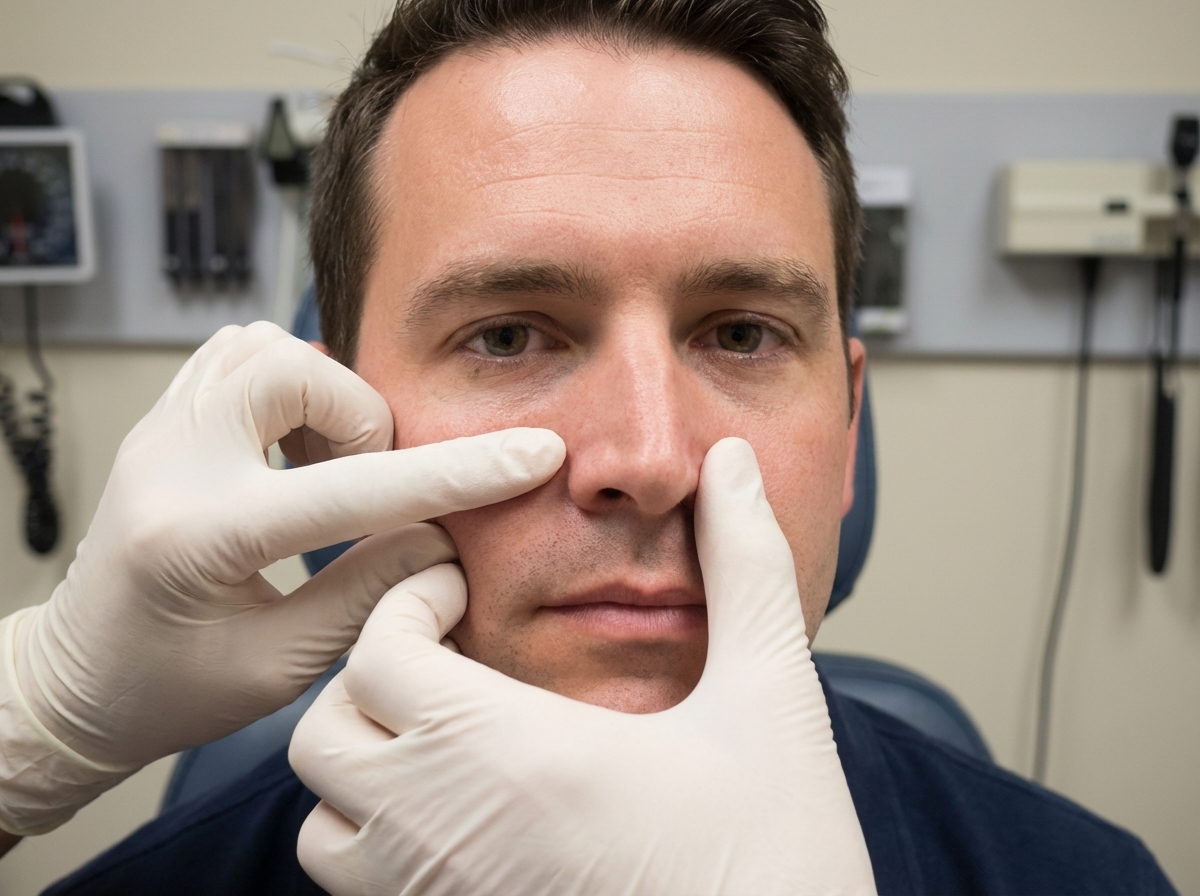
The following test is done for the evaluation of:
What is the treatment of choice for ethmoidal polyps?
Explanation: ***Fossa of Rosenmuller*** - The **fossa of Rosenmuller**, also known as the pharyngeal recess, is the most common site for the development of **nasopharyngeal carcinoma (NPC)**. - This anatomical location is prone to tumor development due to its complex lymphatic drainage and potential exposure to environmental factors. *Post part of Nasal cavity close to the margin of sphenopalatine foramen* - While this area is part of the nasopharynx, it is not the **predominant site** for the origin of **nasopharyngeal carcinoma (NPC)**. - Tumors originating here would be less common than those in the fossa of Rosenmuller. *Post end of septum* - The posterior end of the nasal septum is an anatomical structure in the nasopharynx but is **not a common primary site** for **nasopharyngeal carcinoma**. - Tumors are more likely to arise from the lateral walls or roof of the nasopharynx. *Lateral part of nasopharynx* - The lateral part of the nasopharynx is a general description, and while the **fossa of Rosenmuller** is located on the lateral wall, it is a **more specific and common site** for NPC. - Simply stating "lateral part" is less precise than identifying the fossa of Rosenmuller.
Explanation: ***Meningoencephalocele*** - A soft, compressible nasal swelling that increases with **coughing** or **straining** is highly suggestive of a meningoencephalocele due to increased intracranial pressure. - This condition involves a **herniation of brain tissue** (encephalocele) and meninges through a bony defect, often in the nasal region. *Lacrimal sac cyst* - A lacrimal sac cyst would typically present as a swelling in the **medial canthal region** and is usually associated with **tear duct obstruction**, not directly on the nose increasing with coughing. - While soft, it is not usually **compressible** or affected by changes in intracranial pressure in the same way. *Arteriovenous malformation* - An arteriovenous malformation (AVM) would typically present as a **pulsatile** mass with a **bruit**, and might cause warmth or discoloration. - It would not characteristically increase in size with **coughing** as a result of intracranial pressure changes. *Ethmoid cyst* - An ethmoid cyst is a fluid-filled sac originating from the **ethmoid sinuses**. While it can cause nasal obstruction or swelling, it usually presents as a firm, non-pulsatile mass. - It would not typically exhibit **compressibility** with an increase in size when coughing, differentiating it from an intracranial connection.
Explanation: ***Surgery and Radiotherapy*** - For **stage III maxillary sinus carcinoma (T3 N0 M0)**, a **multimodal approach** combining surgical resection with postoperative radiation therapy is generally considered the standard of care for optimal local control and survival outcomes. - **Surgery** aims to achieve clear margins, while **radiotherapy** targets microscopic residual disease and reduces the risk of recurrence. *Chemotherapy* - **Chemotherapy** alone is typically used for **systemic disease** or as a palliative measure, not as a primary curative treatment for localized stage III carcinoma. - Its role in **maxillary sinus cancer** is often reserved for induction therapy in advanced unresectable cases or as part of concurrent chemoradiation. *Chemotherapy and Surgery* - While chemotherapy may be used in combination with surgery for some advanced cancers, it is not the primary adjunctive modality alongside surgery for **stage III maxillary sinus carcinoma**; **radiotherapy** is more commonly indicated. - The primary role of chemotherapy in this context is usually in conjunction with radiation or for distant metastasis. *Radiotherapy* - **Radiotherapy alone** would not be sufficient for a T3 tumor, which involves extensive local invasion (e.g., bone of orbit, anterior ethmoid sinus, pterygoid plates, or cheek skin). - While radiation is crucial, **surgical debulking** or resection is necessary to remove the bulk of the disease and allow the radiation to be more effective.
Explanation: ***Cervical lymphadenopathy*** - **Cervical lymphadenopathy** is the most frequent initial symptom, with over 75% of patients presenting with a palpable neck mass, often a **painless, firm mass** in the upper deep cervical chain. - This is due to the rich lymphatic drainage of the nasopharynx to the cervical lymph nodes, leading to early metastasis. *Epistaxis* - While **epistaxis** (nosebleeds) can occur in nasopharyngeal carcinoma, it is generally not the most common presenting symptom. - It usually presents as recurrent, mild **epistaxis** or bloody discharge rather than severe bleeding. *Hoarseness of voice* - **Hoarseness of voice** is typically associated with laryngeal involvement or recurrent laryngeal nerve palsy, which is a less common and usually later manifestation of nasopharyngeal carcinoma. - Primary nasopharyngeal tumors do not directly cause hoarseness unless they extend significantly or metastasize to structures affecting vocal cord function. *Nasal stuffiness* - **Nasal stuffiness** or obstruction can be a symptom due to tumor growth within the nasopharynx. - However, it is a less specific symptom and often overshadowed by the more prominent presentation of cervical lymphadenopathy.
Explanation: ***Surgery and Radiotherapy*** - For **T3N0M0 maxillary sinus carcinoma**, a multidisciplinary approach involving both **surgery** (for primary tumor resection) and **postoperative adjuvant radiotherapy** is the preferred treatment. - This combined modality offers the best chance for **local control** and improved survival due to the aggressive nature and potential for microscopic residual disease in T3 tumors. *Surgery* - While surgery is crucial for removing the primary tumor, it alone may not be sufficient for **T3 tumors** due to the high risk of **microscopic residual disease** at the margins. - **Single modality treatment** with surgery for T3 tumors often results in higher rates of **local recurrence**. *Radiotherapy* - **Radiotherapy alone** is generally reserved for unresectable tumors or in cases where surgery is contraindicated due to comorbidities. - It may not achieve adequate **tumor eradication** as a primary standalone treatment for a T3 tumor without the benefit of surgical debulking. *Surgery and chemotherapy* - **Chemotherapy** is often considered in the context of **neoadjuvant** or **concurrent chemoradiation** for advanced head and neck cancers, or for metastatic disease. - For localized T3N0M0 maxillary sinus carcinoma, the primary adjuvant modality after surgery is **radiotherapy**, with chemotherapy reserved for specific scenarios or advanced stages.
Explanation: ***Surgery and Radiotherapy*** - For **resectable T4N0M0 head and neck carcinoma**, the standard treatment is **surgical resection** of the primary tumor followed by **adjuvant radiotherapy**. - This approach achieves optimal **local control** for advanced primary tumors without nodal involvement. - **Adjuvant radiotherapy** is essential for T4 tumors due to high risk of microscopic residual disease and local recurrence. - Surgery allows for complete tumor removal with negative margins, while radiotherapy addresses subclinical disease. *Radiotherapy alone* - Radiotherapy alone is **insufficient as monotherapy** for T4 tumors due to the large tumor burden and extensive local invasion. - Single modality radiation cannot reliably achieve adequate tumor control for advanced primary lesions. - Generally reserved for early-stage disease or patients unfit for surgery. *Chemoradiation* - **Definitive chemoradiation** is an alternative for **unresectable T4 tumors** or when organ preservation is desired (e.g., laryngeal cancer). - For **resectable** T4N0M0 disease, surgery with adjuvant RT is preferred as it provides better local control and allows pathological staging. - Chemoradiation may be used postoperatively if high-risk features are found (positive margins, perineural invasion, extranodal extension). - In this **N0 case with resectable tumor**, upfront surgery is the preferred initial approach. *Surgery alone* - While surgical resection is crucial for T4 tumors, **surgery alone is inadequate** due to high risk of locoregional recurrence. - T4 classification indicates extensive local invasion, necessitating **adjuvant radiotherapy** to eradicate microscopic disease. - Combined modality treatment (surgery + RT) significantly improves local control and survival compared to surgery alone.
Explanation: ***Squamous cell Carcinoma*** - **Squamous cell carcinoma (SCC)** accounts for approximately **80% of all malignant tumors** of the maxillary antrum. - This prevalence is due to the **squamous metaplasia** of the respiratory epithelium lining the sinus, especially in response to chronic irritation or inflammation. *Mucoepidermoid Carcinoma* - While it can occur in the maxillary sinus, **mucoepidermoid carcinoma** is a rare tumor, typically arising from **minor salivary glands**. - It is far **less common** than squamous cell carcinoma in the maxillary antrum. *Adenoid cystic Carcinoma* - **Adenoid cystic carcinoma** is a relatively rare tumor that more commonly affects the **major and minor salivary glands** and is known for its **perineural invasion** and slow growth, but it is not the most common in the maxillary antrum. - Its presence in the maxillary sinus is usually an **extension from adjacent structures** or a primary tumor of minor salivary glands within the sinus. *Adenocarcinoma* - **Adenocarcinoma** of the maxillary antrum is less common than SCC, often associated with exposure to **wood dust** or **leather processing**. - It typically arises from **seromucinous glands** within the sinus lining, but its incidence is significantly lower than that of squamous cell carcinoma.
Explanation: ***Tissue biopsy for histopathological examination*** - The patient has persistent **mucosal edema** despite previous FESS and patent ostia, raising suspicion for less common etiologies such as **eosinophilic mucin rhinosinusitis** or even a **neoplastic process**, which require histological confirmation. - A biopsy is essential to differentiate between inflammatory conditions not responsive to standard medical therapy and other distinct pathologies, guiding further specific treatment. *Immediate revision FESS* - Revision FESS is usually considered when there is evidence of **recurrent obstruction** or **sinus scarring**, neither of which is indicated by the "patent ostia" observed during DNE. - Performing FESS without addressing the underlying cause of persistent mucosal edema is unlikely to be curative and risks repeat failure. *High-dose systemic steroids* - While systemic steroids can reduce inflammation, persistent symptoms despite prior surgical intervention and observed mucosal edema warrant investigating the underlying cause before resorting to high-dose systemic therapy. - Prolonged use of high-dose systemic steroids carries significant side effects and should be reserved for cases where the etiology is well-defined and responsive, such as severe asthma or certain inflammatory conditions. *Topical antifungal therapy* - While fungal elements can contribute to rhinosinusitis, the broad application of topical antifungals without specific evidence of fungal infection (e.g., fungal balls, invasive fungal sinusitis) is not standard initial management. - The description of "mucosal edema" and absence of specific fungal features (like thick, inspissated mucin or fungal hyphae) makes empirical antifungal therapy less appropriate as the primary next step.
Explanation: ***Cheek tenderness in maxillary sinusitis*** - The image shows a person palpating the area over the **maxillary sinus** with their fingers. This examination technique is used to elicit tenderness, a common sign of **maxillary sinusitis**. - **Tenderness on palpation** over the maxillary sinus is a key clinical finding indicating inflammation or infection within the sinus cavity. *Abnormality of nasal valve* - Evaluation of the nasal valve typically involves external observation, internal examination with a speculum, or specialized maneuvers like the **Cottle test**, which involves pulling the cheek laterally to open the valve; it does not involve pressing on the cheek as depicted. - The nasal valve is an internal structure, and its palpation for abnormality would not be performed by pressing on the outer cheekbone as shown. *Severity of proptosis* - Proptosis (exophthalmos) refers to the **abnormal protrusion of the eyeball**. It is typically measured using an **exophthalmometer**. - The action shown in the image, pressing on the cheek, is not a method used to assess or quantify the severity of proptosis. *Skin pinch for dehydration* - The **skin pinch test** (turgor test) for dehydration is usually performed by pinching the skin on the back of the hand, lower arm, or abdomen, not the cheek. - Delayed return of the pinched skin to its normal state, known as **poor skin turgor**, indicates dehydration. The image does not show this technique.
Explanation: ***Functional Endoscopic sinus surgery with polypectomy*** - This is the **gold standard treatment** for ethmoidal polyps, as it allows for **direct visualization** and complete removal of polyps while preserving healthy mucosa. - It also enables restoration of normal sinus ventilation and drainage, which helps prevent recurrence. *Intranasal ethmoidectomy* - This is an **older technique** that is performed blindly and carries a higher risk of complications, such as **orbital or intracranial injury**, compared to endoscopic approaches. - It often results in incomplete polyp removal, leading to a higher rate of recurrence. *Transantral ethmoidectomy* - This approach, also known as the **Caldwell-Luc procedure**, is primarily used for diseases of the **maxillary sinus** and is not the preferred method for isolated ethmoidal polyps. - It is a more invasive external approach with risks including facial swelling, pain, and damage to dental nerves. *Extranasal ethmoidectomy* - This is a more invasive **external approach** involving an incision on the face and is generally reserved for extensive or complicated cases, such as **tumors or severe trauma**, not for routine polyp removal. - It carries risks of visible scarring and longer recovery times, making it less favorable than endoscopic techniques.
Get full access to all questions, explanations, and performance tracking.
Start For Free