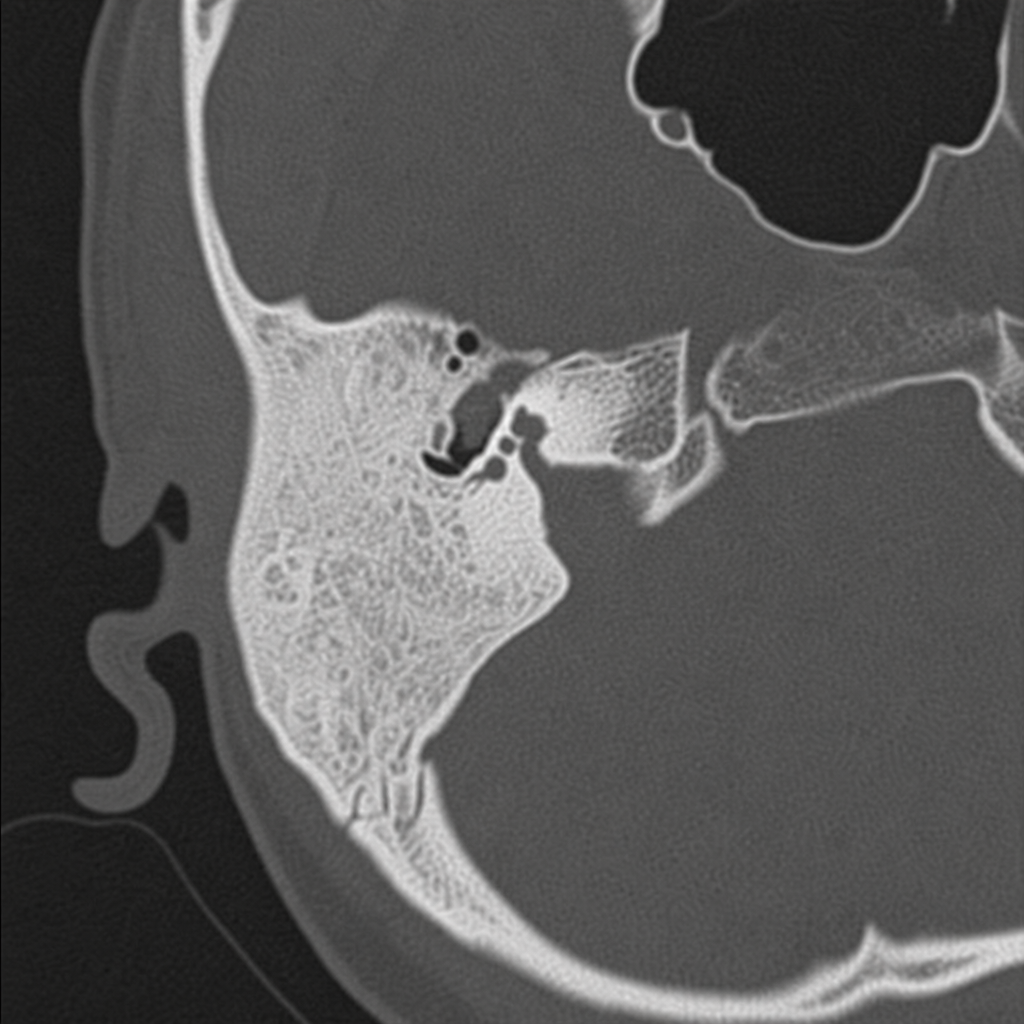
External auditory canal atresia has been associated with all of the following except?
What condition is characterized by a pulsatile tumor in the external auditory meatus that bleeds on touch?
External auditory canal exostosis occurs due to?
Which of the following ear ossicles is the first to be affected in otitis media?
Which condition is characterized by endolymphatic hydrops?
What is the earliest symptom of a glomus tumor?
Lateral sinus thrombosis is associated with all of the following except:
A 35-year-old patient presents with 6 weeks of ear discharge that is not foul-smelling. Which of the following management options is NOT indicated?
Cholesteatoma commonly perforates which structure?
What is the diagnosis?

Explanation: **Explanation:** Congenital External Auditory Canal (EAC) Atresia occurs due to a failure in the canalization of the first branchial cleft during the 7th month of intrauterine life. It is frequently associated with microtia and ossicular malformations. **Why Polyhydramnios is the Correct Answer:** Polyhydramnios (excessive amniotic fluid) is **not** a known risk factor for EAC atresia. In fact, EAC atresia and associated renal anomalies (as seen in syndromes like Townes-Brocks) are more frequently linked with **Oligohydramnios** (deficient amniotic fluid) due to decreased fetal urine production. Polyhydramnios is typically associated with fetal gastrointestinal obstructions or CNS anomalies that interfere with swallowing. **Analysis of Incorrect Options:** * **Low Birth Weight:** Prematurity and low birth weight are statistically significant risk factors for various congenital craniofacial anomalies, including aural atresia. * **Intrauterine Infections:** TORCH infections (especially **Rubella**) are well-documented causes of congenital ear malformations and sensorineural hearing loss. * **Intrauterine Toxins:** Teratogenic exposure during the first trimester is a major cause. Classic examples include **Thalidomide**, Isotretinoin (Vitamin A derivatives), and maternal alcohol consumption. **High-Yield Clinical Pearls for NEET-PG:** * **Embryology:** The EAC develops from the **1st Branchial Cleft**; the Pinna develops from **6 Hillocks of His** (1st and 2nd arches). * **Syndromic Associations:** EAC atresia is commonly seen in **Treacher Collins Syndrome**, **Goldenhar Syndrome**, and **Branchio-Oto-Renal (BOR) Syndrome**. * **Management:** The gold standard for evaluation is a **High-Resolution CT (HRCT) of the Temporal Bone** to assess the Jahrsdoerfer scale score before surgical reconstruction.
Explanation: **Explanation:** The correct answer is **Glomus tumor** (specifically Glomus Jugulare or Glomus Tympanicum). These are highly vascular, slow-growing, benign but locally invasive neuroendocrine tumors arising from the paraganglia. **Why Glomus Tumor is correct:** The hallmark of a glomus tumor is its **extreme vascularity**. When the tumor grows from the middle ear and erodes through the tympanic membrane into the external auditory meatus, it appears as a reddish-pink, fleshy mass. Because it arises from vascular tissue, it exhibits **pulsatility** (synchronous with the pulse) and **profuse bleeding** upon even minor manipulation or touch. **Why other options are incorrect:** * **Cholesteatoma:** This is a keratinizing squamous epithelium collection. It typically appears as a pearly white, non-vascular mass and does not bleed on touch or pulsate. * **Polyp:** While an inflammatory aural polyp can bleed, it is usually associated with chronic suppurative otitis media (CSOM) and lacks the characteristic rhythmic pulsation of a glomus tumor. * **Malignancy of the middle ear:** Squamous cell carcinoma can present as a friable mass that bleeds, but it is characterized by deep-seated pain, blood-stained discharge, and early facial nerve palsy rather than a distinct pulsatile nature. **High-Yield Clinical Pearls for NEET-PG:** * **Pulsatile Tinnitus:** The most common early symptom of a glomus tumor. * **Brown’s Sign:** Pulsation of the tumor seen on otoscopy, which ceases when ear canal pressure is raised above systolic pressure using a Siegel’s speculum. * **Aqueduct Sign (Phelps' Sign):** Loss of bony septum between the jugular bulb and the carotid canal (seen on CT). * **Rising Sun Appearance:** A red flush seen behind an intact tympanic membrane in early stages.
Explanation: **Explanation:** **External Auditory Canal (EAC) Exostoses**, often referred to as **"Surfer’s Ear,"** are benign, broad-based bony outgrowths of the bony portion of the external ear canal. **Why Option D is Correct:** The primary etiology is **recurrent and prolonged exposure to cold water** (and occasionally cold wind). This thermal stimulus triggers a reactive osteoblastic activity in the periosteum of the bony canal, leading to the formation of new bone. It is typically seen in surfers, divers, and swimmers. **Analysis of Incorrect Options:** * **Options A & B:** Repeated instrumentation or recurrent otitis externa (infection) typically lead to inflammatory changes, skin thickening, or localized furuncles. While chronic irritation can cause stenosis, it does not trigger the specific osteoblastic proliferation seen in exostosis. * **Option C:** A wide meatus does not predispose to exostosis; rather, the exostoses themselves cause the meatus to become narrow and tortuous. **High-Yield Clinical Pearls for NEET-PG:** * **Appearance:** Exostoses are usually **multiple, bilateral, and symmetric**. They appear as smooth, hard, sessile elevations. * **Location:** They arise from the **tympanic bone** (bony EAC), medial to the isthmus. * **Clinical Feature:** Usually asymptomatic but can cause conductive hearing loss or otitis externa due to the "trapping" of wax and water. * **Differential Diagnosis (Osteoma):** Unlike exostoses, an **Osteoma** is typically **solitary, unilateral, and pedunculated**, arising from the tympanosquamous or tympanomastoid sutures. * **Management:** Conservative (water avoidance) for mild cases; **canalplasty** (surgical removal) if there is significant hearing loss or recurrent infection.
Explanation: The **long process of the incus** is the most common site of ossicular necrosis in chronic suppurative otitis media (CSOM). ### Why the Long Process of Incus is the Correct Answer: The primary reason is its **precarious blood supply**. The long process of the incus is supplied by small vessels that must travel a long distance along the bone. Unlike the malleus, which is partially embedded in the tympanic membrane, the incus lies relatively free in the middle ear. During inflammation (otitis media), the following occurs: 1. **Vascular Compromise:** The mucosal swelling and increased pressure easily compress these end-arteries. 2. **Bony Resorption:** The long process has a high surface-area-to-volume ratio, making it highly susceptible to osteoclastic activity triggered by inflammatory cytokines and enzymes (like acid phosphatase) present in the infected middle ear. ### Why Other Options are Incorrect: * **Stapes (B):** While the stapes suprastructure can be involved, it is generally more resistant than the incus. The footplate of the stapes is rarely destroyed because it receives a dual blood supply from both the middle ear mucosa and the otic capsule. * **Handle of Malleus (C):** The malleus is the second most common ossicle to be affected. However, the handle is relatively protected because it is attached to the tympanic membrane, which provides an additional collateral blood supply. * **Body of Malleus (D):** The body of the malleus and the body of the incus are bulkier and have better vascularity, making them more resistant to necrosis compared to the slender long process. ### NEET-PG High-Yield Pearls: * **Order of involvement in CSOM:** Long process of Incus > Stapes suprastructure > Malleus handle. * **Most common ossicular deformity:** Erosion of the long process of the incus. * **Most resistant ossicle:** Malleus (due to its robust blood supply from the tympanic membrane). * **Cholesteatoma:** While it can destroy any bone, the incus remains the most frequent victim due to its anatomical position and blood supply.
Explanation: **Explanation:** **Meniere’s Disease (Endolymphatic Hydrops)** is the correct answer. The underlying pathophysiology involves the distension of the endolymphatic system due to an imbalance between the production and resorption of endolymph (specifically in the scala media and saccule). This buildup of pressure leads to the classic tetrad of symptoms: episodic vertigo, fluctuating sensorineural hearing loss (SNHL), low-frequency tinnitus, and a sensation of aural fullness. **Analysis of Options:** * **Monaural Diplacusis:** This is a *symptom*, not a disease entity. It refers to a phenomenon where a single tone is perceived as two different pitches in the same ear. While it can occur in Meniere’s due to hair cell distortion, it is not synonymous with hydrops. * **Lermoyez Syndrome:** This is a rare *variant* of Meniere’s disease. It is characterized by the "phenomenon of improvement," where hearing improves immediately following an attack of vertigo. While hydrops is present, Meniere’s is the primary clinical diagnosis for the condition itself. * **Otosclerosis:** This is a metabolic bone disease of the otic capsule characterized by bony ankylosis of the stapes footplate. It typically presents with conductive hearing loss and a normal endolymphatic system. **High-Yield Clinical Pearls for NEET-PG:** * **Glycerol Test:** Used for diagnosis; glycerol acts as an osmotic diuretic to temporarily reduce hydrops and improve hearing. * **Electrocochleography (ECoG):** Shows an increased **SP/AP ratio (>0.3)**. * **Audiometry:** Early stages show low-frequency SNHL (rising curve); late stages show a flat configuration. * **Management:** Low-salt diet and diuretics are first-line; **Betahistine** is used for maintenance. Intratympanic Gentamicin is used for chemical labyrinthectomy in refractory cases.
Explanation: **Explanation:** **Glomus tumors** (Paragangliomas) are highly vascular, slow-growing benign tumors arising from the paraganglia of the middle ear (Glomus Tympanicum) or the jugular bulb (Glomus Jugulare). 1. **Why Pulsatile Tinnitus is correct:** Because these tumors are extremely vascular and often supplied by the ascending pharyngeal artery, the patient hears their own heartbeat as the blood flows through the tumor. This **pulsatile tinnitus** is typically the **earliest symptom**, often described as a "whooshing" sound synchronous with the pulse. It may be relieved by carotid artery compression (Brown’s sign). 2. **Why the other options are incorrect:** * **Hearing loss:** This is usually the second most common symptom. It occurs later as the tumor mass increases in size, leading to ossicular chain fixation or middle ear obstruction (conductive loss). * **Polypoid growth:** A red, vascular mass (Rising Sun appearance) may be seen behind the intact tympanic membrane, but a visible polypoid growth in the external canal only occurs in advanced stages if the tumor erodes through the drum. * **Blood-stained otorrhoea:** This is a late feature occurring only when the tumor ulcerates or breaches the tympanic membrane. **Clinical Pearls for NEET-PG:** * **Phelps Sign:** Loss of bony crest between the carotid canal and jugular foramen (seen on CT). * **Aquino’s Sign:** Pulsation of the tumor stops with pressure on the carotid artery. * **Brown’s Sign:** Increasing ear canal pressure with a Siegel’s speculum causes the tumor to blanch and then pulsate more vigorously. * **Investigation of Choice:** Contrast-enhanced MRI (shows "Salt and Pepper" appearance) and Gold Standard is Digital Subtraction Angiography (DSA).
Explanation: **Explanation:** **Lateral Sinus Thrombosis (LST)**, also known as Sigmoid Sinus Thrombosis, is a serious intracranial complication of chronic suppurative otitis media (CSOM). It occurs when infection spreads to the venous sinus, leading to thrombus formation. **Why Gradenigo Triad is the Correct Answer:** Gradenigo triad is the hallmark of **Petrositis** (infection of the petrous apex), not lateral sinus thrombosis. It consists of: 1. **Abducens (VI) nerve palsy** (causing diplopia). 2. **Deep-seated retro-orbital pain** (due to Trigeminal/V nerve involvement). 3. **Persistent ear discharge.** **Analysis of Other Options (Associated with LST):** * **Griesinger’s Sign:** Edema and tenderness over the mastoid process due to thrombosis of the **mastoid emissary vein**. * **Crowe-Beck Sign:** Engorgement of retinal veins and supraorbital veins upon manual compression of the internal jugular vein (IJV) on the healthy side. * **Tobey-Ayer Test:** A manometric test during lumbar puncture. Compression of the IJV on the diseased side causes no rise in CSF pressure, whereas compression on the healthy side causes a rapid rise. **High-Yield Clinical Pearls for NEET-PG:** * **Picket-fence fever:** The characteristic clinical presentation of LST (hectic spikes with chills and rigors). * **Greisinger's sign** is a classic physical exam finding for LST. * **Investigation of Choice:** MR Venogram (shows the "Empty Delta Sign"). * **Management:** Intravenous antibiotics, anticoagulants, and mastoidectomy with clot removal if necessary.
Explanation: ### Explanation The clinical presentation of 6 weeks of **non-foul-smelling** ear discharge suggests a diagnosis of **Chronic Suppurative Otitis Media (CSOM) - Mucosal type** (also known as Tubotympanic or "Safe" type). **1. Why Mastoidectomy is NOT indicated:** Mastoidectomy is primarily indicated for **Squamosal type CSOM** (Atticoantral or "Unsafe" type), which is characterized by bone-eroding cholesteatoma and foul-smelling discharge. In Mucosal CSOM, the pathology is limited to the middle ear mucosa without bone destruction. Therefore, an invasive mastoidectomy is unnecessary unless there is evidence of mastoid reservoir infection or failure of conservative management. **2. Analysis of other options:** * **Topical Antibiotics (A):** These are the first-line treatment for an active mucosal ear discharge to control infection and achieve a "dry ear." * **Systemic Antibiotics (B):** Indicated during acute exacerbations or when topical therapy alone is insufficient to control the infection. * **Tympanoplasty (D):** This is the definitive surgical treatment for Mucosal CSOM. Once the ear is dry, tympanoplasty is performed to reconstruct the hearing mechanism and close the tympanic membrane perforation. **3. Clinical Pearls for NEET-PG:** * **Mucosal (Safe) CSOM:** Central perforation, non-foul-smelling (mucoid) discharge, low risk of complications. Treatment: Medical management followed by **Tympanoplasty**. * **Squamosal (Unsafe) CSOM:** Marginal/Attic perforation, foul-smelling (purulent) discharge, presence of cholesteatoma, high risk of intracranial complications. Treatment: **Mastoidectomy** (Modified Radical or Canal Wall Down). * **Rule of Thumb:** If the discharge is "safe," think reconstruction (Tympanoplasty); if "unsafe," think clearance (Mastoidectomy).
Explanation: **Explanation:** Cholesteatoma is a destructive, keratinizing squamous epithelial lesion of the middle ear. Its primary clinical significance lies in its ability to produce osteolytic enzymes (like collagenases and acid phosphatases) that cause bone erosion. **Why the Lateral Semicircular Canal (LSCC) is correct:** The **Lateral Semicircular Canal** is the most common site of bony erosion and fistula formation caused by cholesteatoma. This is due to its anatomical proximity to the **aditus ad antrum** and the **epitympanum** (attic), where cholesteatomas typically originate and expand. Erosion of the LSCC often presents clinically with the **Fistula Test positive** (vertigo and nystagmus induced by pressure changes in the external ear canal). **Analysis of Incorrect Options:** * **B. Superior Semicircular Canal:** While it can be involved in extensive disease, it is located more superiorly and is less frequently affected than the LSCC. It is more commonly associated with "Superior Canal Dehiscence Syndrome," which is usually idiopathic rather than cholesteatoma-induced. * **C. Promontory:** This is the basal turn of the cochlea. While cholesteatoma can involve the middle ear cleft, the promontory is a dense bony structure and is rarely the *primary* or most common site of perforation compared to the LSCC. * **D. Oval Window:** Though cholesteatoma frequently erodes the ossicles (most commonly the **long process of the incus**), it rarely "perforates" the oval window itself as a primary site of bone erosion compared to the LSCC. **High-Yield Clinical Pearls for NEET-PG:** * **Most common ossicle eroded:** Incus (specifically the long process). * **Most common site of fistula:** Lateral Semicircular Canal (85-90% of cases). * **Pathogenesis of bone destruction:** Mediated by cytokines (TNF-α, IL-1) and osteoclast activation. * **Clinical Sign:** Hennebert’s sign (false positive fistula test) is seen in Meniere’s or Congenital Syphilis, but a true positive test in a "safe" ear suggests a fistula, most likely in the LSCC.
Explanation: ***Exostosis*** - Shows characteristic **smooth, hard, bony protrusions** in the external auditory canal on otoscopic examination. - Often called **"surfer's ear"** due to association with chronic cold water exposure, causing reactive bone growth. *Otitis externa* - Would show **inflamed, erythematous skin** with possible discharge and debris in the ear canal. - Patient would typically present with **ear pain** and **tenderness** on manipulation of the pinna. *Keratosis obturans* - Appears as a **white, keratin plug** that completely obstructs the ear canal. - Associated with **conductive hearing loss** and **ear fullness** rather than bony growths. *Cerumen* - Presents as **waxy, yellowish-brown material** that can vary in consistency from soft to hard. - Has a **characteristic waxy appearance** and texture, unlike the smooth bony surface seen in exostosis.
Otitis Externa
Practice Questions
Acute Otitis Media
Practice Questions
Chronic Otitis Media
Practice Questions
Complications of Otitis Media
Practice Questions
Otosclerosis
Practice Questions
Presbycusis
Practice Questions
Sudden Sensorineural Hearing Loss
Practice Questions
Noise-Induced Hearing Loss
Practice Questions
Ménière's Disease
Practice Questions
Benign Paroxysmal Positional Vertigo
Practice Questions
Vestibular Neuritis
Practice Questions
Tumors of the Ear and Temporal Bone
Practice Questions
Get full access to all questions, explanations, and performance tracking.
Start For Free