In otosclerosis, the tympanogram is:
What is the purpose of Rinne's test?
What condition is characterized by a bluish appearance of the tympanic membrane?
Most common bone affected by otosclerosis?
Which of the following conditions is associated with objective tinnitus?
What is a specific indication for the use of a Bone-Anchored Hearing Aid (BAHA)?
Which of the following statements about tubercular otitis media is false?
Posterosuperior retraction pocket if allowed to progress will lead to?
Which of the following statements about conductive deafness is true?
What causes the cart-wheel appearance of the tympanic membrane in acute suppurative otitis media (ASOM)?
Explanation: ***Low compliance*** - In **otosclerosis**, the **stapes footplate** becomes fixed in the **oval window**, hindering sound transmission. - This fixation leads to reduced movement of the **tympanic membrane** and ossicular chain, resulting in a **low-compliance tympanogram** (Type As). *High compliance* - **High compliance** (Type Ad tympanogram) indicates a very mobile or **flaccid tympanic membrane**, often seen in conditions like **ossicular discontinuity**. - This is opposite to the stiffening effect seen in otosclerosis. *Normal compliance* - A **normal tympanogram** (Type A) signifies healthy middle ear function with appropriate pressure and mobility. - This would not be observed in otosclerosis, where there is a clear pathology affecting the **ossicular chain** and sound conduction. *None of the options* - This is incorrect because **otosclerosis** presents with a characteristic **low-compliance tympanogram**. - The disease specifically impairs the **mobility of the middle ear system**, which directly impacts tympanometric findings.
Explanation: ***To differentiate between conductive and sensorineural hearing loss*** - Rinne's test is a **hearing test** used to assess the type of hearing loss by comparing **air conduction** to **bone conduction**. - In the test, a vibrating **tuning fork** is placed on the **mastoid process** (bone conduction) and then near the **external auditory meatus** (air conduction). - **Normal/Sensorineural loss**: Air conduction > Bone conduction (Rinne positive) - **Conductive loss**: Bone conduction > Air conduction (Rinne negative) - This test, along with **Weber's test**, helps clinicians determine the **type and laterality** of hearing loss. *To test the function of the vestibular system* - The vestibular system is tested using different tests such as the **caloric test**, **Dix-Hallpike maneuver**, or **head impulse test**. - Rinne's test does not assess balance or vestibular function. *To measure the degree of hearing loss in decibels* - **Pure tone audiometry** is used to measure the **degree of hearing loss** in decibels (dB). - Rinne's test is a qualitative test that identifies the **type** of hearing loss, not the quantitative degree. *To assess the patency of the Eustachian tube* - **Eustachian tube function** is assessed using tests like **tympanometry**, **Valsalva maneuver**, or **Toynbee test**. - Rinne's test does not evaluate Eustachian tube patency.
Explanation: ***Otitis media with effusion (with hemotympanum)*** - A bluish appearance of the tympanic membrane is characteristically seen when there is **blood in the middle ear space (hemotympanum)**, which can occur in **otitis media with effusion containing hemorrhagic fluid**. - The blue discoloration results from **blood or hemorrhagic effusion** behind the intact tympanic membrane, which imparts a blue or purple hue when visualized through the translucent drum. - This can occur with **traumatic hemotympanum** (basal skull fracture, temporal bone trauma), **hemorrhagic OME**, or in patients with **bleeding disorders**. - Classic causes of blue tympanic membrane include middle ear hemorrhage associated with effusion. *Chronic suppurative otitis media* - CSOM typically involves persistent **purulent (pus-filled) discharge** and often a **perforation of the tympanic membrane**. - The tympanic membrane in CSOM is usually **inflamed, thickened, or perforated**, with active mucopurulent drainage rather than a bluish tinge. - The blue discoloration specifically indicates **blood in the middle ear**, not purulent infection. *Normal tympanic membrane* - A normal tympanic membrane is **pearly gray, translucent**, and mobile, with a visible cone of light and normal middle ear landmarks. - It does not exhibit bluish discoloration, which specifically indicates **underlying hemorrhage or hemorrhagic fluid** in the middle ear space. *Tympanic membrane perforation* - A perforation is a **visible hole or defect in the eardrum**, often with evidence of drainage. - While perforations can occur with various middle ear pathologies, a **blue/purple discoloration of an intact drum** specifically indicates **hemotympanum** (blood behind the membrane), not a perforation itself.
Explanation: ***Stapes*** - **Otosclerosis** is characterized by abnormal bone remodeling in the otic capsule, primarily affecting the **stapes footplate**. - This leads to its fixation in the oval window, causing **conductive hearing loss**. - The **stapediovestibular joint** is the most common site, occurring in over 90% of cases. *Bony labyrinth* - While otosclerosis originates in the **otic capsule** (which forms the bony labyrinth), the term refers to a broader anatomical structure. - The specific site of clinical significance is the **stapes footplate**, not the labyrinth as a whole. *Mastoid process* - The **mastoid process** is part of the temporal bone but is structurally distinct from the middle ear and otic capsule. - It is not involved in otosclerosis pathology. *Incus* - While the **incus** is a middle ear ossicle, it is rarely affected by otosclerosis. - The disease process specifically targets the **stapes footplate** at the oval window, not other ossicles.
Explanation: ***Glomus tumor*** - A glomus tumor is a **vascular tumor** that can cause turbulent blood flow, leading to a pulsatile, objective tinnitus that can be heard by an examiner. - The sound is often described as a **thumping or whooshing** sound synchronous with the patient's heartbeat. *Ménière's disease* - **Ménière's disease** is associated with subjective tinnitus, a ringing or roaring sensation perceptible only to the patient. - It is characterized by the triad of **vertigo, fluctuating hearing loss, and tinnitus**. *Acoustic neuroma* - An acoustic neuroma (vestibular schwannoma) typically causes **unilateral, subjective tinnitus**, often described as a high-pitched ringing. - It is a benign tumor on the **vestibulocochlear nerve** and is also associated with sensorineural hearing loss and balance issues. *Ear wax* - **Impacted ear wax** can cause subjective tinnitus due to its interference with sound conduction and resonance within the ear canal. - The tinnitus is not typically audible to an examiner, making it a **subjective finding**.
Explanation: ***Congenital canal atresia*** - **Congenital canal atresia** represents a classic, specific indication for BAHA because the ear canal is congenitally absent or severely stenosed, making conventional hearing aids impossible to fit or ineffective. - BAHA bypasses the absent ear canal entirely by transmitting sound vibrations directly to the **cochlea through bone conduction**, providing an ideal solution for this anatomical abnormality. *Bilateral conductive hearing loss* - While BAHA can be used for conductive hearing loss, **conventional hearing aids** are typically the first-line treatment when ear canals are intact and functional. - Bilateral cases often benefit from traditional amplification devices or **surgical correction** of the underlying conductive pathology before considering BAHA. *Unilateral sensorineural hearing loss* - BAHA is commonly used for **single-sided deafness (SSD)** to route sound from the deaf ear to the hearing ear via bone conduction using the **CROS principle**. - However, this indication is less specific than congenital canal atresia, as other treatment options like **conventional CROS hearing aids** may also be considered. *Conductive hearing loss due to other causes* - This option is too **broad and non-specific** as it encompasses many different etiologies of conductive hearing loss. - Many other causes of conductive hearing loss have **alternative treatments** such as surgical repair, conventional hearing aids, or medical management, making BAHA a secondary consideration.
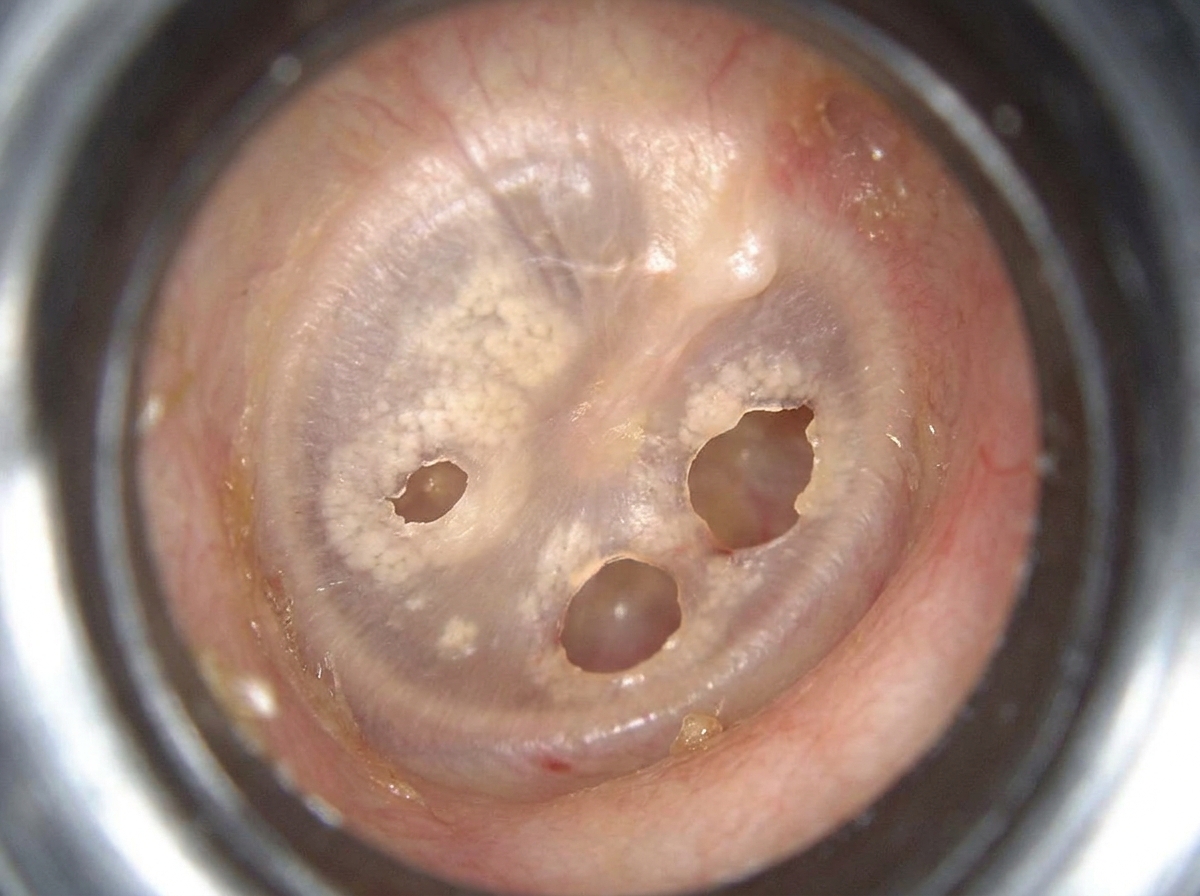
Explanation: ***Causes painful ear discharge*** - **Pain** is typically an **absent or minimal symptom** in tubercular otitis media, even with significant ear discharge. - The discharge is usually **thin, watery, and non-purulent**, reflecting the indolent nature of the infection. *Spreads through the eustachian tube* - Tubercular otitis media can spread via the **eustachian tube** from the nasopharynx, especially in cases of active pulmonary or pharyngeal tuberculosis. - This is a common route for infectious agents to reach the middle ear. *Usually affects only one ear* - Tubercular otitis media predominantly presents as a **unilateral infection**. - While bilateral involvement can occur, it is less common than unilateral presentation. *May cause multiple perforations* - Tubercular otitis media is notorious for causing **multiple, small perforations** in the tympanic membrane. - This feature, often described as a "sieve-like" drum, is a characteristic diagnostic clue for the condition.
Explanation: ***Primary cholesteatoma*** - A posterosuperior retraction pocket is a common precursor to the development of a **primary cholesteatoma**. - This pocket, formed by **negative pressure** in the middle ear, accumulates **desquamated keratin** and can erode surrounding bone. *SNHL* - While a cholesteatoma can ultimately cause **sensorineural hearing loss (SNHL)** due to extensive bone erosion affecting the inner ear, it is a later complication, not the direct outcome of the initial retraction pocket itself. - **SNHL** is more commonly associated with conditions directly damaging the **cochlea or auditory nerve**. *Secondary cholesteatoma* - A **secondary cholesteatoma** typically arises from a perforation in the tympanic membrane where skin migrates into the middle ear, not from an intact retraction pocket. - This condition is also known as a **'migratory'** or **'acquired'** cholesteatoma. *Tympanosclerosis* - **Tympanosclerosis** involves the formation of **hyalinized collagen and calcium deposits** within the tympanic membrane or middle ear mucosa, resulting from chronic inflammation or previous trauma. - It is a **fibrotic healing response** and does not directly result from a retraction pocket, although both can be sequelae of chronic otitis media.
Explanation: ***Rinne's test is negative in conductive deafness.*** - A **negative Rinne's test** indicates that **bone conduction is heard longer or equally as long as air conduction** in the affected ear. - This occurs because the sound transmission through the middle ear is impaired due to the conductive hearing loss. *Weber's test shows no lateralization in conductive deafness.* - In unilateral conductive deafness, the **Weber's test will lateralize to the affected ear**, not show no lateralization. - This is because the sound is perceived as louder in the ear with the conductive loss due to the masking effect of ambient noise being reduced. *There is no decay in threshold tone in conductive deafness.* - **Threshold tone decay** is typically associated with **retrocochlear lesions** (sensorineural hearing loss), not conductive deafness. - Conductive hearing loss is a mechanical problem that does not affect the persistence of auditory nerve firing. *Air conduction is always completely absent in conductive deafness during Rinne's test.* - While air conduction is poorer than bone conduction (making Rinne's negative), it is **not always completely absent**. - In a profound conductive loss, air conduction might be near absent, but in milder cases, it is simply significantly reduced compared to bone conduction.
Explanation: ***Congested blood vessels along the malleus*** - The **cart-wheel appearance** in **acute suppurative otitis media (ASOM)** is a characteristic sign caused by the significant **engorgement of blood vessels** radiating out from the **malleus handle**. - This vascular congestion gives the tympanic membrane a distinct spoke-like pattern, resembling the spokes of a **cart wheel**. *Perforation of the tympanic membrane* - While **tympanic membrane perforation** can occur in ASOM, it typically signals a later stage of the disease, often leading to relief of pain and discharge, not the cart-wheel appearance. - Perforation appears as a **hole or defect** in the tympanic membrane, altering its integrity rather than its vascular pattern. *Edema of the tympanic membrane* - **Edema** (swelling) of the tympanic membrane does occur in ASOM due to inflammation, giving it a **dull, thickened, or bulging appearance**. - However, edema alone does not create the specific spoke-like pattern seen in the cart-wheel appearance; this pattern is primarily vascular. *Granulation tissue on the tympanic membrane* - **Granulation tissue** formation is more commonly associated with **chronic inflammatory processes** or healing after injury, and it would present as a **red, friable mass** on the tympanic membrane. - It is not a feature of early or established ASOM leading to the cart-wheel sign, which is an acute vascular phenomenon.
Otitis Externa
Practice Questions
Acute Otitis Media
Practice Questions
Chronic Otitis Media
Practice Questions
Complications of Otitis Media
Practice Questions
Otosclerosis
Practice Questions
Presbycusis
Practice Questions
Sudden Sensorineural Hearing Loss
Practice Questions
Noise-Induced Hearing Loss
Practice Questions
Ménière's Disease
Practice Questions
Benign Paroxysmal Positional Vertigo
Practice Questions
Vestibular Neuritis
Practice Questions
Tumors of the Ear and Temporal Bone
Practice Questions
Get full access to all questions, explanations, and performance tracking.
Start For Free