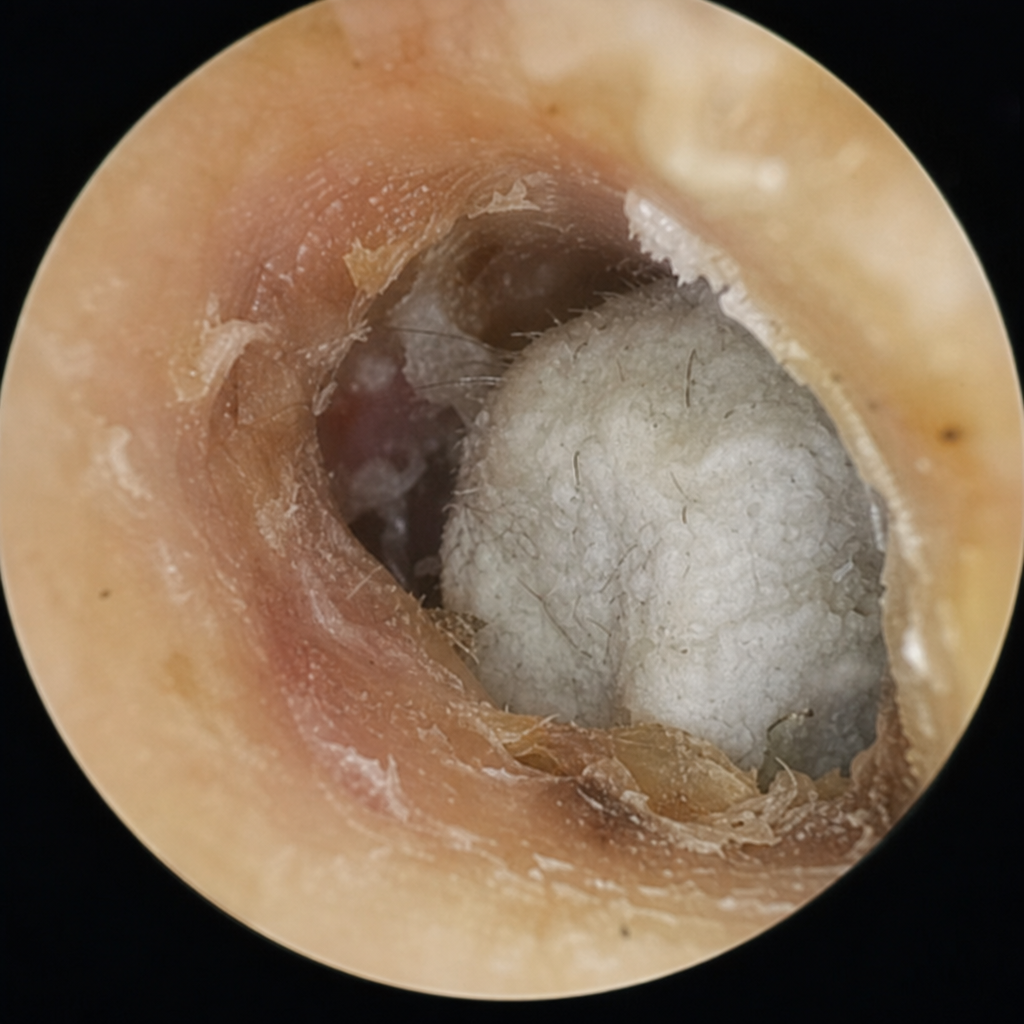
A 5-year-old child presents with reduced hearing for the past 2-3 months. Based on the otoscopy findings shown, what is the most likely diagnosis?

Which of the following is NOT a characteristic of Tubercular Otitis Media?
All of the following are features of Tubotympanic CSOM except which of the following?
Which perforation of the tympanic membrane is most commonly seen with tubotympanic CSOM?
Most common cause of otitis externa is
Otosclerosis affects which bone?
In otosclerosis, which structure is primarily affected?
In which condition is the Schwartze sign observed?
All are intracranial complications of otitis media except which of the following?
What is the treatment of choice for atticoantral type of chronic suppurative otitis media (CSOM)?
Explanation: ***Otitis media with effusion*** - The image clearly shows the presence of **bubbles behind the tympanic membrane**, indicating fluid accumulation in the middle ear. - This fluid leads to **reduced hearing**, as reported in the 5-year-old child, consistent with otitis media with effusion (OME), also known as "glue ear." *Myringitis* - Myringitis typically presents with **inflammation of the tympanic membrane**, often with vesicles or bullae on the drum, which are not visible here. - While it can cause pain, it does not typically show the characteristic bubbles signifying middle ear effusion. *Acute ear infection* - An **acute otitis media** would show a **bulging, erythematous (red), and opaque tympanic membrane** due to inflammation and pus, which is not consistent with the image. - Systemic symptoms like fever and severe ear pain would also be expected with an acute infection. *Air in the middle ear* - The presence of **air in the middle ear is normal** and indicates a healthy, functioning Eustachian tube. - The visible bubbles in the image are consistent with **fluid and air-fluid levels**, not just air, and indicate a pathological condition affecting hearing.
Explanation: ***Painful otorrhea*** - **Tubercular otitis media** is typically characterized by **painless otorrhea** (ear discharge). - The absence of significant pain, despite chronic infection, is a hallmark feature, distinguishing it from more common bacterial otitis media. *Multiple perforations* - Multiple or **kissing perforations** of the tympanic membrane are characteristic findings in tubercular otitis media due to the extensive tissue destruction. - These perforations are often progressive and can coalesce. *Pale granulations* - The middle ear mucosa often shows the presence of **pale granulations** and polyps, which represent the inflammatory response to Mycobacterium tuberculosis. - These granulations can be extensive and fill the middle ear space. *Chronic progressive hearing loss* - **Chronic progressive conductive hearing loss** is a common symptom due to effusions, ossicular destruction, and tympanic membrane perforations. - If left untreated, the hearing loss can become severe and even sensorineural due to inner ear involvement.
Explanation: ***Extreme pain*** - **Extreme pain** is NOT a characteristic feature of **tubotympanic CSOM**. This type is typically associated with a history of **painless otorrhea**. - Tubotympanic CSOM is considered the "safe" type with inflammation limited to the mucosa without bone erosion. - The presence of severe pain should raise suspicion for complications or the **atticoantral (unsafe) type** of CSOM. *Profuse discharge* - **Profuse, mucoid** or **mucopurulent discharge** is a hallmark feature of tubotympanic CSOM. - This discharge results from chronic inflammation of the **middle ear mucoperiosteum** through a central perforation in the **pars tensa**. - The discharge is typically non-foul smelling (unlike atticoantral CSOM). *Hearing loss* - **Conductive hearing loss** is a universal feature of tubotympanic CSOM. - Results from **tympanic membrane perforation**, middle ear effusion, and potential ossicular discontinuity. - The degree of hearing loss correlates with the size and location of the perforation. *Facial nerve paralysis* - Facial nerve paralysis is **NOT a typical feature** of tubotympanic (safe) CSOM. - This complication is characteristically associated with **atticoantral (unsafe) CSOM** with cholesteatoma causing bone erosion. - While theoretically possible in very advanced neglected tubotympanic disease, it would indicate transformation to unsafe disease or secondary complications. - **Note:** Some sources may list this as a rare complication, but it is not a characteristic feature distinguishing tubotympanic CSOM, making this option potentially ambiguous in an "EXCEPT" question format.
Explanation: ***Central*** - A **central perforation** of the tympanic membrane is the most common type seen in **tubotympanic chronic suppurative otitis media (CSOM)**. - This type of perforation involves the **pars tensa** of the tympanic membrane, leaving an intact annulus. *Anterosuperior* - While perforations can occur anywhere, an **anterosuperior perforation** is not the hallmark of tubotympanic CSOM. - This location does not specifically correlate with the characteristic inflammatory patterns seen in tubotympanic disease. *Posterosuperior* - A **posterosuperior perforation** is more often associated with **atticoantral CSOM** due to **cholesteatoma formation**. - **Cholesteatoma** typically begins in the pars flaccida or posterosuperior pars tensa, which is different from tubotympanic CSOM. *Posteroinferior* - A **posteroinferior perforation** is not the most typical presentation for tubotympanic CSOM. - This location does not specifically differentiate it from other forms of otitis media or reflect the primary pathology of tubotympanic disease.
Explanation: ***Bacterial infection*** - The most common pathogens causing **otitis externa** are bacteria, primarily **Pseudomonas aeruginosa** and **Staphylococcus aureus**. - This condition, often called "swimmer's ear," is favored by moisture in the ear canal, which creates a conducive environment for bacterial growth. *Fungal infection* - While fungal infections (otomycosis) can cause otitis externa, they are **less common** than bacterial causes. - Fungi like *Aspergillus* and *Candida* are typically involved, often in immunocompromised individuals or after prolonged antibiotic use. *Seborrheic disease* - **Seborrheic dermatitis** can affect the ear canal and surrounding skin, leading to flaking, itching, and inflammation. - However, it is a primary skin condition and does not directly cause infectious otitis externa, although it can predispose to secondary infections. *Herpes Zoster* - **Herpes zoster oticus** (Ramsay Hunt syndrome) is a viral infection affecting the facial nerve, causing a painful rash, facial paralysis, and hearing loss. - It is a specific viral etiology with distinct neurological symptoms and is not a common cause of general otitis externa.
Explanation: ***Stapes*** - **Otosclerosis** is a condition characterized by abnormal bone growth in the middle ear, specifically around the **stapes footplate**. - This abnormal growth fixates the stapes, preventing it from vibrating properly and leading to **conductive hearing loss**. - **Fenestral otosclerosis** (most common type) directly affects the oval window and stapes footplate. *Incus* - The **incus** is the middle ossicle in the chain, between the malleus and the stapes. - While it can be affected by other middle ear pathologies, otosclerosis primarily targets the **stapes**. *Malleus* - The **malleus** is the outermost ossicle, attached to the eardrum. - Its involvement in otosclerosis is rare and indirect, as the primary site of disease is the **stapes**. *Cochlea* - **Cochlear (retrofenestral) otosclerosis** can occur but is less common and typically causes **sensorineural hearing loss**. - The classic presentation of otosclerosis involves **stapedial fixation** causing conductive hearing loss, not primary cochlear involvement.
Explanation: ***Foot plate of stapes*** - Otosclerosis is a disease of the **temporal bone** that causes abnormal bone growth, primarily affecting the footplate of the stapes. - This abnormal bone growth leads to the **fixation of the stapes** in the oval window, impairing sound conduction and causing **conductive hearing loss**. *Oval window* - While the oval window is the location where the stapes articulates, otosclerosis specifically affects the **footplate of the stapes**, causing it to become fixed within the oval window. - The oval window itself is a structure of the inner ear, but the primary pathology involves the **stapes bone**. *Round window* - The round window plays a role in relieving pressure in the **cochlea** by bulging outwards when the oval window bulges inwards. - It is **not directly affected** by the abnormal bone growth characteristic of otosclerosis. *Utricle* - The utricle is a part of the **vestibular system** in the inner ear, responsible for sensing linear acceleration and head tilt. - It is **not involved** in the pathogenesis of otosclerosis, which is primarily a conductive hearing loss disorder.
Explanation: ***Otosclerosis*** - The **Schwartze sign** is a reddish blush seen through the tympanic membrane, indicative of increased vascularity over the promontory. - It is a classic clinical finding in **active otosclerosis**, distinguishing it from inactive forms. *Glomus Jugulare* - This is a highly **vascular tumor** of the middle ear and mastoid, often presenting with pulsating tinnitus and hearing loss. - While vascularity is present, it manifests as a **reddish-blue mass behind the tympanic membrane**, not the diffuse blush characteristic of Schwartze sign. *Meniere's disease* - Characterized by episodes of **vertigo, fluctuating hearing loss, tinnitus**, and aural fullness due to endolymphatic hydrops. - It does not present with any specific otoscopic findings like the Schwartze sign. *Acoustic neuroma* - This is a **benign tumor of the vestibulocochlear nerve (CN VIII)**, typically causing progressive unilateral sensorineural hearing loss, tinnitus, and balance issues. - It does not produce any visible changes on otoscopy and therefore lacks the Schwartze sign.
Explanation: ***Facial nerve palsy*** - This is an **extracranial complication** of otitis media affecting the **facial nerve within the temporal bone**, not an intracranial structure. - The facial nerve (CN VII) runs through the **fallopian canal** in the temporal bone and can be affected by inflammation from adjacent mastoid or middle ear infection. - Classified as a **temporal bone complication** rather than an intracranial complication. *Lateral sinus thrombophlebitis* - This is a true **intracranial complication** involving thrombosis of the **sigmoid and lateral venous sinuses** within the cranial cavity. - Results from direct extension of infection through the **mastoid tegmen** or via septic thrombophlebitis. - Presents with features of sepsis, headache, and papilledema. *Brain abscess* - A severe **intracranial complication** representing focal suppurative infection within the **brain parenchyma** (commonly temporal lobe or cerebellum). - Occurs through direct extension via bony erosion, retrograde thrombophlebitis, or hematogenous spread. - Requires urgent neurosurgical intervention. *Hydrocephalus* - An **intracranial complication** that can occur secondary to **otogenic meningitis** or **lateral sinus thrombosis**. - Results from impaired CSF absorption or obstruction of CSF pathways. - More common in pediatric otitis media with CNS complications.
Explanation: ***Modified radical mastoidectomy*** - The **atticoantral type of CSOM** is characterized by active **cholesteatoma**, which requires surgical removal to prevent further bone erosion and complications. - A **modified radical mastoidectomy** is the treatment of choice as it removes the cholesteatoma and diseased mastoid air cells while aiming to preserve residual hearing. *Antibiotics* - While topical or systemic antibiotics may be used to control acute infections or discharge in CSOM, they do not eradicate **cholesteatoma**. - **Cholesteatoma** is an epidermoid cyst that requires surgical excision, as antibiotics alone cannot resolve it. *Tympanoplasty* - **Tympanoplasty** is primarily performed to reconstruct the tympanic membrane (eardrum) and/or the ossicular chain to restore hearing. - It is typically indicated for the **tubotympanic type of CSOM** (safe type) without cholesteatoma, not for the atticoantral type which involves cholesteatoma. *None of the options* - This option is incorrect because **modified radical mastoidectomy** is a well-established and necessary treatment for the atticoantral type of CSOM involving cholesteatoma.
Otitis Externa
Practice Questions
Acute Otitis Media
Practice Questions
Chronic Otitis Media
Practice Questions
Complications of Otitis Media
Practice Questions
Otosclerosis
Practice Questions
Presbycusis
Practice Questions
Sudden Sensorineural Hearing Loss
Practice Questions
Noise-Induced Hearing Loss
Practice Questions
Ménière's Disease
Practice Questions
Benign Paroxysmal Positional Vertigo
Practice Questions
Vestibular Neuritis
Practice Questions
Tumors of the Ear and Temporal Bone
Practice Questions
Get full access to all questions, explanations, and performance tracking.
Start For Free