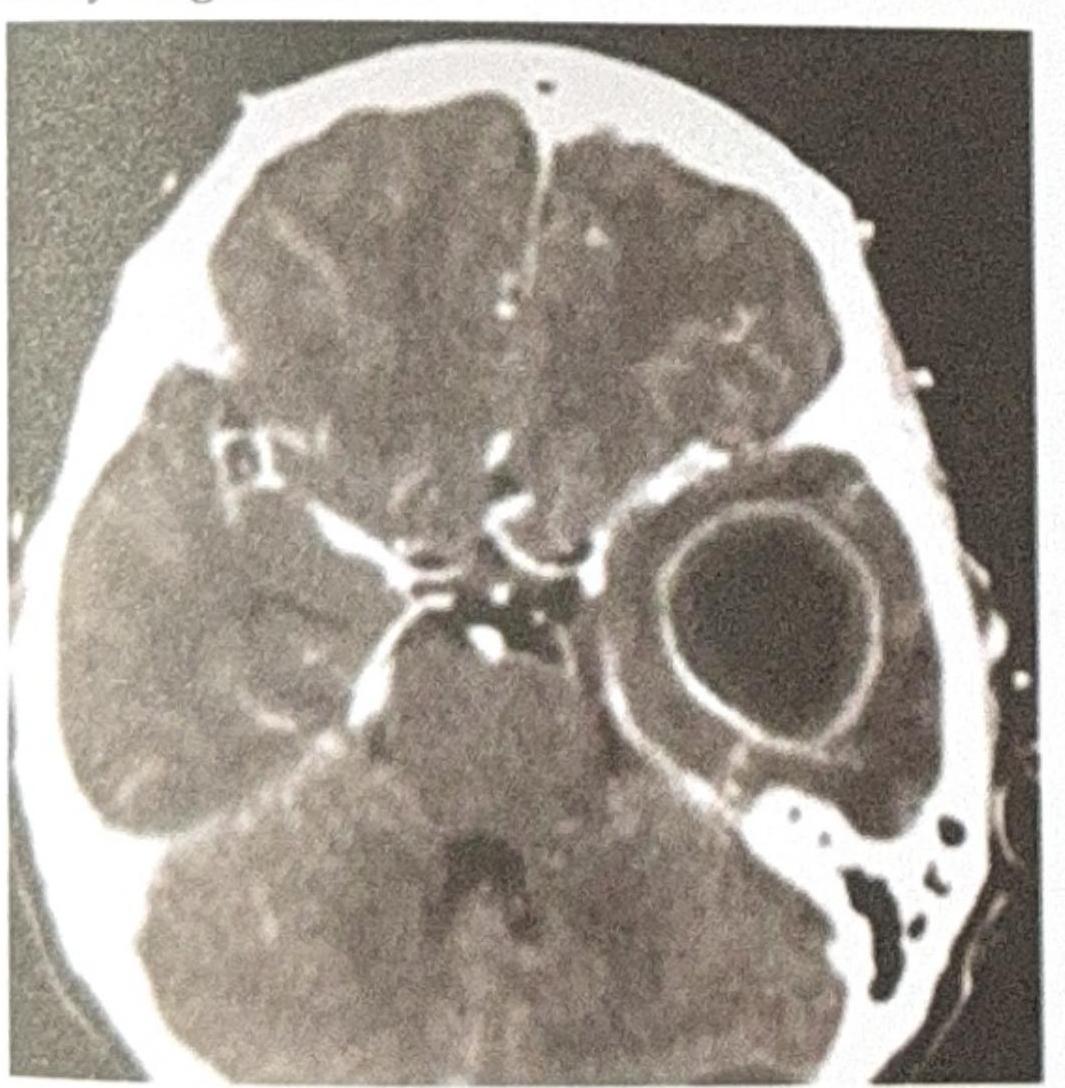
C-shaped curve on tympanometry is seen in?
Rinne test is:
Tuberculous otitis media of the middle ear has all of the following except:-
In air blast injury, which is the most commonly affected organ? CMC (Vellore) 07; AI 09; AIIMS 10; NEET 14
A 60-year-old diabetic presents with otalgia, otorrhea, and granulation tissue in EAC. Empiric treatment should include:
A child presents with recurrent ear infections and conductive hearing loss. What is the most likely diagnosis?
Which of the following is not a feature of otosclerosis?
Which of the following signs is not associated with otitis media with effusion?
What is the mechanism by which otosclerosis leads to hearing loss?
A 65-year-old patient presents with gradual progressive hearing loss over several years. Rinne test shows bone conduction > air conduction bilaterally. Weber test lateralizes to the worse ear. Tympanic membranes are intact and normal. Which is the most likely diagnosis?
Explanation: ***Eustachian tube obstruction*** - A **C-shaped curve** (Type C tympanogram) indicates **negative middle ear pressure**, which results from a poorly functioning **Eustachian tube**. - This type of curve shows maximal compliance at a **negative pressure**, signifying that the middle ear is under suction. *Serous otitis media* - **Serous otitis media** (otitis media with effusion) typically presents with a **Type B tympanogram**, indicating **reduced or absent tympanic membrane mobility** due to fluid in the middle ear. - This is a flat curve with no distinct peak, reflecting the presence of **effusion**. *Otosclerosis* - **Otosclerosis** causes **stiffening of the ossicular chain**, particularly the stapes, leading to a **Type As tympanogram**. - This curve shows **normal middle ear pressure** but **reduced compliance** (shallower peak) compared to a normal Type A. *TM perforation* - A **tympanic membrane perforation** results in an **open middle ear space**, leading to an **extremely high compliance** and **no discernible peak** on the tympanogram (Type B with a large ear canal volume). - This is because the pressure applied by the tympanometer escapes through the perforation, failing to pressurize the system.
Explanation: ***A tuning fork test for hearing assessment*** - The **Rinne test** is a well-established otological examination that uses a **tuning fork** (typically 512 Hz) to compare **air conduction (AC)** and **bone conduction (BC)** hearing. - Normal result shows **air conduction > bone conduction** (positive Rinne test), while **conductive hearing loss** shows bone conduction > air conduction (negative Rinne test). *Not a recognized medical term* - This is completely false. The **Rinne test** is a widely recognized and standard medical diagnostic test in **otolaryngology** and **audiology**. - It has been used clinically for over a century and is taught in medical schools worldwide, named after **Heinrich Adolf Rinne**, a German otologist who described it in 1855. *A clinical examination technique for tympanic membrane* - While the Rinne test is part of ear examination, it does not directly examine the **tympanic membrane**. - The test assesses **hearing pathways** rather than directly visualizing or examining the tympanic membrane structure; direct examination is done through **otoscopy**. *A type of audiometry test* - **Audiometry** refers to formal, quantitative hearing tests using specialized electronic equipment that produce **audiograms** with detailed hearing threshold measurements. - The Rinne test is a simple, qualitative **bedside test** using a tuning fork that provides a quick comparison between air and bone conduction, but does not produce numerical thresholds or detailed audiometric data.
Explanation: ***Painful otorrhea is seen*** - **Tuberculous otitis media** is often characterized by **painless otorrhea**, making painful otorrhea an unlikely finding. - The absence of pain is attributed to the **insidious** and slow-growing nature of the infection, which often delays diagnosis. *Multiple perforations are seen* - **Multiple tympanic membrane perforations** are a classic sign of tuberculous otitis media, differentiating it from other chronic otitis media forms. - These perforations are often **small and non-healing**, contributing to persistent discharge. *Pale granulomas are seen* - The presence of **pale granulomas** in the middle ear is a histological hallmark of tuberculosis, reflecting the characteristic **caseating granulomatous inflammation**. - These granulomas can lead to **ossicular erosion** and subsequent conductive hearing loss. *ATT should be started* - **Anti-tubercular treatment (ATT)** is the definitive therapy for tuberculous otitis media, targeting the underlying Mycobacterium tuberculosis infection. - Early initiation of ATT is crucial to prevent further **destruction** of middle ear structures and hearing loss.
Explanation: ***Eardrum*** - The **eardrum (tympanic membrane)** is the most commonly affected organ in air blast injuries due to its thin, delicate structure and direct exposure to pressure waves. - Its rupture threshold is relatively low, making it highly susceptible to damage from sudden changes in air pressure. *Stomach* - While **hollow organs** like the stomach can be affected by blast injuries (secondary to barotrauma), they are less commonly ruptured than the eardrum. - Injury to the stomach generally requires a higher intensity blast or immersion in water. *Lungs* - **Pulmonary barotrauma** (blast lung) is a serious consequence of blast injury, characterized by hemorrhage, edema, and contusions. - However, the eardrum is far more frequently (and often mildly) injured compared to severe lung damage. *Liver* - The **liver**, being a solid organ, is generally more resistant to direct blast effects compared to hollow or air-filled structures. - Liver injuries from blast are more often due to secondary trauma (e.g., impact from flying debris) rather than the primary blast wave itself.
Explanation: ***Anti-pseudomonal therapy IV*** - The constellation of **otalgia**, **otorrhea**, **granulation tissue in the external auditory canal (EAC)**, and **diabetes** in an elderly patient is highly suggestive of **necrotizing (malignant) otitis externa**. - This condition is almost exclusively caused by **Pseudomonas aeruginosa**, requiring prompt and aggressive systemic anti-pseudomonal antibiotic therapy. *Fluconazole* - **Fluconazole** is an antifungal medication, while necrotizing otitis externa is primarily a bacterial infection. - While fungal infections can occur in the ear, the classic presentation described strongly points to a bacterial etiology, specifically *Pseudomonas*. *Cloxacillin oral* - **Cloxacillin** is a penicillinase-resistant penicillin primarily active against staphylococcal and streptococcal infections. - It does not provide adequate coverage against **Pseudomonas aeruginosa**, the causative agent of necrotizing otitis externa, and an oral route is insufficient for this severe infection. *Ciprofloxacin with steroids* - Oral **ciprofloxacin** is commonly used for *Pseudomonas* infections, but the severity and potential for skull base osteomyelitis in necrotizing otitis externa typically necessitate **intravenous therapy** initially. - **Steroids** are generally contraindicated in active infections like necrotizing otitis externa as they can suppress the immune response and worsen the infection.
Explanation: ***Correct: Glue ear*** - **Glue ear** (otitis media with effusion - OME) is the **most common cause of conductive hearing loss in children** - Frequently develops after **recurrent episodes of acute otitis media**, with persistent middle ear effusion - The thick, glue-like fluid behind the tympanic membrane impairs ossicular movement, causing **conductive hearing loss** - Classic presentation: child with history of recurrent ear infections who develops persistent hearing impairment between acute episodes - Diagnosis confirmed by **tympanometry** showing flat type B curve and **otoscopy** revealing retracted tympanic membrane with fluid level or air bubbles *Incorrect: Chronic otitis media* - Implies **persistent tympanic membrane perforation** with chronic discharge (>6-12 weeks) - More severe, established pathology with potential complications like cholesteatoma - While it causes conductive hearing loss, it's **less common** than OME in typical pediatric presentations - Would expect to see persistent otorrhea and visible perforation on examination *Incorrect: Acute otitis media* - Characterized by **sudden onset** with acute symptoms: otalgia, fever, irritability, bulging red tympanic membrane - While recurrent episodes are common in children, the question describes ongoing conductive hearing loss, suggesting **persistent effusion** rather than isolated acute episodes - Each acute episode resolves, but may be followed by OME *Incorrect: Otitis externa* - **External ear canal** infection ("swimmer's ear"), not a middle ear problem - Presents with ear pain worsened by **tragal pressure** or pinna manipulation, canal edema, and discharge - Does **not cause conductive hearing loss** unless severe canal occlusion occurs - Not associated with recurrent middle ear infections
Explanation: ***Vertigo*** - While some forms of **otosclerosis** can, in rare cases, lead to **vestibular symptoms**, significant or prominent **vertigo** is not a typical or defining feature due to the primary involvement of the ossicular chain and cochlear otic capsule. - **Otosclerosis** primarily causes conductive or mixed hearing loss by fixing the stapes in the oval window, which does not directly lead to **vertigo**. *Paracusis of Willis* - **Paracusis of Willis** is a hallmark symptom of **otosclerosis**, where the patient hears better in noisy environments. - This occurs because normal-hearing individuals raise their voices in noisy environments, which helps the otosclerotic patient hear more clearly. *Schwartz sign* - The **Schwartz sign** (flamingo pink blush behind the tympanic membrane) is a characteristic clinical finding in **otosclerosis**. - It indicates increased vascularity resulting from active otospongiosis within the bony labyrinth. *Progressive hearing loss* - **Progressive hearing loss**, initially conductive and later often mixed, is the most common and defining symptom of **otosclerosis**. - This is due to the gradual fixation of the stapes footplate in the oval window by abnormal bone growth.
Explanation: ***AD curve on tympanometry with conductive hearing loss*** - An **AD tympanogram** indicates a **hypercompliant tympanic membrane**, often seen in conditions like ossicular discontinuity or healed perforations, not otitis media with effusion. - In otitis media with effusion, the presence of fluid behind the eardrum causes a **conductive hearing loss** but typically presents with a **Type B tympanogram**. *Mostly resolves on its own* - Otitis media with effusion often **spontaneously resolves** within weeks to months without specific intervention. - This characteristic is a common feature rather than an absence, making it associated with the condition. *Mostly bilateral* - Otitis media with effusion frequently affects **both ears**, especially in younger children due to immature Eustachian tube function. - This is a common presentation, so it is associated with the diagnosis. *Type B tympanogram* - A **Type B tympanogram** indicates a flat or absent peak, signifying **reduced mobility of the tympanic membrane** due to fluid in the middle ear. - This is the classic tympanometric finding for otitis media with effusion, confirming its association.
Explanation: ***Causes conductive hearing loss due to stapes immobilization*** - **Otosclerosis** involves abnormal bone remodeling in the otic capsule, primarily affecting the **stapes footplate** - This abnormal bone growth leads to **fixation of the stapes** in the oval window, preventing its normal vibratory motion and thus impairing sound transmission to the inner ear - Results in **conductive hearing loss** as the primary and most common presentation *Causes hearing loss due to recurrent ear infections* - This mechanism describes **otitis media**, particularly chronic forms, which can lead to hearing loss through fluid accumulation or ossicular chain damage - Otosclerosis is a primary bone disorder, not caused by or directly associated with recurrent ear infections *Causes sensorineural hearing loss by damaging the cochlea* - While some cases of otosclerosis can have a sensorineural component (**cochlear otosclerosis**), the primary and most common mechanism is conductive - Sensorineural hearing loss is typically due to damage to the hair cells in the cochlea or the auditory nerve, which is not the principal pathology in otosclerosis *Causes damage to the auditory nerve* - Damage to the **auditory nerve** results in **sensorineural hearing loss** and is seen in conditions like acoustic neuroma or auditory neuropathy - Otosclerosis primarily affects the mechanical transmission of sound through the middle ear ossicles, not the neural pathways
Explanation: ***Otosclerosis*** - **Otosclerosis** is characterized by abnormal bone remodeling in the otic capsule, leading to **stapes fixation** at the oval window - Classic presentation: **progressive bilateral conductive hearing loss** in adults (typically 20-40 years) - **Rinne negative** (bone conduction > air conduction) and **Weber lateralizes to worse ear** confirm conductive hearing loss - **Carhart notch** (bone conduction dip at 2000 Hz) is pathognomonic on audiometry - Tympanic membrane appears **normal** - key differentiating feature *Cerumen impaction* - Would cause conductive hearing loss but presents with **visible earwax obstruction** on otoscopy - Typically **acute onset**, not gradual progressive loss over years - Easily identified and removed during examination - Does not match the clinical picture of intact, normal tympanic membranes with chronic progressive bilateral loss *Acoustic neuroma* - Causes **sensorineural hearing loss**, not conductive - **Rinne would be positive** (air conduction > bone conduction) in both ears - Typically **unilateral** hearing loss with associated tinnitus and possible vestibular symptoms - Weber lateralizes to the **better ear** in sensorineural loss *Cholesteatoma* - Causes conductive hearing loss but presents with **abnormal tympanic membrane** findings - Typically shows **whitish mass visible behind or within the tympanic membrane** - Often associated with **chronic ear discharge** and history of chronic otitis media - Usually **unilateral** presentation - Does not match the description of intact, normal tympanic membranes bilaterally
Otitis Externa
Practice Questions
Acute Otitis Media
Practice Questions
Chronic Otitis Media
Practice Questions
Complications of Otitis Media
Practice Questions
Otosclerosis
Practice Questions
Presbycusis
Practice Questions
Sudden Sensorineural Hearing Loss
Practice Questions
Noise-Induced Hearing Loss
Practice Questions
Ménière's Disease
Practice Questions
Benign Paroxysmal Positional Vertigo
Practice Questions
Vestibular Neuritis
Practice Questions
Tumors of the Ear and Temporal Bone
Practice Questions
Get full access to all questions, explanations, and performance tracking.
Start For Free