True about Pendred syndrome:
All are true for Gradenigo's syndrome except
Hyperacusis in Bell's palsy is due to the paralysis of the following muscle:
A case of CSOM presenting with vertigo can have any of the following except -
Incision used in the endomeatal approach to the ear?
The diagnosis in a patient with 6th nerve palsy, retro-orbital pain and persistent ear discharge is -
Carhart's notch in audiogram is seen at which frequency?
Treatment of choice for CSOM with vertigo and facial nerve palsy is:
A 35-year-old patient presents with hearing loss and discomfort in the right ear. Examination reveals keratin accumulation in the ear canal. What is the most likely diagnosis?
Earliest symptom of glomus tumor is?
Explanation: ***Bilateral sensorineural deafness*** - Pendred syndrome is characterized by **bilateral sensorineural hearing loss**, often congenital or early-onset, and can range from moderate to profound. - This deafness results from a defect in the **pendrin protein** (encoded by the *SLC26A4* gene), which is crucial for iodine transport and inner ear function. - Associated inner ear abnormalities include **Mondini dysplasia** and **enlarged vestibular aqueduct**. *Generalized edema* - **Generalized edema** is not a characteristic feature of Pendred syndrome. - Edema is typically associated with conditions like **congestive heart failure**, **kidney disease**, or **liver failure**, which are distinct from Pendred syndrome. *Intellectual disability* - **Intellectual disability** is not a direct or characteristic manifestation of Pendred syndrome. - While other genetic conditions can lead to developmental delays, Pendred syndrome primarily affects **hearing** and **thyroid function**. *No goiter* - Pendred syndrome is associated with a **goiter** in about 60-75% of cases due to impaired thyroid hormone synthesis. - The goiter often appears in late childhood or adolescence and may be accompanied by **hypothyroidism**.
Explanation: ***It is associated with conductive hearing loss*** - While patients with Gradenigo's syndrome typically have **underlying otitis media** which causes conductive hearing loss, **conductive hearing loss is NOT part of the defining clinical triad** of Gradenigo's syndrome itself. - The syndrome is specifically defined by: **(1) suppurative otitis media, (2) retro-orbital/facial pain from CN V involvement, and (3) abducens nerve palsy (CN VI) causing diplopia**. - Hearing loss relates to the underlying middle ear disease, not to the petrous apex complications that define the syndrome. - Therefore, this is the **EXCEPT** answer - it's associated with the underlying condition but not a defining feature of the syndrome. *It is characterised by retro-orbital pain* - **TRUE** - This is a classic feature of Gradenigo's syndrome due to involvement of the **trigeminal nerve (CN V)**, particularly the ophthalmic division. - The pain is typically described as **retro-orbital** or deep facial pain. *It leads to involvement of the cranial nerve V and VI* - **TRUE** - Cranial nerve involvement is the hallmark of Gradenigo's syndrome: - **CN VI (abducens nerve)** palsy causes **lateral rectus weakness** leading to **diplopia and medial deviation** of the affected eye (runs through Dorello's canal near petrous apex). - **CN V (trigeminal nerve)** involvement causes the characteristic **facial/retro-orbital pain**. *It is caused by an abscess in the petrous apex* - **TRUE** - Gradenigo's syndrome results from **petrous apicitis** (purulent infection/inflammation of the petrous apex), usually as a complication of **acute or chronic suppurative otitis media**. - The infection spreads from the middle ear to the **pneumatized petrous apex**, causing inflammation and compression of adjacent cranial nerves (V and VI).
Explanation: ***Stapedius*** - The **stapedius muscle** is innervated by the **facial nerve (CN VII)** via the nerve to stapedius. Paralysis of this muscle in Bell's palsy leads to hyperacusis because it can no longer dampen loud sounds. - Its normal function is to contract and pull the **stapes posteriorly**, dampening the **ossicular chain movement** and reducing excessive sound transmission to the inner ear during loud noise exposure (acoustic reflex). *Levator palatini* - This muscle is primarily involved in **soft palate elevation** for swallowing and speech. It is innervated by the **vagus nerve (CN X)**, not the facial nerve. - Its paralysis would affect **speech (hypernasality)** and **swallowing**, but not hearing sensitivity. *Tensor tympani* - The **tensor tympani muscle** is innervated by the **trigeminal nerve (CN V3)** and its contraction pulls the **malleus** medially, stiffening the **tympanic membrane**. - While it also helps to dampen sound, its dysfunction is not directly responsible for hyperacusis in Bell's palsy, as the dominant facial nerve involvement affects the stapedius. *Tensor veli palatini* - This muscle **tenses the soft palate** and **opens the Eustachian tube** during swallowing and yawning. It is innervated by the **trigeminal nerve (CN V3)**. - Its dysfunction would primarily affect **Eustachian tube function** and soft palate tension, not auditory sensitivity.
Explanation: ***Dural sinus thrombosis (Correct - Does NOT typically cause vertigo)*** - Dural sinus thrombosis is an intracranial complication of CSOM that presents with **headache**, **papilledema**, **seizures**, and **focal neurological deficits** - **Vertigo is NOT a characteristic feature** of dural sinus thrombosis - While it's a serious complication of CSOM, it does not directly affect the vestibular system, making it the exception in this list *Cerebellar abscess (Incorrect - DOES cause vertigo)* - Cerebellar abscess is a serious intracranial complication of CSOM that **commonly causes vertigo** - Due to proximity to the **vestibular nuclei** and brainstem pathways, cerebellar pathology disrupts balance and coordination - Presents with prominent **vertigo**, **ataxia**, **nystagmus**, and other cerebellar signs *Fistula with semicircular canal (Incorrect - DOES cause vertigo)* - **Labyrinthine fistula** is a direct cause of vertigo in CSOM - Erosion from chronic infection creates an abnormal communication between the middle ear and inner ear (commonly affects the **lateral semicircular canal**) - Produces **pressure-induced vertigo** (positive fistula test) as pressure changes directly stimulate the vestibular system - Classic presentation: vertigo triggered by loud sounds (Tullio phenomenon) or pressure changes *Any of the above (Incorrect)* - This option is incorrect because NOT all listed complications cause vertigo - While cerebellar abscess and labyrinthine fistula are well-established causes of vertigo in CSOM, dural sinus thrombosis does not typically present with vertigo - Therefore, "any of the above" is not accurate
Explanation: ***Rosen's incision*** - **Rosen's incision** is a common incision used in the **endomeatal approach** to the ear, typically for procedures like **stapedectomy**. - It involves an incision in the **posterior meatal wall**, allowing excellent access to the middle ear structures. *Wilde's incision* - **Wilde's incision** is a **postauricular incision** used for draining subperiosteal abscesses associated with acute **mastoiditis**. - It is not used for an endomeatal approach to the middle ear. *Lempert I incision* - **Lempert I incision** (also known as a **Lempert flap**) is a **tympanomeatal flap** elevated for accessing the middle ear, often in tympanoplasty. - While it provides access to the middle ear, it's a flap rather than a distinct incision name like Rosen's for the overall approach. *Lempert II incision* - **Lempert II incision** generally refers to an extension of the **Lempert I flap**, used for wider exposure in more complex middle ear surgeries. - It is also a flap design rather than the primary incision name for the endomeatal approach.
Explanation: ***Gradenigo's syndrome*** - This syndrome is characterized by a triad of symptoms: **6th nerve palsy** (diplopia due to lateral rectus muscle paralysis), **retro-orbital pain** (due to trigeminal nerve involvement), and **persistent ear discharge** (indicating otitis media or mastoiditis). - It arises from inflammation or infection (often **petrous apicitis**) spreading from the middle ear to the adjacent petrous apex, affecting cranial nerves VI and V. *Frey's syndrome* - This syndrome is also known as **auriculotemporal syndrome** and is characterized by sweating and flushing in the distribution of the auriculotemporal nerve during eating. - It typically occurs after trauma or surgery to the parotid gland, leading to aberrant reinnervation of sweat glands by parasympathetic fibers. *Rendu-Osler-Weber disease* - This is an autosomal dominant disorder also known as **hereditary hemorrhagic telangiectasia (HHT)**. - It is characterized by widespread **telangiectasias** and **arteriovenous malformations**, often presenting with recurrent epistaxis, gastrointestinal bleeding, and visceral malformations. *Sjogren's syndrome* - This is a chronic autoimmune disease characterized by **dry eyes (keratoconjunctivitis sicca)** and **dry mouth (xerostomia)**, due to lymphocytic infiltration of exocrine glands. - It may also involve systemic manifestations but does not typically present with 6th nerve palsy or ear discharge.
Explanation: ***2 KHz*** - **Carhart's notch** is a characteristic **ipsilateral bone conduction threshold elevation** observed in patients with **otosclerosis** at **2000 Hz (2 KHz)**. - This notch disappears after successful **stapedectomy**, indicating its origin in the **ossicular chain fixation**. *4 KHz* - A **notch at 4 KHz** is typically seen in **noise-induced hearing loss (NIHL)**, not otosclerosis, and reflects damage to the **cochlear hair cells**. - This type of notch is associated with **sensorineural hearing loss**, whereas Carhart's notch is a feature of **conductive hearing loss** with a specific bone conduction anomaly. *8 KHz* - Hearing loss at **8 KHz** often indicates **presbycusis** (age-related hearing loss) or other forms of **high-frequency sensorineural hearing loss**. - It is not a characteristic feature of **Carhart's notch** or **otosclerosis**. *0.5 KHz* - Hearing loss at **0.5 KHz (500 Hz)** is common in various conditions causing **low-frequency conductive hearing loss**, such as **otitis media with effusion**. - While otosclerosis can cause low-frequency hearing loss, the specific **Carhart's notch** is observed at **2 KHz**, not 0.5 KHz.
Explanation: ***Immediate mastoid exploration*** - Vertigo and facial nerve palsy in the context of CSOM (Chronic Suppurative Otitis Media) indicate **intracranial complications** or significant **bone erosion** by the cholesteatoma, necessitating urgent surgical intervention. - **Mastoid exploration** allows for removal of the cholesteatoma, drainage of infection, and decompression of the facial nerve, preventing irreversible damage and life-threatening complications. *Myringoplasty* - This procedure involves **repairing the tympanic membrane** (eardrum) and is primarily performed for simple perforations without labyrinthine involvement or facial nerve complications. - It would not address the underlying pathology of **cholesteatoma erosion** or the serious symptoms of vertigo and facial nerve palsy. *Antibiotics and labyrinthine sedative* - While antibiotics may be part of the management for active infection, they alone cannot resolve an extensive **cholesteatoma** causing bone destruction and nerve compression. - **Labyrinthine sedatives** might temporarily relieve vertigo but do not treat the causative disease process, which requires surgical intervention. *Labyrinthectomy* - This procedure involves **destroying the labyrinth** to alleviate intractable vertigo, typically reserved for severe, unilateral Meniere's disease or non-functioning labyrinths. - It is a **destructive procedure** that would result in complete hearing loss and would not address the underlying **cholesteatoma** or the facial nerve palsy.
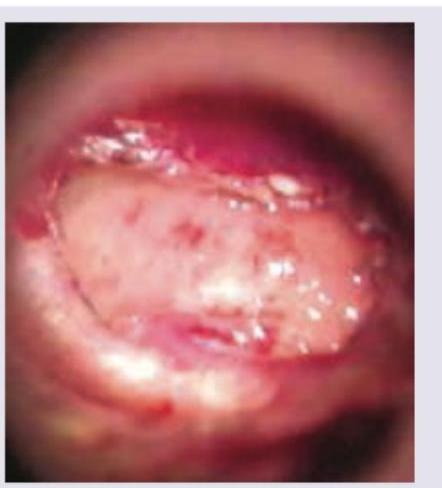
Explanation: ***Keratosis obturans*** - This condition is characterized by an **accumulation of desquamated keratin** and epithelial debris in the bony external auditory canal, leading to earache, conductive hearing loss, and sometimes widening of the ear canal. - The patient's presentation of **hearing loss**, **discomfort in the right ear**, and **keratin accumulation** aligns directly with the description of keratosis obturans. *Exostosis* - Exostoses are **bony growths** in the ear canal, often associated with cold water exposure. - While they can cause hearing loss and earwax impaction, they do not involve primary **keratin accumulation** as described. *Cerumen* - **Cerumen** is normal earwax, which is a mix of secretions and desquamated cells. - While excessive cerumen can cause hearing loss, the description of **keratin accumulation** suggests a more organized, dense plug than typical cerumen impaction. *Otitis externa* - **Otitis externa** is an inflammation or infection of the ear canal, presenting with pain, redness, swelling, and discharge. - While it can cause discomfort and sometimes lead to debris, the primary finding is **inflammation**, not specifically a large accumulation of keratin.
Explanation: ***Pulsatile tinnitus*** - **Pulsatile tinnitus** is often the earliest and most characteristic symptom of a glomus tumor due to its highly vascular nature and close proximity to vascular structures. - Patients typically report hearing a **heartbeat-like sound** in their ear that corresponds to their pulse. *Pulsatile otorrhoea* - **Pulsatile otorrhoea** would indicate active discharge from the ear, often associated with a perforating membrane or advanced infection, which is not an early sign of an internal vascular tumor. - This symptom suggests a more advanced or complicated ear pathology rather than the primary presentation of a glomus tumor. *Facial nerve palsy* - **Facial nerve palsy** occurs when the glomus tumor has grown to a significant size and begins to compress or invade the facial nerve, indicating a more advanced stage of the disease. - Isolated facial nerve weakness is not typically the first symptom but rather a complication of tumor extension. *Hearing Loss* - While **hearing loss** can be a symptom of a glomus tumor, it is often not the earliest and is usually **conductive** due to obstruction of the middle ear rather than sensorineural. - Many other middle ear pathologies like otitis media or otosclerosis cause hearing loss earlier and more commonly.
Otitis Externa
Practice Questions
Acute Otitis Media
Practice Questions
Chronic Otitis Media
Practice Questions
Complications of Otitis Media
Practice Questions
Otosclerosis
Practice Questions
Presbycusis
Practice Questions
Sudden Sensorineural Hearing Loss
Practice Questions
Noise-Induced Hearing Loss
Practice Questions
Ménière's Disease
Practice Questions
Benign Paroxysmal Positional Vertigo
Practice Questions
Vestibular Neuritis
Practice Questions
Tumors of the Ear and Temporal Bone
Practice Questions
Get full access to all questions, explanations, and performance tracking.
Start For Free