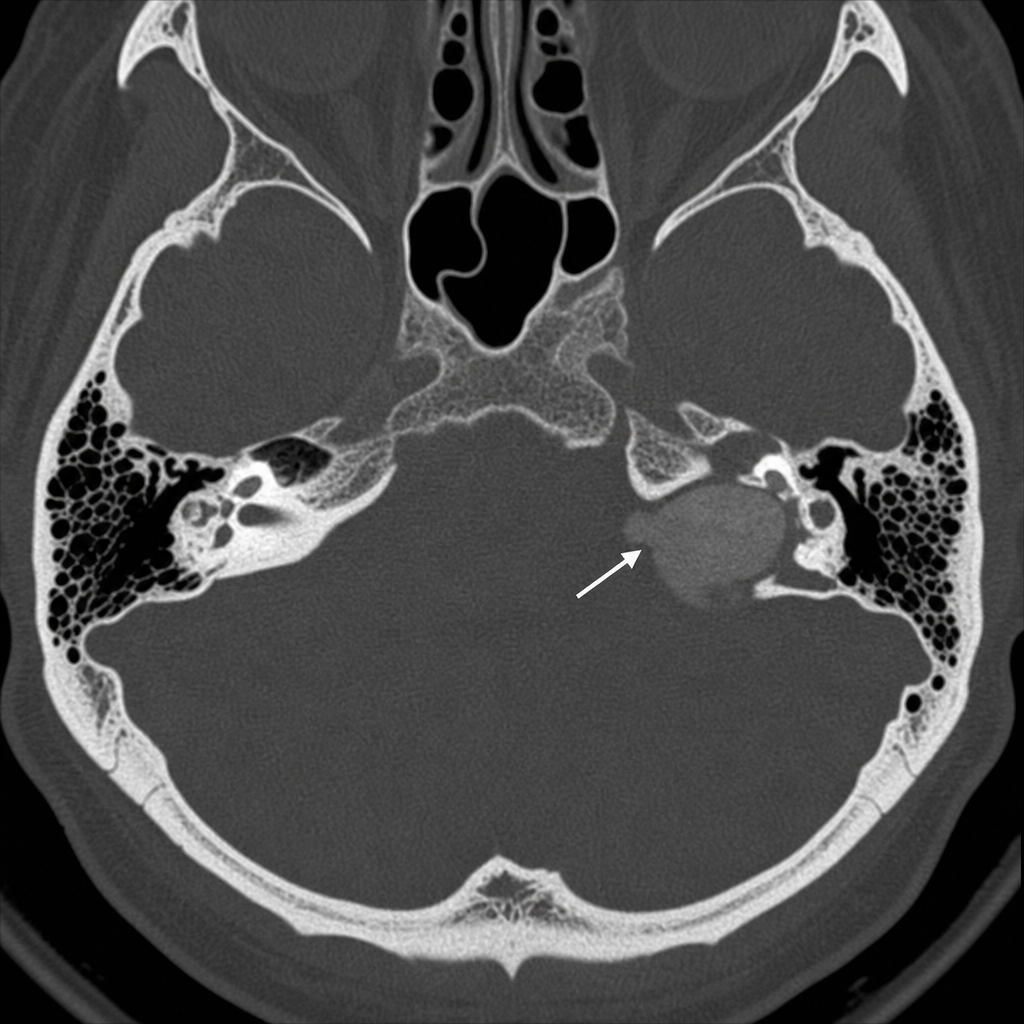
A female patient's pure tone audiometry (PTA) findings show the presence of a Carhart's notch. Which of the following specific clinical signs can be seen in this patient?
Most common bone affected by otosclerosis?
Positive Rinne test is seen in -
A 45-year-old female presents with hearing loss, vertigo, and tinnitus in her right ear. Which condition is most likely?
Surgeries used in management of Meniere's disease are all Except
35 years old female presents with tinnitus, vertigo and aural fullness. Likely diagnosis:
Carhart's notch in audiometry is seen in -
In which condition is the Schwartze sign observed?
Paracusis Willisii is seen in:
Otosclerosis affects which bone?
Explanation: ***Schwartz sign*** - A **Carhart's notch** (bone conduction dip at 2000 Hz) is a characteristic finding in **otosclerosis**, a condition where the stapes bone becomes fixed. - The **Schwartz sign** (reddish/pinkish hue behind the tympanic membrane) indicates **active otosclerosis** with increased vascularity in the promontory. - This is a **specific clinical sign** directly associated with otosclerosis and would be the expected finding on otoscopy. *Hitselberger sign* - The **Hitselberger sign** refers to **hypesthesia** (numbness or decreased sensation) in the **posterior external auditory canal wall**. - It is associated with **acoustic neuromas** (vestibular schwannomas) due to compression of the facial nerve, not otosclerosis. *Hennebert sign* - The **Hennebert sign** involves **nystagmus or vertigo** induced by changes in external ear canal pressure (fistula test). - It is typically seen in conditions causing a **perilymphatic fistula**, such as **Meniere's disease** or **syphilitic labyrinthitis**, not otosclerosis. *Rinne test negative (conductive hearing loss)* - While otosclerosis does cause **conductive hearing loss** with a negative Rinne test (bone conduction > air conduction), this is a **general audiometric finding**, not a specific clinical sign. - A negative Rinne test can occur in **any cause of conductive hearing loss** (chronic otitis media, ossicular discontinuity, cholesteatoma, etc.). - The question asks for a **specific clinical sign**, making the **Schwartz sign** the most appropriate answer as it specifically indicates otosclerosis.
Explanation: ***Stapes*** - **Otosclerosis** is characterized by abnormal bone remodeling in the otic capsule, primarily affecting the **stapes footplate**. - This leads to its fixation in the oval window, causing **conductive hearing loss**. - The **stapediovestibular joint** is the most common site, occurring in over 90% of cases. *Bony labyrinth* - While otosclerosis originates in the **otic capsule** (which forms the bony labyrinth), the term refers to a broader anatomical structure. - The specific site of clinical significance is the **stapes footplate**, not the labyrinth as a whole. *Mastoid process* - The **mastoid process** is part of the temporal bone but is structurally distinct from the middle ear and otic capsule. - It is not involved in otosclerosis pathology. *Incus* - While the **incus** is a middle ear ossicle, it is rarely affected by otosclerosis. - The disease process specifically targets the **stapes footplate** at the oval window, not other ossicles.
Explanation: ***Presbycusis*** - A **positive Rinne test** indicates that **air conduction is better than bone conduction (AC > BC)**, which is normal. - In presbycusis, which is a **sensorineural hearing loss**, the inner ear is affected. While hearing is impaired, the *relationship between air and bone conduction remains normal*, thus a positive Rinne test is maintained. *Wax impacted ear* - This causes a **conductive hearing loss** by obstructing the ear canal. - In conductive hearing loss, **bone conduction is better than air conduction (BC > AC)**, resulting in a **negative Rinne test**. *CSOM* - **Chronic Suppurative Otitis Media (CSOM)** involves infection and perforation of the tympanic membrane and/or damage to ossicles. - This leads to **conductive hearing loss**, where **bone conduction is better than air conduction**, resulting in a **negative Rinne test**. *Otosclerosis* - This condition involves **abnormal bone growth** in the middle ear, particularly around the stapes footplate, leading to fixation. - It causes a **conductive hearing loss**, characterized by **bone conduction being better than air conduction**, meaning a **negative Rinne test**.
Explanation: ***Meniere's disease*** - This condition classically presents with the triad of **vertigo**, **tinnitus**, and **fluctuating sensorineural hearing loss**, often in one ear. - The symptoms are thought to be caused by an excess of fluid, known as **endolymphatic hydrops**, in the inner ear. *Acoustic neuroma* - While it can cause **unilateral hearing loss** and **tinnitus**, it typically causes more persistent, progressive symptoms and **vertigo is less common or severe** than in Meniere's. - An acoustic neuroma is a **benign tumor** on the vestibulocochlear nerve (cranial nerve VIII) that can also cause **facial numbness** or weakness in later stages. *Chronic otitis media* - This condition primarily causes **conductive hearing loss** due to damage to the middle ear structures and often involves **tympanic membrane perforation** and **otorrhea**. - It does not typically present with vertigo unless there is an erosion into the inner ear (labyrinthitis), and **tinnitus is less prominent** than in Meniere's disease. *Otosclerosis* - This condition primarily causes **progressive conductive hearing loss** in younger to middle-aged adults, often bilaterally, due to abnormal bone growth in the middle ear. - While **tinnitus can occur**, **vertigo is rare** and not a primary symptom, distinguishing it from Meniere's disease.
Explanation: ***Stapedectomy*** - **Stapedectomy** is a surgical procedure primarily used to treat **otosclerosis**, a condition causing conductive hearing loss due to abnormal bone growth in the middle ear. - It involves removing the stapes bone and replacing it with a prosthesis to restore sound conduction, which is not a treatment for **Meniere's disease**. *Sacculotomy* - This procedure involves making a small incision in the **saccule** (part of the labyrinth) to decompress the inner ear in Meniere's disease. - Its goal is to reduce inner ear pressure and improve symptoms like **vertigo**, but it carries a risk of hearing loss. *Endolymphatic shunt operation* - This surgery aims to create a drainage path for excess **endolymph** from the endolymphatic sac, reducing pressure in the inner ear. - It is a common surgical option for intractable Meniere's disease to control vertigo attacks while preserving hearing. *Labyrinthectomy* - **Labyrinthectomy** is a destructive surgical procedure where the entire **labyrinth**, including the vestibular and cochlear structures, is removed. - It is typically reserved for severe, intractable Meniere's disease in patients with **non-serviceable hearing** in the affected ear, as it results in complete hearing loss.
Explanation: ***Meniere's Disease*** - The classic triad of symptoms for Meniere's disease includes **tinnitus**, **vertigo**, and **aural fullness**, along with fluctuating sensorineural hearing loss. - This condition is thought to be caused by an excess of **endolymphatic fluid** within the inner ear. *Ototoxicity* - This condition typically presents with **bilateral, symmetrical hearing loss** and tinnitus, often induced by certain medications (e.g., aminoglycosides, aspirin in high doses). - It usually does not involve episodic vertigo or aural fullness, which are characteristic of Meniere's. *Noise Induced Hearing Loss* - Characterized primarily by **permanent sensorineural hearing loss**, often at specific frequencies (e.g., 4000 Hz notch), and **tinnitus** after prolonged exposure to loud noise. - It does not typically cause the episodic vertigo or sense of aural fullness seen in Meniere's disease. *Otosclerosis* - This condition causes **progressive conductive hearing loss** due to abnormal bone growth around the stapes bone, impairing its movement. - While it can cause tinnitus, it typically does not present with vertigo or aural fullness, and the primary hearing loss is conductive, not sensorineural.
Explanation: ***Otosclerosis*** - **Carhart's notch** is a characteristic dip in the **bone conduction threshold** at 2000 Hz, typically observed in patients with **otosclerosis**. - This phenomenon is believed to be due to an artifact caused by the **stapes fixation** interfering with the normal inertial and compressional bone conduction mechanisms. *Ossicular discontinuity* - While ossicular discontinuity causes a **conductive hearing loss**, it typically does not present with a specific notch at 2000 Hz in bone conduction. - The audiogram would show a significant **air-bone gap** but without the characteristic bone conduction dip. *Otomycosis* - **Otomycosis** is a fungal infection of the external auditory canal and can cause **conductive hearing loss** if there is significant debris or swelling. - It does not, however, lead to a Carhart's notch on the audiogram. *Haemotympanum* - **Haemotympanum**, or blood behind the tympanic membrane, causes a **conductive hearing loss** by dampening the movement of the tympanic membrane and ossicles. - This condition results in a **flat or low-frequency conductive hearing loss** without the specific audiometric feature of Carhart's notch.
Explanation: ***Otosclerosis*** - The **Schwartze sign** is a reddish blush seen through the tympanic membrane, indicative of increased vascularity over the promontory. - It is a classic clinical finding in **active otosclerosis**, distinguishing it from inactive forms. *Glomus Jugulare* - This is a highly **vascular tumor** of the middle ear and mastoid, often presenting with pulsating tinnitus and hearing loss. - While vascularity is present, it manifests as a **reddish-blue mass behind the tympanic membrane**, not the diffuse blush characteristic of Schwartze sign. *Meniere's disease* - Characterized by episodes of **vertigo, fluctuating hearing loss, tinnitus**, and aural fullness due to endolymphatic hydrops. - It does not present with any specific otoscopic findings like the Schwartze sign. *Acoustic neuroma* - This is a **benign tumor of the vestibulocochlear nerve (CN VIII)**, typically causing progressive unilateral sensorineural hearing loss, tinnitus, and balance issues. - It does not produce any visible changes on otoscopy and therefore lacks the Schwartze sign.
Explanation: *CSOM* - **Chronic Suppurative Otitis Media (CSOM)** involves chronic infection and discharge from the middle ear, usually with a tympanic membrane perforation. - While it causes **conductive hearing loss**, it typically does not present with Paracusis Willisii; hearing loss is generally worse in noisy environments due to the masking effect of noise. *ASOM* - **Acute Suppurative Otitis Media (ASOM)** is an acute infection of the middle ear, usually characterized by pain, fever, and a bulging tympanic membrane. - It causes fluctuating **conductive hearing loss** acutely, but Paracusis Willisii is not a characteristic symptom. ***Otosclerosis*** - **Paracusis Willisii** is a classic symptom of otosclerosis, where the patient hears better in noisy environments. - This phenomenon occurs because others raise their voices in noisy environments, which helps the patient with **conductive hearing loss** to hear more clearly. - The stapes fixation in otosclerosis impairs normal air conduction, but when ambient noise forces people to speak louder, the increased sound intensity compensates for the conductive deficit. *Meniere's disease* - **Meniere's disease** is characterized by episodic vertigo, fluctuating sensorineural hearing loss, tinnitus, and aural fullness. - The hearing loss in Meniere's is typically **sensorineural**, and Paracusis Willisii is not associated with this condition; patients often experience increased sensitivity to loud sounds (recruitment).
Explanation: ***Stapes*** - **Otosclerosis** is a condition characterized by abnormal bone growth in the middle ear, specifically around the **stapes footplate**. - This abnormal growth fixates the stapes, preventing it from vibrating properly and leading to **conductive hearing loss**. - **Fenestral otosclerosis** (most common type) directly affects the oval window and stapes footplate. *Incus* - The **incus** is the middle ossicle in the chain, between the malleus and the stapes. - While it can be affected by other middle ear pathologies, otosclerosis primarily targets the **stapes**. *Malleus* - The **malleus** is the outermost ossicle, attached to the eardrum. - Its involvement in otosclerosis is rare and indirect, as the primary site of disease is the **stapes**. *Cochlea* - **Cochlear (retrofenestral) otosclerosis** can occur but is less common and typically causes **sensorineural hearing loss**. - The classic presentation of otosclerosis involves **stapedial fixation** causing conductive hearing loss, not primary cochlear involvement.
Get full access to all questions, explanations, and performance tracking.
Start For Free