Tests of SNHL are characterized by all EXCEPT
A pure tone audiogram showing a bone conduction dip (Carhart notch) at 2000 Hz is characteristic of-
What is the maximum allowable noise exposure according to the Indian Factory Act?
The acceptable noise level that can be tolerated without any damage to hearing is:
All the following are true about Meniere's disease except?
In noise induced hearing loss, audiogram shows a typical notch at
35 years old female presents with tinnitus, vertigo and aural fullness. Likely diagnosis:
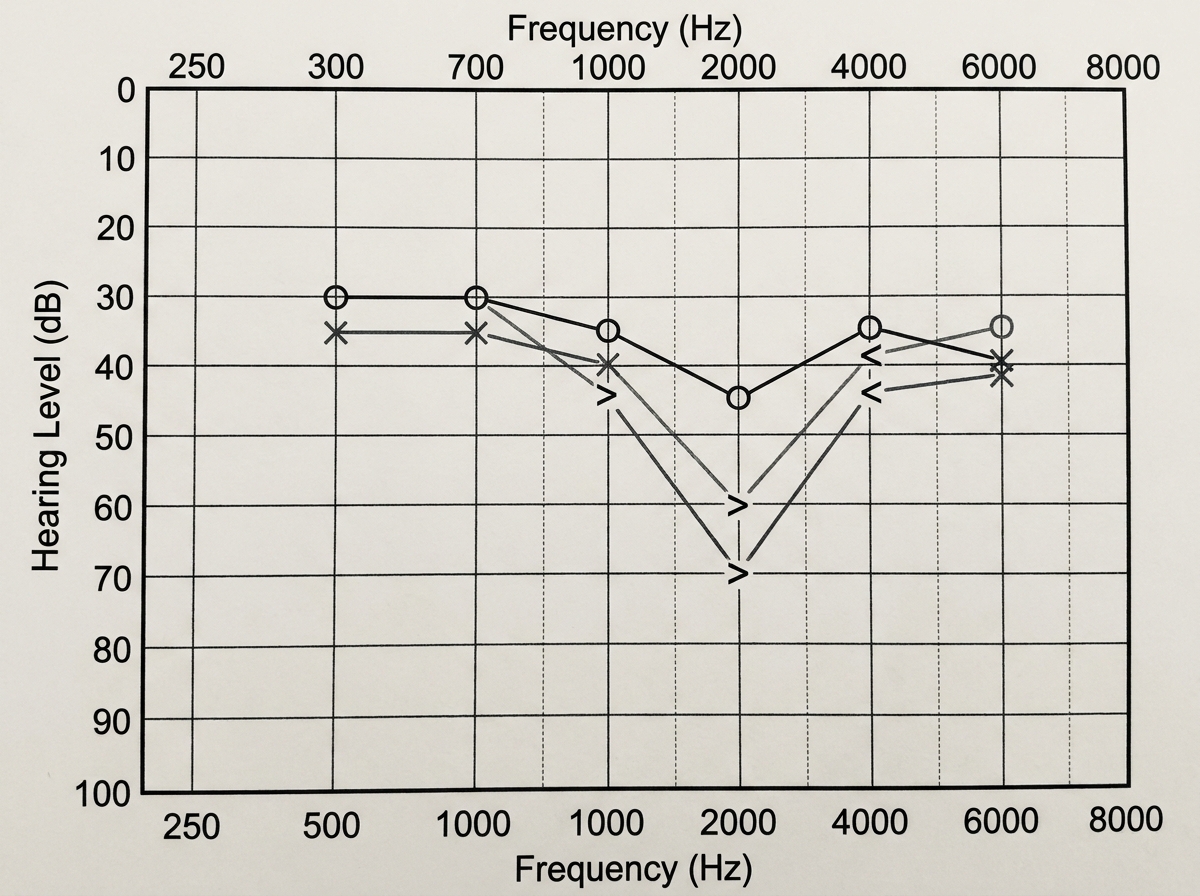
A female patient presents with mild conductive hearing loss (CHL) and tinnitus. Based on the pure tone audiometry (PTA) shown in the image, what is the most likely diagnosis?
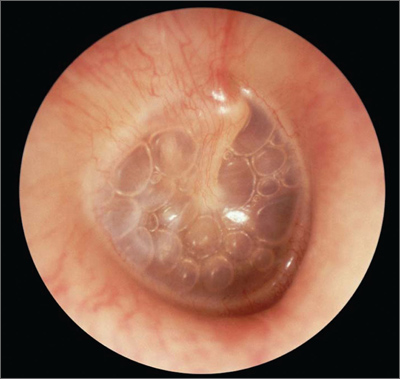
A 5-year-old child presents with reduced hearing for the past 2-3 months. Based on the otoscopy findings shown, what is the most likely diagnosis?
A patient presents with fullness in the ear and hearing loss. Tympanometry shows a type B curve. What does this indicate?
Explanation: ***Speech discrimination is good*** - In **sensorineural hearing loss (SNHL)**, damage to the cochlea or auditory nerve specifically impairs the processing of complex sound signals. - This typically leads to **poor speech discrimination**, particularly in noisy environments, making it difficult to understand spoken words even when the volume is adequate. - **This is NOT characteristic of SNHL**, making it the correct answer to this EXCEPT question. ***Positive Rinne test*** - A **positive Rinne test** (air conduction > bone conduction) **is characteristic of SNHL**. - In SNHL, both air and bone conduction are reduced equally, but air conduction remains better than bone conduction, maintaining the positive Rinne pattern. - There is **no air-bone gap** in SNHL (unlike conductive hearing loss where Rinne becomes negative). ***Weber lateralised to better ear*** - In **unilateral SNHL**, the **Weber test lateralizes to the better-hearing ear** because the healthy cochlea perceives the sound vibration more strongly. - The damaged ear is less able to detect the bone-conducted sound, causing the perception that the sound is louder in the unaffected ear. - **This is characteristic of SNHL**. ***More often involving high frequencies*** - **SNHL often affects high frequencies first** due to specific vulnerabilities of the **basal turn of the cochlea** to age-related degeneration, noise exposure, and ototoxic drugs. - This pattern of hearing loss is common in **presbycusis** and noise-induced hearing loss. - **This is characteristic of SNHL**.
Explanation: ***Otosclerosis*** - A **Carhart notch** is a characteristic feature on a pure tone audiogram in otosclerosis, specifically a **bone conduction dip at 2000 Hz**. - This notch is believed to be an **artifact of cochlear mechanics** caused by the fixation of the stapes in the oval window. *Presbyacusis* - Characterized by a **bilateral, symmetrical, high-frequency sensorineural hearing loss** that gradually worsens with age. - It does not present with a specific bone conduction dip like the Carhart notch. *Ototoxicity* - Hearing loss induced by ototoxic drugs (e.g., aminoglycosides, loop diuretics) typically causes **bilateral, progressive, high-frequency sensorineural hearing loss**. - A Carhart notch is not a typical finding in ototoxicity. *Noise induced hearing loss* - Often presents with a **sensorineural hearing loss notch at 4000 Hz** (or sometimes 3000 Hz or 6000 Hz) on the audiogram. - This pattern is distinct from the 2000 Hz bone conduction dip seen in a Carhart notch.
Explanation: ***85 dB for 8 hours*** - According to the **Indian Factory Act** and **Noise Pollution (Regulation and Control) Rules, 2000**, the maximum permissible noise exposure for workers is **85 decibels (dB)** over an **8-hour workday**. - This limit is established to prevent **noise-induced hearing loss (NIHL)** and ensure worker safety in industrial environments. - **Indian Standard IS 4954** specifies this limit, which is more conservative than some international standards. *90 dB for 8 hours* - **90 dB** is the limit used by **OSHA (USA)**, not the Indian Factory Act. - Indian standards are more stringent with **85 dB for 8 hours** to provide better hearing protection. - At 90 dB, Indian regulations would permit only **2.5-4 hours** of exposure, not 8 hours. *90 dB for 6 hours* - While the duration is closer to permissible exposure at 90 dB under Indian standards, this is not the standard maximum limit specified. - The benchmark reference is **85 dB for 8 hours**, from which other exposure levels are calculated. *80 dB for 8 hours* - While **80 dB** is considered a safe exposure level, it is below the maximum permissible limit. - The **Indian Factory Act** sets the threshold at **85 dB for 8 hours**, balancing safety with industrial practicality.
Explanation: ***85 dB*** - Prolonged exposure to noise levels above **85 dB** can cause permanent hearing damage, making this the generally accepted upper limit for safe, continuous exposure. - Occupational safety and health regulations, such as those from OSHA, often set permissible exposure limits based on this threshold. *100 dB* - Exposure to **100 dB** of noise for even relatively short periods (e.g., more than 15 minutes) can cause significant and irreversible hearing damage. - This level is considered highly damaging and is well above the safe limit for sustained exposure. *90 dB* - While 90 dB is slightly lower than 100 dB, it still represents a level that can cause **hearing loss** with prolonged or repeated exposure. - Regulatory bodies often mandate hearing protection and implement noise control measures when sound levels reach or exceed this threshold for certain durations. *95 dB* - Continuous exposure to **95 dB** of noise will lead to rapid and significant damage to the delicate structures of the inner ear. - This level is far beyond what can be tolerated without serious risk of permanent hearing impairment.
Explanation: ***Destroying the cochlea is mandatory*** - While various interventions, including **destructive procedures**, exist for Meniere's disease in severe cases refractory to medical therapy (e.g., labyrinthectomy, vestibular neurectomy), it is **not mandatory** for diagnosis or initial management. - Initial management typically involves **conservative medical treatment** to control symptoms, such as **diuretics**, low-salt diet, and symptomatic relief during attacks. *Low frequency hearing loss* - Meniere's disease typically presents with **fluctuating sensorineural hearing loss**, predominantly affecting **low frequencies** in the early stages. - This characteristic hearing loss is often associated with aural fullness and tinnitus. *Increase in endolymph* - The underlying pathology of Meniere's disease is believed to be **endolymphatic hydrops**, which is an **excessive accumulation of endolymph** in the inner ear. - This increased pressure within the endolymphatic system distorts the membranous labyrinth, leading to the classic symptoms. *Idiopathic* - Meniere's disease is generally considered **idiopathic**, meaning its specific cause is unknown. - While various theories exist regarding its etiology (e.g., viral infections, autoimmune disorders, vascular compromise), a definitive cause has not been identified.
Explanation: ***4000 Hz*** - Noise-induced hearing loss (NIHL) characteristically presents with a **notch** at **4000 Hz** on an audiogram, indicating damage to the hair cells in the cochlea that are tuned to this frequency range. - This specific frequency is particularly vulnerable to damage from loud noise exposure due to the **resonant properties of the external auditory canal** and the mechanical action of the inner ear. *2000 Hz* - While hearing loss can occur at 2000 Hz, it is not the typical or most prominent frequency affected in the early stages of **noise-induced hearing loss**. - Other types of hearing loss, such as **presbycusis** (age-related hearing loss), might show a general decline across various frequencies but not a distinct notch at 2000 Hz. *3000 Hz* - A notch at 3000 Hz could be observed, but the **4000 Hz notch** is considered the hallmark and most consistent finding in **NIHL**. - The damage pattern in NIHL tends to focus around the 4000 Hz region before spreading to adjacent frequencies. *1000 Hz* - Hearing loss at 1000 Hz is generally less common in the initial stages of **noise-induced hearing loss**, as the inner ear structures responsive to lower frequencies are often more resilient to noise damage. - Significant hearing loss at 1000 Hz would typically indicate a more advanced or diffuse hearing loss, rather than the characteristic **NIHL pattern**.
Explanation: ***Meniere's Disease*** - The classic triad of symptoms for Meniere's disease includes **tinnitus**, **vertigo**, and **aural fullness**, along with fluctuating sensorineural hearing loss. - This condition is thought to be caused by an excess of **endolymphatic fluid** within the inner ear. *Ototoxicity* - This condition typically presents with **bilateral, symmetrical hearing loss** and tinnitus, often induced by certain medications (e.g., aminoglycosides, aspirin in high doses). - It usually does not involve episodic vertigo or aural fullness, which are characteristic of Meniere's. *Noise Induced Hearing Loss* - Characterized primarily by **permanent sensorineural hearing loss**, often at specific frequencies (e.g., 4000 Hz notch), and **tinnitus** after prolonged exposure to loud noise. - It does not typically cause the episodic vertigo or sense of aural fullness seen in Meniere's disease. *Otosclerosis* - This condition causes **progressive conductive hearing loss** due to abnormal bone growth around the stapes bone, impairing its movement. - While it can cause tinnitus, it typically does not present with vertigo or aural fullness, and the primary hearing loss is conductive, not sensorineural.
Explanation: ***Otosclerosis*** - The audiogram shows a **conductive hearing loss** with a notable **Carhart notch** (bone conduction dip at 2000 Hz), which is characteristic of otosclerosis. - The patient's symptoms of **mild CHL** and **tinnitus** are consistent with the presentation of otosclerosis, a condition involving abnormal bone growth in the middle ear. *Ménière's disease* - This condition primarily causes **sensorineural hearing loss**, often fluctuating and affecting low frequencies initially, along with **vertigo, tinnitus, and aural fullness**. - The audiogram indicates **conductive hearing loss**, not sensorineural, and **vertigo** is not mentioned as a primary symptom. *Ototoxicity* - Ototoxicity typically results in **sensorineural hearing loss**, often bilateral and affecting high frequencies first. - The audiogram demonstrates **conductive hearing loss**, and there is no information about exposure to ototoxic medications. *Noise-Induced Hearing Loss (NIHL)* - NIHL is characterized by **sensorineural hearing loss**, typically with a **notch at 3000-6000 Hz** (most commonly 4000 Hz notch) on the audiogram. - The audiogram reflects **conductive hearing loss**, and the specific pattern does not match that of NIHL.
Explanation: ***Otitis media with effusion*** - The image clearly shows the presence of **bubbles behind the tympanic membrane**, indicating fluid accumulation in the middle ear. - This fluid leads to **reduced hearing**, as reported in the 5-year-old child, consistent with otitis media with effusion (OME), also known as "glue ear." *Myringitis* - Myringitis typically presents with **inflammation of the tympanic membrane**, often with vesicles or bullae on the drum, which are not visible here. - While it can cause pain, it does not typically show the characteristic bubbles signifying middle ear effusion. *Acute ear infection* - An **acute otitis media** would show a **bulging, erythematous (red), and opaque tympanic membrane** due to inflammation and pus, which is not consistent with the image. - Systemic symptoms like fever and severe ear pain would also be expected with an acute infection. *Air in the middle ear* - The presence of **air in the middle ear is normal** and indicates a healthy, functioning Eustachian tube. - The visible bubbles in the image are consistent with **fluid and air-fluid levels**, not just air, and indicate a pathological condition affecting hearing.
Explanation: ***Middle ear effusion*** - A **Type B tympanogram** indicates a stiff, non-compliant middle ear system, typically due to fluid (effusion) filling the middle ear space. - This fluid prevents the eardrum from moving freely, leading to the **flat curve** on the tympanogram and resulting in hearing loss and a sense of fullness. *Normal middle ear function* - **Normal middle ear function** would be indicated by a **Type A tympanogram**, which shows a characteristic peak pressure near 0 daPa and normal compliance. - This type of curve signifies an air-filled middle ear with a mobile tympanic membrane. *Eustachian tube dysfunction* - **Eustachian tube dysfunction** can lead to negative middle ear pressure, often shown as a **Type C tympanogram** (a peak shifted to negative pressure). - While it can precede effusion, a Type B curve specifically suggests the presence of fluid, not just pressure imbalance. *Otosclerosis* - **Otosclerosis** often results in increased stiffness of the ossicular chain, leading to a **Type As (shallow A) tympanogram**. - This curve shows normal middle ear pressure but reduced compliance with a shallow peak because of the fixation of the stapes.
Get full access to all questions, explanations, and performance tracking.
Start For Free