Auditory screening is required in children under which of the following conditions?
Cochlear implant is indicated at the minimum age of?
What type of tympanogram curve is typically seen in otosclerosis?
A patient presents with a hearing defect. His tuning fork test results were: Weber test - sound from a vibrating tuning fork was louder than normal; Schwabach test - bone conduction was better than normal; and Rinne test - air conduction did not outlast bone conduction. What is the most likely diagnosis?
A person hears two different tones in the left and right ear when presented with a single tone. What is this condition called?
In a case of bilateral hearing loss, what management options are appropriate?
In right-sided middle ear pathology, what will be the finding in Weber's test?
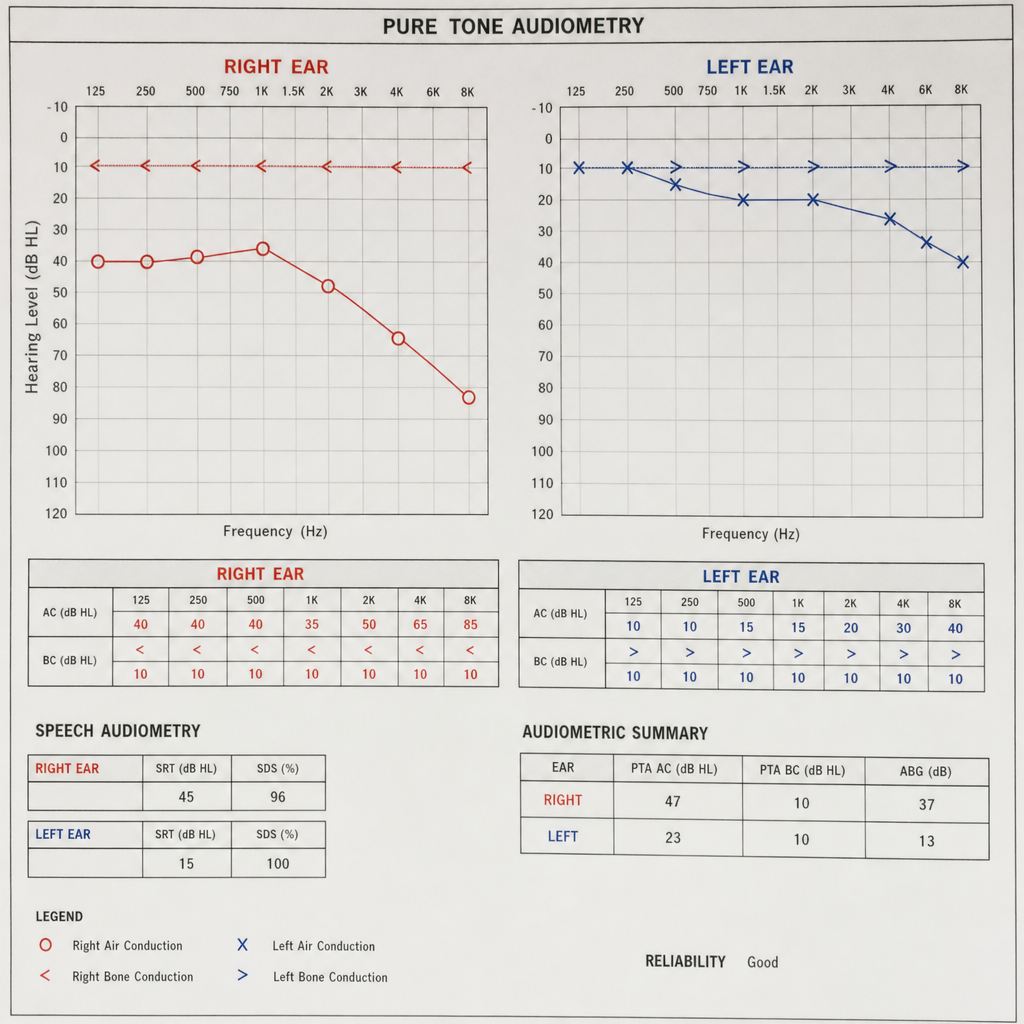
In which of the following conditions is the threshold for bone conduction normal and the threshold for air conduction increased?
What is the ideal hearing aid for a patient with anotia?
What is presbycusis?
Explanation: **Explanation:** The correct answer is **All of the above** because each condition listed is a recognized high-risk factor for **Sensorineural Hearing Loss (SNHL)** in neonates and children. 1. **Hyperbilirubinemia (Option A):** Severe jaundice requiring exchange transfusion is a critical risk factor. High levels of unconjugated bilirubin are neurotoxic and can cross the blood-brain barrier, leading to **Kernicterus**. This specifically damages the cochlear nuclei and the auditory nerve, often resulting in **Auditory Neuropathy Spectrum Disorder (ANSD)**. 2. **Prematurity (Option B):** Premature babies (especially those <1500g or born <32 weeks) are at high risk due to underdeveloped auditory systems, prolonged NICU stays, and frequent exposure to hypoxia, acidosis, or ototoxic medications. 3. **Aminoglycoside Therapy (Option C):** Drugs like Gentamicin and Amikacin are notoriously **ototoxic**. They cause permanent damage to the outer hair cells of the cochlea. Screening is essential to detect early-onset hearing loss before it impacts speech development. **Clinical Pearls for NEET-PG:** * **Universal Newborn Hearing Screening (UNHS):** The gold standard protocol is the **"1-3-6" Rule**: Screen by 1 month, Diagnose by 3 months, and Initiate Intervention by 6 months. * **Screening Tools:** **OAE (Otoacoustic Emissions)** is used for initial screening (tests outer hair cell function), while **AABR (Automated Auditory Brainstem Response)** is preferred for NICU graduates as it can detect retrocochlear pathology like ANSD. * **Other High-Risk Factors:** TORCH infections (especially CMV), craniofacial anomalies, and a family history of childhood SNHL.
Explanation: **Explanation:** **1. Why 12 months is correct:** The FDA and international guidelines currently recommend **12 months** as the minimum age for a cochlear implant (CI) in children with bilateral profound sensorineural hearing loss (SNHL). This age is chosen because it balances the benefits of early neuroplasticity with surgical safety. The first two years of life are the "critical period" for language development; implanting by 12 months allows the child to access auditory stimuli during peak brain plasticity, leading to superior speech and language outcomes compared to later implantation. **2. Why the other options are incorrect:** * **At birth / Intrauterine:** These are technically and physiologically impossible. A CI requires a surgical procedure on the temporal bone, which is not sufficiently developed at birth. Furthermore, hearing loss must be confirmed via objective tests (like ABR/BERA) and a trial of hearing aids must be attempted first. * **24 months:** While children were previously implanted at 24 months, modern advancements in anesthesia and surgical techniques have safely lowered the age to 12 months (and in some specific cases of meningitis-induced ossification, even earlier) to prevent developmental delays. **Clinical Pearls for NEET-PG:** * **Ideal Candidate:** Bilateral profound SNHL (thresholds >90 dB) who show little to no benefit from a 3–6 month trial of powerful hearing aids. * **Prerequisite:** A patent cochlea and a functional **Cochlear Nerve (CN VIII)** must be present (confirmed via MRI/CT). * **Components:** The CI bypasses damaged hair cells to directly stimulate the spiral ganglion cells. * **Meningitis Alert:** If SNHL is post-meningitis, urgent implantation is required regardless of age due to the risk of **Labyrinthitis Ossificans** (cochlear ossification).
Explanation: **Explanation:** In **Otosclerosis**, the primary pathology is the fixation of the stapes footplate in the oval window due to abnormal bone remodeling. This leads to increased **stiffness** of the ossicular chain. **1. Why 'As' is correct:** The **Type As** (S = Stiff/Shallow) tympanogram is characterized by a normal peak pressure (around 0 daPa) but a **reduced compliance** (low peak height). Since the ossicular chain is fixed and stiff in otosclerosis, the tympanic membrane cannot move as freely as normal, resulting in this shallow curve. **2. Why other options are incorrect:** * **Type Ad (D = Discontinuous/Deep):** Shows high compliance (tall peak). This is seen in **ossicular discontinuity** or a hypermobile/monomeric tympanic membrane. * **Type A:** Represents normal middle ear function with normal pressure and compliance. While early otosclerosis may show a Type A curve, the classic diagnostic finding is Type As. * **Type B (Flat):** Indicates no point of maximum compliance. This is typical of **Otitis Media with Effusion (Glue ear)**, a large TM perforation, or impacted wax. **Clinical Pearls for NEET-PG:** * **Carhart’s Notch:** A characteristic dip in the bone conduction threshold at **2 kHz** seen in otosclerosis. * **Schwartz Sign:** A flamingo-pink flush seen on the promontory through the TM, indicating active otosclerosis. * **Gelle’s Test:** Usually negative in otosclerosis (no change in hearing with increased ear canal pressure). * **Stapedial Reflex:** Typically absent or shows an "on-off" effect in early stages.
Explanation: ### Explanation The clinical findings described point toward **bilateral conductive hearing loss (CHL)**. To arrive at this diagnosis, we must analyze each tuning fork test: 1. **Rinne Test (Negative):** The statement "air conduction did not outlast bone conduction" means **BC > AC**. This is a "Negative Rinne," which is the hallmark of conductive deafness. 2. **Schwabach Test (Prolonged):** When bone conduction is "better than normal" (the patient hears the fork longer than the examiner), it indicates that ambient room noise is not being heard via air conduction, making the patient more sensitive to bone-conducted sounds. This occurs in **CHL**. 3. **Weber Test (Centralized/Louder):** In bilateral symmetrical conductive loss, the Weber test does not lateralize to one side but may be perceived as "louder than normal" or "centralized" because the masking effect of environmental noise is removed. #### Why the other options are incorrect: * **Sensorineural Deafness (SNHL):** Rinne would be positive (AC > BC), Schwabach would be "shortened" (examiner hears it longer), and Weber would lateralize to the better ear. * **Normal Hearing:** Rinne would be positive (AC > BC) and Schwabach would be "equal" to the examiner. * **Mixed Deafness:** While both components exist, the specific combination of a negative Rinne and a *prolonged* Schwabach specifically highlights the conductive pathology. #### High-Yield Clinical Pearls for NEET-PG: * **Rinne Test:** Requires a 256 Hz or 512 Hz fork. A negative Rinne indicates a conductive gap of at least **15–20 dB**. * **Weber Test:** Lateralizes to the **worse ear** in conductive loss and the **better ear** in sensorineural loss. * **ABC (Absolute Bone Conduction) Test:** A variation of Schwabach where the examiner plugs the patient's external canal to eliminate the masking effect of noise. It is **decreased in SNHL** and **normal in CHL**.
Explanation: **Explanation:** **1. Why Binaural Diplacusis is Correct:** Diplacusis (double hearing) is a clinical phenomenon where a single auditory stimulus is perceived differently by the two ears. **Binaural diplacusis** (specifically *diplacusis binauralis dysharmonica*) occurs when a single frequency is presented to both ears, but the patient perceives a different pitch in each ear. This is typically caused by a lesion in the cochlea (sensory hearing loss), where damage to the hair cells or the basilar membrane alters the frequency-to-place mapping, causing the brain to interpret the same frequency as two distinct tones. **2. Analysis of Incorrect Options:** * **A. Monoaural diplacusis:** In this condition, a single tone is perceived as two different tones or a "fuzzy" sound in the **same ear**. It is often associated with localized cochlear pathology. * **C. Tinnitus:** This refers to the perception of sound (ringing, buzzing, or hissing) in the absence of an external auditory stimulus. It is a "phantom" sound, not a distorted perception of an existing tone. * **D. Increased sensitivity to sound:** This is known as **Hyperacusis**. It is a condition where normal environmental sounds are perceived as uncomfortably loud or painful, often seen in Bell’s palsy (due to stapedius muscle paralysis) or recruitment phenomenon. **3. NEET-PG High-Yield Pearls:** * **Recruitment:** A hallmark of cochlear lesions where there is an abnormal growth in the perception of loudness. * **Diplacusis** is a classic sign of **Cochlear pathology** (e.g., Meniere’s disease). * If a patient hears a sound for a longer duration than the stimulus, it is called **Diplacusis echoica**. * **Metanousis** is another term sometimes used for distorted pitch perception.
Explanation: ### Explanation The correct answer is **Sodium fluoride**. This question specifically pertains to the medical management of **Otosclerosis**, a common cause of progressive bilateral conductive or mixed hearing loss in young adults. **Why Sodium Fluoride is correct:** Sodium fluoride is used in the **active phase of Otosclerosis (Otospongiosis)**, characterized by a positive **Schwartze sign** (a reddish hue behind the tympanic membrane due to increased vascularity). It works by: 1. Inhibiting proteolytic enzymes that destroy bone. 2. Promoting the conversion of active spongiotic bone into more stable, dense sclerotic bone. 3. Preventing the progression of sensory-neural hearing loss (SNHL) in cochlear otosclerosis. **Why other options are incorrect:** * **Stapedectomy (A):** This is the surgical treatment of choice for **stable/inactive** otosclerosis. It is contraindicated in the active (spongiotic) phase because it can lead to a "dead ear" or sensorineural loss due to the hypervascularity of the footplate. * **Cochlear Implant (B):** This is reserved for profound bilateral sensorineural hearing loss where hearing aids provide no benefit. It is not the primary management for standard bilateral hearing loss unless it is end-stage. * **Hearing aid bone implant (C):** While BAHA (Bone Anchored Hearing Aids) can be used for conductive loss, they are typically second-line options if conventional hearing aids or surgery are not feasible. **Clinical Pearls for NEET-PG:** * **Schwartze Sign:** Pathognomonic for active otospongiosis; indicates the need for Sodium Fluoride. * **Carhart’s Notch:** A characteristic dip in the bone conduction threshold at **2000 Hz** seen in otosclerosis. * **Gelle’s Test:** Negative in otosclerosis (indicates a fixed ossicular chain). * **Tympanometry:** Typically shows an **As type** curve (reduced compliance).
Explanation: ### Explanation **Underlying Medical Concept** Weber’s test is a tuning fork test (using 512 Hz) that assesses bone conduction. In a normal individual, the sound is heard equally in both ears (centralized). However, in **Conductive Hearing Loss (CHL)**—such as middle ear pathology—the sound **lateralizes to the affected ear**. This occurs because of two main reasons: 1. **Masking Effect:** In the diseased ear, ambient room noise is blocked by the pathology (e.g., fluid or ossicular fixation), making the ear more sensitive to the bone-conducted vibrations of the tuning fork. 2. **Occlusion Effect:** The pathology prevents the escape of sound energy from the external auditory canal, reflecting it back to the cochlea. Since the question specifies **right-sided middle ear pathology** (a conductive defect), the sound will be heard louder in the **right ear**. **Analysis of Options** * **Option A & B (Normal/Centralized):** These are the findings in a healthy individual or someone with symmetrical hearing. * **Option D (Lateralized to the left side):** This would occur if the patient had Sensorineural Hearing Loss (SNHL) in the right ear or CHL in the left ear. In SNHL, the sound lateralizes to the **better-hearing** ear. **Clinical Pearls for NEET-PG** * **Weber’s Test Rule of Thumb:** Lateralizes to the **Worse** ear in CHL; lateralizes to the **Better** ear in SNHL. * **Rinne’s Test:** Usually performed alongside Weber's. In middle ear pathology, Rinne’s will be **Negative** (Bone Conduction > Air Conduction). * **High-Yield Combo:** A patient with a **Negative Rinne on the right** and **Weber lateralized to the right** definitively has Right Conductive Hearing Loss.
Explanation: ### Explanation The question describes a classic **Air-Bone Gap (ABG)**, which is the hallmark of **Conductive Hearing Loss (CHL)**. **1. Why Middle Ear Disease is Correct:** In Conductive Hearing Loss, the pathology lies in the external or middle ear (e.g., Otitis Media, Otosclerosis, or impacted wax). These structures are responsible for conducting sound waves to the cochlea. * **Air Conduction (AC):** Increased threshold (poor hearing) because the sound must pass through the diseased middle ear. * **Bone Conduction (BC):** Normal threshold because the bone vibrator bypasses the middle ear and stimulates the cochlea directly. If the cochlea is healthy, BC remains normal. **2. Why the Other Options are Incorrect:** * **Inner Ear Disease (B) & Cochlear Nerve Lesion (C):** These cause **Sensorineural Hearing Loss (SNHL)**. In SNHL, both AC and BC thresholds are increased (poor) to a similar degree, meaning there is no Air-Bone Gap. * **Temporal Lobe Lesion (D):** This represents a **Central Auditory Pathway** lesion. Pure tone audiometry (AC and BC) is often surprisingly normal or shows complex processing deficits rather than a simple threshold shift, as the primary auditory cortex is involved in interpretation rather than basic sound detection. **3. NEET-PG High-Yield Pearls:** * **Air-Bone Gap:** Defined as a difference of **>15 dB** between AC and BC thresholds. * **Carhart’s Notch:** A specific dip in the BC threshold at **2000 Hz** seen in Otosclerosis (a middle ear disease), which disappears after stapedectomy. * **Rinne Test:** In middle ear disease (CHL), the Rinne test is **Negative** (BC > AC). * **Weber Test:** Lateralizes to the **poorer ear** in CHL and to the **better ear** in SNHL.
Explanation: ### Explanation **Correct Option: B. Bone anchored hearing aid (BAHA)** **Underlying Medical Concept:** Anotia is the complete absence of the pinna and the external auditory canal (atresia). In such cases, sound cannot be transmitted through the external ear to the tympanic membrane (conductive hearing loss). A **Bone Anchored Hearing Aid (BAHA)** is the ideal solution because it bypasses the external and middle ear entirely. It works via **direct bone conduction**, where a titanium implant is surgically fixed into the skull (mastoid bone). The sound processor converts sound into vibrations, which are transmitted through the bone directly to the functioning cochlea. **Why incorrect options are wrong:** * **A. In-the-canal (ITC) hearing aid:** These require a patent external auditory canal to house the device. In anotia/canal atresia, there is no canal to place the aid. * **C. Vestibular implant:** These are experimental devices designed to restore balance function in patients with bilateral vestibular loss, not to treat hearing loss. * **D. Transcutaneous hearing aid:** While some BAHA models are transcutaneous (using magnets), the term is broad. In the context of anotia, the specific gold standard for permanent rehabilitation is the bone-anchored system. **High-Yield Clinical Pearls for NEET-PG:** * **Indications for BAHA:** Bilateral canal atresia (like Treacher Collins syndrome), chronic suppurative otitis media (CSOM) where a discharging ear prevents the use of conventional aids, and single-sided deafness. * **Minimum Age:** BAHA implantation is typically delayed until **age 5** when the skull bone is thick enough (before this, a "softband" BAHA is used). * **Anotia vs. Microtia:** Anotia is the total absence of the pinna; Microtia is a small, malformed pinna. Both are frequently associated with canal atresia.
Explanation: **Explanation:** **Presbycusis** is defined as progressive, bilateral, symmetrical **sensorineural hearing loss (SNHL)** resulting from the physiological aging process. It typically affects high frequencies first and is caused by the degeneration of the hair cells in the Organ of Corti, atrophy of the stria vascularis, or loss of spiral ganglion neurons. **Analysis of Options:** * **Option B (Correct):** The term is derived from Greek (*presbys* = elder, *akousis* = hearing). It is the most common cause of hearing impairment in the elderly, usually manifesting after age 60. * **Option A:** Loss of accommodation power is called **Presbyopia**, which is the age-related decline in the eye's ability to focus on near objects. * **Option C:** Noise-induced hearing loss (NIHL) is caused by chronic exposure to loud sounds. It characteristically shows a "dip" or **notch at 4000 Hz** (Acoustic dip) on an audiogram. * **Option D:** Congenital deafness refers to hearing loss present at birth, often due to genetic factors or intrauterine infections (e.g., TORCH). **High-Yield Clinical Pearls for NEET-PG:** * **Audiogram Pattern:** Shows a sloping, symmetrical SNHL, primarily affecting **high frequencies**. * **Speech Discrimination:** Patients often complain that they can "hear but not understand," indicating a disproportionately low speech discrimination score (phonemic regression). * **Schuknecht’s Classification:** Includes Sensory, Neural, Strial (Metabolic), and Cochlear Conductive types. * **Management:** The treatment of choice is **Bilateral Hearing Aids**.
Hearing Assessment Techniques
Practice Questions
Tympanometry and Acoustic Reflexes
Practice Questions
Otoacoustic Emissions
Practice Questions
Auditory Brainstem Response
Practice Questions
Hearing Aids
Practice Questions
Cochlear Implants
Practice Questions
Bone-Anchored Hearing Devices
Practice Questions
Speech and Language Development
Practice Questions
Articulation Disorders
Practice Questions
Stuttering
Practice Questions
Dysphonia
Practice Questions
Rehabilitation of Hearing-Impaired Children
Practice Questions
Get full access to all questions, explanations, and performance tracking.
Start For Free