Carhart's notch is typically observed at which frequency?
What is the initial screening test for newborn hearing disorder?
All are true about electrocochleography except?
All are true about stapedial reflex except?
Which of the following conditions causes the maximum hearing loss?
Otoacoustic emissions arise from which structures?
Auditory fatigue commonly occurs at which frequency range?
Rinne's test negative is seen in which of the following conditions?
Which of the following is not a cause of conductive hearing loss?
A 30-year-old female presents with hearing loss. An audiogram is obtained. What is her most likely diagnosis?
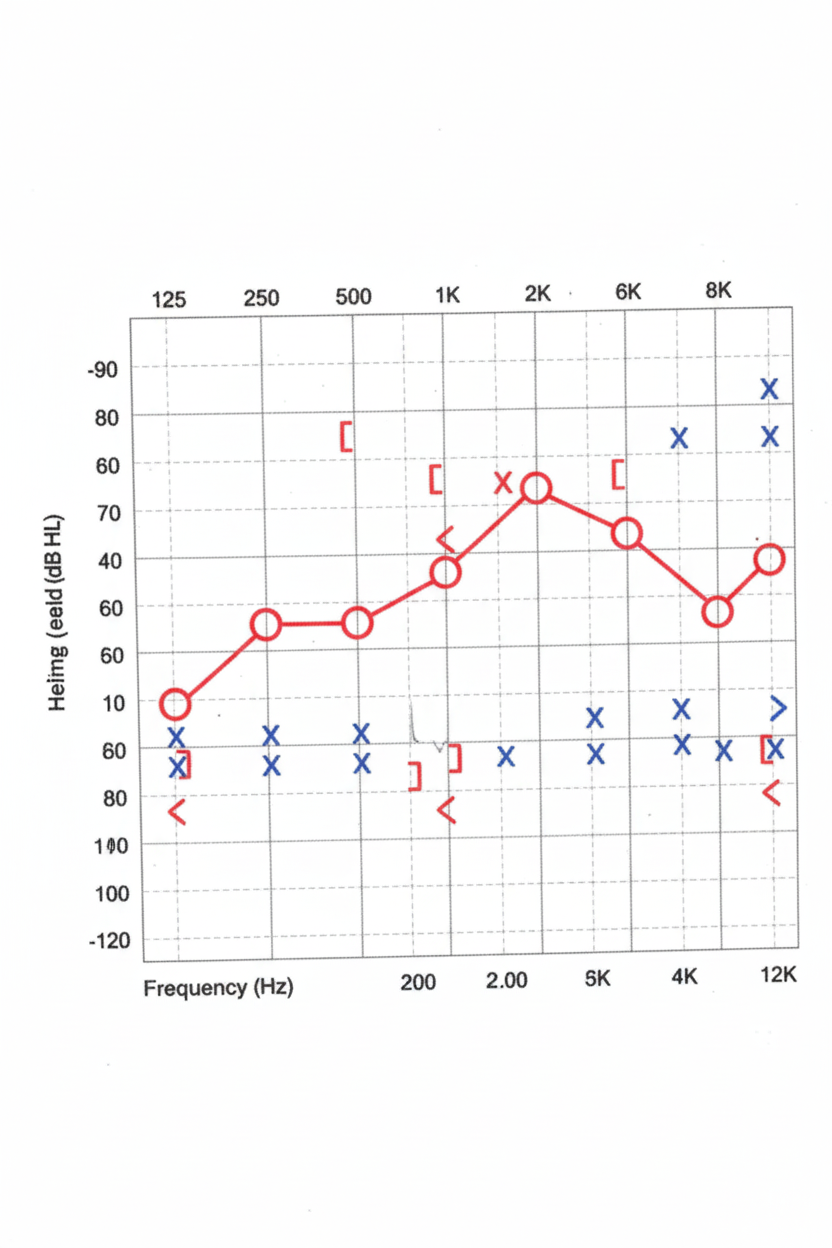
Explanation: **Explanation:** **Carhart’s Notch** is a classic audiological sign of **Otosclerosis**. It is characterized by a mechanical dip in the bone conduction threshold, most prominent at **2000 Hz**. **1. Why 2000 Hz is correct:** The notch is not a result of true sensorineural hearing loss but is a **mechanical artifact**. In a normal ear, the resonance of the ossicular chain contributes to the bone conduction sensitivity. In otosclerosis, stapes fixation disrupts this natural resonance and reduces the inertial component of bone conduction. This mechanical efficiency loss is maximal at 2000 Hz. Notably, this notch often disappears after a successful stapedotomy/stapedectomy. **2. Why other options are incorrect:** * **1000 Hz & 3000 Hz:** While the dip can occasionally involve these frequencies, the nadir (deepest point) is consistently localized at 2000 Hz. * **4000 Hz:** This frequency is associated with **Acoustic Trauma** (Noise-Induced Hearing Loss), where a dip is seen in both air and bone conduction (Boiler-maker's notch). **Clinical Pearls for NEET-PG:** * **Schwartze Sign:** A flamingo-pink flush seen on the promontory through the TM, indicating active otosclerosis (vascularization). * **Gelle’s Test:** Negative in otosclerosis (no change in hearing with increased ear canal pressure). * **Tympanometry:** Typically shows an **As type** (stiffened) curve. * **Stapedial Reflex:** Usually absent or shows an "on-off" effect in early stages. * **Treatment of choice:** Stapedotomy (using a Teflon piston). Medical management includes Sodium Fluoride to stabilize active lesions.
Explanation: **Explanation:** The gold standard for **Universal Newborn Hearing Screening (UNHS)** follows a staged protocol, where **Otoacoustic Emissions (OAE)** is the preferred initial screening test. **1. Why OAE is the Correct Answer:** OAEs are low-level sounds produced by the **Outer Hair Cells (OHC)** of the cochlea. The test is non-invasive, quick (takes about 1 minute), objective, and does not require a specialist to perform. It is highly sensitive in detecting cochlear hearing loss. If a newborn "fails" the OAE, they are then referred for an ABR to confirm the diagnosis. **2. Analysis of Incorrect Options:** * **Auditory Brainstem Response (ABR):** While ABR is the most definitive objective test for hearing and is used to diagnose **Auditory Neuropathy**, it is more expensive and time-consuming. It is used as a **second-tier** screening tool or for confirmation after a failed OAE. * **Free Field Audiometry:** This is a subjective behavioral test used for older infants (usually >6 months) who can localize sound. It is not suitable for newborn screening. * **Visual Reinforcement Audiometry (VRA):** This is a behavioral test used for children aged **6 months to 2.5 years**. It relies on the child turning their head toward a sound source in response to a visual reward. **Clinical Pearls for NEET-PG:** * **Screening Protocol:** OAE is done first $\rightarrow$ if failed, repeat OAE $\rightarrow$ if failed again, perform **Automated ABR (AABR)**. * **Target:** The goal is the **1-3-6 Rule**: Screening by **1 month**, Diagnosis by **3 months**, and Intervention (Hearing aids/Cochlear implant) by **6 months**. * **Limitation:** OAE cannot detect **Retro-cochlear lesions** (e.g., Auditory Neuropathy Spectrum Disorder); ABR is required for these cases.
Explanation: Electrocochleography (ECochG) is a technique used to record the electrical potentials generated in the inner ear and auditory nerve in response to sound stimulation. **Explanation of the Correct Answer (Option B):** Option B is false because the **Action Potential (AP)** represents the synchronous firing of the **distal portion of the auditory nerve (CN VIII)**, not the hair cells. Furthermore, the AP is characterized by a **negative deflection (N1 and N2)**, not positive waves. The potentials generated by the hair cells are the Cochlear Microphonic (CM) and Summating Potential (SP). **Analysis of Other Options:** * **Option A:** True. To obtain a clear signal-to-noise ratio, the electrode should be as close to the cochlea as possible. Transtympanic electrodes (placed on the promontory) provide the highest amplitude, though extratympanic electrodes (near the TM) are more commonly used clinically. * **Option C:** True. The **Cochlear Microphonic (CM)** is an AC potential that primarily reflects the integrity of the **outer hair cells**. * **Option D:** True. ECochG is most commonly used to diagnose and monitor **Meniere’s disease** (Endolymphatic Hydrops). An increased **SP/AP ratio (>0.45)** is a classic diagnostic marker. **High-Yield Clinical Pearls for NEET-PG:** 1. **Components of ECochG:** CM (Outer hair cells), SP (Inner hair cells/Organ of Corti), and AP (Auditory nerve). 2. **Meniere’s Disease:** Look for an increased **SP/AP ratio** due to the displacement of the basilar membrane. 3. **Auditory Neuropathy:** Characterized by a preserved CM but absent or distorted ABR/AP. 4. **Electrode Placement:** Transtympanic is the "Gold Standard" for maximum amplitude.
Explanation: ### Explanation The stapedial reflex (acoustic reflex) is an involuntary contraction of the stapedius muscle in response to high-intensity sound. **1. Why Option B is the Correct Answer (The Exception):** The stapedial reflex is a **subcortical reflex arc**. It does not involve the auditory cortex. The reflex arc follows this pathway: * **Afferent:** 8th Nerve (Vestibulocochlear) * **Center:** Ventral Cochlear Nucleus and **Superior Olivary Complex (SOC)** in the brainstem (Pons). * **Efferent:** 7th Nerve (Facial) to the stapedius muscle. Since the integration occurs in the brainstem, any statement claiming the auditory cortex is the center is physiologically incorrect. **2. Analysis of Other Options:** * **Option A:** It is used to detect **non-organic (functional) hearing loss**. If a patient claims total deafness but demonstrates a brisk stapedial reflex at 70–100 dB, the hearing loss is likely feigned. * **Option C:** The reflex requires an intact **8th nerve** to carry the sound stimulus and an intact **7th nerve** to contract the muscle. Absence of the reflex can localize lesions in either nerve. * **Option D:** It helps differentiate **Cochlear vs. Retrocochlear** lesions. In cochlear lesions (e.g., Meniere’s), the reflex is often present at lower sensation levels due to **recruitment**. In retrocochlear lesions (e.g., Acoustic Neuroma), the reflex is typically absent or shows **reflex decay**. ### High-Yield Clinical Pearls for NEET-PG: * **Reflex Decay:** Significant if the reflex amplitude decreases by >50% within 10 seconds; highly suggestive of **8th nerve pathology** (Retrocochlear). * **Otosclerosis:** The reflex is typically **absent** because the stapes is fixed and cannot move. * **Facial Nerve Palsy:** The presence of the stapedial reflex indicates the lesion is **distal** to the nerve's branch to the stapedius muscle (prognostically favorable). * **Sound Intensity:** The reflex is usually elicited at **70–100 dB** above the hearing threshold.
Explanation: ### Explanation The degree of hearing loss in middle ear pathology depends on how much the **sound transformer mechanism** is impaired and whether the **phase difference** between the oval and round windows is maintained. **1. Why Option A is Correct:** In **ossicular disruption with an intact tympanic membrane**, the hearing loss is maximal (typically **54–60 dB**). This occurs because the intact drum acts as a barrier, preventing sound waves from reaching the oval window directly. Simultaneously, the break in the ossicular chain prevents the transmission of vibrations. This results in the loss of the "transformer action" of the middle ear and eliminates the effective pressure difference between the two windows. **2. Analysis of Incorrect Options:** * **Option B:** While this describes a type of ossicular disruption, Option A is the more comprehensive clinical description. If the malleus and incus are disrupted but the stapes is intact and the drum is healed/intact, the loss remains in the 54–60 dB range. * **Option C:** Partial fixation of the stapes (early Otosclerosis) typically results in a lower degree of conductive hearing loss (initially **20–30 dB**), as some vibrations still pass through the stiffened chain. * **Option D:** Otitis Media with Effusion (OME) causes fluid to dampen the movement of the drum and ossicles, usually resulting in a mild to moderate hearing loss of **20–40 dB**. **3. High-Yield Clinical Pearls for NEET-PG:** * **Normal Middle Ear Gain:** The transformer mechanism provides a gain of approximately **25–30 dB**. * **Maximum Conductive Hearing Loss:** The theoretical maximum is **60 dB**. If a patient has a conductive loss >60 dB, suspect an additional sensorineural component (Mixed Hearing Loss). * **Perforation vs. Disruption:** A simple tympanic membrane perforation usually causes 10–30 dB loss. If the drum is perforated *and* the chain is disrupted, the loss is actually *less* (approx. 38 dB) than if the drum were intact, because sound can reach the oval window directly.
Explanation: **Explanation:** **Otoacoustic Emissions (OAEs)** are low-intensity sounds generated within the cochlea that can be measured in the external auditory canal. **Why Outer Hair Cells (OHCs) are correct:** The primary source of OAEs is the **Outer Hair Cells**. These cells possess a unique property called **electromotility**, mediated by the protein **prestin**. OHCs act as a "cochlear amplifier" by actively vibrating and changing length in response to sound. This mechanical energy travels backward through the middle ear ossicles to the tympanic membrane, where it is recorded as an OAE. The presence of OAEs indicates a healthy, functioning cochlear amplifier. **Why other options are incorrect:** * **Inner Hair Cells (IHCs):** These are the primary sensory receptors that convert mechanical energy into neural impulses (transduction). They do not possess motile properties and do not generate OAEs. * **Organ of Corti:** While the OHCs are *part* of the Organ of Corti, this option is too broad. The specific physiological mechanism of OAEs is localized strictly to the OHCs. **High-Yield Clinical Pearls for NEET-PG:** 1. **Screening:** OAE is the most common tool for **Universal Newborn Hearing Screening (UNHS)** because it is non-invasive, objective, and rapid. 2. **Pre-neural:** Since OAEs test OHC function, they will be **present** in cases of **Auditory Neuropathy Spectrum Disorder (ANSD)** but **absent** in sensory hearing loss (cochlear damage). 3. **Requirements:** For OAEs to be recorded, the patient must have a **normal middle ear** function. Even minor middle ear effusion can block the emission. 4. **Types:** Spontaneous (SOAEs) and Evoked (EOAEs). Clinical testing usually utilizes Transient Evoked (TEOAE) or Distortion Product (DPOAE).
Explanation: **Explanation:** The correct answer is **4000 Hz (Option C)**. This phenomenon is primarily related to the pathophysiology of **Noise-Induced Hearing Loss (NIHL)** and the anatomical configuration of the human ear. **Why 4000 Hz is correct:** Auditory fatigue, often manifesting as a Temporary Threshold Shift (TTS), most commonly occurs at 4000 Hz due to the **"Half-Octave Shift"** rule. The human external auditory canal has a resonant frequency of approximately 3000 Hz, which amplifies sound in that range. When the ear is exposed to loud noise, the maximum acoustic energy is delivered to the basal turn of the cochlea. Due to the mechanics of the traveling wave, the maximum damage/fatigue occurs about half an octave above the exposure frequency, typically resulting in a characteristic "dip" or "notch" at 4000 Hz (Boies' notch). **Analysis of Incorrect Options:** * **2000 Hz (Option A):** While speech frequencies (500–2000 Hz) are critical for communication, they are less susceptible to initial noise-induced fatigue compared to higher frequencies. * **3000 Hz (Option B):** This is the resonant frequency of the ear canal where energy is highest, but the physiological damage manifests slightly higher at 4000 Hz. * **8000 Hz (Option D):** This frequency is at the extreme end of the basal turn. While it can be affected in presbycusis or ototoxicity, it is not the primary site for initial auditory fatigue from noise. **Clinical Pearls for NEET-PG:** * **Acoustic Notch:** In NIHL, the notch is deepest at 4000 Hz, with recovery at 8000 Hz. * **Carhart’s Notch:** Seen in **Otosclerosis**, typically at **2000 Hz** (bone conduction). * **Early Sign:** Auditory fatigue is the earliest sign of noise damage; if the stimulus continues, it leads to a Permanent Threshold Shift (PTS). * **Dip at 6000 Hz:** Some recent studies suggest a notch at 6000 Hz is also common, but 4000 Hz remains the classic "textbook" answer for exams.
Explanation: ### Explanation The **Rinne’s test** is a tuning fork test used to compare Air Conduction (AC) and Bone Conduction (BC). 1. **Why CSOM is correct:** Chronic Suppurative Otitis Media (CSOM) causes **Conductive Hearing Loss (CHL)** due to a perforated tympanic membrane or ossicular chain disruption. In CHL, the sound transmission through the external/middle ear is impaired, making BC more efficient than AC. A **"Negative Rinne"** (BC > AC) occurs when there is a conductive gap of at least **15–20 dB**. 2. **Why the other options are incorrect:** * **Presbycusis (A), Labyrinthitis (C), and Meniere’s disease (D)** are all causes of **Sensorineural Hearing Loss (SNHL)**. In SNHL, both AC and BC are reduced, but the relative efficiency of the conducting mechanism remains intact. Therefore, AC remains better than BC (**Positive Rinne**), though the overall hearing duration is shortened. ### Clinical Pearls for NEET-PG: * **False Negative Rinne:** Seen in **severe unilateral SNHL**. The patient perceives sound via the "better" ear through bone conduction, leading the examiner to believe BC > AC in the affected ear. * **Weber Test Correlation:** In CSOM (CHL), the Weber test will **lateralize to the poorer ear**. In SNHL, it lateralizes to the **better ear**. * **Tuning Fork Choice:** 512 Hz is the preferred frequency as it provides the best balance between bone-air gap sensitivity and minimal vibrotactile sensation. * **Summary Table:** | Condition | Rinne Test | Weber Test | | :--- | :--- | :--- | | **Normal** | Positive (AC > BC) | Central | | **Conductive (e.g., CSOM)** | **Negative (BC > AC)** | Lateralizes to **affected** ear | | **Sensorineural (e.g., Meniere's)** | Positive (AC > BC) | Lateralizes to **better** ear |
Explanation: **Explanation:** To answer this question, one must distinguish between **Conductive Hearing Loss (CHL)**, which results from pathology in the external or middle ear, and **Sensorineural Hearing Loss (SNHL)**, which results from lesions in the inner ear (cochlea) or the VIIIth cranial nerve. **Why Presbycusis is the Correct Answer:** **Presbycusis** is age-related hearing loss. It is a classic example of **Sensorineural Hearing Loss**. It occurs due to the progressive degeneration of the hair cells in the Organ of Corti, stria vascularis, or the spiral ganglion cells. It typically presents as bilateral, symmetrical, high-frequency hearing loss in elderly patients. **Analysis of Incorrect Options (Causes of CHL):** * **Chronic Suppurative Otitis Media (CSOM):** Involves a permanent perforation of the tympanic membrane and/or ossicular chain destruction, preventing sound from being conducted efficiently to the oval window. * **Otosclerosis:** Characterized by abnormal bone remodeling in the middle ear, most commonly leading to **stapedial fixation**. This prevents the stapes footplate from vibrating, causing CHL (often with the characteristic *Carhart’s notch* at 2 kHz). * **Serous Otitis Media (SOM):** Also known as Otitis Media with Effusion (OME). The presence of sterile fluid in the middle ear cleft dampens the vibration of the tympanic membrane and ossicles, leading to CHL. **High-Yield Clinical Pearls for NEET-PG:** * **Rinne Test:** Negative in CHL (BC > AC) and Positive in SNHL (AC > BC). * **Weber Test:** Lateralizes to the **poorer** ear in CHL and to the **better** ear in SNHL. * **Most common cause of CHL in children:** Serous Otitis Media. * **Most common cause of CHL in adults:** Otosclerosis or impacted wax.
Explanation: ***Otosclerosis*** - The audiogram shows **conductive hearing loss** with an **air-bone gap**, indicating impaired sound transmission through the middle ear structures. - **Carhart's notch** at **2 kHz** is a characteristic finding in otosclerosis, caused by stapes fixation affecting bone conduction measurements. *Ototoxicity* - Typically causes **high-frequency sensorineural hearing loss** starting at **8 kHz and above**, not the conductive pattern seen here. - Associated with medications like **aminoglycosides** or **loop diuretics**, and shows no air-bone gap on audiometry. *Noise-induced hearing loss* - Produces a characteristic **4 kHz notch** on audiometry, representing sensorineural hearing loss at this specific frequency. - Results from prolonged exposure to **loud sounds** and does not cause conductive hearing loss or air-bone gaps. *Meniere's disease* - Causes **low-frequency sensorineural hearing loss** in early stages, progressing to involve all frequencies over time. - Associated with **episodic vertigo**, **tinnitus**, and **aural fullness**, with no conductive component on audiometry.
Hearing Assessment Techniques
Practice Questions
Tympanometry and Acoustic Reflexes
Practice Questions
Otoacoustic Emissions
Practice Questions
Auditory Brainstem Response
Practice Questions
Hearing Aids
Practice Questions
Cochlear Implants
Practice Questions
Bone-Anchored Hearing Devices
Practice Questions
Speech and Language Development
Practice Questions
Articulation Disorders
Practice Questions
Stuttering
Practice Questions
Dysphonia
Practice Questions
Rehabilitation of Hearing-Impaired Children
Practice Questions
Get full access to all questions, explanations, and performance tracking.
Start For Free