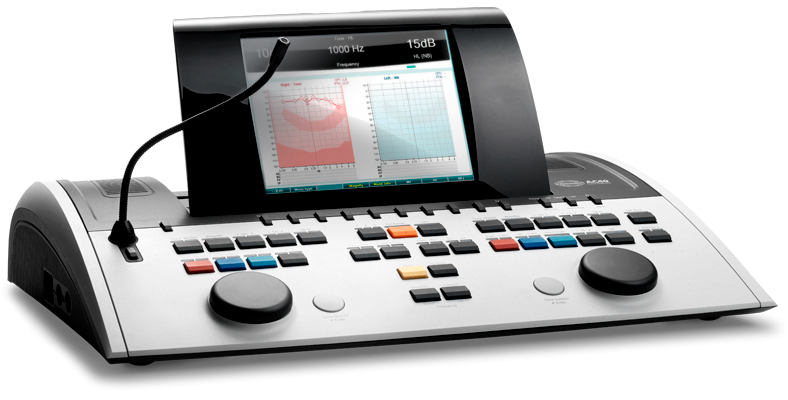
Tone decay test is done for:
Acoustic dip occurs at:
Which of the following interventions is least appropriate for an 8-year-old boy with bilateral sensorineural hearing loss?
A patient presents with a dip at 4000 Hz on pure tone audiometry. They work in a noisy environment and experience occasional tinnitus. What is the most appropriate preventive measure to recommend?
A 30-year-old construction worker presents with gradual hearing loss in both ears. Pure tone audiometry shows a dip at 4000 Hz. What is the most likely diagnosis?
Which hearing aid is most suitable for a patient with a draining ear?
Which statement about electrocochleography is correct?
Earliest age for doing BERA is?
A female patient presents with hearing loss. Rinne test results show Rinne negative at 256 Hz and 512 Hz, while Rinne positive at 1024 Hz. Based on these findings, what is the expected air conduction and bone conduction gap?
Which of the following tests is used to differentiate between cochlear and retrocochlear hearing loss?
Explanation: ***Neural deafness*** - The **tone decay test** measures the ability to sustain the perception of a continuous tone; significant decay indicates **retrocochlear pathology**, which is characteristic of neural deafness. - This test helps differentiate between cochlear and retrocochlear lesions by assessing the auditory nerve's ability to maintain a neural response. *Cochlear deafness* - While patients with **cochlear deafness** may experience some tone decay, it is typically less pronounced than in neural deafness. - **Cochlear pathologies** primarily affect the hair cells, leading to issues with sound perception and clarity rather than rapid decay of tone perception. *Otosclerosis* - **Otosclerosis** is a condition of the **middle ear** that causes **conductive hearing loss** due to the abnormal growth of bone. - It does not primarily affect the neural pathways or the inner ear's ability to sustain tones, so the tone decay test is not the primary diagnostic tool. *Middle ear problem* - **Middle ear problems** generally result in **conductive hearing loss** as they impede the transmission of sound to the inner ear. - The tone decay test is designed to evaluate issues within the inner ear and auditory nerve, not conductive pathologies.
Explanation: ***4000 Hz*** - An **acoustic dip or notch** in an audiogram is a characteristic finding in **noise-induced hearing loss**. - This dip typically occurs at **4000 Hz**, indicating damage to the **cochlear hair cells** most sensitive to this frequency. *1500 Hz* - Hearing loss at **1500 Hz** is not a classic presentation of the acoustic dip associated with noise exposure. - While other forms of hearing loss can affect this frequency, it's not the primary frequency for noise-induced damage. *2000 Hz* - Although hearing loss can extend to other frequencies in noise-induced hearing loss, the **initial and most pronounced dip** is typically observed at 4000 Hz, not 2000 Hz. - A dip at **2000 Hz** would be less specific for noise trauma and might suggest other etiologies. *500 Hz* - **Low frequencies (like 500 Hz)** are generally less affected in the early stages of noise-induced hearing loss. - Hearing loss at these frequencies is more commonly associated with **conductive hearing loss** or other types of sensorineural hearing loss.
Explanation: ***Adenoidectomy with grommet insertion*** - This procedure addresses **conductive hearing loss** (e.g., due to **otitis media with effusion**), while the boy has **sensorineural hearing loss (SNHL)**. - **Grommet insertion** (tympanostomy tubes) is used to improve middle ear ventilation and drain fluid, which is irrelevant for SNHL. *Hearing aid* - A **hearing aid** amplifies sound and is a common and appropriate intervention for **sensorineural hearing loss**, especially for mild to severe cases. - It can significantly improve a child's ability to hear and develop speech. *Cochlear implant* - A **cochlear implant** is appropriate for children with **severe to profound sensorineural hearing loss** who do not benefit sufficiently from hearing aids. - It directly stimulates the auditory nerve, bypassing damaged parts of the inner ear. *Preferential sitting in the classroom* - This is a simple and effective **accommodative strategy** to improve a child's listening environment and is appropriate for any degree of hearing loss. - It helps the child to better hear the teacher and participate in classroom discussions.
Explanation: ***Custom-fitted earplugs*** - A **4000 Hz notch** on audiometry and tinnitus in a noisy environment are classic signs of **noise-induced hearing loss (NIHL)**. - **Custom-fitted earplugs** provide superior sealing and attenuation compared to generic earplugs, offering the most effective protection against hazardous noise exposure to prevent further hearing damage. - They are specifically designed to match the individual's ear canal anatomy, ensuring consistent protection and comfort during prolonged use in occupational settings. *Noise-reducing headphones* - While useful for reducing general environmental noise, **noise-reducing headphones** (particularly active noise-canceling types) are primarily designed for low-frequency noise reduction and comfort. - They may not provide sufficient **passive attenuation** against industrial-level noise that causes NIHL, especially at the critical **4000 Hz frequency range**. - They are often less practical and effective than earplugs for continuous, high-level occupational noise exposure. *Regular audiometric monitoring* - **Regular audiometric monitoring** is essential for detecting changes and progression of hearing loss but is a **surveillance measure**, not a preventive one. - It helps track the effectiveness of preventive strategies and identifies worsening hearing loss early, but does not itself prevent further damage from noise exposure. - It is complementary to, not a substitute for, hearing protection devices. *Avoiding ototoxic medications* - While avoiding ototoxic drugs (aminoglycosides, loop diuretics, chemotherapy agents) is important for preventing **drug-induced hearing loss**, it is not relevant to preventing **noise-induced hearing loss**. - This patient's hearing loss is clearly related to **occupational noise exposure**, not medication use. - Ototoxicity typically causes bilateral high-frequency hearing loss but without the characteristic **4000 Hz notch** seen in NIHL.
Explanation: ***Noise-induced hearing loss*** - The patient's occupation as a **construction worker** exposes him to significant **noise pollution**, a common cause of this condition. - The characteristic **4000 Hz dip** on pure tone audiometry is a hallmark of **noise-induced hearing loss**, indicating damage to specific cochlear hair cells. *Presbycusis* - This is **age-related hearing loss**, typically occurring in older individuals, whereas the patient is only 30 years old. - It usually presents as a **bilateral, progressive high-frequency hearing loss** without a specific audiometric "notch." *Otosclerosis* - This condition involves abnormal bone growth in the middle ear, leading to **conductive hearing loss**. - While it can be bilateral, it often presents with a **Carhart notch** (a dip at 2000 Hz often seen with conductive loss) and is not typically associated with occupational noise exposure. *Meniere's disease* - Characterized by a triad of symptoms: **vertigo, tinnitus, and fluctuating sensorineural hearing loss**, often unilateral initially. - The lack of vertigo and tinnitus, and the specific 4000 Hz dip, make this diagnosis less likely.
Explanation: ***Correct: Bone conduction hearing aid*** - **Bone conduction hearing aids** transmit sound vibrations directly to the inner ear via the skull, bypassing the external and middle ear. - This is ideal for a **draining ear** as it avoids placing any device in the ear canal, preventing irritation, infection, and interference with drainage. - Particularly useful in **chronic suppurative otitis media (CSOM)** with active discharge. *Incorrect: In-the-ear hearing aid* - **In-the-ear (ITE) hearing aids** fit directly into the ear canal, which would obstruct drainage and worsen potential **infections** in a draining ear. - The presence of pus and moisture can also damage the electronic components of the hearing aid. *Incorrect: Behind-the-ear hearing aid* - While the main body rests behind the ear, a **behind-the-ear (BTE) hearing aid** still requires an earmold or tube to be placed in the ear canal. - This could still interfere with **drainage** and create a moist environment conducive to bacterial growth. *Incorrect: Cochlear implant* - A **cochlear implant** is a surgical device used for severe to profound sensorineural hearing loss, not typically for conductive hearing loss with drainage issues. - Its insertion requires a **surgical procedure** and is not a primary solution for a draining ear.
Explanation: **_Outer hair cells are primarily involved in generating cochlear microphonics and summation potential._** - The **cochlear microphonics (CM)** are generated primarily by the **outer hair cells** of the cochlea in response to sound, reflecting the mechanical-electrical transduction process. - The **summation potential (SP)** is generated by **both inner and outer hair cells**, with outer hair cells playing a significant role in its generation. - These are receptor potentials measured in electrocochleography (ECochG). *It measures middle ear latency* - **Electrocochleography (ECochG)** primarily measures electrical potentials from the **inner ear**, including the cochlea and auditory nerve, not middle ear latency. - Middle ear function and latency are typically assessed with **tympanometry** and **acoustic reflex testing**. *Total AP represents endocochlear receptor potential to an external auditory stimulus* - The **Action Potential (AP)** in ECochG represents the **synchronous discharge of auditory nerve fibers**, not the endocochlear receptor potential. - The endocochlear receptor potentials are the **cochlear microphonics (CM)** and **summation potential (SP)**. *Summation potential is a compound of synchronous auditory nerve potential* - The **summation potential (SP)** is a direct current (DC) shift generated by the **inner and outer hair cells** in response to sound stimulus. - It is distinct from the **Action Potential (AP)**, which is the compound synchronous discharge of **auditory nerve fibers**.
Explanation: ***At birth*** - **Brainstem Evoked Response Audiometry (BERA)** can be performed on **newborns** as a universal hearing screening tool. - The auditory pathway is sufficiently developed at birth to generate reliable **BERA responses**, allowing for early detection of hearing loss. - **Early detection** is crucial for optimal speech and language development outcomes. *In utero - before birth* - While the auditory system develops in utero, performing a **BERA test** before birth is not feasible due to technical challenges and the invasive nature it would require. - Hearing in utero can be assessed by observing fetal reactions to sound, but this is not a diagnostic BERA test. *3 months* - Waiting until 3 months delays the diagnosis of potential hearing loss, which can critically impact speech and language development. - Newborn hearing screening programs aim for screening by 1 month, diagnosis by 3 months, and intervention by 6 months (1-3-6 guidelines). *6 months* - A delay until 6 months for BERA testing is too late for optimal outcomes in managing congenital hearing loss, potentially leading to developmental delays. - Comprehensive newborn hearing screening programs aim for diagnosis and intervention much earlier than 6 months.
Explanation: ***15-30 dB*** - The pattern of **Rinne negative at 256 Hz and 512 Hz** combined with **Rinne positive at 1024 Hz** is characteristic of a **mild to moderate conductive hearing loss** with an air-bone gap in the **15-30 dB range**. - In this range, the conductive component is sufficient to cause Rinne negativity at lower frequencies where bone conduction is more efficient, but at higher frequencies (1024 Hz), the gap narrows and air conduction becomes relatively better, resulting in a positive Rinne test. - This frequency-dependent pattern indicates the air-bone gap is **closing at higher frequencies**, typical of mild conductive losses. *30-45 dB* - An air-bone gap of **30-45 dB** represents a **moderate conductive hearing loss** where Rinne test would remain **negative across all frequencies** including 1024 Hz. - At this magnitude of conductive loss, bone conduction would still significantly exceed air conduction even at higher frequencies. - The transition to Rinne positive at 1024 Hz would NOT occur with this degree of hearing loss. *45-60 dB* - This represents a **moderate-severe conductive hearing loss** with a substantial air-bone gap. - Rinne test would be **strongly negative across all tested frequencies** without exception. - The large gap would prevent any frequency from showing air conduction superiority. *>60 dB* - This indicates a **severe to profound conductive hearing loss** with a very large air-bone gap. - Rinne test would be **markedly negative at all frequencies**, with bone conduction dramatically exceeding air conduction. - Air conduction may be barely perceptible or absent at this level of loss.
Explanation: **Evoked response audiometry** - **Evoked response audiometry (ERA)**, specifically **Auditory Brainstem Response (ABR)** or **Brainstem Evoked Response Audiometry (BERA)**, is the gold standard for differentiating between cochlear and retrocochlear hearing loss. - ABR measures electrical activity from the auditory nerve and brainstem in response to sound, allowing for differentiation between **cochlear pathology** (normal ABR latencies with hearing loss) and **retrocochlear pathology** (prolonged interpeak latencies, absent waves, or abnormal waveform morphology suggestive of auditory nerve or brainstem lesion). - Classic findings in retrocochlear lesions include prolonged I-V interpeak latency or absent Wave V. *SISI test* - The **Short Increment Sensitivity Index (SISI) test** assesses the ability to detect small (1 dB) increments in sound intensity superimposed on a continuous tone. - A **high SISI score (>70%)** indicates **cochlear dysfunction** due to recruitment phenomenon, while a **low score (<20%)** may suggest retrocochlear pathology. - However, it does not directly differentiate between cochlear and retrocochlear lesions with the same specificity and sensitivity as ABR. *Threshold tone decay test* - The **Tone Decay Test (TDT)** measures the ability to sustain the perception of a continuous pure tone presented at or near threshold level. - **Significant tone decay (>30 dB in 60 seconds)** suggests **retrocochlear pathology** due to auditory nerve fatigue, making it useful for screening. - While helpful, it is less precise, sensitive, and specific than ABR for definitive differentiation and may have false positives. *Recruitment* - **Recruitment** is an abnormal growth in the perception of loudness, where a small increase in sound intensity leads to a disproportionately large increase in perceived loudness. - It is a classic sign of **cochlear hearing loss**, particularly associated with outer hair cell damage (sensory hearing loss). - Its presence confirms cochlear pathology but its absence does not confirm retrocochlear lesions, making it less reliable as a differentiating test compared to ABR.
Hearing Assessment Techniques
Practice Questions
Tympanometry and Acoustic Reflexes
Practice Questions
Otoacoustic Emissions
Practice Questions
Auditory Brainstem Response
Practice Questions
Hearing Aids
Practice Questions
Cochlear Implants
Practice Questions
Bone-Anchored Hearing Devices
Practice Questions
Speech and Language Development
Practice Questions
Articulation Disorders
Practice Questions
Stuttering
Practice Questions
Dysphonia
Practice Questions
Rehabilitation of Hearing-Impaired Children
Practice Questions
Get full access to all questions, explanations, and performance tracking.
Start For Free