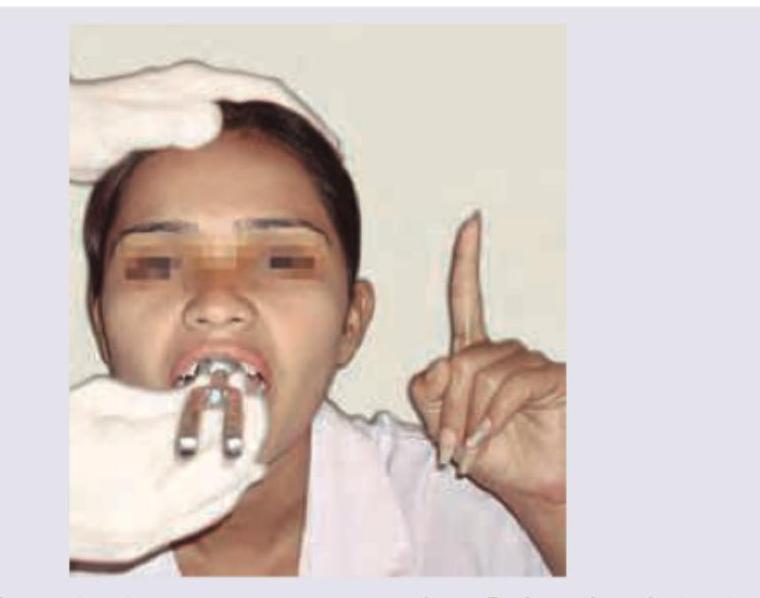
Which type of hearing aid is shown below?

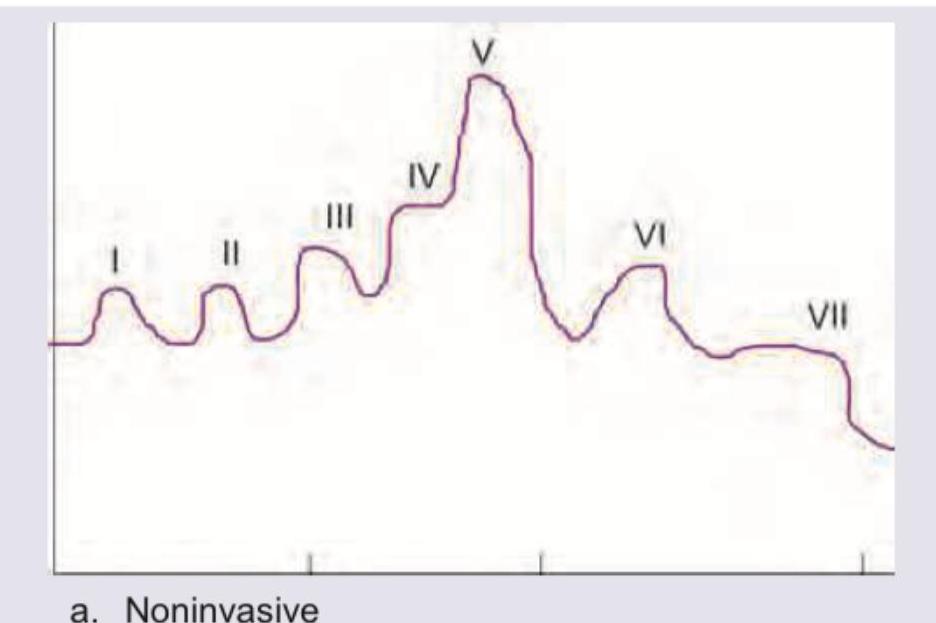
A 1-year-old child has spastic cerebral palsy. Which of the following tests is being performed on the child?

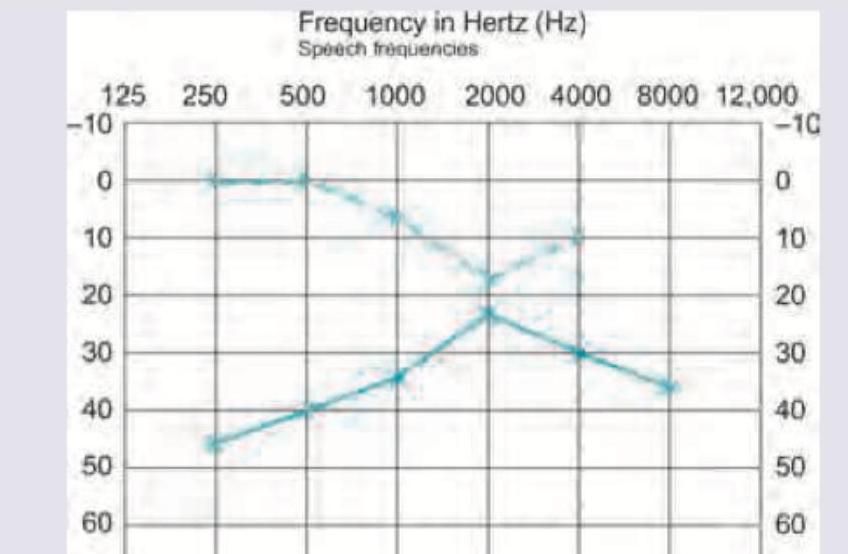
The audiogram shown below denotes:

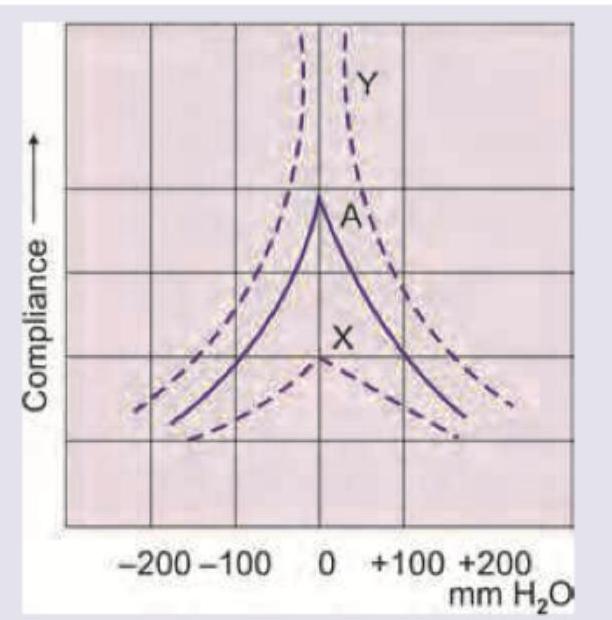
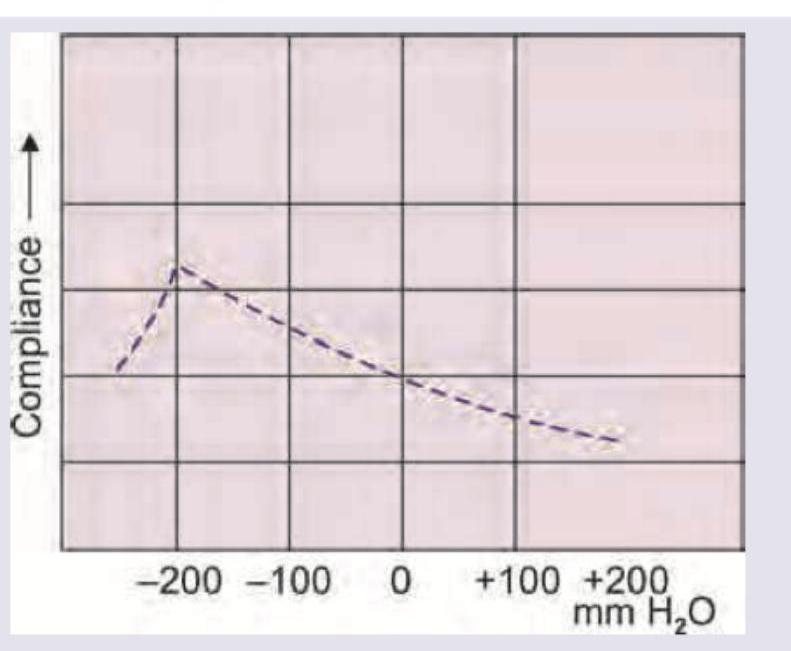
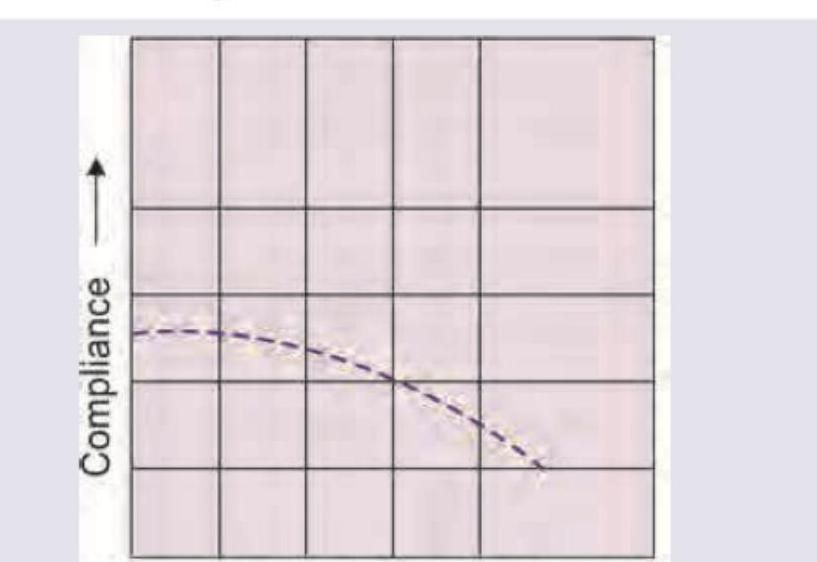
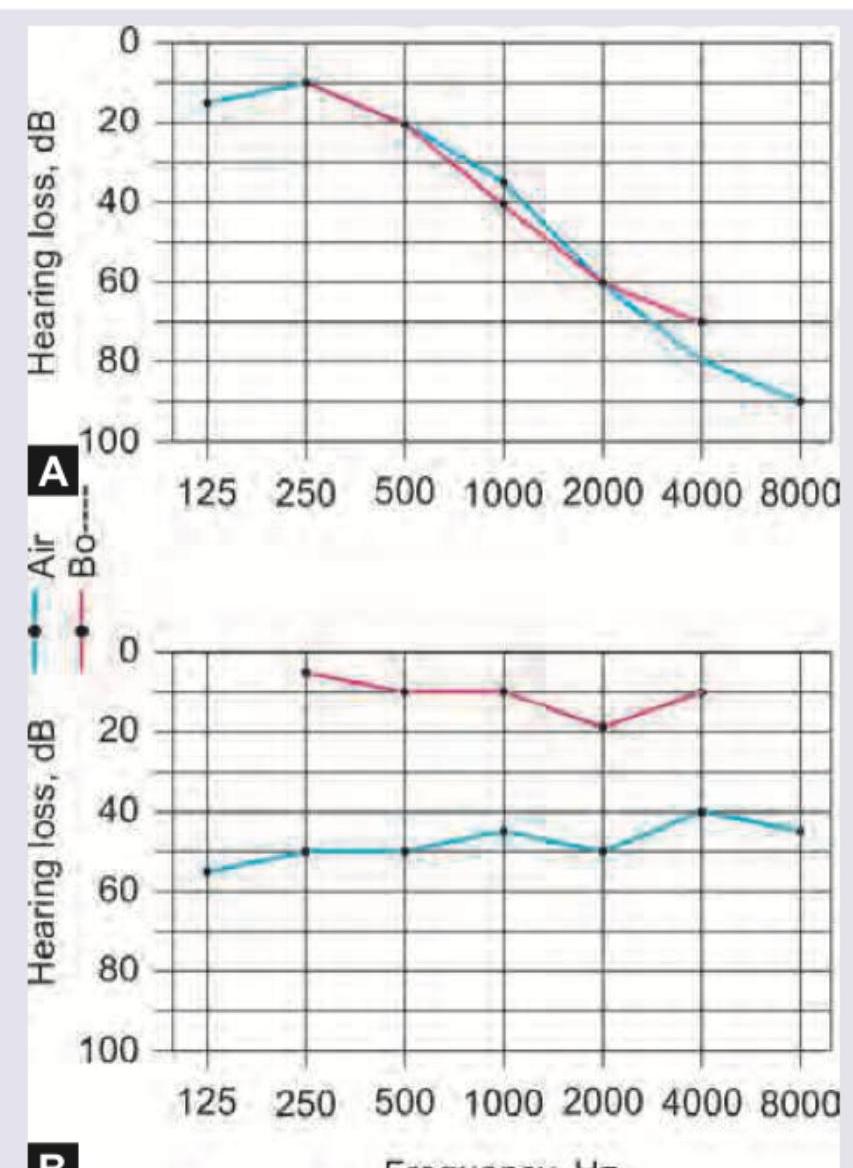
Which is correct about the pure tone audiometry tracing given below?
Dip at 4000 Hz in pure tone audiometry indicates:
According to the WHO definition of hearing loss, what is the value to classify as profound hearing loss?
Bilateral Rinne test +ve and Weber test lateralized to right with a shortened Schwabach test on left side suggests ?
A pure tone audiogram showing a bone conduction dip (Carhart notch) at 2000 Hz is characteristic of-
Which is the investigation of choice in assessing hearing loss in neonates -
In pure tone audiogram the symbol X is used to mark:
Explanation: ***Body-worn*** - This image displays a **body-worn hearing aid**, which is characterized by a separate unit worn on the body (e.g., in a pocket or clipped to clothing) connected by a wire to an ear mold. - They are typically used for **severe to profound hearing loss** and are less common today due to advancements in smaller, more discreet models. *In-the-ear* - **In-the-ear (ITE) hearing aids** fit entirely within the outer ear bowl and are custom-made for the individual. - They are larger than canal models but still fit within the ear, unlike the device shown. *In-the-canal* - **In-the-canal (ITC) hearing aids** are smaller than ITE models and fit partially into the ear canal, with a small portion visible in the outer ear. - They are more discreet than ITEs but still housed within the ear, which does not match the pictured device. *Completely in canal* - **Completely-in-canal (CIC) hearing aids** are the smallest and fit almost entirely inside the ear canal, making them nearly invisible. - The pictured device is clearly a larger, external unit, not designed to fit invisibly within the canal.
Explanation: ***Brainstem evoked auditory response*** - The image shows a child with electrodes placed on the head and an earphone in the ear, along with a waveform graph labeled "Neonate" and showing peaks I, III, and V, which are characteristic of **Brainstem Evoked Auditory Response (BAER)**, also known as ABR. - BAER is an objective and reliable test for assessing **auditory nerve and brainstem pathways** in infants and uncooperative individuals, making it suitable for a 1-year-old with spastic cerebral palsy to screen for hearing loss. *Otoacoustic emission* - This test measures sounds produced by the **cochlea's outer hair cells** and is primarily used for **newborn hearing screening**. - While also objective, it does not assess the **auditory nerve or brainstem function**, which is often crucial in children with neurological conditions like cerebral palsy. *Pure tone audiometry* - This is a **subjective test** that requires the patient to respond to different tones, which is not feasible for a 1-year-old child, especially one with spastic cerebral palsy. - It measures the **thresholds of hearing across different frequencies** but cannot be performed reliably in uncooperative patients. *Caloric electronystagmogram* - This test assesses the function of the **vestibular system** by introducing warm or cold water into the ear canal to induce nystagmus. - It is used to evaluate **balance disorders** and vertigo, not for assessing primary hearing loss, and is generally performed in older children or adults.
Explanation: ***High frequency sensorineural hearing loss*** - The audiogram shows a significant drop in hearing thresholds (increased hearing loss in dB) at **higher frequencies (2000 Hz and above)** for both air and bone conduction. - The **air and bone conduction thresholds are closely matched (within 10-15 dB)**, indicating a sensorineural hearing loss, as there is no significant air-bone gap. *Low frequency sensorineural hearing loss* - This audiogram demonstrates relatively normal hearing thresholds at **lower frequencies (below 1000 Hz)**, contradicting a low-frequency hearing loss. - While it is a sensorineural loss, the pattern is clearly affecting the higher frequencies, not the lower ones. *High frequency conductive hearing loss* - A conductive hearing loss would present with an **air-bone gap**, where air conduction thresholds are significantly worse than bone conduction thresholds. - In this audiogram, the air and bone conduction thresholds are very similar, ruling out a conductive component. *Low frequency conductive hearing loss* - The audiogram shows **no air-bone gap** at any frequency, including the lower frequencies, ruling out conductive hearing loss. - Additionally, the hearing thresholds at **low frequencies (125-1000 Hz) are normal or near-normal**, so there is no low-frequency hearing loss of any type.
Explanation: ***A= Conductive hearing loss, B= Sensorineural hearing loss*** - Graph A demonstrates a significant **air-bone gap** (air conduction thresholds worse than bone conduction by >10 dB), which is the hallmark of **conductive hearing loss** - Graph B shows **overlapping air and bone conduction thresholds** at elevated levels with no significant air-bone gap, characteristic of **sensorineural hearing loss** *A= Sensorineural hearing loss, B= Conductive hearing loss* - Incorrect: Graph A shows clear **air-bone gap** (conductive pattern), not overlapping thresholds - Incorrect: Graph B shows **overlapping elevated thresholds** (sensorineural pattern), not air-bone gap *A= Normal, B= Conductive hearing loss* - Incorrect: Graph A shows significant hearing loss with **air-bone gap**, not normal hearing (0-25 dB) - Incorrect: Graph B shows **overlapping elevated thresholds** indicating sensorineural hearing loss, not conductive *A= Sensorineural hearing loss, B= Normal* - Incorrect: Graph A displays **air-bone gap** characteristic of conductive hearing loss, not sensorineural - Incorrect: Graph B shows elevated thresholds indicating **hearing loss is present**, not normal hearing
Explanation: ***Noise induced hearing loss*** - A characteristic **"4 kHz Notch"** or dip in the audiogram is a hallmark of **noise-induced hearing loss**, resulting from damage to the **cochlear hair cells** in this frequency range. - This specific frequency is most susceptible to damage from loud noise exposure due to the physical properties of the **basilar membrane**. *Meniere's disease* - Typically presents with **low-frequency hearing loss**, often fluctuating, along with **tinnitus**, **vertigo**, and a feeling of **aural fullness**. - A dip at 4000 Hz is not a characteristic audiometric finding for **Meniere's disease**. *Age related hearing loss* - Also known as **presbycusis**, it is typically a **symmetrical, progressive, sensorineural hearing loss** that primarily affects **higher frequencies**, but it usually presents as a more gradual slope rather than a sharp dip at a specific frequency like 4 kHz. - While high frequencies are affected, the pattern is usually a broader high-frequency loss, not an isolated notch. *Otosclerosis* - This condition is a form of **conductive hearing loss** (though it can have a sensorineural component in advanced stages) due to abnormal bone growth around the **stapes footplate**. - Its classic audiometric finding is a **Carhart notch** around 2000 Hz, with a conductive hearing loss pattern, rather than a sensorineural dip at 4000 Hz.
Explanation: ***>91 dB*** - According to the **WHO classification of hearing loss**, a hearing threshold of **greater than 91 dB** in the better ear is defined as **profound hearing loss**. - Individuals with profound hearing loss typically have extreme difficulty hearing and understanding speech even with powerful hearing aids. *61-71 dB* - This range generally falls into the category of **severe hearing loss** (71-90 dB) or **moderately severe hearing loss** (61-70 dB) depending on the exact threshold, but not profound. - Severe hearing loss means hearing speech sounds at this level would be very difficult without amplification. *>101 dB* - While >101 dB is indeed profound hearing loss, the WHO definition for profound hearing loss starts at **>91 dB**. - This option specifies a threshold that is higher than the minimum for profound, making it less precise as the direct definition. *>81 dB* - This threshold falls within the range of **severe hearing loss**, which is defined by the WHO as a hearing threshold between **71 and 90 dB** in the better ear. - Severe hearing loss is distinct from profound hearing loss.
Explanation: ***Left inner ear pathology*** - A **bilateral positive Rinne test** indicates that **air conduction is better than bone conduction** in both ears, which is either normal or suggests **sensorineural hearing loss** (rules out conductive loss). - **Weber test lateralizing to the right** means sound is heard better in the right ear, indicating **left ear pathology**. Combined with positive Rinne bilaterally, this confirms **left sensorineural hearing loss**. - A **shortened Schwabach test on the left side** means **bone conduction duration is reduced** compared to normal, directly confirming **sensorineural hearing loss** in the left ear. *Right middle ear pathology* - A **conductive hearing loss** on the right would cause a **negative Rinne test** on the right side (bone conduction better than air conduction), contradicting the bilateral positive Rinne findings. - While **Weber would lateralize to the right** with right conductive loss, the **positive Rinne bilaterally** rules out any significant conductive pathology. *Right inner ear pathology* - A **sensorineural hearing loss** on the right would cause Weber test to **lateralize to the better (left) ear**, not to the right as described in the question. - The **shortened Schwabach test is on the left side**, not the right, indicating left ear pathology rather than right inner ear involvement. *Left middle ear pathology* - A **conductive hearing loss** in the left ear would cause a **negative Rinne test on the left side** (bone conduction better than air conduction), contradicting the bilateral positive findings. - **Weber test would lateralize to the left ear** (affected ear with conductive loss), not to the right as stated in the question.
Explanation: ***Otosclerosis*** - A **Carhart notch** is a characteristic feature on a pure tone audiogram in otosclerosis, specifically a **bone conduction dip at 2000 Hz**. - This notch is believed to be an **artifact of cochlear mechanics** caused by the fixation of the stapes in the oval window. *Presbyacusis* - Characterized by a **bilateral, symmetrical, high-frequency sensorineural hearing loss** that gradually worsens with age. - It does not present with a specific bone conduction dip like the Carhart notch. *Ototoxicity* - Hearing loss induced by ototoxic drugs (e.g., aminoglycosides, loop diuretics) typically causes **bilateral, progressive, high-frequency sensorineural hearing loss**. - A Carhart notch is not a typical finding in ototoxicity. *Noise induced hearing loss* - Often presents with a **sensorineural hearing loss notch at 4000 Hz** (or sometimes 3000 Hz or 6000 Hz) on the audiogram. - This pattern is distinct from the 2000 Hz bone conduction dip seen in a Carhart notch.
Explanation: ***Brainstem Evoked Response Audiometry (BERA)*** - **BERA** is the gold standard for assessing hearing loss in neonates because it measures the **brain's electrical activity** in response to sounds, making it objective and reliable in infants who cannot cooperate with behavioral tests. - It is crucial for **early detection** of hearing impairment, allowing for timely intervention to support language and developmental milestones. *Behavioral audiometry* - This method relies on the child's **behavioral responses** to sound, such as head turns or startling, which is not reliable or consistent for neonates. - It is typically used for older infants or children who can actively participate and respond to stimuli. *Impedance audiometry* - Measures the **middle ear function** (e.g., tympanometry, acoustic reflex), which can detect issues like fluid in the middle ear but does not directly assess the baby's ability to hear. - While useful for diagnosing **middle ear pathologies**, it is not a direct measure of hearing threshold. *Free field audiometry* - This technique involves presenting sounds through loudspeakers and observing the child's reaction in a **sound-attenuated room**. - Similar to other behavioral tests, its reliability is limited in neonates due to their inability to provide consistent and voluntary responses to sound.
Explanation: ***Air conduction in left ear*** - The symbol **X** is the standard notation in a pure tone audiogram to represent the **air conduction threshold for the left ear**. - This symbol indicates the softest sound level (in dB HL) at which a patient can hear a specific pure tone presented to their left ear via headphones. *Bone conduction in right ear* - **Bone conduction for the right ear** is typically marked with a **<** (unmasked) or **[** (masked) symbol. - This measures inner ear function, bypassing the outer and middle ear. *No response in air conduction in right ear* - A **no response** in air conduction for the right ear is often indicated by an **arrow pointing down from the O symbol** for the right ear. - This indicates that the patient did not respond to the maximum output of the audiometer for that frequency. *Air conduction in right ear* - **Air conduction in the right ear** is typically marked with a **O** symbol on the audiogram. - This symbol, usually plotted in red, represents the hearing threshold for the right ear when sound is delivered through headphones.
Hearing Assessment Techniques
Practice Questions
Tympanometry and Acoustic Reflexes
Practice Questions
Otoacoustic Emissions
Practice Questions
Auditory Brainstem Response
Practice Questions
Hearing Aids
Practice Questions
Cochlear Implants
Practice Questions
Bone-Anchored Hearing Devices
Practice Questions
Speech and Language Development
Practice Questions
Articulation Disorders
Practice Questions
Stuttering
Practice Questions
Dysphonia
Practice Questions
Rehabilitation of Hearing-Impaired Children
Practice Questions
Get full access to all questions, explanations, and performance tracking.
Start For Free