Hepatitis C is associated with all of the following conditions EXCEPT:
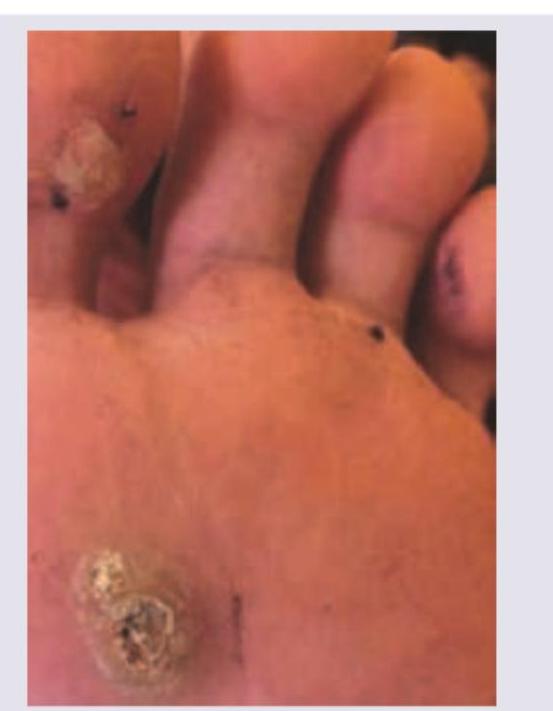
A 13-year-old girl presents with two non-tender lesions on her fingers that appeared over 5 months. Examination reveals 0.5-cm slightly raised, pebbly-surfaced, gray-white papules, one on the dorsum of her distal right index finger, and another periungual to her little finger. The lesions gradually disappear over the next 18 months. Which of the following is the most likely factor in the pathogenesis of her lesions?
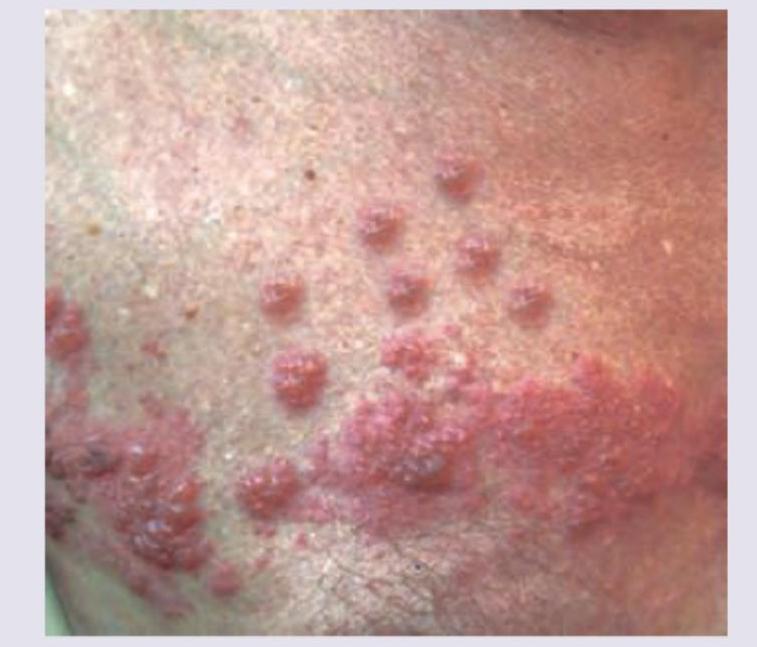
A patient is suffering from painful vesicular eruption at the T-4 dermatome. What is the likely cause?
Multinucleate giant cells are seen in Tzanck smear in which of the following conditions?
Eczema herpeticum is described as which of the following?
Multiple nodular lesions occurring most commonly on the lower lip, resembling oral papillomas and microscopically containing virus-like particles are most likely to be what condition?
What is the 'kissing lesion' associated with?
Condyloma acuminatum is caused by which types of HPV?
A 26-year-old male kidney transplant recipient presents with multiple brown keratotic papules on the forehead and scalp. What is the common cause of these lesions?
An HIV-positive patient presents with a characteristic appearance of the leg and a history of HHV-8 infection. What is the most likely diagnosis?

Explanation: **Explanation:** The correct answer is **A. Polyarteritis nodosa (PAN)**. While PAN is a systemic necrotizing vasculitis strongly associated with viral hepatitis, it is classically linked to **Hepatitis B Virus (HBV)**, not Hepatitis C. Approximately 10–30% of PAN cases are associated with HBV. In contrast, Hepatitis C is most famously associated with **Mixed Cryoglobulinemia (Type II and III)**, which presents as a small-vessel leukocytoclastic vasculitis. **Analysis of other options:** * **Lichen Planus (C):** There is a well-established epidemiological link between Hepatitis C Virus (HCV) and Lichen Planus (especially the oral erosive subtype). Screening for HCV is often recommended in patients presenting with chronic Lichen Planus. * **Psoriasis (D):** HCV has been identified as a potential trigger or exacerbating factor for Psoriasis. Furthermore, treating psoriasis in HCV-positive patients requires caution due to the hepatotoxicity of certain systemic therapies (e.g., Methotrexate). * **Dermatomyositis-like syndrome (B):** HCV infection can occasionally trigger inflammatory myopathies or paraneoplastic-like cutaneous features resembling dermatomyositis. **NEET-PG High-Yield Pearls:** * **HCV Specific Associations:** Mixed Cryoglobulinemia (Palpable purpura), Porphyria Cutanea Tarda (PCT), Lichen Planus, and Necrolytic Acral Erythema (highly specific for HCV). * **HBV Specific Association:** Polyarteritis Nodosa (PAN) and Gianotti-Crosti Syndrome (though other viruses also cause the latter). * **Rule of Thumb:** If a question asks about a vasculitis associated with **HBV**, think **PAN**. If it asks about **HCV**, think **Cryoglobulinemic Vasculitis**.
Explanation: **Explanation:** The clinical presentation of slightly raised, pebbly-surfaced, gray-white papules in a pediatric patient is classic for **Verruca Vulgaris (Common Warts)**. **1. Why the Correct Answer is Right:** Verruca vulgaris is caused by **Human Papillomavirus (HPV)**, most commonly types **1, 2, 4, and 7**. These viruses infect the basal layer of the epithelium, leading to epidermal hyperplasia (acanthosis) and hyperkeratosis. The "pebbly" or "verrucous" surface is a hallmark of HPV-induced skin changes. A key feature of viral warts, especially in children, is their tendency for **spontaneous regression** (as seen in this patient over 18 months) due to the development of a cell-mediated immune response. **2. Why Incorrect Options are Wrong:** * **A. BRAF gene mutation:** This is associated with melanocytic neoplasms, most notably **Malignant Melanoma** and Seborrheic Keratosis. It does not cause infectious verrucous papules. * **C. IgA antibody deposition:** This is the hallmark of **Dermatitis Herpetiformis** (associated with Celiac disease) or IgA Vasculitis (HSP). It presents as pruritic vesicles or purpura, not painless pebbly papules. * **D. Type IV hypersensitivity reaction:** This is the mechanism behind **Allergic Contact Dermatitis**. While it involves T-cells, it typically presents with acute erythema, scaling, and intense itching rather than stable, discrete viral papules. **3. NEET-PG High-Yield Pearls:** * **Histopathology:** Look for **Koilocytes** (cells with perinuclear halos and wrinkled nuclei) in the upper epidermis. * **Clinical Sign:** **Auspitz-like bleeding** (pinpoint bleeding) occurs when the surface is pared down due to the presence of elongated dermal papillae with prominent capillaries. * **Koebner Phenomenon:** Warts can spread linearly along lines of trauma (Pseudo-Koebner). * **Treatment:** Salicylic acid (keratolytic), cryotherapy (liquid nitrogen), or imiquimod.
Explanation: ### Explanation **Correct Answer: B. Herpes zoster** **Mechanism and Clinical Presentation:** Herpes zoster (Shingles) is caused by the **reactivation of the Varicella-Zoster Virus (VZV)**, which remains latent in the sensory dorsal root ganglia after a primary chickenpox infection. When immunity wanes, the virus travels down the sensory nerve to the skin. The hallmark of this condition is a **painful, unilateral vesicular eruption** that follows a specific **dermatome** (most commonly thoracic, such as T-4). The pain often precedes the rash (pre-herpetic neuralgia). **Analysis of Incorrect Options:** * **A. Epstein-Barr virus (EBV):** Primarily causes Infectious Mononucleosis. While it can cause a maculopapular rash (especially after taking Ampicillin), it does not present with dermatomal vesicles. * **C. Cytomegalovirus (CMV):** Typically causes asymptomatic infections or mononucleosis-like syndromes in immunocompetent hosts. In immunocompromised patients, it causes retinitis or GI ulcers, not dermatomal skin eruptions. * **D. Herpes simplex virus (HSV):** Causes grouped vesicles on an erythematous base (HSV-1: oral; HSV-2: genital). While it can recur, it typically does not follow a strict dermatomal distribution and is usually localized to the site of inoculation. **High-Yield Clinical Pearls for NEET-PG:** * **Tzanck Smear:** A rapid diagnostic test showing **multinucleated giant cells** and Cowdry Type A inclusion bodies (seen in both HSV and VZV). * **Hutchinson’s Sign:** Vesicles on the tip of the nose indicating involvement of the nasociliary branch of the ophthalmic nerve; a predictor of ocular involvement. * **Ramsay Hunt Syndrome:** Triad of facial palsy, external auditory canal vesicles, and tinnitus/vertigo (involvement of Geniculate ganglion). * **Treatment:** Oral Acyclovir, Valacyclovir, or Famciclovir (most effective if started within 72 hours).
Explanation: **Explanation:** The **Tzanck smear** is a rapid bedside diagnostic test used primarily to identify acantholytic cells or viral cytopathic effects. In the context of viral infections, the presence of **multinucleate giant cells** (formed by the fusion of infected keratinocytes) is a hallmark of the **Herpesviridae** family. **1. Why Herpes Genitalis is Correct:** Herpes genitalis is caused by Herpes Simplex Virus (HSV-2 or HSV-1). The virus induces characteristic changes in epithelial cells, including ballooning degeneration and the formation of multinucleated giant cells with "molding" of nuclei. These are easily visualized on a Tzanck smear stained with Giemsa or Wright stain. **2. Analysis of Incorrect Options:** * **Pemphigus (Option D):** While Tzanck smear is used here, it shows **Acantholytic cells (Tzanck cells)**—rounded, detached keratinocytes with hyperchromatic nuclei—rather than multinucleate giant cells. * **Bullous Pemphigoid (Option B):** This is a subepidermal blistering disease. A Tzanck smear typically shows an inflammatory infiltrate (predominantly **eosinophils**) but lacks acantholytic or multinucleate cells. * **Toxic Epidermal Necrolysis (Option C):** Tzanck smear reveals **necrotic keratinocytes** and inflammatory cells, reflecting the full-thickness epidermal death characteristic of the condition. **NEET-PG High-Yield Pearls:** * **Tzanck Smear Positivity:** Positive in HSV, VZV (Chickenpox/Shingles), and Pemphigus vulgaris. * **Viral Cytopathic Effect:** Look for the "3 Ms": **M**ultinucleation, Nuclear **M**argination of chromatin, and Nuclear **M**olding. * **Limitation:** Tzanck smear **cannot** differentiate between HSV-1, HSV-2, and VZV; for specific typing, PCR or viral culture is required.
Explanation: **Explanation:** **Eczema Herpeticum (Kaposi Varicelliform Eruption)** is a disseminated viral infection caused by the **Herpes Simplex Virus (HSV-1 or HSV-2)**. It typically occurs in patients with a pre-existing skin condition, most commonly **Atopic Dermatitis**, where the skin barrier is compromised. **Why Option B is Correct:** The underlying medical concept is a secondary viral superinfection. When the skin barrier is defective (as in eczema), HSV can spread rapidly across the affected areas. It presents clinically as "punched-out" erosions, monomorphic vesicles, and hemorrhagic crusting, often accompanied by systemic symptoms like fever and lymphadenopathy. **Why Other Options are Incorrect:** * **Option A:** While the name contains "Eczema," it is not a primary eczematous process. It is a viral complication *superimposed* on eczema. * **Option C & D:** Though patients with atopic dermatitis are prone to bacterial (e.g., *Staph. aureus*) and fungal infections, Eczema Herpeticum is specifically defined by its viral etiology (HSV). **High-Yield Clinical Pearls for NEET-PG:** * **Causative Agent:** Most commonly HSV-1. * **Clinical Hallmark:** Monomorphic, umbilicated, "punched-out" erosions. * **Diagnosis:** Tzanck smear showing **multinucleated giant cells** and Cowdry Type A inclusion bodies. * **Treatment:** This is a dermatological emergency. The drug of choice is **Acyclovir** (oral or IV depending on severity). * **Associated Conditions:** Besides atopic dermatitis, it can occur in Darier’s disease, Pemphigus foliaceus, and burns.
Explanation: ### Explanation **Heck Disease (Focal Epithelial Hyperplasia)** Heck disease is a rare, benign condition caused by **Human Papillomavirus (HPV) types 13 and 32**. It typically presents as multiple, soft, smooth, flattened or rounded papules/nodules on the oral mucosa, most frequently involving the **lower lip**, buccal mucosa, and tongue. * **Pathogenesis:** It is characterized by acanthosis and thickening of the epithelium. Microscopically, it shows "mitosoid cells" (cells with degenerating nuclei resembling mitotic figures) and virus-like particles under electron microscopy. * **Clinical Context:** It is most common in children and young adults, often showing a familial clustering or association with low socioeconomic status. **Analysis of Incorrect Options:** * **Fordyce Spots:** These are ectopic sebaceous glands. They appear as small (1-2 mm), yellowish-white granules on the vermilion border of the lips or buccal mucosa. They are not viral and do not form large nodular lesions. * **Lingual Varices:** These are dilated, tortuous veins (varicosities) typically found on the ventral surface of the tongue in elderly patients. They appear bluish-purple and are vascular, not epithelial/viral. * **Linea Alba:** This is a common white, horizontal line on the buccal mucosa at the level of the occlusal plane, caused by friction or pressure from teeth (hyperkeratosis). It is not nodular or viral. **High-Yield Pearls for NEET-PG:** * **Causative Agents:** HPV 13 and 32 (High-yield association). * **Mitosoid Cells:** The pathognomonic histological feature of Heck disease. * **Management:** Usually self-limiting; treatment (cryotherapy or CO2 laser) is only for cosmetic or functional concerns. * **Differential Diagnosis:** Must be distinguished from Condyloma acuminatum (HPV 6, 11), which usually has a more "cauliflower" appearance and a different transmission pattern.
Explanation: **Explanation:** In dermatology, the term **'kissing lesion'** refers to a clinical presentation where a skin infection or lesion on one surface spreads to an opposing, touching skin surface. This is most classically associated with **Candidiasis** (specifically Candidal Intertrigo). **1. Why Candidiasis is correct:** Candidiasis thrives in warm, moist, and macerated environments found in skin folds (intertriginous areas) such as the axilla, inframammary folds, and groin. When the infected skin surface comes into constant contact with the opposing healthy skin surface, the fungal organisms (typically *Candida albicans*) are transferred, creating a symmetrical "mirror image" or "kissing" lesion. A hallmark of this condition is the presence of **satellite pustules** or papules at the periphery. **2. Why other options are incorrect:** * **Infectious Mononucleosis:** Caused by the Epstein-Barr virus (EBV), it typically presents with a triad of fever, pharyngitis, and lymphadenopathy. While it can cause a maculopapular rash (especially after taking Ampicillin), it does not produce "kissing lesions." * **Histoplasmosis:** This is a systemic fungal infection primarily affecting the lungs. While cutaneous manifestations can occur in disseminated cases, they present as nodules, ulcers, or molluscum-like lesions, not as symmetrical intertriginous kissing lesions. **Clinical Pearls for NEET-PG:** * **Other 'Kissing' associations:** In ophthalmology, "kissing choroidals" refer to massive choroidal detachments. In venereology, **Chancroid** (caused by *H. ducreyi*) can also produce "kissing ulcers" on the labia or thighs due to autoinoculation. * **Diagnosis of Candidiasis:** Look for the keyword **"Satellite lesions"** and confirm with KOH mount showing **pseudohyphae and budding yeast cells**. * **Treatment:** Topical antifungals (Azoles/Nystatin) and keeping the area dry.
Explanation: **Explanation:** **Condyloma acuminatum**, commonly known as anogenital warts, is a sexually transmitted infection caused by the **Human Papillomavirus (HPV)**. **1. Why Option C is Correct:** HPV types **6 and 11** are classified as **"low-risk"** genotypes. They are responsible for approximately 90% of all cases of Condyloma acuminatum. These types cause benign epithelial proliferation (warts) but have a very low potential for malignant transformation into squamous cell carcinoma. **2. Analysis of Incorrect Options:** * **Option D (16, 18):** These are **"high-risk"** oncogenic types. While they can cause flat lesions, they are primarily associated with cervical intraepithelial neoplasia (CIN), cervical cancer, and other anogenital malignancies (vulvar, anal, and penile cancers). * **Option A (18, 31):** Both are high-risk types associated with malignancy rather than benign condylomas. * **Option B (17, 12):** These types are associated with **Epidermodysplasia verruciformis**, a rare genetic disorder characterized by an increased susceptibility to specific HPV strains and subsequent skin cancer. **3. NEET-PG High-Yield Pearls:** * **Clinical Appearance:** Flesh-colored, cauliflower-like growths in the perianal or genital region. * **Histopathology:** Characterized by **Koilocytes** (keratinocytes with perinuclear halo and wrinkled "raisinoid" nuclei). * **Treatment of Choice:** Podophyllotoxin, Imiquimod (immunomodulator), or destructive methods like cryotherapy and CO2 laser. * **Vaccination:** The quadrivalent vaccine (Gardasil) covers types 6, 11, 16, and 18, protecting against both warts and cervical cancer.
Explanation: ### Explanation The clinical presentation describes **Verruca Plana (Flat Warts)**. These are characterized by small (1–5 mm), flat-topped, smooth or slightly keratotic, flesh-colored to brown papules. They commonly occur on the face, forehead, and dorsum of hands. In immunocompromised individuals, such as kidney transplant recipients, these lesions can be more numerous and persistent due to impaired cell-mediated immunity. **Why Option C is correct:** * **HPV subtypes 3 and 10** are the specific genotypes responsible for Verruca Plana. The description of "brown keratotic papules" on the forehead is the classic clinical vignette for this condition. **Why other options are incorrect:** * **Option A (HPV 6, 11):** These cause **Condyloma Acuminata** (Anogenital warts) and Laryngeal Papillomatosis. They are low-risk mucosal types. * **Option B (HPV 2, 4):** These are the most common causes of **Verruca Vulgaris** (Common warts), which are typically rough, exophytic, "cauliflower-like" lesions found on fingers and periungual areas. * **Option D (HPV 16, 18):** These are high-risk oncogenic types associated with **Bowenoid papulosis**, cervical cancer, and squamous cell carcinoma. **High-Yield Clinical Pearls for NEET-PG:** * **Koebner Phenomenon:** Flat warts often show linear distribution due to autoinoculation (e.g., from shaving or scratching). * **Butcher’s Warts:** Caused by HPV-7. * **Deep Palmoplantar Warts (Myrmecia):** Caused by HPV-1. * **Epidermodysplasia Verruciformis (EV):** A rare genetic condition associated with HPV-5 and HPV-8, which carries a high risk of progression to Squamous Cell Carcinoma (SCC). * **Treatment:** First-line includes topical salicylic acid, cryotherapy, or topical retinoids (especially for flat warts).
Explanation: ***Kaposi sarcoma*** - **HHV-8 (Human herpesvirus-8)** is the causative agent of Kaposi sarcoma, particularly in **HIV-positive patients** with immunosuppression. - Presents with characteristic **violaceous (purple-red) plaques or nodules** on the legs and other sites, which matches the described appearance. *Lymphoma* - While HIV patients have increased risk of lymphomas, **HHV-8 infection** is not typically associated with most lymphoma types. - Lymphomas usually present as **enlarged lymph nodes** or systemic B-symptoms, not characteristic leg lesions. *Malignant melanoma* - **Not associated with HHV-8 infection** and occurs independently of HIV status in most cases. - Typically presents as an **asymmetric, irregularly bordered pigmented lesion** that changes over time, not the violaceous appearance described. *Non-Hodgkin's lymphoma* - Although **HIV patients** have increased NHL risk, it is **not specifically linked to HHV-8** infection. - Usually presents with **lymphadenopathy**, hepatosplenomegaly, or extranodal masses, not characteristic skin lesions on legs.
Herpes Simplex Virus Infections
Practice Questions
Varicella-Zoster Virus Infections
Practice Questions
Human Papillomavirus Infections
Practice Questions
Molluscum Contagiosum
Practice Questions
Viral Exanthems
Practice Questions
Hand, Foot, and Mouth Disease
Practice Questions
Orf and Milker's Nodule
Practice Questions
Cytomegalovirus Cutaneous Manifestations
Practice Questions
Epstein-Barr Virus Manifestations
Practice Questions
Poxvirus Infections
Practice Questions
HIV-Related Dermatoses
Practice Questions
Viral Infections in Immunocompromised Hosts
Practice Questions
Get full access to all questions, explanations, and performance tracking.
Start For Free