Which of the following is the most common cause of erythema multiforme minor?
Which skin condition is often triggered by an upper respiratory tract infection?
A 60-year-old man presents with a vesicular rash in a dermatomal distribution on the chest. What is the most likely complication if left untreated?
What type of lesion is characteristic of molluscum contagiosum?
What is the most common identifiable precipitant of erythema multiforme?
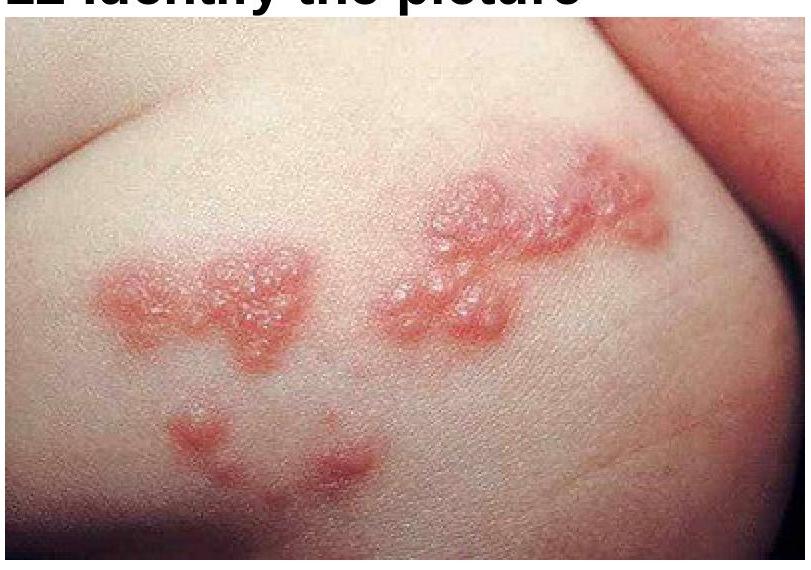
A patient presents with painful vesicular eruptions on one side of the body. What is the most likely diagnosis based on the clinical image?
Which area is typically not involved in a chickenpox rash?
What is the most common trigger associated with erythema multiforme?
A teenager presented with a skin lesion that appeared as a thin, oval plaque with a fine collarette of scale located inside the periphery of the plaque. Pityriasis rosea is diagnosed. All of the following are characteristic of pityriasis rosea, except:
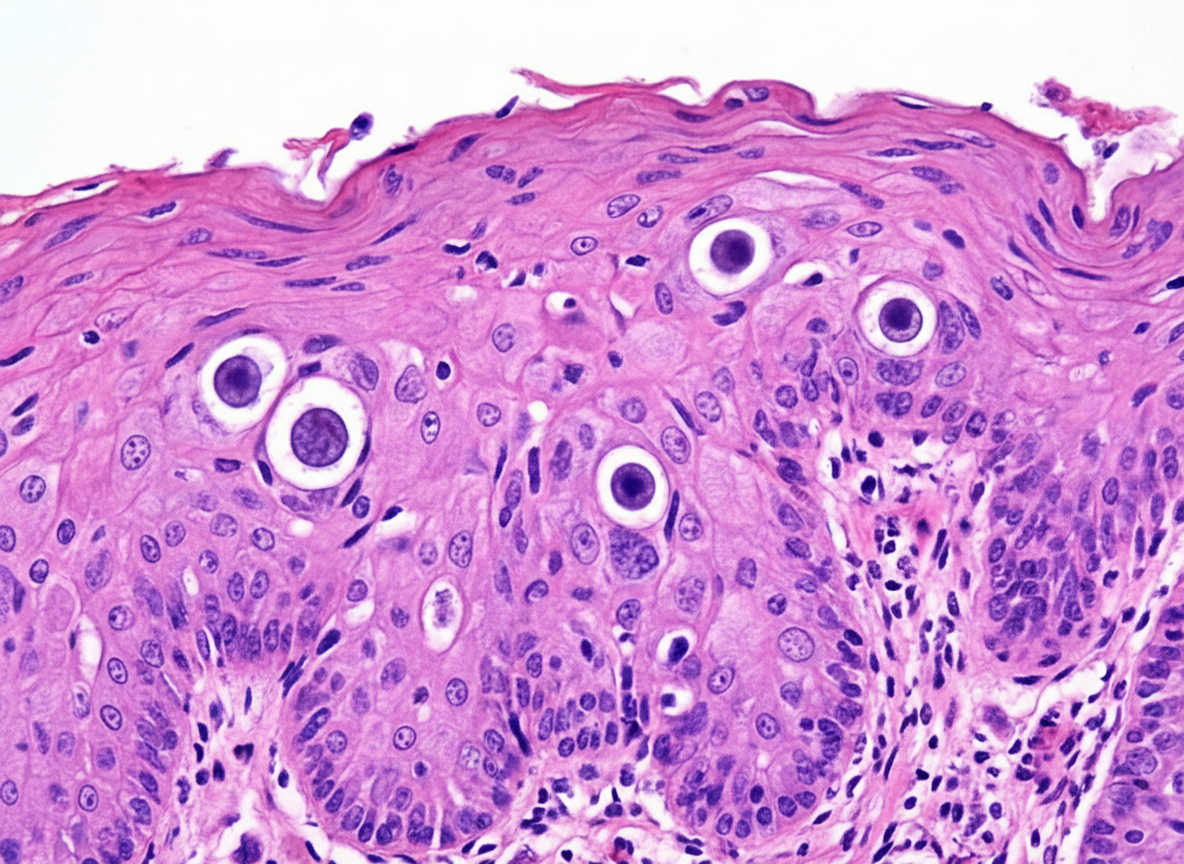
A 35-year-old professional businesswoman notices the appearance of several hyperkeratotic, well-demarcated growths on the palmar surface of her index finger and on her toe. They do not change in size and cause her only minimal discomfort. A biopsy of one of the lesions, viewed at 40x magnification, is shown. Which of the following viruses is the most likely etiologic agent?
Explanation: **Viral infections** - The most common cause of **erythema multiforme minor** is **herpes simplex virus (HSV)** infection, accounting for 50-60% of cases. - The rash typically appears 1-2 weeks after an HSV outbreak (recurrent herpes labialis or genitalis). - Other viral triggers include Epstein-Barr virus, but HSV is by far the predominant cause. *Bacterial infections* - While some bacterial infections can trigger erythema multiforme, they are less frequent causes compared to viral infections. - **Mycoplasma pneumoniae** is the most notable bacterial trigger and is more commonly associated with erythema multiforme major rather than minor. - Streptococcal infections have also been reported but are uncommon. *Fungal infections* - Fungal infections are **rarely** implicated as a cause of erythema multiforme. - This etiology is not a primary consideration in routine clinical practice for erythema multiforme minor. *Drug reactions* - Drug reactions are the primary cause of **erythema multiforme major** and **Stevens-Johnson Syndrome (SJS)/Toxic Epidermal Necrolysis (TEN)**, which are more severe mucocutaneous reactions. - For erythema multiforme minor, drug reactions account for only 10-15% of cases, making them significantly less common than viral infections. - When drugs are implicated in EM minor, NSAIDs, antibiotics (especially sulfonamides), and anticonvulsants are the usual culprits.
Explanation: ***Pityriasis rosea*** - This condition is often preceded by an **upper respiratory tract infection** (typically viral), suggesting a possible viral etiology, though the exact cause is unknown. - It typically presents with a **herald patch** followed by smaller, oval, pinkish-red patches with fine scales, often arranged in a **Christmas tree pattern** on the trunk. - The prodromal viral-like illness makes this the classic condition associated with URTI. *Psoriasis* - While **guttate psoriasis** can be triggered by **bacterial streptococcal pharyngitis** (not typical viral URTI), general psoriasis is a **chronic autoimmune** condition with genetic predispositions. - Psoriasis is characterized by **erythematous plaques** with silvery scales, commonly affecting extensor surfaces, the scalp, and nails. - The trigger for guttate psoriasis is specifically bacterial (strep throat), not the viral URTIs typically associated with pityriasis rosea. *Lichen planus* - This is an **inflammatory skin condition** that affects the skin, hair, nails, and mucous membranes, with no clear association with an acute URTI. - It typically presents with **pruritic, polygonal, planar, purple papules and plaques** (the "6 Ps"). *Eczema* - Eczema (or **atopic dermatitis**) is a chronic, relapsing inflammatory skin condition associated with a compromise in the skin barrier and often linked to allergies or asthma. - It is characterized by **itchy, dry, red, and inflamed patches of skin**, and is not typically triggered by an URTI.
Explanation: ***Postherpetic neuralgia*** - This is the most common and debilitating complication of **herpes zoster**, characterized by persistent pain in the affected dermatome for months or even years after the rash resolves. - The risk of **postherpetic neuralgia** increases with age and is particularly common in individuals over 60. *Cellulitis* - While possible, **bacterial superinfection** leading to cellulitis is a secondary complication, not the most likely long-term complication of untreated herpes zoster itself. - Cellulitis would involve localized inflammation and warmth, distinct from the neuropathic pain of postherpetic neuralgia. *Lymphadenopathy* - **Regional lymphadenopathy** is a common acute finding during the active phase of herpes zoster due to immune response to the viral infection. - It is not considered a long-term complication of untreated zoster; rather, it's a transient symptom. *Systemic lupus erythematosus* - This is an **autoimmune disease** with a wide range of systemic manifestations and no direct causal link to untreated herpes zoster. - There is no evidence to suggest that untreated herpes zoster leads to the development of SLE.
Explanation: ***Papules*** - Molluscum contagiosum typically presents as **small, flesh-colored, dome-shaped papules** with a characteristic **umbilicated center**. - These lesions are caused by a **poxvirus** and are highly contagious. *Vesicles* - **Vesicles** are small, fluid-filled blisters (less than 1 cm in diameter), characteristic of conditions like **herpes simplex** or **chickenpox**. - Molluscum contagiosum lesions are solid rather than fluid-filled. *Nodules* - **Nodules** are larger, deeper solid lesions (greater than 1 cm), often extending into the dermis or subcutis. - While molluscum lesions can be palpated, their characteristic size and appearance are generally smaller, making "papule" a more precise description. *Pustules* - **Pustules** are small, elevated lesions containing **pus**, typically seen in bacterial infections like **folliculitis** or **acne**. - Molluscum contagiosum lesions do not contain pus, differentiating them from pustules.
Explanation: ***HSV*** - **Herpes simplex virus (HSV)** infection is the most common identifiable cause of erythema multiforme, particularly the recurrent form. - The rash typically appears **1-3 weeks after an HSV outbreak**, suggesting an **immune-mediated hypersensitivity reaction** to viral antigens. - HSV-1 (oral herpes) is more commonly associated than HSV-2. *Idiopathic* - While a significant portion of erythema multiforme cases are **idiopathic** (no identifiable cause found), the question asks for the most common *identifiable* precipitant. - By definition, idiopathic means the cause cannot be identified, so it doesn't answer the question. *Drugs* - **Drugs** are an important cause of erythema multiforme, but they more commonly cause severe variants like **Stevens-Johnson syndrome (SJS)** and **toxic epidermal necrolysis (TEN)**. - For classic erythema multiforme minor, **HSV is a more frequent trigger** than medications. - Common drug culprits include NSAIDs, sulfonamides, anticonvulsants, and antibiotics. *TB* - **Tuberculosis (TB)** can cause various dermatological manifestations such as **erythema induratum** (Bazin's disease) or **lupus vulgaris**. - TB is **not a recognized precipitant** of erythema multiforme.
Explanation: ***Herpes zoster*** - The image displays characteristic **vesicular lesions** grouped together on an erythematous base, typically following a **dermatomal distribution**, which is classic for herpes zoster (shingles). - These lesions often cause significant pain and are due to the **reactivation of the varicella-zoster virus**. *Smallpox* - Smallpox lesions are typically **deep-seated, firm, round pustules** that are all in the same stage of development. - While smallpox also features vesicular lesions, their appearance and distribution are distinct from the clustered, dermatomal pattern seen in the image. *Chickenpox* - Chickenpox presents as a generalized rash with lesions at **various stages of development** (macules, papules, vesicles, scabs), often described as a "dewdrop on a rose petal." - Unlike the localized, dermatomal pattern of herpes zoster, chickenpox lesions are typically **widespread** over the body. *Atopic dermatitis* - Atopic dermatitis typically manifests as **erythematous, scaly, intensely itchy patches or plaques**, often in areas like the flexural creases. - It does not present with the characteristic **vesicular, grouped lesions in a dermatomal pattern** seen in the image.
Explanation: ***Palms and soles*** - The chickenpox rash, caused by the **varicella-zoster virus**, typically spares the palms and soles. - Chickenpox exhibits a characteristic **centripetal distribution** (center-predominant), with lesions most numerous on the trunk and progressively fewer on the extremities. - **Sparing of palms and soles** is a classic differentiating feature from other viral exanthems like hand-foot-and-mouth disease. *Trunk* - The **trunk** is usually the **most heavily involved area** in a chickenpox rash, with lesions often appearing first and being most numerous here. - This is the hallmark of the characteristic **centripetal distribution** of the rash. *Axilla* - The **axilla** is a common site for chickenpox lesions due to its location on the trunk and the presence of **warm, moist skin folds** that can favor lesion development. - The rash tends to be widespread, making secondary sites like the axilla commonly involved. *Back* - The **back** is a major part of the trunk and is therefore extensively involved in a chickenpox rash. - The rash often starts on the trunk and spreads outwards, ensuring significant involvement of the back.
Explanation: ***Herpes simplex*** - **Herpes simplex virus (HSV)** is the most common precipitating factor for **erythema multiforme**, accounting for **50-60% of identifiable cases**, particularly the recurrent form. - The rash typically appears **10-14 days after an HSV outbreak**, suggesting an immune-mediated reaction. - **HSV-1** is more commonly implicated than HSV-2. *Mycoplasma pneumoniae* - **Mycoplasma pneumoniae** is the **second most common infectious trigger** for erythema multiforme, especially in children and young adults. - EM associated with Mycoplasma typically occurs during or after respiratory infection. - However, it is still less common than HSV as a trigger. *TB* - **Tuberculosis (TB)** is not typically associated with erythema multiforme. - While other infections can trigger erythema multiforme, TB is rarely implicated. *Drugs* - **Drug reactions** are a recognized cause of erythema multiforme, but they are less common than HSV infection as a trigger. - Certain medications like **sulfonamides, anticonvulsants, NSAIDs, and penicillins** are among the drugs that can induce erythema multiforme.
Explanation: ***Lower respiratory infection*** - **Pityriasis rosea** is a self-limiting inflammatory skin condition, and while patients may experience mild prodromal symptoms like fatigue and malaise, a **lower respiratory infection** is not a characteristic feature or complication. - The disease is primarily a mucocutaneous eruption with no typical association with pulmonary involvement. *Herald patch* - The **herald patch** is the initial, solitary, larger lesion that precedes the generalized rash in pityriasis rosea. - It often appears a few days to two weeks before the widespread eruption and is a key diagnostic feature. *Moderate itching* - **Pruritus**, or itching, is a common symptom associated with pityriasis rosea, ranging from mild to moderate. - While not universally present or severe, it is a characteristic complaint for many patients. *Low grade fever* - Many patients with pityriasis rosea experience mild, **flu-like prodromal symptoms**, including a **low-grade fever**, malaise, and headache. - These symptoms typically precede the skin eruption and resolve as the rash develops.
Explanation: ***HPV*** - The clinical description of **hyperkeratotic**, **well-demarcated growths** on the palmar surface and toe is highly characteristic of **warts** (verrucae), which are caused by **Human Papillomavirus (HPV)**. - The biopsy likely shows **koilocytes** (HPV-infected keratinocytes with perinuclear vacuolization), which are pathognomonic for HPV infection in the skin. *Adenovirus* - Adenovirus typically causes **respiratory tract infections**, **conjunctivitis**, or **gastroenteritis**, and less commonly skin lesions. - Skin manifestations from adenovirus are usually non-specific rashes, not hyperkeratotic growths like those described. *Molluscum contagiosum virus* - **Molluscum contagiosum** is caused by the **Molluscum contagiosum virus (MCV)** and presents as **umbilicated papules**, differing morphologically from the described hyperkeratotic warts. - Histologically, molluscum contagiosum lesions are characterized by **Molluscum bodies** (large eosinophilic cytoplasmic inclusions), which are different from koilocytes. *Echovirus* - Echoviruses are enteroviruses primarily associated with a wide range of syndromes including **aseptic meningitis**, **exanthems (rashes)**, and **respiratory illnesses**. - They do not typically cause localized, hyperkeratotic skin growths like warts.
Herpes Simplex Virus Infections
Practice Questions
Varicella-Zoster Virus Infections
Practice Questions
Human Papillomavirus Infections
Practice Questions
Molluscum Contagiosum
Practice Questions
Viral Exanthems
Practice Questions
Hand, Foot, and Mouth Disease
Practice Questions
Orf and Milker's Nodule
Practice Questions
Cytomegalovirus Cutaneous Manifestations
Practice Questions
Epstein-Barr Virus Manifestations
Practice Questions
Poxvirus Infections
Practice Questions
HIV-Related Dermatoses
Practice Questions
Viral Infections in Immunocompromised Hosts
Practice Questions
Get full access to all questions, explanations, and performance tracking.
Start For Free