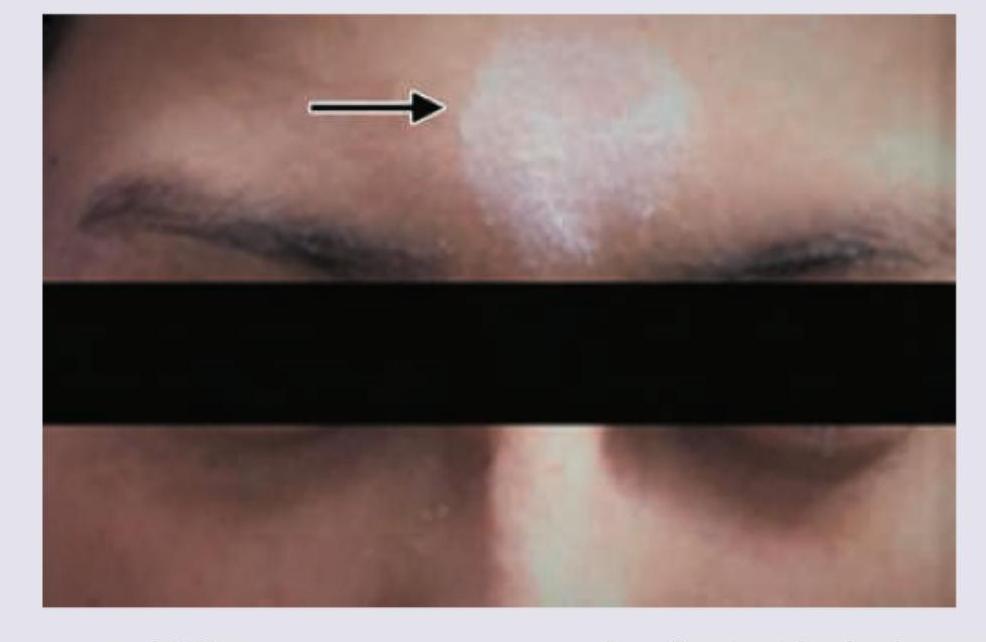
A patient presents with the skin finding shown in the image. Identify the most likely diagnosis for this lesion.
Q172
A 28-year-old lady has asymptomatic dome-shaped small lesions on the forehead for the past 2 months. She lives with her 2-year-old daughter who also is having similar lesions. What is the causative agent of these lesions?
Q173
Which of the following is INCORRECT regarding genital warts (condyloma acuminata)?
1. It is usually single.
2. It is related to HPV Types 6 and 11.
3. It can be transmitted sexually.
4. It can involve vagina and anus.
Q174
Which of the following statements about molluscum contagiosum is FALSE?
Q175
What is the primary route of transmission for molluscum contagiosum in adults?
Q176
A 30-year-old man with recurrent genital warts has undergone multiple treatments without success. Which of the following treatments would be most appropriate to try next?
Q177
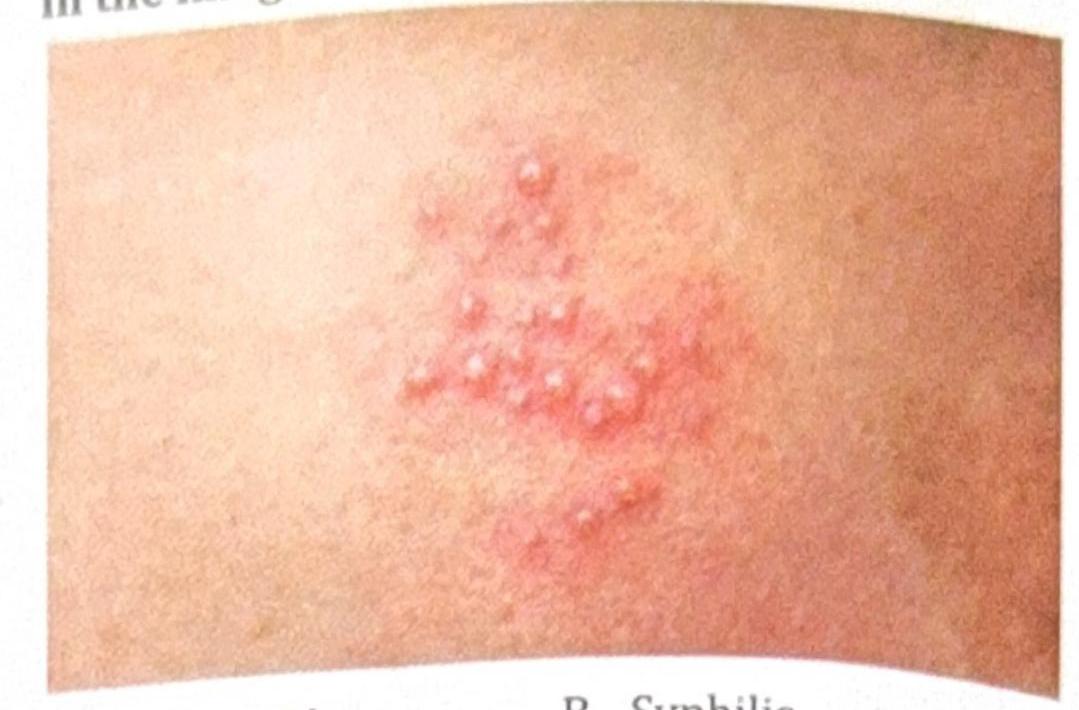
A patient presents with painful vesicles as shown in the image. What is the diagnosis?
Q178
A 7-year-old child presents to the dermatology clinic with multiple small, painless, flesh-colored papules on the trunk and arms that have been present for 3 months. The lesions are 2-4 mm in diameter, dome-shaped with a smooth surface, and several have a characteristic central umbilication. The child is otherwise healthy and immunocompetent. The lesions are not pruritic and there is no associated lymphadenopathy. On closer examination, a white, cheesy material can be expressed from the central depression of some lesions.
What is the most likely diagnosis?
Q179
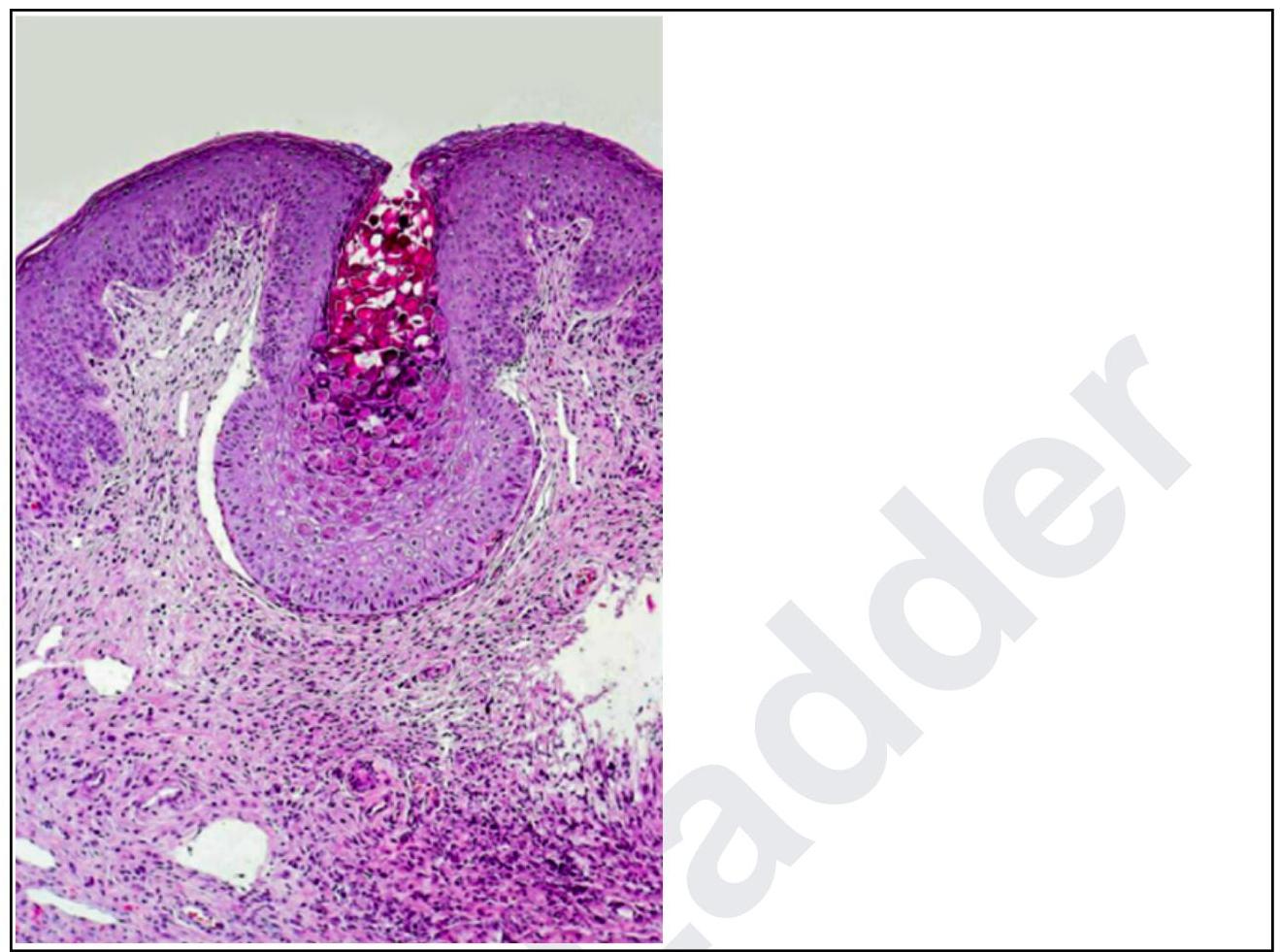
A woman presents with lesions on the inner thighs and peri-anal region. They are nodular, 4-6 mm in size and appear pale. The histopathological image shows multiple intracytoplasmic inclusion bodies consistent with Henderson-Patterson bodies. The diagnosis is:
Q180
A 60-year-old patient presents with unilateral vesicular lesions in a dermatomal distribution on the torso. The lesions are painful and appeared over the past 2-3 days, progressing from erythematous patches to fluid-filled vesicles. The patient reports prodromal burning and tingling sensation in the affected area. Which of the following is the most likely diagnosis?
Viral Skin Infections Indian Medical PG Practice Questions and MCQs
Question 171: A patient presents with the skin finding shown in the image. Identify the most likely diagnosis for this lesion.
A. Vitiligo
B. Contact leukoderma
C. Piebaldism (Correct Answer)
D. Albinism
Explanation: ***Piebaldism***
- The image shows a **localized patch of depigmentation** on the forehead, characteristic of **piebaldism**.
- **Piebaldism** is a rare, congenital autosomal dominant disorder caused by a defect in melanocyte development and migration, resulting in stable, well-demarcated depigmented areas, often with a **white forelock**.
*Vitiligo*
- **Vitiligo** typically presents as **progressive, acquired macules and patches of depigmentation** that often enlarge over time.
- While it can appear on the face, the sharply demarcated, congenital appearance seen here is more consistent with piebaldism.
*Contact leukoderma*
- **Contact leukoderma** is an **acquired depigmentation** resulting from exposure to chemicals (e.g., rubber, phenols).
- It would usually present in areas of direct contact, and the congenital nature of the lesion in the image rules this out.
*Albinism*
- **Albinism** is a **generalized hypopigmentation** affecting the skin, hair, and eyes due to a defect in melanin production.
- The image shows a localized patch of depigmentation, not a widespread lack of pigment characteristic of albinism.
Question 172: A 28-year-old lady has asymptomatic dome-shaped small lesions on the forehead for the past 2 months. She lives with her 2-year-old daughter who also is having similar lesions. What is the causative agent of these lesions?
A. HSV
B. HPV
C. Poxvirus (Correct Answer)
D. VZV
Explanation: ***Poxvirus***
- The description of asymptomatic, **dome-shaped small lesions** and their presence in both a mother and her young child strongly suggests **molluscum contagiosum**, which is caused by a **poxvirus**.
- Molluscum contagiosum lesions are typically **umbilicated**, which often appears dome-shaped, and are highly contagious, commonly spread through close contact.
*HSV*
- **Herpes Simplex Virus (HSV)** typically causes clusters of **painful vesicles** on an erythematous base, which later crust over.
- The lesions described are asymptomatic and dome-shaped, not vesicular or painful.
*HPV*
- **Human Papillomavirus (HPV)** causes **warts**, which are rough, verrucous papules or plaques, not smooth dome-shaped lesions.
- While warts can spread through close contact, their morphology differs significantly from the lesions described.
*VZV*
- **Varicella-Zoster Virus (VZV)** causes **chickenpox** (widespread itchy vesicles) or **shingles** (painful dermatomal rash).
- The lesions described do not fit the characteristic presentation of either chickenpox or shingles, as they are asymptomatic and dome-shaped.
Question 173: Which of the following is INCORRECT regarding genital warts (condyloma acuminata)?
1. It is usually single.
2. It is related to HPV Types 6 and 11.
3. It can be transmitted sexually.
4. It can involve vagina and anus.
A. It can involve vagina and anus.
B. It is related to HPV Types 6 and 11.
C. It is usually single. (Correct Answer)
D. It can be transmitted sexually.
Explanation: ***It is usually single.***
- **Genital warts (condyloma acuminata)** caused by Human Papillomavirus (HPV) are typically **multiple lesions**, not single.
- They often appear as **clusters** or "cauliflower-like" growths in the anogenital region.
*It can involve vagina and anus.*
- **Genital warts** can indeed involve the **vagina, anus, vulva, penis, perineum, and cervix**, as these are common areas of HPV infection.
- The type of sexual activity influences the location of the lesions.
*It is related to HPV Types 6 and 11.*
- **HPV types 6 and 11** are indeed the most common causes of **genital warts**, accounting for approximately 90% of cases.
- These are considered **low-risk HPV types** because they are rarely associated with cancer.
*It can be transmitted sexually.*
- **Genital warts** are a classic example of a **sexually transmitted infection (STI)**.
- Transmission occurs through **skin-to-skin contact** during sexual activity.
Question 174: Which of the following statements about molluscum contagiosum is FALSE?
A. Lesions contain characteristic inclusion bodies
B. Autoinoculation can spread the infection to new sites
C. It is caused by a poxvirus
D. Laboratory confirmation is required for diagnosis (Correct Answer)
Explanation: ***Laboratory confirmation is required for diagnosis***
- The diagnosis of **molluscum contagiosum** is primarily **clinical**, based on the characteristic appearance of the lesions (small, flesh-colored, dome-shaped papules with central umbilication).
- While histology can confirm the diagnosis by revealing **molluscum bodies**, it is **not routinely required** for typical cases.
*Lesions contain characteristic inclusion bodies*
- This statement is **true**. Histological examination of molluscum contagiosum lesions reveals large, eosinophilic cytoplasmic inclusions, known as **molluscum bodies** or **Henderson-Paterson bodies**, within infected epidermal cells.
- These inclusion bodies contain viral particles and are a **hallmark of the infection**.
*Autoinoculation can spread the infection to new sites*
- This statement is **true**. Molluscum contagiosum is highly contagious, and scratching or touching existing lesions can lead to the spread of the virus to previously unaffected skin areas on the same individual.
- This process of **autoinoculation** explains why lesions often appear in clusters or linear arrays (Koebner phenomenon).
*It is caused by a poxvirus*
- This statement is **true**. Molluscum contagiosum is caused by the **molluscum contagiosum virus (MCV)**, which belongs to the **Poxviridae family**.
- Poxviruses are known for their relatively large size and the ability to replicate entirely in the cytoplasm of host cells.
Question 175: What is the primary route of transmission for molluscum contagiosum in adults?
A. Fecal-oral route
B. Respiratory droplets
C. Vector-borne transmission
D. Sexual contact (Correct Answer)
Explanation: ***Sexual contact***
- In adults, **molluscum contagiosum** is predominantly transmitted through **direct skin-to-skin contact**, especially during sexual activity.
- The lesions are often found in the **genital**, **perineal**, and **lower abdominal areas** in sexually active individuals.
*Fecal-oral route*
- This route of transmission is associated with infections spread through contaminated food or water, such as **Hepatitis A** or **gastroenteritis**, not molluscum contagiosum.
- Molluscum contagiosum is a **poxvirus** that infects the skin directly, and is not shed in feces.
*Respiratory droplets*
- Diseases like the **common cold**, **influenza**, and **COVID-19** are typically spread via respiratory droplets, which involve airborne transmission from coughing or sneezing.
- Molluscum contagiosum is a **dermal infection** and is not transmitted through the air.
*Vector-borne transmission*
- Vector-borne diseases are transmitted by living organisms, such as **mosquitoes** (e.g., malaria, dengue) or **ticks** (e.g., Lyme disease).
- Molluscum contagiosum has no known insect or animal vector involved in its transmission.
Question 176: A 30-year-old man with recurrent genital warts has undergone multiple treatments without success. Which of the following treatments would be most appropriate to try next?
A. Imiquimod cream (Correct Answer)
B. Electrocautery
C. Podophyllin resin
D. Liquid nitrogen cryotherapy
Explanation: ***Imiquimod cream***
- **Imiquimod** is an **immune response modifier** that stimulates the production of **cytokines**, such as interferon-alpha, which has antiviral and antiproliferative effects, making it effective for persistent warts.
- It is particularly useful for recurrent warts or those unresponsive to ablative therapies due to its mechanism of action targeting the underlying viral infection.
*Electrocautery*
- **Electrocautery** physically destroys the wart tissue using heat, which can be effective but carries risks of scarring and potential recurrence if not completely eradicated.
- For recurrent warts, the underlying Human Papillomavirus (HPV) infection needs to be addressed, which ablative methods like electrocautery do not inherently do.
*Podophyllin resin*
- **Podophyllin resin** is a **cytotoxic agent** that inhibits cell division, leading to tissue necrosis; however, it can be irritating and is generally not recommended for extensive or recurrent lesions due to potential systemic absorption and toxicity.
- Its mechanism primarily involves destroying the infected cells rather than stimulating a host immune response, which might be less effective for recurrent cases.
*Liquid nitrogen cryotherapy*
- **Liquid nitrogen cryotherapy** works by freezing and destroying the wart tissue, but it often requires multiple sessions and can be painful.
- Similar to electrocautery, it is an ablative method that does not directly enhance the host's immune response to clear the Human Papillomavirus (HPV), making it less ideal for recurrent cases where host immunity might be a factor.
Question 177: A patient presents with painful vesicles as shown in the image. What is the diagnosis?
A. Chancroid
B. Syphilis
C. Herpes (Correct Answer)
D. Candidiasis
Explanation: ***Herpes***
- The image shows a cluster of **small, painful vesicles on an erythematous base**, which is highly characteristic of a herpes simplex virus (HSV) infection.
- These lesions typically evolve into ulcers, crust over, and heal, and are often recurrent.
*Chancroid*
- Chancroid presents as **painful, soft chancres** (ulcers) with irregular, undermined borders and a gray or yellow base, often accompanied by **buboes** (enlarged, tender lymph nodes).
- It does not typically manifest as clusters of small vesicles.
*Syphilis*
- Primary syphilis presents as a **painless chancre**—a single, firm, ulcerated lesion with a clean base and raised borders.
- Secondary syphilis can cause a variety of skin manifestations, but not painful vesicles.
*Candidiasis*
- Cutaneous candidiasis usually appears as a **red, moist rash with satellite lesions** (smaller papules or pustules spreading from the main rash), often in skin folds.
- While it can be inflammatory and itchy, it does not typically form discreet painful vesicles as seen in the image.
Question 178: A 7-year-old child presents to the dermatology clinic with multiple small, painless, flesh-colored papules on the trunk and arms that have been present for 3 months. The lesions are 2-4 mm in diameter, dome-shaped with a smooth surface, and several have a characteristic central umbilication. The child is otherwise healthy and immunocompetent. The lesions are not pruritic and there is no associated lymphadenopathy. On closer examination, a white, cheesy material can be expressed from the central depression of some lesions.
What is the most likely diagnosis?
A. Trichodysplasia spinulosa
B. Condyloma acuminata
C. Donovanosis
D. Molluscum contagiosum (Correct Answer)
Explanation: ***Molluscum contagiosum***
- The classic presentation of **flesh-colored, dome-shaped papules** with **central umbilication** is pathognomonic for molluscum contagiosum.
- The presence of a **white, cheesy material** that can be expressed from the central depression is characteristic of the viral core.
*Trichodysplasia spinulosa*
- This condition presents with **follicular papules** and **spiny projections**, primarily on the face, and is typically seen in **immunocompromised** individuals.
- The description of **flesh-colored, dome-shaped papules** with **umbilication** does not fit the typical presentation of trichodysplasia spinulosa.
*Condyloma acuminata*
- These are **genital warts** caused by HPV, typically presenting as **verrucous** or **cauliflower-like lesions** on the anogenital region.
- The description of **small, painless, flesh-colored papules** with **central umbilication** on the trunk and arms is inconsistent with condyloma acuminata.
*Donovanosis*
- Donovanosis, or **granuloma inguinale**, is a rare bacterial infection causing **ulcerative lesions** in the genital and perianal areas.
- This diagnosis is highly unlikely given the child's age, rash location (trunk and arms), and the specific morphology of the lesions.
Question 179: A woman presents with lesions on the inner thighs and peri-anal region. They are nodular, 4-6 mm in size and appear pale. The histopathological image shows multiple intracytoplasmic inclusion bodies consistent with Henderson-Patterson bodies. The diagnosis is:
A. Trichodysplasia spinulosa
B. Molluscum contagiosum (Correct Answer)
C. Condyloma acuminata
D. Donovanosis
Explanation: ***Molluscum contagiosum***
- The clinical presentation of **nodular, pale lesions** in the inner thighs and peri-anal region, combined with histopathology showing **Henderson-Patterson bodies** (large eosinophilic intracytoplasmic inclusions), is pathognomonic for molluscum contagiosum.
- Henderson-Patterson bodies represent viral factories within infected keratinocytes, a key diagnostic feature of this **poxvirus** infection.
*Trichodysplasia spinulosa*
- This condition is characterized by **follicular papules** with prominent keratin spines, typically occurring on the face, and is associated with the **Trichodysplasia spinulosa-associated polyomavirus**.
- It does not present with Henderson-Patterson bodies or the typical nodular lesions seen in molluscum contagiosum.
*Condyloma acuminata*
- These are **genital warts** caused by the **human papillomavirus (HPV)**, presenting as verrucous or cauliflower-like growths.
- Histologically, they show **koilocytic atypia** (vacuolated cells with nuclear abnormalities), not Henderson-Patterson bodies.
*Donovanosis*
- Also known as **granuloma inguinale**, this is a chronic, progressive, ulcerative granulomatous disease caused by **Klebsiella granulomatis**.
- Histopathology reveals **Donovan bodies** (intracellular bacteria within macrophages), which are distinct from Henderson-Patterson bodies and the clinical presentation of nodular lesions.
Question 180: A 60-year-old patient presents with unilateral vesicular lesions in a dermatomal distribution on the torso. The lesions are painful and appeared over the past 2-3 days, progressing from erythematous patches to fluid-filled vesicles. The patient reports prodromal burning and tingling sensation in the affected area. Which of the following is the most likely diagnosis?
A. Herpes zoster infection (Correct Answer)
B. Irritant contact dermatitis
C. Allergic contact dermatitis
D. Herpes Simplex Infection
Explanation: ***Herpes zoster infection***
- The patient's presentation of **unilateral vesicular lesions** in a **dermatomal distribution**, accompanied by severe pain and a **prodromal burning and tingling sensation**, is classic for herpes zoster (shingles).
- Herpes zoster results from the **reactivation of latent varicella-zoster virus (VZV)** in a sensory ganglion, leading to painful rash along the affected nerve path.
*Irritant contact dermatitis*
- This condition involves inflammation due to direct contact with an irritating substance, often presenting with **eczematous lesions**, redness, itching, and sometimes vesicles.
- However, it typically lacks the characteristic **dermatomal distribution** and severe neuropathic pain seen in herpes zoster.
*Allergic contact dermatitis*
- Allergic contact dermatitis is an immune-mediated reaction to an allergen, causing intensely pruritic, erythematous, and often **vesicular or bullous eruptions** that tend to spread beyond the initial contact area over time.
- While it can cause vesicles, it does not follow a **dermatomal pattern** and is usually very itchy, rather than primarily painful and burning, with a distinct prodrome.
*Herpes Simplex Infection*
- Herpes simplex virus (HSV) infections also cause **vesicular lesions** but typically present as clusters of vesicles on an **erythematous base** in a localized area, often around the mouth (cold sores) or genitals.
- Unlike herpes zoster, HSV lesions are usually **recurrent** in the same small area and typically do not exhibit a widespread, **unilateral dermatomal pattern** or the associated severe, persistent neuropathic pain.