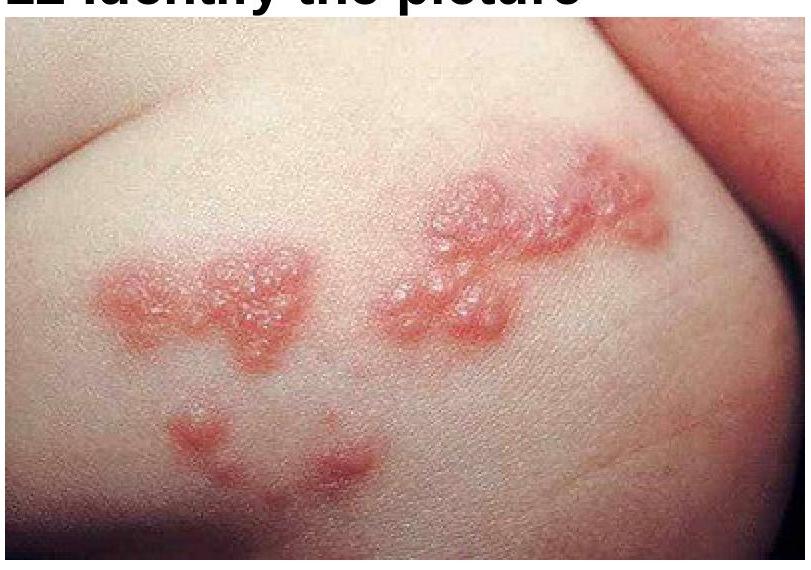
A 45-year-old male has multiple grouped vesicular lesions present on the T10 dermatome associated with pain. What is the most likely diagnosis?
Which of the following lesions is NOT an infection caused by human papilloma virus?
In Tzanck smear, multinucleated cells are seen in which of the following conditions?
What is the causative agent of hairy leukoplakia, a condition characterized by severe discomfort on the lateral part of the tongue?
A 69-year-old man presents with a gradual onset of pain, tingling, and hyperesthesia in the medial aspect of his right arm. Subsequently, he develops erythema and an outbreak of vesicles on the medial aspect of his right arm, extending from his medial epicondyle to the wrist. After several days, the lesions crust over and resolve, but he is left with a residual "burning" pain in the same distribution as the lesions, with occasional sharp pain provoked by touch. The infectious agent responsible for this condition resides in which part of the neuraxis?
Scrum pox is typically seen in athletes participating in which sport?
Infection by which virus gives rise to the following skin lesions?

What is the treatment of choice for genital warts in pregnancy?
A 23-year-old, sexually active man has been treated for Neisseria gonorrhoeae infection 6 times during the past 5 years. He now comes to the physician because of the increasing number and size of warty lesions slowly enlarging on his external genitalia during the past year. On physical examination, there are multiple 1- to 3-mm sessile, nonulcerated, papillary excrescences over the inner surface of the penile prepuce. These lesions are excised, but 2 years later, similar lesions appear. Which of the following conditions most likely predisposed him to the development of these recurrent lesions?
Tzank smear helps in the diagnosis of which of the following conditions?
Explanation: ### **Explanation** **1. Why Herpes Zoster is Correct:** The clinical presentation of **grouped vesicular lesions** distributed along a **single dermatome** (T10) associated with **pain** (neuralgia) is the classic hallmark of **Herpes Zoster** (Shingles). This condition results from the reactivation of the latent Varicella-Zoster Virus (VZV) in the dorsal root ganglia. The T10 dermatome (level of the umbilicus) is a common site. The unilateral, dermatomal distribution is the most significant diagnostic clue. **2. Why Other Options are Incorrect:** * **Dermatitis Herpetiformis:** While it presents with vesicles, they are typically **symmetrically distributed** on extensor surfaces (elbows, knees) and are associated with intense pruritus and Celiac disease, not dermatomal pain. * **Herpes Simplex:** HSV usually presents as grouped vesicles on a red base, but it is typically localized to the **mucocutaneous junctions** (lips or genitals) and does not follow a specific dermatomal pattern. * **Scabies:** This is a parasitic infestation characterized by **nocturnal itching** and burrows in web spaces. It does not present with grouped vesicles in a dermatomal distribution. **3. High-Yield Clinical Pearls for NEET-PG:** * **Tzanck Smear:** Shows **Multinucleated Giant Cells** (common to both HSV and VZV). * **Hutchinson’s Sign:** Vesicles on the tip of the nose indicating involvement of the ophthalmic nerve (Nasociliary branch), risking ocular complications. * **Ramsay Hunt Syndrome:** Involvement of the geniculate ganglion leading to facial palsy and vesicles in the external auditory canal. * **Post-Herpetic Neuralgia (PHN):** The most common complication, defined as pain persisting >3 months after the rash heals. * **Treatment:** Oral Acyclovir (800 mg 5 times/day for 7 days), Valacyclovir, or Famciclovir.
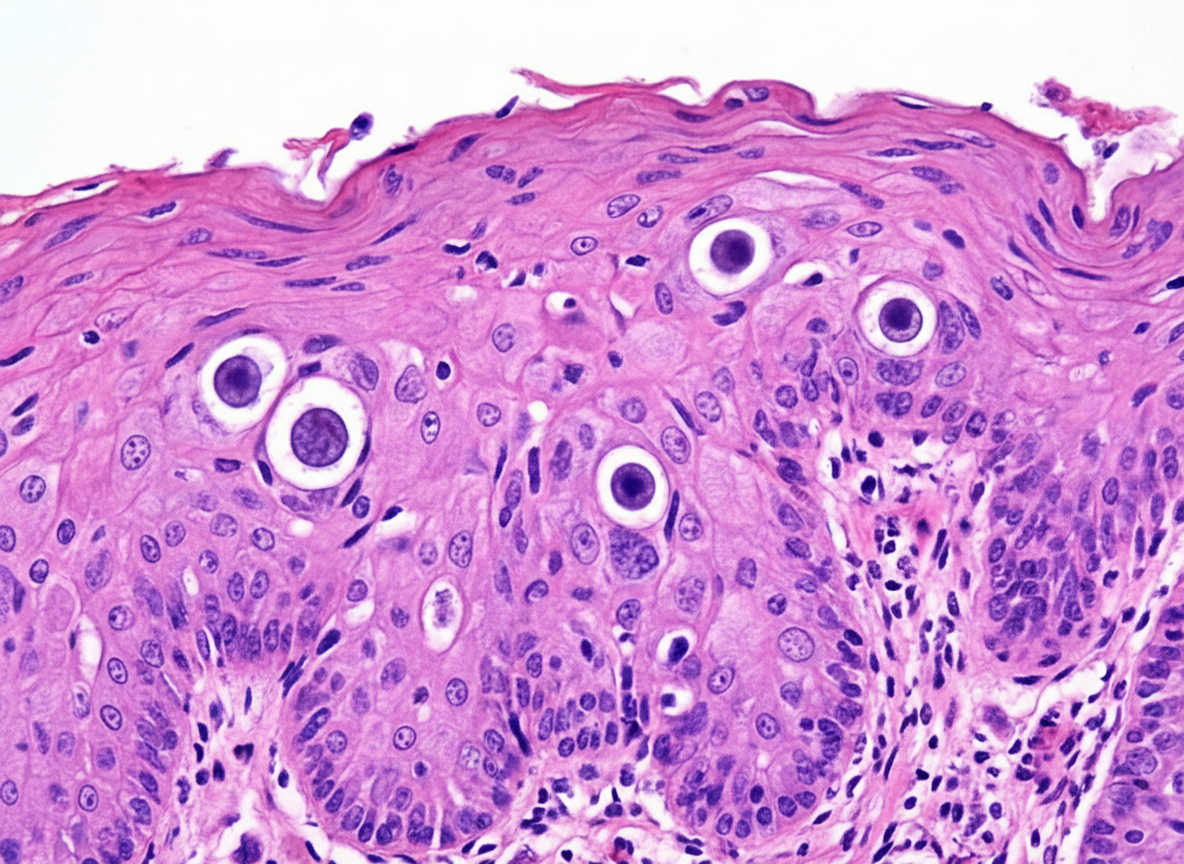
Explanation: **Explanation:** The correct answer is **None of the above** because all three listed conditions are clinical manifestations of the **Human Papillomavirus (HPV)**, a double-stranded DNA virus that infects keratinocytes of the skin and mucous membranes. 1. **Verruca Vulgaris (Common Warts):** These are hyperkeratotic, exophytic papules most commonly found on the hands and fingers. They are primarily caused by **HPV types 1, 2, 4, and 7**. 2. **Focal Epithelial Hyperplasia (Heck’s Disease):** This is a rare, benign condition characterized by multiple white-to-pink papules in the oral cavity (lips, tongue, buccal mucosa). It is specifically associated with **HPV types 13 and 32**. 3. **Condyloma Acuminatum (Anogenital Warts):** These are sexually transmitted cauliflower-like growths in the anogenital region. They are most commonly caused by "low-risk" **HPV types 6 and 11**. **Clinical Pearls for NEET-PG:** * **Deep Palmoplantar Warts (Myrmecia):** Caused by HPV-1. * **Butcher’s Warts:** Common in meat handlers, caused by HPV-7. * **Epidermodysplasia Verruciformis:** A genetic susceptibility to HPV (tree-man syndrome), associated with HPV-5 and HPV-8, which carry a high risk of progression to Squamous Cell Carcinoma (SCC). * **Oncogenic Strains:** HPV-16 and 18 are the most high-risk types for cervical, anal, and oropharyngeal cancers. * **Histology:** Look for **Koilocytes** (keratinocytes with perinuclear halos and wrinkled "raisin-like" nuclei), which are pathognomonic for HPV infection.
Explanation: **Explanation:** The **Tzanck smear** is a rapid bedside diagnostic test used primarily to identify acantholytic cells or viral cytopathic effects. In the context of viral infections, the presence of **multinucleated giant cells** (formed by the fusion of infected keratinocytes) is a hallmark finding. * **Why Chickenpox is correct:** Chickenpox (Varicella-Zoster Virus) belongs to the Herpesviridae family. Like Herpes Simplex (HSV), it causes characteristic cytopathic changes including **multinucleation**, nuclear molding, and chromatin margination. These are easily visualized on a Tzanck smear stained with Giemsa or Wright stain. **Analysis of Incorrect Options:** * **Psoriasis:** A chronic inflammatory condition characterized by epidermal hyperplasia (acanthosis) and Munro’s microabscesses (neutrophils in the stratum corneum), not multinucleated cells. * **Molluscum contagiosum:** Caused by a Poxvirus. A Tzanck smear would show **Henderson-Paterson bodies** (large, intracytoplasmic eosinophilic inclusion bodies), not multinucleated cells. * **Pemphigus vulgaris:** While Tzanck smear is used here, it reveals **Acantholytic cells (Tzanck cells)**—which are rounded, detached keratinocytes with hyperchromatic nuclei—but these are typically **mononucleated**, not multinucleated. **High-Yield Clinical Pearls for NEET-PG:** * **Tzanck Smear Mnemonic:** It is positive in **"CHAMP"**: **C**hickenpox, **H**erpes simplex/Zoster, **A**cantholytic disorders (Pemphigus), **M**olluscum contagiosum (Inclusions), and **P**ustular psoriasis (Neutrophils). * **Key Distinction:** Multinucleated giant cells help differentiate Herpes group viruses from other vesicular eruptions but *cannot* distinguish between HSV-1, HSV-2, and VZV. * **Stains used:** Giemsa, Wright, or Leishman stain.
Explanation: **Explanation:** **Oral Hairy Leukoplakia (OHL)** is a clinical marker of significant immunodeficiency, most commonly associated with HIV/AIDS. The correct answer is **Epstein-Barr Virus (EBV)**. The underlying pathophysiology involves the opportunistic replication of EBV within the squamous epithelium of the tongue. It presents as white, corrugated (hairy), non-scrapable patches, typically localized to the **lateral borders of the tongue**. **Analysis of Options:** * **Epstein-Barr Virus (EBV):** This is the definitive causative agent. While OHL is a sign of HIV progression, the virus actually replicating in the lesion is EBV. * **Human Immunodeficiency Virus (HIV):** While OHL is highly predictive of HIV infection, the virus itself does not cause the epithelial changes; it merely creates the immunosuppressed state that allows EBV to flourish. * **Herpes Simplex Virus (HSV):** HSV typically causes painful, grouped vesicles or punched-out erosions (herpetic stomatitis), not fixed white plaques. * **Human Papillomavirus (HPV):** HPV is associated with oral warts (verruca vulgaris) or condylomas, which present as pedunculated or sessile papules with a "cauliflower" surface, rather than lateral "hairy" plaques. **High-Yield Clinical Pearls for NEET-PG:** * **Differential Diagnosis:** Unlike Oral Candidiasis (Thrush), the lesions of OHL **cannot be scraped off** with a tongue depressor. * **Prognostic Significance:** In an undiagnosed patient, OHL is a "red flag" for HIV and often indicates a CD4 count below 200–300 cells/mm³. * **Treatment:** Usually unnecessary as it is asymptomatic; however, if required, systemic antivirals like Acyclovir or topical Podophyllin can be used. * **Histology:** Look for "balloon cells" (koicyte-like cells) in the upper stratum spinosum and nuclear inclusions.
Explanation: ### Explanation The clinical presentation describes a classic case of **Herpes Zoster (Shingles)** followed by **Post-herpetic Neuralgia (PHN)**. The patient exhibits a dermatomal distribution of vesicles (medial arm corresponds to the **T1 dermatome**) preceded by prodromal pain and followed by chronic neuropathic pain. #### Why the Correct Answer is Right The causative agent is the **Varicella-Zoster Virus (VZV)**. After a primary infection (Chickenpox), the virus travels retrograde along sensory axons and establishes **latency** within the **Dorsal Root Ganglia (DRG)** of spinal nerves or the sensory ganglia of cranial nerves (e.g., Trigeminal ganglion). When cell-mediated immunity declines (due to age or immunosuppression), the virus reactivates, replicates, and travels anterograde down the sensory nerve to the skin, causing the characteristic painful vesicular rash. #### Why Incorrect Options are Wrong * **A. Brainstem:** While VZV can affect cranial nerves (like the Trigeminal nerve in Ramsay Hunt Syndrome), the primary site of latency for spinal nerves is the DRG, not the brainstem parenchyma. * **C. Sensory nerve axon:** The axon serves as the "highway" for viral transport during primary infection and reactivation, but it is not the site where the virus resides during its latent phase. * **D. Sensory nerve root:** The nerve root connects the DRG to the spinal cord, but the viral DNA specifically persists in the cell bodies of the neurons located within the ganglion itself. #### NEET-PG High-Yield Pearls * **Most common site:** Thoracic dermatomes (T3–L2) are most frequently involved. * **Post-herpetic Neuralgia (PHN):** Defined as pain persisting for >90 days after the onset of the rash. * **Tzanck Smear:** Shows **Multinucleated Giant Cells** and Cowdry Type A intranuclear inclusions (common to HSV and VZV). * **Hutchinson’s Sign:** Vesicles on the tip of the nose indicating involvement of the nasociliary branch of the ophthalmic nerve; predicts high risk of herpes zoster ophthalmicus. * **Treatment:** Oral Acyclovir, Valacyclovir, or Famciclovir (ideally started within 72 hours).
Explanation: **Explanation:** **Scrum pox** (also known as *Herpes Gladiatorum*) is a cutaneous infection caused by **Herpes Simplex Virus type 1 (HSV-1)**. It is characterized by clusters of painful, fluid-filled vesicles on an erythematous base, typically occurring on the face, neck, and arms. **Why Rugby is the Correct Answer:** The term "Scrum pox" is derived from the **"scrum"** formation in Rugby, where players engage in prolonged, forceful skin-to-skin contact. The virus is transmitted through direct contact with active lesions or respiratory secretions. The friction and abrasions occurring during the scrum facilitate the entry of the virus into the skin. **Analysis of Incorrect Options:** * **Football & Hockey:** While these are contact sports, they do not involve the specific, sustained, face-to-face and skin-to-skin "scrumming" action characteristic of Rugby. Furthermore, players in these sports often wear more protective gear (helmets/padding) that acts as a barrier. * **Chess:** This is a non-contact board game with no risk of physical transmission of HSV-1 through skin friction. **High-Yield Clinical Pearls for NEET-PG:** * **Causative Agent:** HSV-1 is the most common cause. * **Common Sites:** The right side of the face/neck is frequently involved in rugby players due to the mechanics of the scrum. * **Differential Diagnosis:** Often misdiagnosed as impetigo or tinea corporis (Tinea Corporis Gladiatorum is also common in wrestlers). * **Management:** Oral acyclovir or valacyclovir is the treatment of choice. Athletes must be excluded from contact sports until all lesions have crusted over. * **Related Term:** In wrestlers, this same condition is more commonly referred to as **Herpes Gladiatorum**.
Explanation: ***Varicella zoster virus*** - Produces the characteristic **polymorphous vesicular rash** described as "**dew drops on rose petals**" - vesicles of different stages on an erythematous base. - The lesions appear in **crops** with vesicles, pustules, and crusts present simultaneously, typically starting on the **trunk** and spreading centripetally. *Herpesvirus* - Causes **grouped vesicles** on an erythematous base, typically clustered in a small area rather than widespread. - Lesions are usually **recurrent** at the same anatomical site and are **monomorphic** (same stage of development). *Measles virus* - Produces a **maculopapular rash** that starts behind the ears and spreads cephalocaudally, not vesicular lesions. - Associated with **Koplik's spots** in the mouth and systemic symptoms like **cough**, **coryza**, and **conjunctivitis**. *Parvovirus* - Causes **erythema infectiosum** with a characteristic "**slapped cheek**" appearance followed by a **lacy reticular rash** on extremities. - The rash is **maculopapular** and **non-vesicular**, completely different from the vesicular pattern described.
Explanation: **Explanation:** The treatment of choice for genital warts (Condyloma acuminata) in pregnancy is **Cryotherapy** (using liquid nitrogen). During pregnancy, the goal of treatment is to remove symptomatic warts and reduce the viral load before delivery to minimize the risk of juvenile-onset recurrent respiratory papillomatosis (JORRP) in the neonate. Cryotherapy is preferred because it is a **physical modality** that is safe, non-teratogenic, and lacks systemic absorption. **Why the other options are incorrect:** * **Podophyllotoxin (Option C):** This is strictly **contraindicated** in pregnancy due to its potent antimitotic effects, which can lead to systemic toxicity and potential fetal death or congenital anomalies. * **Imiquimod (Option B):** While it is an immune response modifier used for warts in non-pregnant patients, it is generally avoided in pregnancy due to a lack of sufficient safety data (Category C). * **Salicylic acid (Option A):** It is generally avoided for genital mucosal surfaces due to its corrosive nature and potential for systemic absorption (salicylism), especially over large surface areas. **High-Yield Clinical Pearls for NEET-PG:** * **Safe alternatives in pregnancy:** Trichloroacetic acid (TCA) 80-90% and surgical excision/electrocautery are also considered safe. * **Causative agents:** HPV types 6 and 11 (Low risk). * **Delivery Method:** Genital warts are *not* an absolute indication for Cesarean section unless they physically obstruct the birth canal or are likely to cause massive hemorrhage during labor. * **Most common viral STI:** HPV is the most common viral sexually transmitted infection worldwide.
Explanation: ### Explanation **Correct Answer: C. Human papillomavirus (HPV) infection** The clinical presentation of multiple, sessile, nonulcerated, papillary excrescences on the genitalia is classic for **Condyloma acuminatum** (anogenital warts). These are caused by **Human Papillomavirus (HPV)**, most commonly types **6 and 11**. The patient’s history of recurrent STIs (gonorrhea) indicates high-risk sexual behavior, which is the primary risk factor for acquiring HPV. The recurrence of these lesions after excision is a hallmark of HPV, as the virus often remains latent in the basal layer of the surrounding skin or mucosa, leading to new lesions even after the physical removal of visible warts. **Analysis of Incorrect Options:** * **A. Candida albicans:** Typically presents as balanitis (inflammation of the glans) with erythema, itching, and a "cheesy" white discharge, not as organized papillary growths. * **B. Circumcision:** This is actually a **protective factor**. Circumcision reduces the risk of acquiring HPV and other STIs because the removal of the prepuce eliminates a warm, moist environment conducive to viral persistence. * **D. Neisseria gonorrhoeae:** While the patient has a history of gonorrhea, this bacterium causes urethritis (purulent discharge and dysuria), not verrucous skin lesions. It does not predispose to warts, though its presence indicates a high risk for co-infection with HPV. **NEET-PG High-Yield Pearls:** * **Etiology:** HPV 6 and 11 (Low risk - warts); HPV 16 and 18 (High risk - associated with squamous cell carcinoma of the cervix, anus, and penis). * **Histopathology:** Look for **Koilocytes** (squamous epithelial cells with perinuclear halos and wrinkled "raisinoid" nuclei). * **Treatment:** Podophyllin, Imiquimod (immunomodulator), cryotherapy, or surgical excision. * **Prevention:** The quadrivalent and nonavalent HPV vaccines are effective against types 6 and 11.
Explanation: **Explanation:** The **Tzanck smear** is a rapid bedside diagnostic test used primarily for the diagnosis of **vesiculobullous disorders**, most notably those caused by the **Herpesviridae** family. **1. Why Option A is Correct:** In Herpes viral infections (Herpes Simplex and Varicella-Zoster), the virus causes characteristic cytopathic changes in keratinocytes. When a smear is taken from the base of a fresh vesicle and stained (with Giemsa, Wright, or Leishman stain), it reveals **multinucleated giant cells** and **acantholytic cells**. These giant cells are formed by the fusion of infected keratinocytes and are the hallmark diagnostic feature of Herpes on a Tzanck smear. **2. Why Other Options are Incorrect:** * **Option B (Bullous Pemphigoid):** While Tzanck smear can be used for Pemphigus Vulgaris (showing Tzanck cells/acantholytic cells), it is **not** diagnostic for Bullous Pemphigoid. In Bullous Pemphigoid, the split is subepidermal, and the smear typically shows numerous **eosinophils** but lacks acantholytic or multinucleated cells. * **Option C (Carcinoma of the cervix):** The screening and diagnostic test for cervical cancer is the **Pap smear** (Papanicolaou test), which identifies dysplastic or malignant epithelial cells. Tzanck smear has no role in oncology. **NEET-PG High-Yield Pearls:** * **Multinucleated Giant Cells:** Seen in HSV-1, HSV-2, VZV (Chickenpox), and Herpes Zoster (Shingles). * **Acantholytic Cells (Tzanck Cells):** Large, round keratinocytes with hyperchromatic nuclei; seen in **Pemphigus Vulgaris** and **Hailey-Hailey disease**. * **Limitations:** Tzanck smear can confirm a herpetic infection but **cannot differentiate** between HSV and VZV. * **Other uses:** Can identify *Molluscum bodies* (Henderson-Paterson bodies) in Molluscum Contagiosum or *Donovan bodies* in Granuloma Inguinale.
Herpes Simplex Virus Infections
Practice Questions
Varicella-Zoster Virus Infections
Practice Questions
Human Papillomavirus Infections
Practice Questions
Molluscum Contagiosum
Practice Questions
Viral Exanthems
Practice Questions
Hand, Foot, and Mouth Disease
Practice Questions
Orf and Milker's Nodule
Practice Questions
Cytomegalovirus Cutaneous Manifestations
Practice Questions
Epstein-Barr Virus Manifestations
Practice Questions
Poxvirus Infections
Practice Questions
HIV-Related Dermatoses
Practice Questions
Viral Infections in Immunocompromised Hosts
Practice Questions
Get full access to all questions, explanations, and performance tracking.
Start For Free