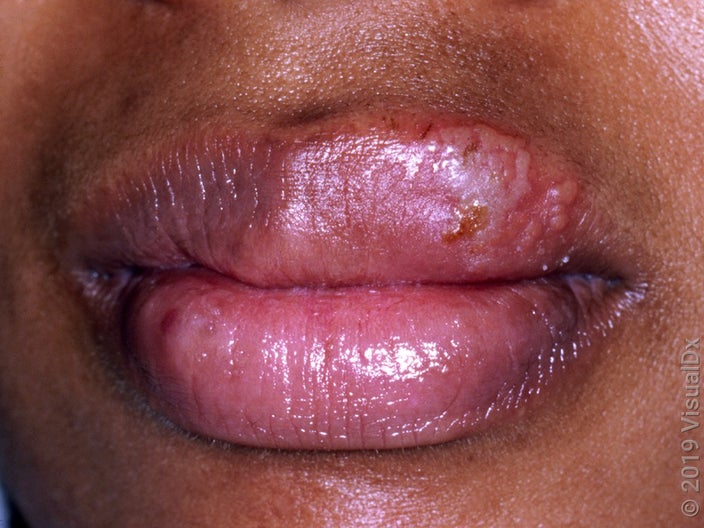
Causative organism for Molluscum contagiosum belongs to which virus family?
Recurrent genital ulcer is caused by which of the following?
Which of the following is NOT a differential diagnosis in a case of fever with vesicular rash for two days?
What is the causative agent for warts?
A patient presents with a split papule at the corner of the mouth. What is the most likely diagnosis?
Which condition is characterized by a morbilliform eruption?
Acyclovir is indicated in which of the following infections?
What is the most common virus causing molluscum contagiosum?
A 5-year-old child presents with raised, firm, flesh-colored nodules. Histopathological examination reveals characteristic findings. What is the most likely diagnosis?
The groove sign of greenbalt is seen in which of the following conditions?
Explanation: **Explanation:** **1. Correct Answer: B. Pox virus** Molluscum contagiosum is caused by the **Molluscum Contagiosum Virus (MCV)**, which is a large, double-stranded DNA virus belonging to the **Poxviridae** family. It is the only member of the genus *Molluscipoxvirus*. Unlike most DNA viruses that replicate in the nucleus, Poxviruses are unique because they replicate within the **cytoplasm** of host cells, leading to the formation of characteristic intracytoplasmic inclusion bodies. **2. Analysis of Incorrect Options:** * **A. Adenovirus:** These are non-enveloped DNA viruses typically associated with respiratory infections, conjunctivitis (pink eye), and gastroenteritis, not umbilicated skin papules. * **C. Picornavirus:** This family includes small RNA viruses such as Poliovirus, Rhinovirus, and Hepatitis A. They do not cause chronic skin lesions like Molluscum. * **D. Rhabdovirus:** This family includes the Rabies virus. These are bullet-shaped RNA viruses primarily transmitted through animal bites, affecting the central nervous system. **3. High-Yield Clinical Pearls for NEET-PG:** * **Morphology:** Characterized by firm, pearly, flesh-colored, **dome-shaped papules** with central **umbilication**. * **Histopathology:** Pathognomonic **Henderson-Paterson bodies** (large, eosinophilic, intracytoplasmic inclusion bodies) are seen in the epidermis. * **Transmission:** Spread via direct skin-to-skin contact, fomites, or autoinoculation. In adults, involvement of the genital area is often considered a **Sexually Transmitted Infection (STI)**. * **HIV Association:** Extensive, giant, or recalcitrant lesions are a marker for underlying immunosuppression (check CD4 count).
Explanation: **Explanation:** The correct answer is **Herpes Simplex Virus 2 (HSV-2)**. Genital herpes is the most common cause of recurrent genital ulcers worldwide. While both HSV-1 and HSV-2 can cause primary genital infections, **HSV-2** is characterized by a significantly higher rate of **reactivation** and recurrence in the genital tract. The virus remains latent in the **sacral ganglia** and periodically undergoes anterograde transport to the skin, causing painful, grouped vesicles on an erythematous base that progress to shallow ulcers. **Analysis of Options:** * **HSV-1 (Option A):** Traditionally associated with orofacial herpes ("cold sores") and latency in the trigeminal ganglia. While it is an increasing cause of *primary* genital herpes (often via orogenital contact), it recurs much less frequently in the genital region compared to HSV-2. * **HSV-3 (Option B):** Also known as **Varicella-Zoster Virus (VZV)**. It causes chickenpox (primary) and herpes zoster/shingles (reactivation). It typically presents in a dermatomal distribution and is not a standard cause of recurrent genital ulcers. * **HSV-4 (Option D):** Also known as **Epstein-Barr Virus (EBV)**. It is associated with Infectious Mononucleosis, Burkitt lymphoma, and Oral Hairy Leukoplakia, but not genital ulceration. **High-Yield Clinical Pearls for NEET-PG:** * **Diagnosis:** Tzanck smear shows **multinucleated giant cells** and Cowdry Type A inclusion bodies. * **Gold Standard:** PCR is the most sensitive test for HSV. * **Treatment:** Acyclovir, Valacyclovir, or Famciclovir. * **Differential:** Unlike Syphilis (painless chancre) or Chancroid (painful, soft, purulent ulcer), HSV presents as **painful, recurrent, grouped vesicles.**
Explanation: **Explanation:** The clinical presentation of **fever with a vesicular rash** typically points toward a viral etiology, most commonly from the Herpesviridae family. The primary differential diagnoses include **Varicella (Chickenpox)**, **Herpes Simplex Virus (HSV)**, and **Hand-Foot-Mouth Disease (Coxsackievirus)**. **Why "All of the above" is correct:** None of the organisms listed in options A, B, or C typically present with a primary vesicular rash. * **Candida albicans (Option A):** This is a fungal infection. Cutaneous candidiasis typically presents as erythematous plaques with characteristic **satellite pustules**, not vesicles. Systemic candidemia may cause skin lesions in immunocompromised patients, but they are usually macronodular or purpuric. * **Infectious Mononucleosis (Option B):** Caused by EBV, it presents with fever, lymphadenopathy, and pharyngitis. While a maculopapular rash may occur (especially after taking Ampicillin), a **vesicular** rash is not a feature. * **Klebsiella pneumoniae (Option C):** This is a Gram-negative bacterium primarily causing pneumonia or UTIs. While it can cause skin and soft tissue infections (like ecthyma gangrenosum in rare septicemic cases), it does not present as a generalized vesicular eruption. **Clinical Pearls for NEET-PG:** 1. **Tzanck Smear:** The gold standard bedside test for vesicular viral infections (Varicella, HSV, HZV). Look for **multinucleated giant cells** and acantholytic cells. 2. **Dewdrops on a rose petal:** Classic description for the vesicles of Varicella (Chickenpox). 3. **Vesicles on an erythematous base:** Characteristic of Herpes Simplex. 4. **Differential for Vesiculobullous disorders:** Always distinguish between viral causes and autoimmune causes (like Pemphigus Vulgaris or Bullous Pemphigoid), which usually lack an acute febrile prodrome.
Explanation: **Explanation:** **Correct Answer: C. Human Papillomavirus (HPV)** Warts (Verrucae) are benign epidermal proliferations caused by the **Human Papillomavirus (HPV)**, a double-stranded DNA virus. HPV infects the basal keratinocytes of the epithelium through minor skin abrasions. Once inside, the virus induces hyperplasia of the epidermis, leading to the characteristic clinical appearance of a wart. Specific genotypes are associated with different clinical types: HPV 1 (Plantar warts), HPV 2 & 4 (Common warts/Verruca vulgaris), and HPV 6 & 11 (Anogenital warts/Condyloma acuminata). **Why other options are incorrect:** * **HIV (Option A):** This is a retrovirus that attacks CD4+ T-cells, leading to AIDS. While HIV patients are more prone to extensive warts due to immunosuppression, the virus itself does not cause them. * **HSV (Option B):** Herpes Simplex Virus causes vesicular eruptions (e.g., Herpes Labialis or Genitalis) characterized by "grouped vesicles on an erythematous base," not verrucous growths. * **VZV (Option C):** This virus causes Chickenpox (primary infection) and Herpes Zoster/Shingles (reactivation), presenting as dermatomal fluid-filled vesicles. **High-Yield NEET-PG Pearls:** * **Histopathology:** Look for **Koilocytes** (keratinocytes with perinuclear halos and pyknotic nuclei) in the upper epidermis—a pathognomonic feature of HPV infection. * **Butcher’s Warts:** Common in meat handlers, usually caused by HPV-7. * **Malignancy Risk:** HPV 16 and 18 are high-risk types strongly associated with cervical cancer and squamous cell carcinoma. * **Treatment:** Salicylic acid, cryotherapy (liquid nitrogen), and podophyllin are common modalities. For genital warts, Imiquimod (an immune response modifier) is frequently tested.
Explanation: **Explanation:** The **split papule** is a classic, high-yield clinical sign of **Secondary Syphilis**. It occurs when a syphilitic papule develops at a mucosal fold, most commonly the angle of the mouth (commissure) or the nasolabial fold. Due to the constant movement and friction at these sites, the papule becomes fissured or "split" down the center, often appearing as two halves of a papule facing each other. **Analysis of Options:** * **Secondary Syphilis (Correct):** Known as the "Great Imitator," its secondary stage is characterized by generalized lymphadenopathy and mucocutaneous lesions. The split papule is a specific morphological variant seen at the angles of the mouth. * **Recurrent Herpes Labialis:** Typically presents as a cluster of painful, grouped vesicles on an erythematous base ("cold sores"), usually at the vermilion border. It does not present as a solid split papule. * **Recurrent Herpetic Stomatitis:** This primarily affects the keratinized oral mucosa (hard palate and gingiva) as small ulcers; it is not characterized by fissured papules at the commissures. * **Increased Vertical Dimension:** This is a dental/prosthodontic term. Conversely, a *decreased* vertical dimension (often seen in edentulous patients) leads to **Angular Cheilitis** due to saliva accumulation in skin folds, but this presents as maceration and erythema, not a distinct split papule. **NEET-PG High-Yield Pearls:** * **Condyloma Lata:** Flat-topped, moist, highly infectious papules in intertriginous areas (also secondary syphilis). * **Palmoplantar Rash:** Secondary syphilis is a classic cause of copper-colored maculopapular rashes on the palms and soles. * **Lues Maligna:** A severe, pleomorphic form of secondary syphilis seen in HIV-positive patients. * **Diagnosis:** Screening is done via VDRL/RPR; confirmation via TPHA/FTA-ABS.
Explanation: **Explanation:** **Rubella (German Measles)** is the classic example of a **morbilliform eruption**, which refers to a maculopapular rash that resembles measles. The rash typically begins on the face and spreads cephalocaudally (downward) to the trunk and extremities within 24 hours. It is characterized by discrete pinkish-red macules that may coalesce but usually disappear by the third day ("3-day measles"). **Analysis of Options:** * **Scarlet Fever (Option A):** Characterized by a **scarlatiniform eruption**. This is a diffuse, erythematous, "sandpaper-like" rash caused by Group A Streptococcus erythrogenic toxins. It typically spares the circumoral area (circumoral pallor) and is associated with "strawberry tongue." * **Toxic Shock Syndrome (Option C):** Presents with a **diffuse erythroderma** (resembling a painless sunburn) that later leads to desquamation, particularly of the palms and soles. It is a systemic inflammatory response, not a morbilliform pattern. * **Option D:** Incorrect because the morphological descriptions of these rashes are distinct in dermatological semiology. **High-Yield Clinical Pearls for NEET-PG:** * **Forchheimer spots:** Small, red petechiae on the soft palate seen in Rubella (not pathognomonic). * **Koplik spots:** Pathognomonic for Measles (Rubeola), found on the buccal mucosa opposite the lower molars. * **Congenital Rubella Syndrome (CRS) Triad:** Cataracts, Sensorineural deafness, and Congenital heart disease (PDA). * **Morbilliform Drug Eruption:** The most common type of cutaneous adverse drug reaction (Type IV hypersensitivity), often caused by beta-lactams or sulfonamides.
Explanation: ### Explanation **Correct Answer: B. Herpes simplex** **Mechanism of Action:** Acyclovir is a **guanosine analogue** that acts as a potent antiviral agent. Its selectivity is due to the viral enzyme **thymidine kinase**, which converts acyclovir into acyclovir monophosphate. Host cell enzymes then convert it into acyclovir triphosphate, which inhibits viral DNA polymerase and causes DNA chain termination. Since this enzyme is primarily found in **Herpes Simplex Virus (HSV)** and **Varicella-Zoster Virus (VZV)**, acyclovir is the drug of choice for these infections. **Analysis of Incorrect Options:** * **A. Candida:** This is a fungus. Treatment requires antifungal agents like Fluconazole or Nystatin, which target the fungal cell membrane (ergosterol synthesis). * **C. Mycoplasma:** This is a bacterium (lacking a cell wall). It requires antibiotics that inhibit protein synthesis, such as Macrolides (Azithromycin) or Tetracyclines. * **D. Pneumocystis (PJP):** This is a yeast-like fungus. The treatment of choice is **Trimethoprim-Sulfamethoxazole (Cotrimoxazole)**. **High-Yield Clinical Pearls for NEET-PG:** * **Spectrum:** Acyclovir is most active against **HSV-1**, followed by **HSV-2**, then **VZV**. It has minimal activity against CMV or EBV. * **Resistance:** Resistance to acyclovir usually occurs due to the absence or mutation of the viral **thymidine kinase** enzyme. In such cases, **Foscarnet** is the drug of choice (as it does not require phosphorylation by viral enzymes). * **Side Effects:** When given intravenously, acyclovir can cause **obstructive nephropathy** (crystalline nephropathy). Adequate hydration is essential to prevent this. * **Valacyclovir:** A prodrug of acyclovir with better oral bioavailability, often preferred for Herpes Zoster to improve compliance.
Explanation: **Explanation:** **Molluscum Contagiosum (MC)** is a common viral skin infection caused by the **Molluscum Contagiosum Virus (MCV)**, which belongs to the *Poxviridae* family (Genus: *Molluscipoxvirus*). 1. **Why Option A is correct:** There are four main subtypes of MCV (MCV-1 to MCV-4). **MCV-1** is the most prevalent subtype globally, accounting for approximately **75% to 90%** of all clinical cases. It is the primary cause of infections in children, typically transmitted through direct skin-to-skin contact or fomites. 2. **Why Options B, C, and D are incorrect:** * **MCV-2** is less common than MCV-1. However, it is clinically significant because it is more frequently isolated in **adults** and is often associated with **sexual transmission** or seen in **immunocompromised individuals** (e.g., HIV patients). * **MCV-3 and MCV-4** are extremely rare and are infrequently isolated in clinical practice. **High-Yield Clinical Pearls for NEET-PG:** * **Clinical Morphology:** Characterized by firm, pearly, flesh-colored, **umbilicated papules**. * **Histopathology:** Pathognomonic **Henderson-Paterson bodies** (large, intracytoplasmic eosinophilic inclusion bodies) are seen in the epidermis. * **Koebner Phenomenon:** MC can show a positive Koebner phenomenon (lesions appearing along the line of trauma/scratching). * **Binkley’s Sign:** In HIV patients, lesions can be giant (>1cm) or occur in atypical locations like the face. * **Treatment of Choice:** Curettage, cryotherapy, or application of KOH (10-20%). In children, many cases are self-limiting.
Explanation: **Explanation:** **Molluscum Contagiosum (Correct Answer):** Molluscum contagiosum is a common viral infection caused by a **Poxvirus**. It typically presents in children as firm, flesh-colored, dome-shaped papules with a characteristic **central umbilication**. The histopathological hallmark is the presence of **Henderson-Paterson bodies** (large, eosinophilic intracytoplasmic inclusion bodies) within the keratinocytes, which displace the nucleus to the periphery. **Why other options are incorrect:** * **Myrmecia (A):** This refers to deep, painful palmoplantar warts caused by **HPV-1**. Histology shows large eosinophilic keratohyalin granules, but they lack the classic umbilication and specific inclusion bodies of Molluscum. * **Herpes Zoster (C) & Herpes Simplex (D):** Both are caused by the Herpesviridae family. Clinically, they present as **vesicles on an erythematous base** (not flesh-colored nodules). Histopathology reveals **multinucleated giant cells** (Tzanck smear positive) and Cowdry Type A intranuclear inclusions, rather than cytoplasmic inclusions. **NEET-PG High-Yield Pearls:** * **Etiology:** DNA Poxvirus (Molluscum Contagiosum Virus). * **Transmission:** Skin-to-skin contact; in adults, it is often considered an **STI** if found in the anogenital region. * **Histology:** Look for the "molluscum body" or **Henderson-Paterson body**. * **Clinical Sign:** Central umbilication (cheesy material can be expressed). * **Association:** Extensive or giant lesions in adults should prompt an **HIV screening**.
Explanation: **Explanation:** The **Groove sign of Greenblatt** is a pathognomonic clinical feature of **Lymphogranuloma venereum (LGV)**, caused by *Chlamydia trachomatis* (serotypes L1, L2, and L3). It occurs during the secondary stage of the disease when there is painful inflammatory enlargement of the inguinal and femoral lymph nodes. These two groups of nodes are separated by the **Poupart’s (inguinal) ligament**, creating a characteristic "groove" or depression between the matted lymph nodes. **Analysis of Options:** * **Lymphogranuloma venereum (Correct):** Characterized by the "Groove sign" and "Esthiomene" (chronic hypertrophic ulceration of the vulva). * **Donovanosis (Granuloma Inguinale):** Caused by *Klebsiella granulomatis*. It presents with painless, beefy-red, bleeding ulcers. Histology shows **Donovan bodies** (safety-pin appearance) within macrophages. * **Chancroid:** Caused by *Haemophilus ducreyi*. It presents with **painful**, soft ulcers and painful inguinal lymphadenopathy (buboes), but lacks the specific groove sign. * **Genital Herpes:** Caused by HSV-2. It presents with multiple, painful, grouped vesicles on an erythematous base. **Clinical Pearls for NEET-PG:** * **LGV Treatment:** Doxycycline (100 mg BID for 21 days) is the drug of choice. * **Bubo Management:** In LGV, fluctuant buboes should be **aspirated** through healthy skin to prevent sinus formation; they should never be incised and drained. * **Frei Test:** An older intradermal test used for LGV diagnosis (now largely replaced by NAAT).
Herpes Simplex Virus Infections
Practice Questions
Varicella-Zoster Virus Infections
Practice Questions
Human Papillomavirus Infections
Practice Questions
Molluscum Contagiosum
Practice Questions
Viral Exanthems
Practice Questions
Hand, Foot, and Mouth Disease
Practice Questions
Orf and Milker's Nodule
Practice Questions
Cytomegalovirus Cutaneous Manifestations
Practice Questions
Epstein-Barr Virus Manifestations
Practice Questions
Poxvirus Infections
Practice Questions
HIV-Related Dermatoses
Practice Questions
Viral Infections in Immunocompromised Hosts
Practice Questions
Get full access to all questions, explanations, and performance tracking.
Start For Free