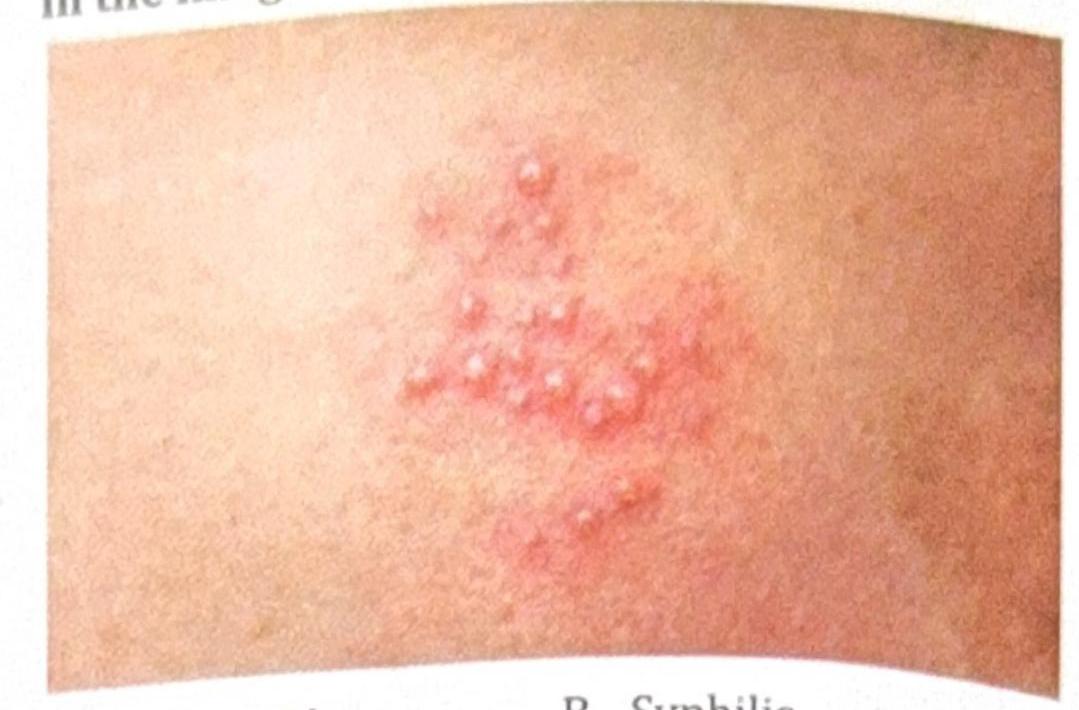
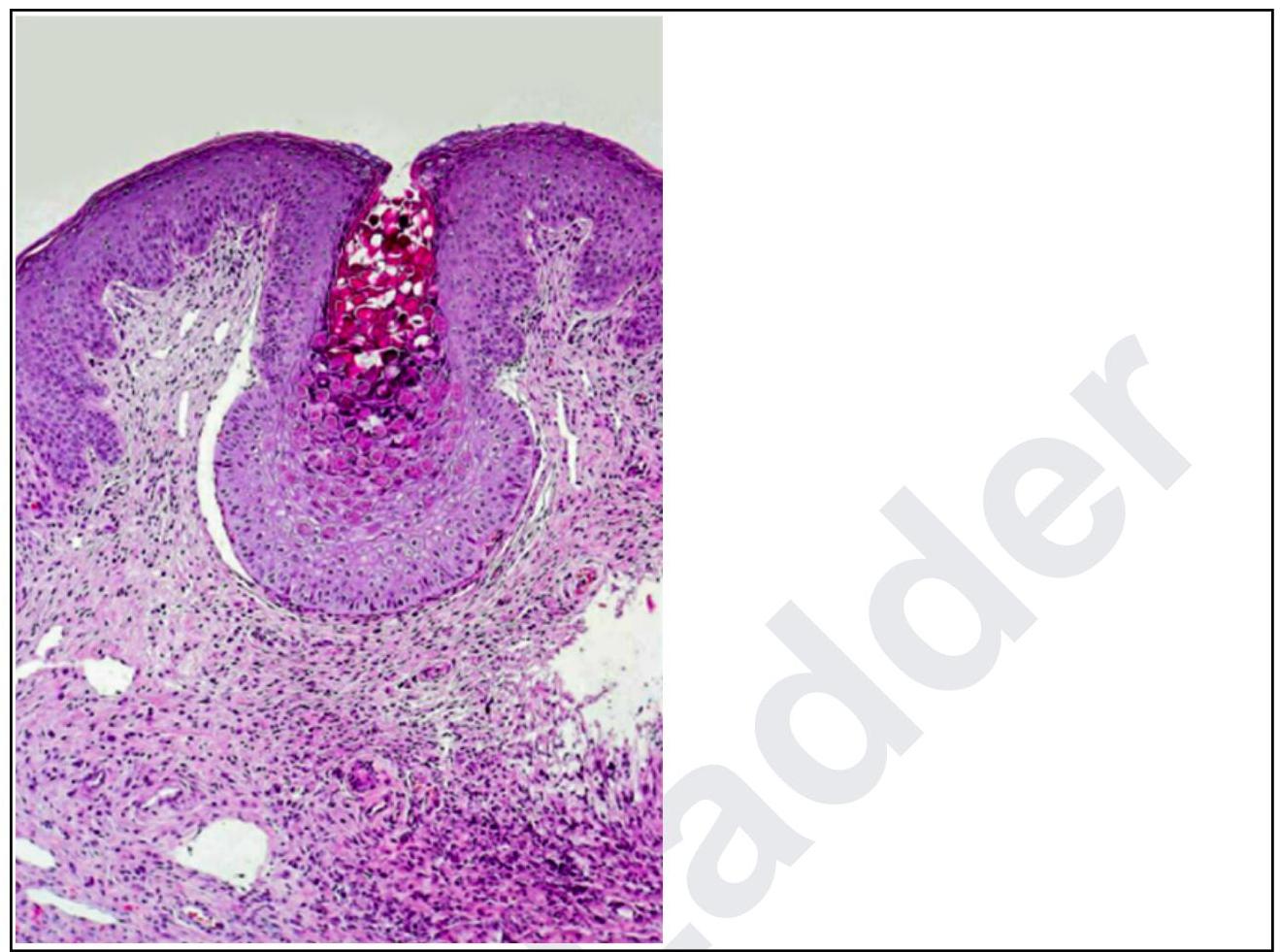
Podophyllin is used to treat which type of wart?
Which type of Human Papillomavirus (HPV) is most commonly implicated in genital warts?
Which syndrome is associated with increased susceptibility to HPV infection?
Hairy leukoplakia is associated with all of the following EXCEPT?
Which of the following is an oral lesion commonly seen in immunocompromised states?
Condyloma acuminatum is caused by which virus?
A 35-year-old man has noted a small bump on his upper trunk for the past 6 weeks. On physical examination, there is a solitary, 0.4-cm, flesh-colored nodule on the upper trunk. The dome-shaped lesion is umbilicated, and a curd-like material can be expressed from the center. This material is smeared on a slide, and the Giemsa stain shows many pink, homogeneous, cytoplasmic inclusions. The lesion regresses over the next 2 months. Which of the following infectious agents most likely produced this lesion?
Which of the following statements about Donovanosis is true?
What is a characteristic feature of acute herpetic gingivostomatitis?
What is the drug of choice for treating genital warts?
Explanation: **Explanation:** **Podophyllin** (Podophyllum resin) is a potent cytotoxic agent derived from the Mayapple plant. It works by binding to tubulin, inhibiting mitotic spindle formation, which leads to cell cycle arrest and necrosis of the treated tissue. **Why Genital Warts (Condyloma Acuminata) is correct:** Podophyllin is specifically indicated for the treatment of **anogenital warts** caused by Human Papillomavirus (HPV) types 6 and 11. Because it is highly caustic and can be systemically absorbed, it is primarily used on mucosal or thin-skinned areas where penetration is effective. It must be applied by a healthcare professional and washed off after 4–6 hours to prevent severe local irritation or systemic toxicity. **Why other options are incorrect:** * **Plantar Warts (Verruca Plantaris):** These occur on the thick, keratinized skin of the soles. Podophyllin lacks the penetrative power to bypass this thick stratum corneum. Salicylic acid or cryotherapy are preferred. * **Verruca Plana (Flat Warts):** These are usually multiple and located on the face or dorsum of hands. Podophyllin is too corrosive for facial use and carries a high risk of scarring and post-inflammatory hyperpigmentation. **Clinical Pearls for NEET-PG:** * **Contraindication:** Podophyllin is strictly **contraindicated in pregnancy** due to its teratogenic potential and risk of fetal death. * **Podophyllotoxin:** This is the active purified fraction of podophyllin. Unlike the resin, it is stable and can be self-applied by the patient. * **Systemic Toxicity:** Over-application or failure to wash it off can lead to "Podophyllin Toxicity," characterized by bone marrow suppression, neurotoxicity (coma/seizures), and multi-organ failure.
Explanation: **Explanation:** **Correct Option: D (HPV 6)** Genital warts, also known as **Condyloma acuminata**, are primarily caused by "low-risk" types of Human Papillomavirus. **HPV 6 and HPV 11** are responsible for approximately 90% of all clinical cases of genital warts. These strains cause benign epithelial proliferation but have a very low potential for malignant transformation. **Incorrect Options:** * **HPV 16 & 18 (Options A & B):** These are "high-risk" oncogenic types. While they can be found in genital lesions, they are most famously associated with **Cervical Intraepithelial Neoplasia (CIN)** and invasive **Cervical Cancer**, as well as anal and oropharyngeal cancers. * **HPV 31 (Option C):** This is another high-risk type associated with cervical cancer, though it is less common than types 16 and 18. **Clinical Pearls for NEET-PG:** * **Morphology:** Condyloma acuminata typically presents as cauliflower-like, flesh-colored sessile growths in the anogenital region. * **Histopathology:** The hallmark finding is **Koilocytosis** (keratinocytes with perinuclear halos and wrinkled "raisin-like" nuclei). * **Other HPV Associations:** * **HPV 1:** Plantar warts (Verruca plantaris). * **HPV 2 & 4:** Common warts (Verruca vulgaris). * **HPV 3 & 10:** Plane warts (Verruca plana). * **HPV 5 & 8:** Associated with **Epidermodysplasia verruciformis** and increased risk of Squamous Cell Carcinoma (SCC). * **Treatment:** Options include Podophyllin, Imiquimod (immunomodulator), cryotherapy, or surgical excision. The HPV vaccine (Gardasil) covers types 6, 11, 16, and 18.
Explanation: **Explanation:** **WHIM Syndrome** is a rare, autosomal dominant primary immunodeficiency disorder characterized by a specific susceptibility to **Human Papillomavirus (HPV)**, leading to extensive cutaneous and mucosal warts. The syndrome is caused by a gain-of-function mutation in the **CXCR4 gene**, which encodes a chemokine receptor. This mutation leads to the retention of mature neutrophils in the bone marrow (medulliphasis), resulting in peripheral neutropenia. The acronym stands for: * **W**arts (recurrent HPV infections) * **H**ypogammaglobulinemia (low antibody levels) * **I**nfections (recurrent bacterial pyogenic infections) * **M**yelokathexis (retention of neutrophils in the marrow) **Analysis of Incorrect Options:** * **WHIP, WHET, and WHIE Syndromes:** These are distractors and do not represent recognized clinical entities in dermatology or immunology. They are phonetically similar to the correct answer to test the candidate's precision in recalling medical acronyms. **Clinical Pearls for NEET-PG:** * **Genetics:** Most cases are due to mutations in the **CXCR4** receptor on chromosome 2q21. * **Treatment:** Management includes G-CSF (Granulocyte colony-stimulating factor) to address neutropenia and IVIG for hypogammaglobulinemia. **Plerixafor**, a CXCR4 antagonist, is a targeted therapy used in these patients. * **Differential Diagnosis:** Another condition with high HPV susceptibility is **Epidermodysplasia Verruciformis** (associated with *EVER1/EVER2* mutations), but it lacks the hematological features (neutropenia) seen in WHIM.
Explanation: **Explanation:** Oral Hairy Leukoplakia (OHL) is a benign, white mucosal lesion primarily caused by the **Epstein-Barr Virus (EBV)**. It is a hallmark opportunistic infection, most commonly seen in patients with **AIDS** or severe immunosuppression. **Why Option A is the Correct Answer (The "Except"):** The description "Filiform to flat patch" is clinically inaccurate for OHL. OHL characteristically presents as **corrugated, vertically oriented white ridges** (resembling "hair" or a "shaggy" surface) that **cannot be scraped off**. While it classically occurs on the **lateral borders of the tongue**, the morphology is typically thick and corrugated rather than a simple flat patch or filiform projection. **Analysis of Other Options:** * **Option B (Bilateral appearance):** OHL is frequently bilateral and symmetrical along the lateral margins of the tongue, which helps distinguish it from other unilateral lesions like squamous cell carcinoma. * **Option C (Epstein Barr virus):** EBV is the definitive causative agent. The virus replicates within the epithelial cells of the tongue, leading to the characteristic hyperkeratosis. * **Option D (AIDS):** OHL is one of the most common oral manifestations of HIV/AIDS. Its presence is often considered a clinical marker of disease progression and a low CD4 count (usually <200 cells/mm³). **High-Yield Clinical Pearls for NEET-PG:** * **Differential Diagnosis:** Unlike Oral Candidiasis, OHL **cannot be scraped off** with a tongue depressor. * **Histopathology:** Look for **"Balloon cells"** (koilocytosis-like changes) in the upper stratum spinosum and nuclear inclusions. * **Treatment:** Usually not required unless for cosmetic reasons; it often resolves with Highly Active Antiretroviral Therapy (HAART) or systemic antivirals like Acyclovir. * **Malignant Potential:** Unlike idiopathic leukoplakia, OHL has **zero** premalignant potential.
Explanation: **Explanation:** **Oral Hairy Leukoplakia (OHL)** is the correct answer because it is a classic opportunistic condition caused by the **Epstein-Barr Virus (EBV)**. It occurs almost exclusively in immunocompromised individuals, most notably those with **HIV/AIDS** (often when CD4 counts fall below 200-300 cells/mm³). Clinically, it presents as white, corrugated (hairy), non-scrapable patches typically located on the **lateral borders of the tongue**. Unlike oral candidiasis, it cannot be rubbed off. **Analysis of Incorrect Options:** * **Lichen Planus (A):** An autoimmune, T-cell mediated inflammatory condition. While it presents with Wickham striae, it is not specifically triggered by an immunocompromised state. * **Lichenoid Eruption (B):** Usually a drug-induced reaction (e.g., NSAIDs, antihypertensives) or a manifestation of Graft-versus-Host Disease; it is not a primary viral infection of the immunocompromised. * **Erythroplakia (D):** A clinical term for a red patch on the oral mucosa. It is a **premalignant** lesion associated with tobacco and alcohol use, rather than viral opportunistic infections. **High-Yield Clinical Pearls for NEET-PG:** * **Etiology:** EBV (Human Herpesvirus 4). * **Diagnostic Feature:** Histology shows **acanthosis, hyperkeratosis, and "balloon cells"** in the upper spinous layer. * **Significance:** OHL is often the first clinical sign of undiagnosed HIV infection or a marker of disease progression. * **Treatment:** Usually unnecessary unless for cosmetic reasons (Acyclovir or Podophyllin resin can be used), but the primary management is **HAART** to improve immune status.
Explanation: **Explanation:** **Condyloma acuminatum**, commonly known as anogenital warts, is caused by the **Human Papillomavirus (HPV)**. It is a sexually transmitted infection characterized by flesh-colored, cauliflower-like growths on the skin and mucous membranes of the genital and perianal regions. Specifically, **HPV types 6 and 11** are responsible for approximately 90% of these cases. These are considered "low-risk" types because they have a low potential for malignant transformation compared to "high-risk" types like 16 and 18. **Analysis of Incorrect Options:** * **Cytomegalovirus (CMV):** A member of the Herpesvirus family, CMV typically causes asymptomatic infections or mononucleosis-like syndromes. In immunocompromised patients, it can cause retinitis, colitis, or esophagitis, but not verrucous genital lesions. * **Lymphogranuloma Venereum (LGV):** This is caused by **Chlamydia trachomatis (serotypes L1, L2, L3)**. It typically presents with a transient primary painless ulcer followed by painful inguinal lymphadenopathy (buboes) and the "Groove sign." * **Hepatitis B Virus (HBV):** This is a blood-borne DNA virus that primarily affects the liver. While it is sexually transmitted, its clinical manifestations are systemic (jaundice, cirrhosis) rather than dermatological growths. **NEET-PG High-Yield Pearls:** * **Histopathology:** Look for **Koilocytes** (squamous epithelial cells with perinuclear halos and wrinkled "raisinoid" nuclei), which are pathognomonic for HPV infection. * **Treatment:** First-line options include Podophyllotoxin, Imiquimod (an immune response modifier), or destructive methods like cryotherapy and CO2 laser. * **Association:** Condyloma **Lata** (flat, moist lesions) is a feature of **Secondary Syphilis**, whereas Condyloma **Acuminatum** (pointed/warty) is **HPV**.
Explanation: ### Explanation The clinical presentation and histopathological findings are classic for **Molluscum Contagiosum**, a common viral skin infection caused by a **Poxvirus** (specifically a large, double-stranded DNA virus). **Why the correct answer is right:** * **Clinical Morphology:** The description of a "flesh-colored, dome-shaped, umbilicated nodule" is the pathognomonic clinical sign of Molluscum. * **Central Expression:** The "curd-like material" expressed from the center represents the necrotic core of the lesion containing viral particles. * **Cytology (Giemsa Stain):** The "pink, homogeneous, cytoplasmic inclusions" are **Henderson-Paterson bodies** (or Molluscum bodies). These are large intracytoplasmic inclusion bodies that displace the nucleus of keratinocytes. * **Natural History:** In immunocompetent individuals, these lesions are self-limiting and typically regress spontaneously within months. **Why incorrect options are wrong:** * **Histoplasma capsulatum:** While it can cause skin nodules in disseminated cases (especially in HIV), it would show small, intracellular yeast cells with a narrow base of budding and a "halo" on Giemsa/PAS stain, not large eosinophilic inclusions. * **Human papillomavirus (HPV):** Causes warts (Verruca). These are typically hyperkeratotic and filiform/verrucous rather than smooth and umbilicated. Histology shows koilocytes (vacuolated cells with wrinkled nuclei), not Henderson-Paterson bodies. * **Staphylococcus aureus:** Causes pyogenic infections like folliculitis or furuncles. These are typically painful, erythematous, and contain purulent pus (neutrophils and cocci) rather than firm, curd-like material. **NEET-PG High-Yield Pearls:** * **Etiology:** Poxvirus (Largest DNA virus); replicates in the **cytoplasm** (unique for DNA viruses). * **Transmission:** Skin-to-skin contact, fomites, or sexual contact (if in the anogenital region). * **Histology:** Look for "Henderson-Paterson bodies"—large, eosinophilic (pink) intracytoplasmic inclusions in the stratum spinosum and granulosum. * **Association:** In adults, extensive or giant lesions should prompt an investigation for **HIV/Immunosuppression**.
Explanation: **Explanation:** **Donovanosis** (Granuloma Inguinale) is a chronic, progressive bacterial infection of the genital and perianal region. 1. **Why Option A is Correct:** The causative agent is **_Klebsiella granulomatis_** (formerly known as **_Calymmatobacterium granulomatis_**). It is a Gram-negative, pleomorphic, intracellular bacillus. The hallmark of diagnosis is the identification of **Donovan bodies** (safety-pin appearance) within large mononuclear cells (macrophages) on a tissue smear stained with Giemsa or Wright stain. 2. **Why Other Options are Incorrect:** * **Option B:** Lymphadenopathy is typically **absent**. However, the disease causes subcutaneous granulation tissue that mimics lymph node enlargement, known as **"Pseudobubo."** * **Option C:** The drug of choice is **Azithromycin** (1g weekly or 500mg daily for at least 3 weeks). Penicillin is ineffective as the organism is an intracellular Gram-negative rod. * **Option D:** Donovanosis is characterized by **painless**, beefy-red, friable ulcers with exuberant granulation tissue. Painful ulcers are characteristic of Chancroid or Herpes Simplex. **High-Yield Clinical Pearls for NEET-PG:** * **Clinical Appearance:** "Beefy red" ulcers that bleed easily on touch. * **Pathognomonic Sign:** Donovan bodies (Intracellular safety-pin appearance). * **Key Distinction:** Unlike Syphilis or Chancroid, it does not involve true regional lymph nodes. * **Common Sites:** Prepuce/frenulum in males; labia/fourchette in females.
Explanation: **Explanation:** **Acute Herpetic Gingivostomatitis (AHGS)** is the most common clinical manifestation of a primary (initial) infection with **Herpes Simplex Virus Type 1 (HSV-1)**. 1. **Why Option A is correct:** While AHGS is most frequently seen in children (typically between 6 months and 5 years of age) due to the lack of prior exposure to the virus, it also occurs in young adults who were not infected during childhood. In adults, the primary infection may present more severely or as herpetic pharyngotonsillitis. Therefore, the age distribution spans both pediatric and young adult populations. 2. **Why Options B and C are incorrect:** These options are too restrictive. While the peak incidence is in early childhood, the infection is not exclusive to that age group. Conversely, it is rarely a "first-time" infection in older adults because most individuals develop antibodies to HSV-1 by middle age. **Clinical Pearls for NEET-PG:** * **Clinical Presentation:** Characterized by high-grade fever, irritability, and painful vesicular lesions on the gingiva, tongue, and buccal mucosa that rupture to form shallow ulcers with a "punched-out" appearance. * **Key Diagnostic Feature:** Look for **Tzanck smear** findings showing **Multinucleated Giant Cells** and Cowdry Type A intranuclear inclusion bodies. * **Differential Diagnosis:** Must be distinguished from Herpangina (caused by Coxsackie A virus), which typically involves the posterior pharynx (soft palate/tonsils) rather than the anterior gingiva. * **Treatment:** Supportive care (hydration) and oral Acyclovir if started within 72 hours of onset.
Explanation: **Explanation:** Genital warts (Condyloma acuminata) are caused by the **Human Papillomavirus (HPV)**, most commonly types 6 and 11. Unlike systemic viral infections, these are localized epidermal proliferations. **Podophyllin** (and its purified form, Podophyllotoxin) is a potent cytotoxic agent that acts as a mitotic inhibitor. It binds to tubulin, preventing mitotic spindle formation, which leads to cell death and the physical destruction of the wart tissue. It remains a standard provider-applied chemical treatment for external genital warts. **Analysis of Options:** * **Acyclovir (A):** This is an antiviral used specifically for DNA viruses of the **Herpes family** (HSV, VZV). It inhibits viral DNA polymerase but has no efficacy against HPV. * **Minocycline (C):** This is a tetracycline antibiotic used primarily for acne, rosacea, and certain bacterial infections. It has no antiviral properties. * **Interferon alpha (D):** While it has antiviral and immunomodulatory properties and can be used for refractory cases (intralesional), it is not the first-line drug of choice due to high cost, side effects, and lower clearance rates compared to topical destructive therapies. **Clinical Pearls for NEET-PG:** * **Imiquimod:** A high-yield alternative; it is an **immune response modifier** (TLR-7 agonist) used for patient-applied treatment. * **Trichloroacetic Acid (TCA):** The preferred chemical treatment for pregnant women with genital warts (Podophyllin is contraindicated in pregnancy). * **Histology:** Look for **Koilocytes** (cells with perinuclear halo and wrinkled "raisinoid" nuclei) on a Tzanck smear or biopsy. * **HPV 16 & 18:** These are high-risk types associated with cervical and anal carcinoma, whereas 6 and 11 are low-risk (benign warts).
Herpes Simplex Virus Infections
Practice Questions
Varicella-Zoster Virus Infections
Practice Questions
Human Papillomavirus Infections
Practice Questions
Molluscum Contagiosum
Practice Questions
Viral Exanthems
Practice Questions
Hand, Foot, and Mouth Disease
Practice Questions
Orf and Milker's Nodule
Practice Questions
Cytomegalovirus Cutaneous Manifestations
Practice Questions
Epstein-Barr Virus Manifestations
Practice Questions
Poxvirus Infections
Practice Questions
HIV-Related Dermatoses
Practice Questions
Viral Infections in Immunocompromised Hosts
Practice Questions
Get full access to all questions, explanations, and performance tracking.
Start For Free