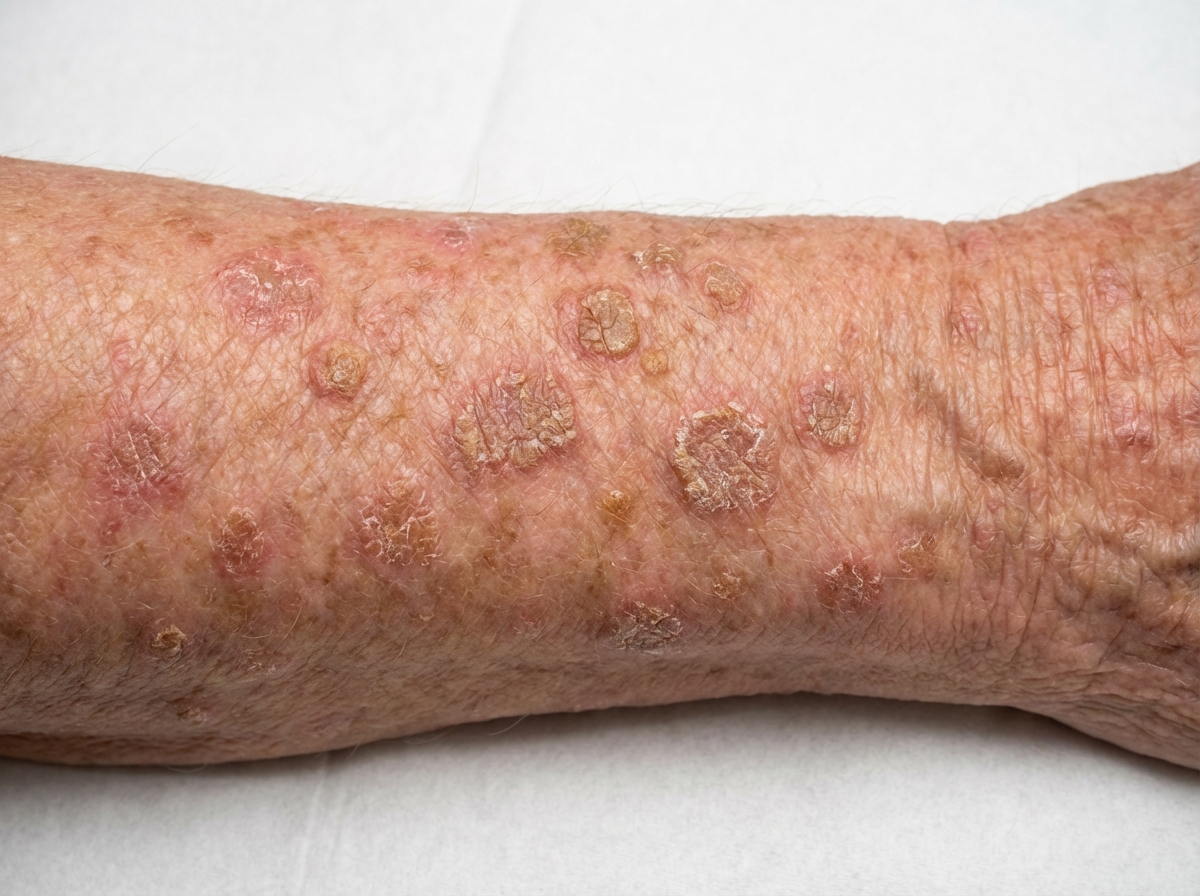
Necrobiosis lipoidica is a clinical finding associated with which of the following conditions?
Which of the following conditions is depicted?

What is the most common origin of melanoma?
Prognosis of malignant melanoma depends upon:
Plexiform neurofibromatosis commonly affects which of the following nerves?
Which of the following is a slow-growing skin tumor that rarely metastasizes to lymph nodes?
Increased incidence of carcinoma is observed with which of the following conditions?
Regarding malignant melanoma, all the following are true EXCEPT?
What is the treatment for Stage I mycosis fungoides?
A 50-year-old male presented with a characteristic lesion on the face for 5 years which is slowly increasing in size and bleeds whenever it is scratched. The patient has a history of chronic sun exposure, and there is no evidence of pain or itching over the lesion. Biopsy from the lesion is performed. Which of the following drugs are approved for the above condition?
Explanation: **Explanation:** **Necrobiosis Lipoidica (NL)** is a chronic granulomatous skin disorder characterized by the degeneration of dermal collagen (necrobiosis) combined with a granulomatous response, thickening of blood vessel walls, and fat deposition. 1. **Why Diabetes Mellitus is Correct:** NL is most classically associated with **Diabetes Mellitus (DM)**. While only about 0.3–1.2% of diabetic patients develop NL, approximately **60–75% of patients with NL have or will develop diabetes**. The pathogenesis is thought to involve microangiopathy. Clinically, it presents as well-demarcated, erythematous papules that evolve into large, yellow-brown, atrophic, telangiectatic plaques, typically on the **pretibial area (shins)**. 2. **Analysis of Incorrect Options:** * **A. Diabetes Insipidus:** This is a disorder of water metabolism (ADH deficiency or resistance) and has no known association with necrobiotic skin conditions. * **B. Lyme Disease:** Caused by *Borrelia burgdorferi*, it is associated with *Erythema Chronicum Migrans*, not NL. * **D. Symmonds Disease:** Also known as panhypopituitarism, it leads to systemic endocrine deficiencies but does not manifest with NL. **High-Yield Clinical Pearls for NEET-PG:** * **Koebner Phenomenon:** NL can exhibit the Koebner phenomenon (lesions appearing at sites of trauma). * **Ulceration:** About 35% of NL lesions undergo ulceration, often following minor trauma. * **Treatment:** First-line treatment includes high-potency topical or intralesional corticosteroids. * **Distinction:** Unlike other diabetic skin markers (like Acanthosis Nigricans), the severity of NL does **not** correlate with glycemic control.
Explanation: ***Plexiform neurofibroma*** - Characteristic **"bag of worms"** appearance with diffuse, infiltrating **soft tissue masses** along nerve distributions, pathognomonic for **NF1**. - Presents as **rope-like**, **tortuous subcutaneous masses** that feel like a collection of intertwined cords or worms under the skin. *Von Hippel Lindau syndrome* - Primarily characterized by **retinal hemangioblastomas** and **cerebellar hemangioblastomas**, not cutaneous neurofibromas. - Associated with **renal cell carcinomas** and **pheochromocytomas**, lacking the distinctive soft tissue masses seen in plexiform neurofibromas. *Marfan syndrome* - Features **arachnodactyly** (long, slender fingers), **lens dislocation**, and **aortic root dilatation**. - Does not present with **cutaneous masses** or the characteristic "bag of worms" appearance. *Tuberous sclerosis* - Characterized by **ash-leaf spots**, **shagreen patches**, and **facial angiofibromas** (adenoma sebaceum). - Lacks the **plexiform growth pattern** and infiltrating soft tissue masses typical of neurofibromas.
Explanation: **Explanation:** **1. Why Junctional Melanocytes is correct:** Melanoma is a malignant tumor arising from **melanocytes**, the pigment-producing cells derived from the neural crest. In the skin, these cells are primarily located at the **dermo-epidermal junction** (the interface between the epidermis and dermis). Most melanomas originate from these junctional melanocytes, either de novo (70%) or from a pre-existing junctional or compound nevus. The initial "radial growth phase" of most melanomas occurs within the epidermis and along this junctional zone before invading deeper into the dermis. **2. Why the other options are incorrect:** * **Epidermal cells:** This is a broad term. While melanocytes reside in the epidermis, the term "epidermal cells" usually refers to keratinocytes. Malignancies of keratinocytes result in Squamous Cell Carcinoma (SCC), not melanoma. * **Basal cells:** These are the innermost cells of the epidermis. Malignant transformation of these cells leads to **Basal Cell Carcinoma (BCC)**, which is the most common skin cancer overall but distinct from melanoma. * **Follicular cells:** These cells make up the hair follicle. While rare subtypes of melanoma can involve the follicular epithelium (like Lentigo Maligna), they are not the primary origin for the majority of melanomas. **3. NEET-PG High-Yield Pearls:** * **Most common site:** In males, it is the **back**; in females, it is the **lower legs**. * **Most common subtype:** **Superficial Spreading Melanoma** (associated with intermittent sun exposure). * **Prognostic Factor:** The most important prognostic indicator for stage I and II melanoma is the **Breslow Depth** (vertical thickness measured in mm). * **ABCDE Criteria:** Used for clinical screening—**A**symmetry, **B**order irregularity, **C**olor variation, **D**iameter >6mm, **E**volving/Elevation.
Explanation: **Explanation:** The prognosis of malignant melanoma is primarily determined by the extent of disease spread and the depth of the primary lesion. **1. Why "Invasion of nearby nodes" is correct:** The most important prognostic factor for malignant melanoma is the **Stage of the disease** at the time of diagnosis. According to the AJCC (American Joint Committee on Cancer) staging, the presence of regional lymph node metastasis (Stage III) significantly decreases the 5-year survival rate compared to localized disease (Stage I or II). Once the tumor invades nearby nodes, it indicates a high potential for systemic dissemination, making it the strongest predictor of outcome among the given options. **2. Why other options are incorrect:** * **Grade of tumor:** Unlike many other cancers, "grading" (degree of differentiation) is not a standard prognostic tool for melanoma. Instead, **Breslow’s Thickness** (measured in mm) and **Clark’s Levels** (anatomical depth) are used. * **Age of the patient:** While older age can be associated with a poorer prognosis, it is a secondary factor and not as definitive as nodal status. * **Site of lesion:** While lesions on the trunk, head, or neck (BANS area: Back, Axilla, Neck, Scalp) generally have a worse prognosis than those on the extremities, the anatomical site is less critical than the stage and depth of the lesion. **High-Yield Clinical Pearls for NEET-PG:** * **Single most important prognostic factor overall:** Lymph node involvement (Stage). * **Most important prognostic factor for Stage I & II (Localized disease):** Breslow’s Thickness (Vertical depth). * **Breslow’s Thickness:** Measured from the granular layer of the epidermis to the deepest point of tumor invasion. * **ABCDE Criteria for diagnosis:** Asymmetry, Border irregularity, Color variation, Diameter >6mm, Evolving. * **Commonest site in Indians:** Palm and Soles (Acral Lentiginous Melanoma).
Explanation: **Explanation:** **Plexiform neurofibromas** are pathognomonic for **Neurofibromatosis Type 1 (NF1)**. Unlike localized neurofibromas, these are congenital, diffuse, and involve multiple fascicles of a nerve, often described as a "bag of worms" on palpation. **Why Trigeminal Nerve is Correct:** While plexiform neurofibromas can involve any nerve, they have a strong predilection for the **Trigeminal nerve (Cranial Nerve V)**, particularly the **ophthalmic division (V1)**. Involvement of the V1 branch often leads to the classic clinical presentation of **S-shaped ptosis** of the upper eyelid. This is a high-yield association frequently tested in postgraduate exams. **Analysis of Incorrect Options:** * **Facial Nerve (A):** While the facial nerve can be compressed by tumors in the parotid or cerebellopontine angle (like vestibular schwannomas in NF2), it is not the primary site for plexiform neurofibromas. * **Peripheral Nerve (C):** Although plexiform neurofibromas *are* tumors of the peripheral nerves, the question asks which specific nerve is "commonly affected." The Trigeminal nerve is the most characteristic cranial nerve involved. * **Glossopharyngeal Nerve (D):** This nerve is rarely involved in NF1. **Clinical Pearls for NEET-PG:** * **Pathognomonic Sign:** Plexiform neurofibroma is one of the cardinal diagnostic criteria for NF1. * **Bag of Worms:** The classic physical exam finding. * **Malignant Transformation:** Unlike cutaneous neurofibromas, plexiform neurofibromas carry a 5-10% lifetime risk of transforming into **Malignant Peripheral Nerve Sheath Tumors (MPNST)**. * **Imaging:** MRI is the gold standard to assess the extent of the lesion.
Explanation: **Explanation:** **Basal Cell Carcinoma (BCC)** is the most common skin cancer globally. It is characterized by its **slow growth** and **locally invasive** nature. The defining clinical feature of BCC is its extremely low potential for lymphatic or distant metastasis (less than 0.1%). It arises from the non-keratinizing cells of the basal layer of the epidermis and typically presents as a pearly papule with telangiectasia, often on sun-exposed areas like the face. **Why the other options are incorrect:** * **Melanoma:** This is the most aggressive form of skin cancer. It has a high propensity for early lymphatic and hematogenous spread, making it the leading cause of skin cancer deaths. * **Squamous Cell Carcinoma (SCC):** While also sun-related, SCC grows faster than BCC and has a significant risk of metastasis (roughly 2–5%), especially when occurring on the lips, ears, or in chronic scars (Marjolin’s ulcer). * **Angiosarcoma:** This is a highly malignant, rapidly progressing vascular tumor. It is notorious for early metastasis and a poor prognosis. **Clinical Pearls for NEET-PG:** * **"Rodent Ulcer":** A clinical variant of BCC that causes extensive local tissue destruction if left untreated. * **Risk Factor:** Chronic UV exposure is the primary cause; however, BCC is also associated with **Gorlin Syndrome** (Basal Cell Nevus Syndrome). * **Histology:** Look for **"Peripheral Palisading"** of nuclei and **retraction artifacts** (clefts) between the tumor nests and the stroma. * **Location:** Most common above the line joining the tragus of the ear to the angle of the mouth.
Explanation: **Explanation:** Leukoplakia is a clinical term for a white patch or plaque on the oral mucosa that cannot be characterized clinically or pathologically as any other disease. It is a **premalignant condition**, but the risk of malignant transformation varies significantly based on its clinical morphology. **1. Why Verrucous Leukoplakia is Correct:** Verrucous leukoplakia (specifically **Proliferative Verrucous Leukoplakia or PVL**) is an aggressive, high-risk variant. It is characterized by an irregular, exophytic, or "warty" surface. It has the highest rate of malignant transformation (often exceeding 60-80%) into Verrucous Carcinoma or Squamous Cell Carcinoma (SCC). It is often multifocal and highly resistant to treatment. **2. Analysis of Incorrect Options:** * **Homogenous Leukoplakia (Option A):** This is the most common clinical form, presenting as a uniform, flat, thin white patch with a smooth or wrinkled surface. It carries the **lowest risk** of malignant transformation (approx. 1–5%). * **Nodular Leukoplakia (Option B):** Also known as granular leukoplakia, it presents as a white patch with small red or white rounded excrescences. While it has a higher risk than the homogenous type, it is generally considered to have a lower cumulative transformation rate compared to the aggressive Proliferative Verrucous form in most clinical contexts. *(Note: In some classifications, "Non-homogenous" types like erythroleukoplakia and nodular leukoplakia are high-risk, but PVL remains the most clinically ominous).* **High-Yield Clinical Pearls for NEET-PG:** * **Most common site:** Buccal mucosa and floor of the mouth. * **Highest risk site:** The floor of the mouth and the ventrolateral tongue are "high-risk" zones for malignancy. * **Erythroplakia:** Carries a significantly higher risk of malignancy (up to 90% show dysplasia/carcinoma at biopsy) than any form of leukoplakia. * **Biopsy:** Mandatory for any non-homogenous or persistent leukoplakia to rule out dysplasia.
Explanation: ### Explanation **Malignant Melanoma** is a highly aggressive malignancy of melanocytes. The question asks for the "EXCEPT" statement, implying that the marked option is actually **true**, but the premise of the question or the provided key requires clarification. In clinical dermatology, **spontaneous regression is a well-documented phenomenon in malignant melanoma**, occurring in approximately 10–15% of cases due to a robust T-cell-mediated immune response. Therefore, if "D" is the intended answer, it is likely because it is a *rare* event, though technically a known feature. #### Analysis of Options: * **A. Vertical depth of invasion (Breslow’s Depth):** This is **TRUE**. It is the most important independent prognostic factor for cutaneous melanoma. It measures the distance from the granular layer of the epidermis to the deepest point of tumor involvement. * **B. Occurs in actinic damaged skin:** This is **TRUE**. Chronic sun exposure (actinic damage) is a major risk factor, especially for subtypes like Lentigo Maligna Melanoma, which typically appears on the sun-exposed faces of elderly patients. * **C. Lentigo maligna is a type of malignant melanoma:** This is **TRUE**. It is a subtype of *melanoma in situ* found on sun-damaged skin. Once it invades the dermis, it is termed Lentigo Maligna Melanoma. * **D. May show spontaneous regression:** This is **TRUE**. While rare, melanoma is one of the few tumors known for spontaneous regression (often appearing as white, depigmented areas within a lesion). *Note: If this question appeared in a NEET-PG context where D is the key, it may be due to a technical error in the question source, as all four statements are clinically accurate.* #### High-Yield Clinical Pearls for NEET-PG: 1. **Breslow Depth:** Most important prognostic factor (Vertical growth). 2. **ABCDE Criteria:** **A**symmetry, **B**order irregularity, **C**olor variation, **D**iameter >6mm, **E**volving. 3. **Commonest Site:** Back (Males), Lower Legs (Females). 4. **Acral Lentiginous Melanoma:** Most common subtype in Asians/dark-skinned individuals (affects palms, soles, and nails). 5. **S-100 & HMB-45:** Key immunohistochemical markers.
Explanation: **Explanation:** **Mycosis Fungoides (MF)** is the most common type of Cutaneous T-Cell Lymphoma (CTCL). It typically progresses through three clinical stages: Patch, Plaque, and Tumor stage. **Why Radiation is Correct:** In the context of NEET-PG and standard oncological management, **Radiation therapy** (specifically local superficial radiotherapy or Total Skin Electron Beam Therapy) is considered the most effective and definitive skin-directed therapy for localized Stage I MF. MF is an exquisitely **radiosensitive** tumor. While Stage IA (localized) can be managed with various skin-directed therapies, radiation offers the highest complete remission rates for localized lesions. **Analysis of Incorrect Options:** * **Topical Corticosteroids (A):** These are used as first-line symptomatic treatment for early patch-stage disease to reduce inflammation, but they are generally considered palliative rather than curative. * **Skin Electron Beam Therapy (B):** This is a specific *type* of radiation. While highly effective, "Radiation" (Option C) serves as the broader, more definitive category in this question's structure. * **UVB Therapy (D):** Narrowband UVB (nbUVB) or PUVA are excellent first-line options for generalized patch/plaque stages (Stage IB), but they have less penetrative depth compared to radiation and are less effective for thicker plaques or localized curative intent. **High-Yield Clinical Pearls for NEET-PG:** 1. **Pautrier’s Microabscess:** Pathognomonic histological feature (intraepidermal clusters of atypical T-cells). 2. **Sezary Syndrome:** The leukemic triad of erythroderma, lymphadenopathy, and atypical T-cells (Sezary cells) in the peripheral blood. 3. **Immunophenotype:** Typically **CD4+** (T-helper cells). 4. **Treatment Ladder:** Stage I is managed with **Skin-Directed Therapies** (Radiation, Steroids, PUVA, Nitrogen Mustard); advanced stages require systemic chemotherapy or Biological Response Modifiers (Interferon-alpha).
Explanation: **Diagnosis: Basal Cell Carcinoma (BCC)** The clinical presentation of a slow-growing, painless facial lesion that bleeds on minor trauma (friability) in an older patient with chronic sun exposure is classic for **Basal Cell Carcinoma (BCC)**. The characteristic "pearly" border and telangiectasia are often seen. ### **Explanation of the Correct Option** **Option A (5-FU, Imiquimod, and Vismodegib)** is correct because these are FDA-approved medical therapies for BCC: * **5-Fluorouracil (5-FU):** A topical cytotoxic agent used for superficial BCC. * **Imiquimod:** An immune response modifier (TLR-7 agonist) used topically for superficial BCC. * **Vismodegib:** A **Hedgehog pathway inhibitor** (targets SMO protein). It is specifically approved for metastatic or locally advanced BCC where surgery or radiation is not feasible. ### **Why Other Options are Incorrect** * **Itraconazole:** While some studies suggest it may inhibit the Hedgehog pathway, it is primarily an antifungal and is **not** an approved standard treatment for BCC. * **Azathioprine:** This is an immunosuppressant used in autoimmune conditions (like Pemphigus) or for prevention of graft rejection. It is not used to treat BCC; in fact, long-term use of immunosuppressants increases the risk of developing skin cancers. ### **High-Yield Clinical Pearls for NEET-PG** * **Most Common Skin Cancer:** BCC is the most common skin malignancy worldwide. * **Most Common Site:** The face, specifically above the line joining the lobe of the ear to the angle of the mouth (inner canthus, nose). * **Pathology:** Look for **"Peripheral Palisading"** of nuclei and **"Retraction Artifacts"** (clefts between tumor nests and stroma) on histology. * **Genetic Association:** Mutations in the **PTCH1 gene** (Hedgehog signaling pathway) are central to BCC pathogenesis, especially in **Gorlin Syndrome** (Basal Cell Nevus Syndrome). * **Metastasis:** BCC is locally invasive ("Rodent Ulcer") but rarely metastasizes.
Benign Epithelial Tumors
Practice Questions
Premalignant Epidermal Tumors
Practice Questions
Basal Cell Carcinoma
Practice Questions
Squamous Cell Carcinoma
Practice Questions
Melanocytic Nevi
Practice Questions
Melanoma
Practice Questions
Merkel Cell Carcinoma
Practice Questions
Vascular Tumors and Malformations
Practice Questions
Cutaneous Lymphomas
Practice Questions
Soft Tissue Tumors
Practice Questions
Metastatic Skin Tumors
Practice Questions
Skin Cancer Prevention and Screening
Practice Questions
Get full access to all questions, explanations, and performance tracking.
Start For Free