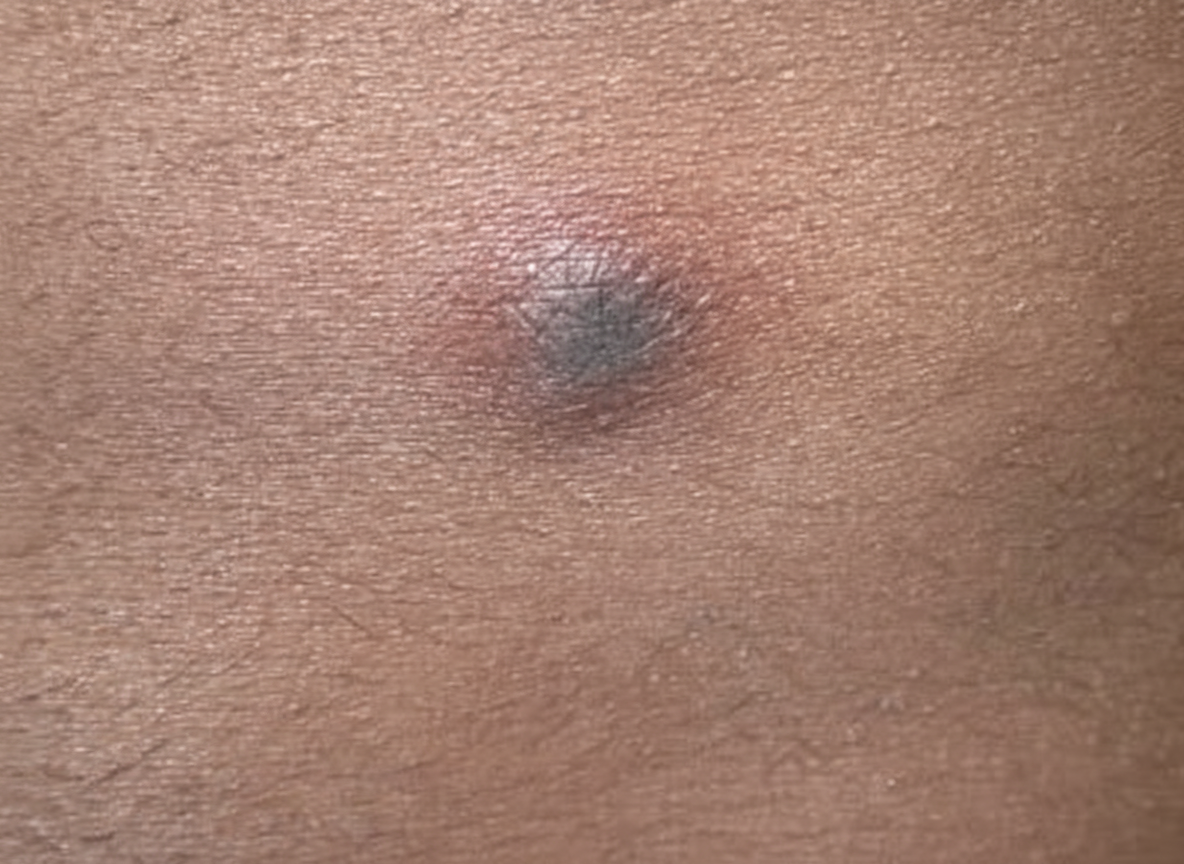
What is the most common site for Basal cell carcinoma?
Which of the following skin lesions does not change or remains the same throughout life?
A 55-year old male presents for evaluation of a lesion on his lower lip for the past year. He is employed as a landscaper and reports infrequent use of sun protection. He denies any pertinent medical history. Physical examination reveals a 5 mm erythematous, ulcerative nodule located within the vermilion of the right lateral aspect of the lower lip. Biopsy confirms the presence of invasive squamous cell carcinoma and the patient is referred for Mohs micrographic surgical excision. Which of the following lymph nodes would be most critical to evaluate for metastasis?
A patient presents with a pruritic lesion over the left shoulder exhibiting cigarette paper atrophy and poikiloderma, along with generalized lymphadenopathy. Histopathological examination of the lesion reveals CD4-positive Sézary-Lutzner cells. What is the dermoepidermal manifestation of this disease?
Which of the following is also known as self-healing carcinoma?
Which of the following characterises malignant change in a nevus?
Which of the following skin findings is NOT typically associated with an underlying internal malignancy?
Which of the following is NOT true about rodent ulcer (basal cell carcinoma)?
All of the following are true statements about malignant melanoma except:
Which of the following is NOT a risk factor for malignant melanoma?
Explanation: **Explanation:** **Basal Cell Carcinoma (BCC)** is the most common skin cancer worldwide. The primary risk factor is cumulative exposure to ultraviolet (UV) radiation, which causes DNA damage in the basal cells of the epidermis. **Why Face is Correct:** Approximately **80-90% of BCCs occur on the head and neck**, with the **face** being the most frequent site. Specifically, the area above a line joining the lobe of the ear to the angle of the mouth (the "mask area" or upper face) is most susceptible. The nose is the single most common anatomical subunit involved. This is due to the high density of pilosebaceous units and maximal sun exposure in these regions. **Why Other Options are Incorrect:** * **Trunk:** While the trunk is a common site for the *Superficial* subtype of BCC, it is far less frequent than the face for BCC overall. * **Neck:** Although part of the head and neck region, the incidence on the neck is lower than on the central facial features. * **Extremities:** These areas are more commonly associated with Squamous Cell Carcinoma (SCC) or are less frequently involved in BCC compared to the face. **High-Yield Clinical Pearls for NEET-PG:** * **Most common subtype:** Nodular BCC (presents as a pearly papule with telangiectasia). * **Classic Description:** "Rodent Ulcer" (locally invasive but rarely metastasizes). * **Characteristic Histology:** Peripheral palisading of nuclei and retraction artifacts. * **Gold Standard Treatment:** Mohs Micrographic Surgery (highest cure rate, tissue-sparing). * **Inherited Syndrome:** Gorlin Syndrome (Nevoid BCC syndrome) – associated with PTCH gene mutation.
Explanation: **Explanation:** The correct answer is **Port-wine stain (PWS)**. The fundamental medical concept here is the distinction between **vascular malformations** and **vascular tumors**. 1. **Why Port-wine Stain is correct:** A Port-wine stain (Nevus Flammeus) is a **capillary malformation** present at birth. Unlike hemangiomas, it is composed of mature, dilated dermal capillaries. It follows the rule of "permanent and progressive": it does not involute, grows proportionately with the child, and often becomes darker, thicker, or more nodular (verrucous) in adulthood. It is a permanent lesion that persists throughout life unless treated with lasers (e.g., Pulsed Dye Laser). 2. **Why the other options are incorrect:** * **Salmon Patch (Nevus Simplex):** Also known as "Stork bites" or "Angel kisses," these are transient capillary ectasias. Most fade and disappear spontaneously within the first 1–2 years of life. * **Strawberry Angioma / Capillary Hemangioma:** These are **vascular tumors** (Infantile Hemangiomas). They typically follow a predictable life cycle: a rapid proliferative phase after birth, followed by a slow spontaneous involution phase. Approximately 50% disappear by age 5, and 90% by age 9. **High-Yield Clinical Pearls for NEET-PG:** * **Sturge-Weber Syndrome:** A PWS in the V1/V2 distribution of the trigeminal nerve may be associated with glaucoma and leptomeningeal angiomatosis (look for "tram-track" calcifications on CT). * **Klippel-Trenaunay Syndrome:** PWS associated with limb hypertrophy and venous malformations. * **Treatment of Choice:** The **Pulsed Dye Laser (585 or 595 nm)** is the gold standard for treating Port-wine stains. * **Mnemonic:** Malformations (PWS) are **Permanent**; Hemangiomas (Strawberry) **Halt and Heal**.
Explanation: **Explanation:** The lymphatic drainage of the lip follows a specific anatomical pattern, which is crucial for predicting the metastatic spread of Squamous Cell Carcinoma (SCC). 1. **Why Submandibular Lymph Nodes are correct:** The **lateral aspects of the lower lip** and the entire upper lip drain primarily into the **submandibular lymph nodes** (Level IB). Since the patient has a lesion on the lateral aspect of the lower lip, these are the first-line nodes for metastatic evaluation. 2. **Why other options are incorrect:** * **Submental lymph nodes:** These nodes primarily receive drainage from the **central (medial) portion** of the lower lip and the tip of the tongue. * **Posterior cervical chain:** These nodes (Level V) typically receive drainage from the scalp, nasopharynx, and oropharynx; they are not the primary drainage site for the lips. * **Jugulodigastric lymph node:** Part of the deep cervical chain (Level II), these nodes receive secondary drainage from the submandibular nodes or primary drainage from the tonsils and posterior tongue. **Clinical Pearls for NEET-PG:** * **SCC of the Lip:** The lower lip is the most common site for oral SCC (90%), usually due to chronic UV exposure (as seen in this landscaper). * **Drainage Rule:** Central lower lip → Submental nodes; Lateral lower lip/Upper lip → Submandibular nodes. * **Prognosis:** SCC of the lip has a higher metastatic potential compared to SCC of the skin, making nodal assessment vital. * **Mohs Micrographic Surgery (MMS):** The gold standard for SCC in "high-risk" zones (like the lip) to ensure complete margin control while sparing tissue.
Explanation: ### **Explanation** The clinical presentation of **cigarette paper atrophy**, **poikiloderma** (a combination of atrophy, telangiectasia, and hyper/hypopigmentation), and generalized lymphadenopathy, combined with the presence of **CD4+ Sézary-Lutzner cells** (cerebriform nuclei), is diagnostic of **Mycosis Fungoides (MF)**, the most common type of Cutaneous T-Cell Lymphoma (CTCL). **Why Option A is Correct:** The hallmark histopathological feature of Mycosis Fungoides is **epidermotropism**—the migration of atypical T-lymphocytes into the epidermis without significant spongiosis. When these malignant T-cells (Sézary-Lutzner cells) aggregate into small clusters within the epidermis, they form **Pautrier’s microabscesses**. This is a pathognomonic finding for MF. **Why the Other Options are Incorrect:** * **Option B (Pinpoint ulcers):** These are typically seen in conditions like Ecthyma or certain vasculitides, not characteristic of CTCL. * **Option C (Discharging sinus):** This is a feature of deep fungal infections (e.g., Mycetoma) or Scrofuloderma (Cutaneous TB), where an underlying focus drains to the surface. * **Option D (Miliaria):** This refers to "prickly heat" caused by the blockage of sweat ducts, presenting as transient vesicles or papules. **High-Yield Clinical Pearls for NEET-PG:** * **Stages of MF:** It progresses through three stages: **Patch** (cigarette paper atrophy/poikiloderma) → **Plaque** → **Tumor**. * **Sézary Syndrome:** This is the leukemic variant of CTCL characterized by the triad of **erythroderma**, **generalized lymphadenopathy**, and **atypical T-cells** (>1000/mm³) in the peripheral blood. * **Immunophenotype:** The malignant cells in MF are typically **CD4+** (T-helper cells). * **Histology Tip:** Look for "Lining up" of atypical lymphocytes along the basal layer of the epidermis (halos around cells).
Explanation: **Explanation:** **Keratoacanthoma (Option A)** is classically known as "self-healing carcinoma" because it is a rapidly growing skin tumor that histologically resembles well-differentiated squamous cell carcinoma (SCC) but undergoes spontaneous regression over several months. It typically presents as a firm, dome-shaped, flesh-colored nodule with a characteristic **central keratinous plug** (crateriform appearance). The life cycle involves three stages: rapid proliferative phase, stable phase, and spontaneous involution, leaving a depressed scar. **Why other options are incorrect:** * **Basal Cell Carcinoma (BCC):** The most common skin cancer. It is slow-growing and locally invasive ("rodent ulcer") but does not regress spontaneously. * **Leukoplakia:** A clinical term for a white patch on the mucosa that cannot be characterized clinically or pathologically as any other disease. It is a **premalignant** condition, not a self-healing one. * **Squamous Cell Carcinoma (SCC):** While Keratoacanthoma is considered a low-grade variant of SCC by some, true SCC is invasive, does not self-heal, and has a significant risk of metastasis. **High-Yield Clinical Pearls for NEET-PG:** * **Classic Morphology:** "Volcano-like" or "Crateriform" nodule with a central keratin plug. * **Growth Pattern:** Rapid growth (weeks) followed by spontaneous resolution (months). * **Syndromic Association:** Multiple keratoacanthomas are seen in **Ferguson-Smith syndrome** (familial) and **Grzybowski syndrome** (generalized eruptive). * **Muir-Torre Syndrome:** Association of keratoacanthomas/sebaceous tumors with internal visceral malignancies (most commonly colon cancer). * **Treatment:** Although they can self-heal, surgical excision is usually performed because they are clinically difficult to distinguish from invasive SCC.
Explanation: In dermatology, the transformation of a benign melanocytic nevus into malignant melanoma is a critical clinical diagnosis. While several physical changes occur, **itching (pruritus)** is often the earliest subjective symptom reported by the patient, preceding visible morphological changes. ### Why Itching is the Correct Answer Itching is considered a "red flag" symptom. It occurs due to the release of inflammatory mediators and the host's immune response as the malignant cells begin to invade the dermo-epidermal junction. In the context of NEET-PG, when asked for a single characteristic that signifies the *onset* of malignant change, itching is the classic textbook answer. ### Analysis of Other Options * **Darkening (A):** While a change in color is part of the ABCDE criteria (Color variegation), simple darkening can occur physiologically due to sun exposure, pregnancy, or puberty. It is less specific than the sudden onset of symptoms like itching. * **Hemorrhage (B):** Bleeding and ulceration are indeed signs of malignancy, but they are **late features**. They indicate that the tumor has already reached an advanced stage with significant dermal invasion. * **All of the above (D):** While all these features can be seen in melanoma, the question specifically looks for the most characteristic early sign of "change." In many standard dermatology references (like IADVL or Khanna), itching is highlighted as the sentinel symptom. ### High-Yield Clinical Pearls (ABCDE Criteria) To identify malignant transformation, remember the **ABCDE** mnemonic: * **A – Asymmetry:** One half does not match the other. * **B – Border:** Irregular, notched, or blurred edges. * **C – Color:** Variegated shades (blue, black, brown, red). * **D – Diameter:** >6 mm is suspicious. * **E – Evolving:** Any change in size, shape, or **symptoms (Itching/Tenderness).** **Note:** The "Ugly Duckling Sign" (a mole that looks different from all other moles on the patient) is also a highly sensitive marker for malignancy.
Explanation: **Explanation:** The correct answer is **Granuloma annulare**. This condition is a benign, self-limiting inflammatory dermatosis characterized by dermal papules arranged in an annular (ring-like) pattern. While it is classically associated with **Diabetes Mellitus**, it is not considered a paraneoplastic syndrome and does not typically signal an underlying internal malignancy. **Analysis of Incorrect Options:** * **Acanthosis Nigricans & Annular Erythema:** Malignant Acanthosis Nigricans (sudden onset, extensive, involving palms/soles) is strongly associated with **Gastric Adenocarcinoma**. * **Bullous Pyoderma & Migratory Necrotizing Erythema:** Bullous Pyoderma Gangrenosum is often linked to **Acute Myeloid Leukemia (AML)**. Necrolytic Migratory Erythema is the pathognomonic cutaneous marker for a **Glucagonoma** (alpha-cell tumor of the pancreas). * **Erythema Gyratum Repens:** This is one of the most specific paraneoplastic markers. It presents with a "wood-grain" appearance and is associated with **Lung, Breast, or Esophageal cancers** in over 80% of cases. **High-Yield Clinical Pearls for NEET-PG:** 1. **Leser-Trélat Sign:** Sudden eruption of multiple seborrheic keratoses; associated with GI malignancies. 2. **Bazex Syndrome (Acrokeratosis paraneoplastica):** Psoriasiform plaques on acral sites; associated with SCC of the upper aerodigestive tract. 3. **Sweet Syndrome:** Neutrophilic dermatosis often associated with AML. 4. **Tripe Palms:** Velvety thickening of palms; associated with Lung (if alone) or Gastric (if with Acanthosis Nigricans) cancer.
Explanation: ### Explanation **Basal Cell Carcinoma (BCC)**, often referred to as a **Rodent Ulcer** due to its locally invasive, "gnawing" nature, is the most common skin cancer. **1. Why Option A is the Correct Answer (The False Statement):** While BCC is technically sensitive to radiation, the statement is considered "not true" in the context of standard clinical management and comparative pathology. BCC is primarily managed via **surgical excision** (especially Mohs Micrographic Surgery). While radiotherapy is an *alternative* for patients unfit for surgery, BCC is **not as radiosensitive as Squamous Cell Carcinoma (SCC)**. In many medical examinations, if a distinction is made, SCC is highlighted as the classically radiosensitive skin tumor, whereas BCC is defined by its **local invasiveness** rather than its response to radiation. **2. Analysis of Other Options:** * **Option B (Lymph node involvement is typically absent):** This is **true**. BCC is notorious for being locally aggressive but having an extremely low rate of metastasis (<0.1%). Lymphatic spread is a rarity. * **Option C (Commonly presents as a facial lesion):** This is **true**. BCC occurs most frequently on sun-exposed areas. A classic high-yield fact is that BCC occurs **above the line joining the tragus of the ear to the angle of the mouth** (inner canthus, nose, and cheeks). * **Option D (Blood-borne metastasis is rare):** This is **true**. As mentioned, BCC almost never spreads via hematogenous or lymphatic routes; it destroys local tissues (cartilage and bone) instead. **Clinical Pearls for NEET-PG:** * **Most common site:** Nose (specifically the ala). * **Characteristic feature:** Pearly white/translucent borders with **telangiectasia**. * **Histopathology:** Peripheral palisading of nuclei and retraction artifacts. * **Gold Standard Treatment:** Mohs Micrographic Surgery (highest cure rate). * **Inherited Syndrome:** Gorlin Syndrome (Basal Cell Nevus Syndrome) – associated with PTCH gene mutation.
Explanation: **Explanation:** The correct answer is **C**. In malignant melanoma, **Acral Lentiginous Melanoma (ALM)** actually carries a **poorer prognosis** compared to Superficial Spreading Melanoma (SSM). This is primarily because ALM—which occurs on palms, soles, and under nails—is often diagnosed at a more advanced stage and tends to be more aggressive. SSM generally has a better prognosis as it stays in the "radial growth phase" longer before invading deeper tissues. **Analysis of other options:** * **A. Clark’s Classification:** This is a valid prognostic tool based on the **anatomical level of invasion** (Layers I-V) into the epidermis and dermis. While *Breslow’s depth* (measured in mm) is now the gold standard, Clark’s level remains a recognized prognostic factor. * **B. Gender and Prognosis:** Statistically, **women have a better survival rate** than men. This is attributed to biological factors and the fact that women often develop lesions on the lower limbs (better prognosis) compared to men, who more frequently develop them on the trunk (worse prognosis). * **D. Limb Perfusion:** Isolated Limb Perfusion (ILP) with chemotherapeutic agents (like Melphalan) is a recognized treatment modality for localized, recurrent, or in-transit melanoma metastases confined to an extremity. **High-Yield Clinical Pearls for NEET-PG:** * **Breslow’s Depth:** The most important prognostic factor for cutaneous melanoma. * **ABCDE Criteria:** Used for clinical screening (Asymmetry, Border irregularity, Color variegation, Diameter >6mm, Evolving). * **Most Common Type:** Superficial Spreading Melanoma is the most common subtype overall. * **Most Common in Indians:** Acral Lentiginous Melanoma is the most common subtype in dark-skinned individuals.
Explanation: **Explanation:** Malignant melanoma is a neoplasm arising from melanocytes. Its pathogenesis is primarily linked to genetic predisposition and ultraviolet (UV) radiation, rather than viral oncogenesis. **Why HPV infection is the correct answer:** Human Papillomavirus (HPV) is strongly associated with squamous cell carcinomas (especially of the cervix, anus, and oropharynx) and certain types of non-melanoma skin cancers (like Verrucous carcinoma). However, **HPV has no established causal link to malignant melanoma.** Melanoma is driven by mutations in the MAPK pathway (e.g., BRAF, NRAS), not viral integration. **Analysis of Incorrect Options:** * **Giant Congenital Nevi:** These are large pigmented lesions present at birth. They carry a significant lifetime risk (approx. 5–10%) of transforming into melanoma, especially if they exceed 20 cm in projected adult diameter. * **Family History:** About 10% of patients have a positive family history. Mutations in the **CDKN2A** gene (encoding p16) are the most common genetic risk factor identified in familial melanoma. * **Exposure to UV Light:** This is the most important environmental risk factor. **Intermittent, blistering sunburns** (especially in childhood) are more closely linked to melanoma than chronic, cumulative exposure. **High-Yield Clinical Pearls for NEET-PG:** * **Most common site:** Back (males), Lower limbs (females). * **Prognostic Marker:** **Breslow’s Depth** (vertical thickness) is the most important prognostic factor. * **ABCDE Criteria:** Asymmetry, Border irregularity, Color variation, Diameter >6mm, Evolving. * **Common Mutation:** **BRAF V600E** is the most frequent mutation (targeted by Vemurafenib). * **Tumor Marker:** S-100, HMB-45, and Melan-A.
Benign Epithelial Tumors
Practice Questions
Premalignant Epidermal Tumors
Practice Questions
Basal Cell Carcinoma
Practice Questions
Squamous Cell Carcinoma
Practice Questions
Melanocytic Nevi
Practice Questions
Melanoma
Practice Questions
Merkel Cell Carcinoma
Practice Questions
Vascular Tumors and Malformations
Practice Questions
Cutaneous Lymphomas
Practice Questions
Soft Tissue Tumors
Practice Questions
Metastatic Skin Tumors
Practice Questions
Skin Cancer Prevention and Screening
Practice Questions
Get full access to all questions, explanations, and performance tracking.
Start For Free