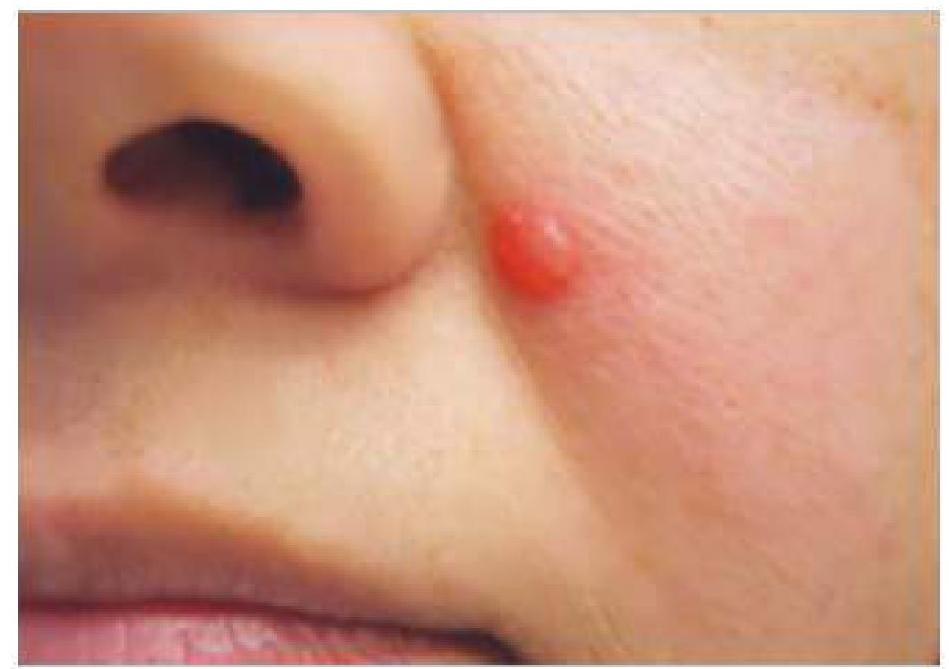
Muir-Torre syndrome is characterized by which of the following findings?
Calcifying epithelioma is also known as?
A 50-year-old female presented with ulcerated firm to hard nodules over the covered parts of her body, along with generalized erythema, edema, and extreme pruritus. Initially, they were barely palpable erythematous, well-defined patches, which later converged to plaques and became itchy, ultimately turning into the current lesions. Cervical lymphadenopathy was also noted. Skin biopsy from the lesion was taken, and a peripheral blood smear showed abnormal cells. Which is the most likely diagnosis?
Sturge-Weber syndrome is associated with which of the following?
Rolled up edges are seen in which of the following ulcers?
Which of the following is NOT a criterion for Sézary syndrome?
Which of the following conditions is characterized by cafe-au-lait spots, non-encapsulation, and potential for malignant transformation?
Sézary-Lutzner cells are characteristic of which condition?
Which of the following skin conditions is primarily associated with sun exposure?
Which FDA-approved drug is used for the treatment of superficial basal cell carcinoma?
Explanation: **Explanation:** **Muir-Torre Syndrome (MTS)** is a rare autosomal dominant genodermatosis and a clinical variant of **Lynch Syndrome (Hereditary Non-Polyposis Colorectal Cancer - HNPCC)**. It is caused by germline mutations in DNA mismatch repair (MMR) genes, most commonly **MSH2** and **MLH1**. 1. **Why Option A is Correct:** The hallmark of MTS is the association of at least one **sebaceous gland tumor** (sebaceous adenoma, sebaceous epithelioma, or sebaceous carcinoma) with at least one **internal malignancy**. Sebaceous adenomas are the most characteristic cutaneous marker for this syndrome. Keratoacanthomas (often multiple) are also frequently seen. 2. **Why Other Options are Incorrect:** * **B. Lisch Nodules:** These are iris hamartomas characteristic of **Neurofibromatosis Type 1 (NF1)**. * **C. Intestinal Polyps:** While MTS is associated with colorectal cancer, the presence of numerous "intestinal polyps" is the defining feature of syndromes like **Familial Adenomatous Polyposis (FAP)** or **Peutz-Jeghers Syndrome**. In MTS/Lynch syndrome, cancers often arise without a preceding profuse polyposis phase. * **D. Hyperelastic Joints:** This is a classic feature of **Ehlers-Danlos Syndrome**, a connective tissue disorder. **High-Yield Clinical Pearls for NEET-PG:** * **Most common internal malignancy in MTS:** Colorectal carcinoma (found in ~50% of cases), followed by genitourinary cancers. * **Genetic Defect:** Microsatellite instability due to MMR gene mutations (MSH2 > MLH1). * **Diagnostic Tip:** Any patient presenting with a sebaceous adenoma (outside the eyelid) should be screened for internal malignancies. * **Mnemonic:** "Muir-Torre = **M**ismatch repair + **S**ebaceous tumors + **I**nternal malignancy."
Explanation: **Explanation:** **Pilomatrixoma**, historically known as **Malherbe’s Calcifying Epithelioma**, is a benign skin tumor originating from the hair follicle matrix. The term "calcifying epithelioma" was coined because the lesion frequently undergoes calcification (in about 70-80% of cases) and occasionally ossification. **Why Pilomatrixoma is correct:** It is a common adnexal tumor, typically presenting as a firm, solitary, deep-seated nodule on the face, neck, or upper extremities of children and young adults. Histologically, it is characterized by the presence of **"Ghost cells" (or Shadow cells)**—cells that have lost their nuclei but retained their cytoplasmic outlines—which are a pathognomonic finding. **Why other options are incorrect:** * **Myoblastoma:** Also known as Granular Cell Tumor, it is a benign neoplasm derived from Schwann cells, not hair follicles. * **Calcinosis cutis:** This is a condition where calcium salts are deposited in the skin due to systemic metabolic issues (metastatic) or local tissue damage (dystrophic); it is not a primary adnexal tumor. * **Dermatofibroma lenticulare:** This is a synonym for a common dermatofibroma (fibrous histiocytoma), which is a benign proliferation of fibroblasts, not related to the hair matrix. **High-Yield Clinical Pearls for NEET-PG:** * **Clinical Sign:** The **"Teeter-totter sign"** (pressing on one edge causes the other to protrude) and the **"Tent sign"** (multiple facets and sharp angles seen when stretching the skin over the tumor). * **Genetics:** Most cases are associated with mutations in the **CTNNB1 gene**, which encodes beta-catenin. * **Associations:** Multiple pilomatrixomas are associated with **Gardner syndrome** and **Myotonic dystrophy**.
Explanation: **Explanation:** The clinical presentation describes the classic progression of **Mycosis Fungoides (MF)**, which has evolved into **Sezary Syndrome (SS)**. The patient’s history follows the characteristic three-stage progression: **Patch stage** (erythematous patches), **Plaque stage** (confluent itchy lesions), and **Tumor stage** (ulcerated firm nodules). The presence of **generalized erythema (erythroderma)**, edema, extreme pruritus, lymphadenopathy, and **abnormal cells in the peripheral blood** (Sezary cells) confirms the diagnosis of Sezary Syndrome. Sezary cells are malignant T-helper cells (CD4+) characterized by a **cerebriform nucleus**. **Why other options are incorrect:** * **Tinea corporis:** Presents as annular (ring-shaped) lesions with central clearing and peripheral scaling; it does not cause generalized erythroderma or peripheral blood abnormalities. * **Psoriasis:** Typically presents with well-demarcated erythematous plaques with silvery-white scales. While it can cause erythroderma, it does not present with ulcerated nodules or malignant cells in the blood. * **Lichen planus:** Characterized by the "6 Ps" (Planar, Purple, Polygonal, Pruritic, Papules, Plaques) and Wickham striae; it does not progress to systemic malignancy or tumor nodules. **High-Yield Clinical Pearls for NEET-PG:** * **Pautrier’s Microabscess:** Pathognomonic histological feature of MF/SS (intraepidermal clusters of malignant T-cells). * **Sezary Cell Criteria:** Diagnosis requires an absolute Sezary cell count of $\ge 1000/mm^3$. * **Immunophenotype:** Typically CD4+ (T-helper cells), leading to a high CD4/CD8 ratio (>10). * **Treatment:** Early stage uses topical steroids/PUVA; advanced stages (SS) require systemic therapy like Extracorporeal Photopheresis (ECP) or Methotrexate.
Explanation: **Explanation:** Sturge-Weber Syndrome (SWS), also known as encephalotrigeminal angiomatosis, is a neurocutaneous disorder characterized by vascular malformations. **Why Option A is the Correct Answer:** The hallmark cutaneous finding in Sturge-Weber syndrome is a **Port-wine stain (Nevus Flammeus)**. This is a congenital capillary malformation that typically presents as a unilateral, blanchable, maculopapular lesion. In SWS, it characteristically involves the skin supplied by the **trigeminal nerve**, most commonly the ophthalmic (V1) and maxillary (V2) distributions. It is associated with underlying leptomeningeal angiomas and glaucoma. *(Note: The prompt indicates Option D as correct; however, in medical literature and standard NEET-PG curriculum, Port-wine stain is the definitive association. Hemangiosarcoma is a malignant tumor not associated with SWS.)* **Analysis of Incorrect Options:** * **B. Cavernous hemangioma:** These are deep vascular malformations (now termed venous malformations) not typically associated with the classic triad of SWS. * **C. Lymphangioma:** These are malformations of the lymphatic system (e.g., cystic hygroma) and are unrelated to the capillary-venous pathology of SWS. * **D. Hemangiosarcoma:** This is a rare, highly malignant neoplasm of endothelial cells. It is not a feature of Sturge-Weber syndrome, which consists of benign vascular malformations. **NEET-PG High-Yield Pearls:** * **Classic Triad:** Port-wine stain (V1/V2 distribution), Leptomeningeal angiomatosis (leading to seizures/hemiparesis), and Glaucoma. * **Radiology:** "Tram-track" calcifications on CT/X-ray due to calcification of the underlying gyri. * **Genetics:** Caused by a somatic mutation in the **GNAQ gene**. * **Management:** Pulsed Dye Laser (PDL) is the gold standard for treating the Port-wine stain.
Explanation: ### Explanation **Correct Answer: C. Rodent (Basal Cell Carcinoma)** The term **"Rodent Ulcer"** is a clinical synonym for **Basal Cell Carcinoma (BCC)**, the most common skin cancer. The characteristic feature of a BCC ulcer is its **rolled-out, pearly, or beaded border**. This occurs because the tumor cells at the periphery grow slowly and push the overlying epidermis upward, creating a raised, translucent edge. The center often undergoes necrosis and ulceration, giving it the appearance of a hole "gnawed" by a rodent. **Analysis of Incorrect Options:** * **A. Tubercular Ulcer:** Typically presents with **undermined edges**, where the disease process (tuberculosis) destroys the subcutaneous tissue faster than the overlying skin. * **B. Venous Ulcer:** Usually found in the "gaiter area" (medial malleolus). These ulcers are shallow with **sloping edges** and are often surrounded by hyperpigmentation and lipodermatosclerosis. * **D. Gummatous Ulcer:** A manifestation of tertiary syphilis. These are classically described as **"punched-out" ulcers** with a wash-leather slough at the base. **High-Yield Clinical Pearls for NEET-PG:** * **BCC (Rodent Ulcer):** Most common site is the upper face (above the line joining the earlobe to the angle of the mouth). It is locally invasive but **rarely metastasizes**. * **Squamous Cell Carcinoma (SCC):** Characterized by **everted (rolled-out) edges**. * **Mnemonic for Ulcer Edges:** * **Undermined:** Tuberculosis * **Punched-out:** Syphilis/Trophic * **Sloping:** Healing/Venous * **Rolled/Beaded:** BCC * **Everted:** SCC/Malignant
Explanation: **Explanation:** Sézary Syndrome (SS) is the leukemic variant of Cutaneous T-cell Lymphoma (CTCL), characterized by a triad of erythroderma, lymphadenopathy, and circulating malignant T-lymphocytes (Sézary cells). **Why Option D is the correct answer:** The diagnostic criteria for Sézary syndrome were updated by the International Society for Cutaneous Lymphomas (ISCL). The threshold for the **absolute Sézary cell count is ≥1000/mm³**, not 2000/mm³. Therefore, Option D is factually incorrect and is the "except" answer. **Analysis of other options:** * **Option A (Erythroderma):** This is a mandatory clinical criterion. Patients must present with generalized redness involving >80% of the body surface area. * **Option B & C (Sézary cell counts):** While the absolute count (≥1000/mm³) is the gold standard, older or alternative criteria include a Sézary cell count of **>5% in the buffy coat** or **>20% in a peripheral blood smear**. These remain recognized markers of significant blood involvement. **High-Yield Clinical Pearls for NEET-PG:** * **Immunophenotype:** Sézary cells are typically **CD4+ T-cells** with a high **CD4/CD8 ratio (>10)**. They often show a loss of T-cell markers like CD7 and CD26. * **Morphology:** Sézary cells are characterized by a **"cerebriform" nucleus** (brain-like folding). * **Pautrier’s Microabscess:** While more common in Mycosis Fungoides, these are intraepidermal clusters of atypical T-cells. * **Prognosis:** SS has a much poorer prognosis compared to early-stage Mycosis Fungoides.
Explanation: ### Explanation **Neurofibroma** is the correct answer because it fits the classic triad mentioned in the question: 1. **Association with Café-au-lait spots:** Multiple neurofibromas are a hallmark of Neurofibromatosis Type 1 (NF1/von Recklinghausen disease), which is characterized by $\geq 6$ café-au-lait macules. 2. **Non-encapsulated:** Unlike Schwannomas, neurofibromas are not encapsulated. They consist of a mixture of cell types (Schwann cells, fibroblasts, perineural cells) and an abundant myxoid matrix that infiltrates the nerve fascicles. 3. **Malignant Transformation:** While most are benign, plexiform neurofibromas have a significant risk (approx. 5–10%) of transforming into **Malignant Peripheral Nerve Sheath Tumors (MPNST)**. --- ### Analysis of Incorrect Options: * **A. Neurilemmoma (Schwannoma):** These are **encapsulated** tumors composed purely of Schwann cells. They do not typically transform into malignancy and are not the primary association for café-au-lait spots. * **C. Traumatic Neuroma:** This is a reactive proliferation of nerve fibers following injury, not a true neoplasm. It is often painful but lacks malignant potential and systemic associations like café-au-lait spots. * **D. Solitary Plasmacytoma:** This is a plasma cell neoplasm of the bone or soft tissue. It is unrelated to neural tumors or the cutaneous markers of neurofibromatosis. --- ### High-Yield Clinical Pearls for NEET-PG: * **Button-hole sign:** Pathognomonic for neurofibromas (the tumor can be pushed back into the dermis with a finger). * **Crowe’s Sign:** Axillary or inguinal freckling (another major diagnostic criterion for NF1). * **Lisch Nodules:** Hamartomas of the iris seen in NF1. * **Histology:** Neurofibromas show a "shredded carrot" appearance of collagen bundles.
Explanation: **Explanation:** **Sézary-Lutzner cells** are the hallmark cytological feature of **Mycosis Fungoides (MF)** and its leukemic variant, Sézary Syndrome. These are atypical T-helper cells (CD4+) characterized by a **cerebriform nucleus**—a nucleus with deep indentations and folding that resembles the surface of the brain. In MF, these cells infiltrate the epidermis, forming pathognomonic clusters known as **Pautrier’s microabscesses**. **Analysis of Options:** * **Mycosis Fungoides (Correct):** The most common primary cutaneous T-cell lymphoma. The presence of these malignant lymphocytes in the skin (and blood in Sézary Syndrome) is diagnostic. * **Anaplastic Large Cell Lymphoma (ALCL):** Characterized by "Hallmark cells" (kidney or horseshoe-shaped nuclei) and strong expression of CD30. * **Hairy Cell Leukemia:** A B-cell neoplasm characterized by "hairy" cytoplasmic projections and a positive TRAP (Tartrate-Resistant Acid Phosphatase) stain. * **Peripheral T-cell Lymphoma (PTCL):** A heterogeneous group of aggressive nodal lymphomas; while they are T-cell derived, they do not typically feature the classic cerebriform Sézary-Lutzner morphology. **High-Yield Clinical Pearls for NEET-PG:** * **Sézary Syndrome Triad:** Erythroderma (exfoliative dermatitis), generalized lymphadenopathy, and the presence of >1000/mm³ Sézary cells in the peripheral blood. * **Immunophenotype:** Typically **CD3+, CD4+, and CD8-**. * **Histology:** Look for "epidermotropism" (T-cells migrating into the epidermis without significant spongiosis). * **Staging:** MF progresses through three clinical stages: Patch $\rightarrow$ Plaque $\rightarrow$ Tumor.
Explanation: **Explanation:** **Actinic Keratosis (AK)** is the correct answer because it is a direct result of cumulative ultraviolet (UV) radiation damage to keratinocytes. It is considered a **premalignant lesion** that can progress to Squamous Cell Carcinoma (SCC). Clinically, it presents as rough, sandpaper-like scaly patches on sun-exposed areas (face, scalp, dorsum of hands). Histologically, it shows dysplasia of the basal layers of the epidermis and parakeratosis. **Analysis of Incorrect Options:** * **Seborrhoeic Keratosis:** This is a benign proliferation of immature keratinocytes. While common in the elderly, its etiology is related to genetics and aging rather than UV radiation. It classically presents as a "stuck-on," waxy, or greasy papule. * **Sebaceous Cell Carcinoma:** This is a rare, aggressive malignancy of the sebaceous glands, most commonly occurring on the eyelid (Meibomian glands). While UV may play a minor role, it is primarily associated with genetic factors (e.g., Muir-Torre syndrome). * **Syringoma:** These are benign adnexal tumors derived from eccrine sweat ducts. They typically appear as small, skin-colored papules on the lower eyelids and are not related to sun exposure. **High-Yield Clinical Pearls for NEET-PG:** * **Cutaneous Horn:** AK is the most common underlying cause of a cutaneous horn. * **Field Cancerization:** This concept explains why the skin surrounding an AK lesion is also at risk for malignancy due to chronic sun damage. * **Treatment of Choice:** Cryotherapy for individual lesions; **5-Fluorouracil (5-FU)** or Imiquimod for field therapy. * **Histology Sign:** Look for the **"Flag Sign"** (alternating orthokeratosis and parakeratosis).
Explanation: **Explanation:** **Imiquimod (Option A)** is the correct answer. It is a topical immune response modifier that acts as a **Toll-like receptor 7 (TLR-7) agonist**. By stimulating the innate immune system, it induces the production of interferon-alpha (IFN-α) and other cytokines, which promote a cell-mediated immune response against tumor cells. The FDA has specifically approved **Imiquimod 5% cream** for the treatment of biopsy-confirmed, primary **superficial Basal Cell Carcinoma (sBCC)** in immunocompetent adults when surgical excision is less appropriate. **Analysis of Incorrect Options:** * **Acyclovir (Option B):** An antiviral drug used for Herpes Simplex and Varicella-Zoster infections; it has no role in treating skin malignancies. * **Clobetasol (Option C):** An ultra-high potency topical corticosteroid used for inflammatory conditions (e.g., Psoriasis, Lichen Planus). It is contraindicated in skin tumors as it can suppress the local immune response. * **Terbinafine (Option D):** An antifungal agent (allylamine) used to treat dermatophytosis (Tinea infections). **High-Yield Clinical Pearls for NEET-PG:** * **Other Indications for Imiquimod:** Actinic Keratosis and Anogenital Warts (Condyloma acuminata). * **Hedgehog Pathway Inhibitors:** For metastatic or locally advanced BCC (not amenable to surgery/radiation), **Vismodegib** and **Sonidegib** are the drugs of choice. * **Gold Standard Treatment:** Surgical excision with 4mm margins or **Mohs Micrographic Surgery** (highest cure rate, especially for the "H-zone" of the face). * **BCC Characteristics:** Most common skin cancer; "pearly" papule with telangiectasia; rarely metastasizes but is locally invasive ("Rodent ulcer").
Benign Epithelial Tumors
Practice Questions
Premalignant Epidermal Tumors
Practice Questions
Basal Cell Carcinoma
Practice Questions
Squamous Cell Carcinoma
Practice Questions
Melanocytic Nevi
Practice Questions
Melanoma
Practice Questions
Merkel Cell Carcinoma
Practice Questions
Vascular Tumors and Malformations
Practice Questions
Cutaneous Lymphomas
Practice Questions
Soft Tissue Tumors
Practice Questions
Metastatic Skin Tumors
Practice Questions
Skin Cancer Prevention and Screening
Practice Questions
Get full access to all questions, explanations, and performance tracking.
Start For Free