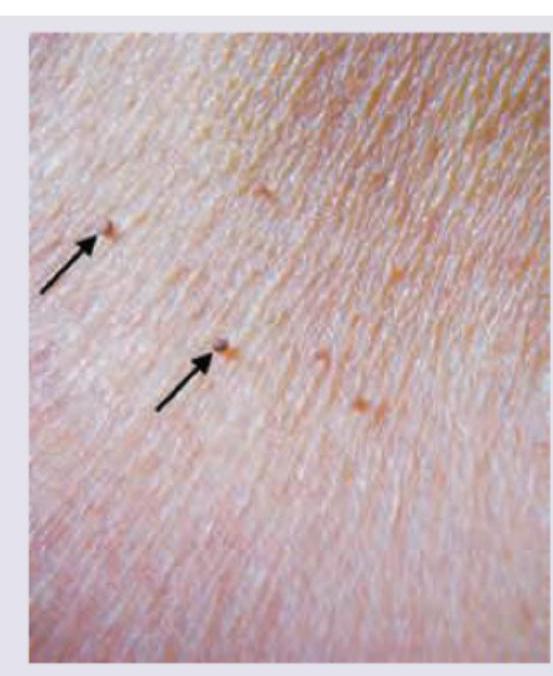
A 19-year-old man has a pigmented skin lesion. Which of the following characteristics suggests a dysplastic nevus (atypical mole) rather than a benign acquired nevus?
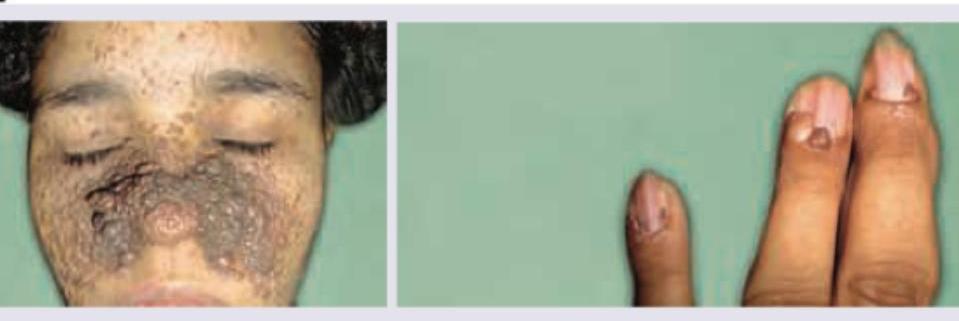
Acanthosis nigricans associated with malignancy has which of the following characteristics?
Which of the following pathways is implicated in the pathogenesis of basal cell carcinoma?
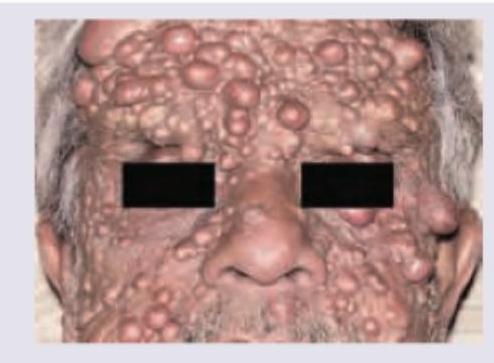
What is the minimum number of neurofibromas required as a diagnostic criterion for adult neurofibromatosis type-I?
What is the best method to treat a large port-wine hemangioma?
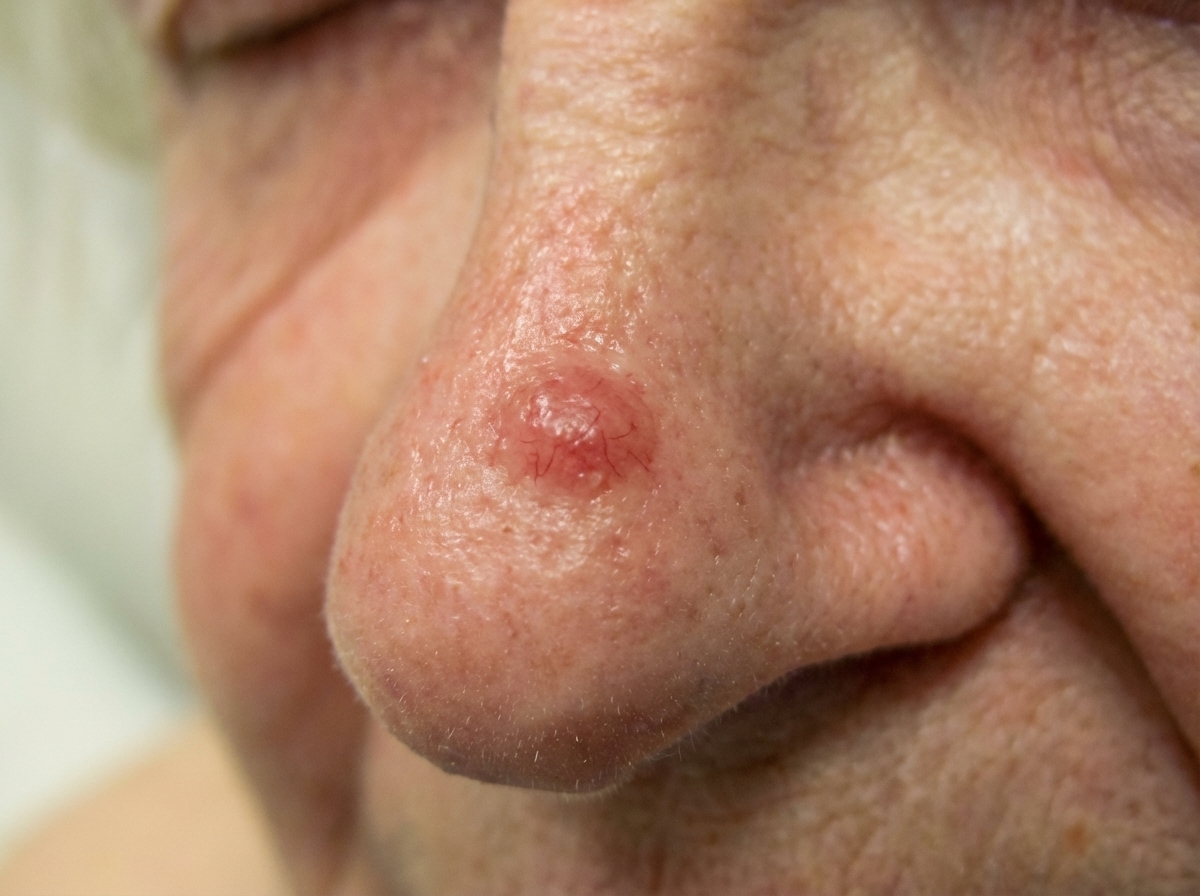
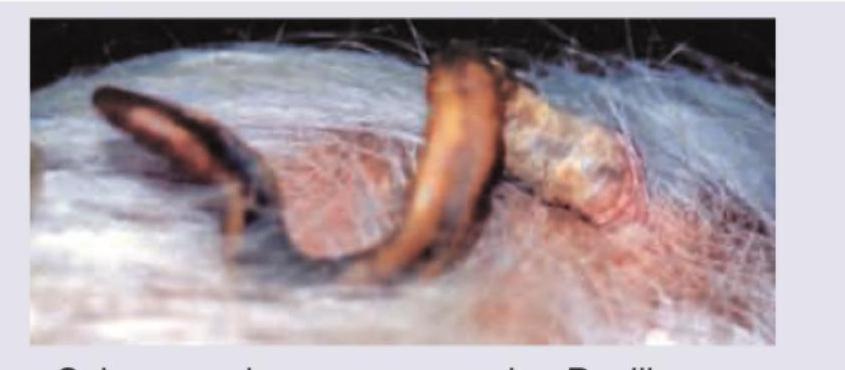
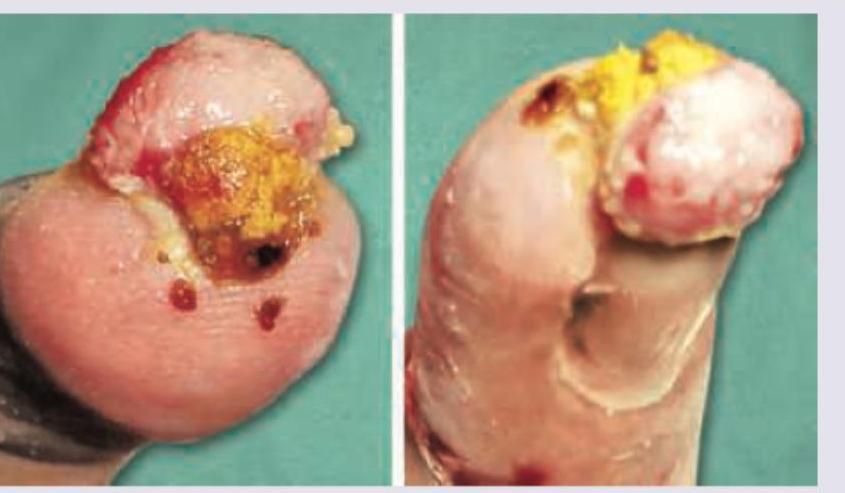
A flesh-colored, dome-shaped, 1.2-cm nodule has appeared on the right earlobe of a 60-year-old man in the past month. A central keratin-filled crater is surrounded by proliferating squamous epithelium. This lesion regresses over the next month and then disappears. Which of the following diagnoses is most appropriate for this lesion?
Which of the following substances is used as biological therapy for malignant melanoma?
Which of the following is true about epidermoid cysts?
Which description best fits the appearance of basal cells in a cylindroma?
What is angiomatosis?
Explanation: **Explanation:** The diagnosis of a **Dysplastic Nevus (Atypical Mole)** is based on clinical and histological criteria that distinguish it from common acquired nevi. **1. Why "Location on the buttock" is correct:** Common acquired nevi typically appear on sun-exposed areas and are rarely found on "double-covered" sites like the buttocks or breasts. In contrast, dysplastic nevi frequently occur on both sun-exposed and **non-sun-exposed areas** (e.g., buttocks, scalp, female breasts). Finding a pigmented lesion in these protected areas is a strong clinical indicator of atypia and increases the suspicion of Dysplastic Nevus Syndrome. **2. Analysis of Incorrect Options:** * **A. Uniform tan color:** This is a feature of a **benign** nevus. Dysplastic nevi characteristically show **variegated coloring** (shades of brown, tan, pink, or black) and irregular, ill-defined borders. * **C. 4 mm in diameter:** Common nevi are usually small (<5 mm). Dysplastic nevi are typically larger, often exceeding **6 mm** in diameter. * **D. 20 similar lesions:** While having many moles is a risk factor, 20 is within the normal range for a young adult. Dysplastic Nevus Syndrome is often associated with a much higher count (frequently **>50 to 100** lesions). **Clinical Pearls for NEET-PG:** * **ABCDE Criteria:** Used for screening (Asymmetry, Border irregularity, Color variation, Diameter >6mm, Evolving). * **Friedman-Rigel Criteria:** Clinical hallmarks of dysplastic nevi include a "fried-egg" appearance (central papule with a flat macule periphery). * **Histology:** Look for "bridging" of melanocytic nests, architectural atypia, and lamellar fibroplasia. * **Inheritance:** Often autosomal dominant; associated with mutations in the **CDKN2A** gene on chromosome 9p21.
Explanation: **Explanation:** Acanthosis Nigricans (AN) is a dermatosis characterized by velvety, hyperpigmented plaques. While most cases are associated with insulin resistance (Type 2 Diabetes, PCOS), **Malignant Acanthosis Nigricans (MAN)** is a distinct paraneoplastic syndrome. **Why "Abrupt Onset" is correct:** Unlike the benign form, which progresses slowly over years, MAN is characterized by a **rapid and extensive onset**. The lesions appear suddenly, spread quickly, and are often more severe (florid). This occurs due to the secretion of Transforming Growth Factor-alpha (TGF-α) by tumor cells, which stimulates epidermal keratinocytes and fibroblasts. **Analysis of Incorrect Options:** * **A & D (Localized/Neck and Axilla only):** Benign AN typically involves the neck and axilla. In contrast, MAN is **generalized and extensive**, often involving unusual sites such as the palms and soles (Tripe palms), oral mucosa, and even the vermilion border of the lips. * **C (Spontaneous resolution):** MAN does not resolve spontaneously. It only regresses if the underlying primary malignancy is successfully treated (surgical resection or chemotherapy). **High-Yield Clinical Pearls for NEET-PG:** * **Most Common Association:** Gastric Adenocarcinoma (up to 60% of cases). * **Tripe Palms:** Velvety, rugose thickening of the palms; highly suggestive of internal malignancy (Lung or Gastric). * **Leser-Trélat Sign:** Sudden eruption of multiple seborrheic keratoses; often co-exists with MAN. * **Clinical Clue:** If AN appears in a non-obese, elderly patient with weight loss, always investigate for an internal malignancy.
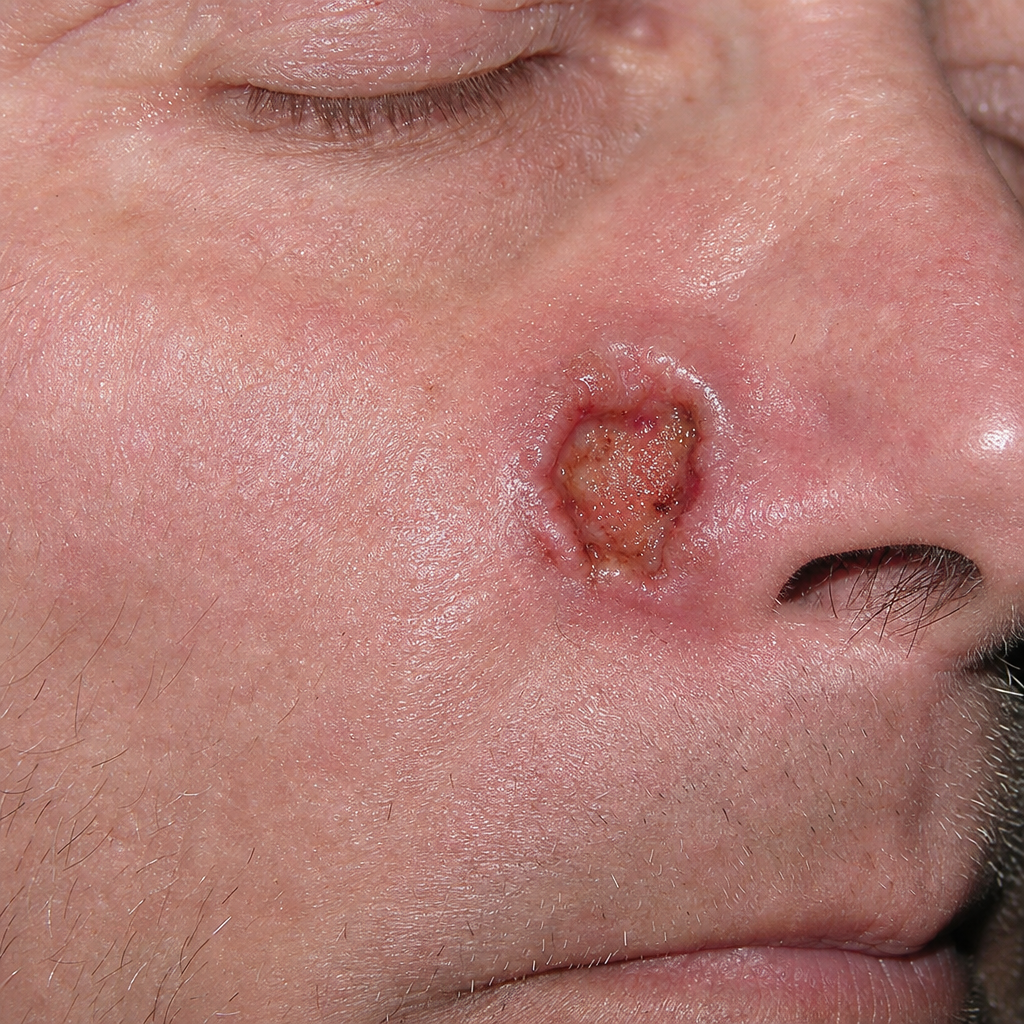
Explanation: **Explanation:** **Basal Cell Carcinoma (BCC)** is the most common skin cancer, and its pathogenesis is fundamentally linked to the dysregulation of the **Sonic Hedgehog (Shh) signaling pathway**. 1. **Why Sonic Hedgehog is Correct:** Under normal conditions, a transmembrane protein called **PTCH1** (Patched) inhibits another protein called **SMO** (Smoothened). In BCC, mutations (often UV-induced) lead to a loss of function in *PTCH1* or a gain of function in *SMO*. This removes the inhibition, allowing SMO to activate **GLI transcription factors**, leading to uncontrolled cell proliferation. This pathway is so central that targeted therapies like **Vismodegib** and **Sonidegib** (SMO inhibitors) are used for advanced BCC. 2. **Why other options are incorrect:** * **mTOR:** Primarily involved in cell growth and metabolism; it is a key target in Tuberous Sclerosis and certain renal cancers, but not the primary driver of BCC. * **WNT:** While involved in hair follicle development and some skin tumors (like pilomatricomas), it is not the defining pathway for BCC. * **RAS:** Mutations in the RAS pathway (specifically HRAS/KRAS) are classically associated with **Squamous Cell Carcinoma (SCC)** and Keratoacanthomas. **High-Yield Clinical Pearls for NEET-PG:** * **Gorlin Syndrome (Basal Cell Nevus Syndrome):** An autosomal dominant condition caused by a germline mutation in the **PTCH1 gene**. It presents with multiple BCCs at a young age, odontogenic keratocysts, and palmar/plantar pits. * **Most common site:** Sun-exposed areas, specifically the upper face (above the line joining the tragus to the angle of the mouth). * **Classic Morphology:** Pearly papule with telangiectasia and a "rolled-out" border. * **Histology:** Peripheral palisading of nuclei and retraction artifacts.
Explanation: **Explanation:** Neurofibromatosis Type 1 (NF-1), also known as von Recklinghausen disease, is an autosomal dominant neurocutaneous syndrome caused by a mutation in the *NF1* gene on chromosome 17. Diagnosis is based on clinical criteria established by the NIH. **Why Option B is Correct:** According to the diagnostic criteria, a patient must have **two or more neurofibromas of any type** OR **one plexiform neurofibroma**. Therefore, "more than 2" is technically inaccurate in phrasing but is the standard answer in medical exams to represent the requirement of $\geq 2$ lesions. In the context of NEET-PG, "2 or more" is the threshold; having only one neurofibroma is insufficient for diagnosis. **Analysis of Incorrect Options:** * **Option A (More than 1):** While 2 is more than 1, the criteria specifically mandate at least two distinct lesions to differentiate from sporadic solitary neurofibromas. * **Option C & D (More than 4/6):** These numbers do not correspond to the neurofibroma count. However, **6 or more** is the specific threshold required for **Café-au-lait macules** (must be $>5$ mm in prepubertal and $>15$ mm in postpubertal individuals). **High-Yield Clinical Pearls for NEET-PG:** To diagnose NF-1, **two or more** of the following must be present: 1. **6+ Café-au-lait spots.** 2. **2+ Neurofibromas** or 1 plexiform neurofibroma. 3. **Axillary or inguinal freckling** (Crowe’s sign). 4. **Optic glioma.** 5. **2+ Lisch nodules** (iris hamartomas seen on slit-lamp exam). 6. **Distinctive bony lesions** (e.g., sphenoid dysplasia or thinning of long bone cortex). 7. **A first-degree relative** with NF-1. *Mnemonic for Chromosome:* NF**1** is on Chromosome **17** (17 letters in "Neurofibromatosis").
Explanation: ### Explanation **Pulsed Dye Laser (PDL)** is the gold standard and treatment of choice for Port-Wine Stains (PWS). The underlying medical concept is **Selective Photothermolysis**. The PDL uses a wavelength (typically 585 or 595 nm) that is specifically absorbed by oxyhemoglobin within the abnormal dermal capillaries. This generates heat that destroys the blood vessels while sparing the surrounding skin tissue, minimizing the risk of scarring. **Analysis of Incorrect Options:** * **Radiotherapy:** This is contraindicated due to the high risk of long-term complications, including radiation dermatitis, permanent scarring, and secondary skin malignancies. * **Tattooing:** While it can camouflage the lesion using skin-colored pigments, the results are often aesthetically poor, the pigment can shift over time, and it does not treat the underlying vascular pathology. * **Excision with Skin Grafting:** This is generally avoided for large lesions because it results in significant scarring and poor cosmetic outcomes (the "patchwork" appearance). It is only considered in rare cases of severe soft tissue hypertrophy or nodularity. **Clinical Pearls for NEET-PG:** * **Port-Wine Stain (Nevus Flammeus):** A congenital vascular malformation (capillary type) that is present at birth and, unlike strawberry hemangiomas, **does not involute** spontaneously. It grows proportionately with the child and may darken or become nodular over time. * **Syndromic Associations:** Always rule out **Sturge-Weber Syndrome** (if the PWS involves the V1/V2 distribution of the trigeminal nerve) and **Klippel-Trenaunay Syndrome** (if it involves a limb with associated hypertrophy). * **Timing:** Treatment with PDL should ideally begin in infancy or early childhood, as the skin is thinner and the lesion is smaller, leading to better clearance rates.
Explanation: ### Explanation **Correct Answer: D. Keratoacanthoma** **Why it is correct:** Keratoacanthoma (KA) is a rapidly growing, well-differentiated squamous neoplasm. The clinical presentation in this case is classic: a **rapidly enlarging** (within weeks), **dome-shaped nodule** with a characteristic **central keratinous plug (crateriform)**. A hallmark feature of KA, which distinguishes it from most other skin malignancies, is its tendency for **spontaneous involution** (regression), often leaving a slightly depressed scar. Histologically, it shows proliferating squamous epithelium with a central crater of keratin. **Why other options are incorrect:** * **A. Basal Cell Carcinoma (BCC):** While BCC is common on sun-exposed areas like the ear, it typically presents as a slow-growing pearly papule with telangiectasia and central ulceration (rodent ulcer). It does **not** regress spontaneously. * **B. Seborrheic Keratosis:** These are benign "stuck-on" warty lesions with horn cysts. They do not have a central keratin crater and do not disappear on their own. * **C. Actinic Keratosis:** This is a premalignant lesion presenting as a rough, sandpaper-like erythematous scale. It is not a large dome-shaped nodule and does not follow a rapid growth-and-regression cycle. **High-Yield Clinical Pearls for NEET-PG:** * **Growth Phases:** KA has three phases: Proliferative (rapid growth), Mature (stable crater), and Involutional (spontaneous resolution). * **Association:** Multiple keratoacanthomas are associated with **Muir-Torre syndrome** (a variant of Lynch syndrome). * **Pathology Note:** Histologically, KA can be very difficult to distinguish from well-differentiated Squamous Cell Carcinoma (SCC). Many dermatopathologists consider it a subtype of SCC. * **Treatment:** Despite potential regression, surgical excision is usually recommended because it is clinically difficult to rule out SCC.
Explanation: **Explanation:** **Interleukin-2 (IL-2)** is a cytokine that plays a critical role in the immune system by stimulating the proliferation and activation of T-cells and Natural Killer (NK) cells. In the context of **Malignant Melanoma**, high-dose IL-2 was one of the first effective biological therapies (immunotherapies) approved. It works by enhancing the body’s own immune surveillance to recognize and destroy melanoma cells. While newer agents like Checkpoint Inhibitors (Pembrolizumab, Nivolumab) are now more common, IL-2 remains a classic high-yield answer for biological therapy in melanoma. **Analysis of Incorrect Options:** * **Infliximab:** This is a chimeric monoclonal antibody against **TNF-alpha**. It is used to treat autoimmune and inflammatory conditions like Psoriasis, Rheumatoid Arthritis, and Crohn’s disease. It is not used for malignancy; in fact, TNF-inhibitors may theoretically increase the risk of certain skin cancers. * **Etanercept:** This is a soluble **TNF-alpha receptor fusion protein**. Like Infliximab, it is used for chronic inflammatory dermatoses (e.g., Psoriatic Arthritis) and is not a treatment for melanoma. **Clinical Pearls for NEET-PG:** * **Targeted Therapy:** If the question mentions a **BRAF V600E mutation**, the drugs of choice are **Vemurafenib** or Dabrafenib. * **Checkpoint Inhibitors:** **Ipilimumab** (anti-CTLA-4) and **Nivolumab/Pembrolizumab** (anti-PD-1) are the modern mainstays of melanoma immunotherapy. * **Prognostic Factor:** The most important prognostic factor for a primary melanoma lesion is the **Breslow Depth** (vertical thickness in mm). * **S-100 & HMB-45:** These are the key immunohistochemical markers used to identify melanoma histologically.
Explanation: **Explanation:** **Epidermoid cysts** (often colloquially but incorrectly called "sebaceous cysts") are the most common cutaneous cysts. They are derived from the follicular infundibulum and are lined by a stratified squamous epithelium that includes a granular layer. 1. **Why Option C is Correct:** The cyst cavity is filled with laminated, cheesy, foul-smelling material. While this material is technically **macerated keratin**, in the context of standard medical examinations (and this specific question), it is frequently referred to as **sebaceous material** due to its oily, lipid-rich consistency and historical nomenclature. 2. **Why Option A is Incorrect:** A **central punctum** (a small opening) is a classic clinical hallmark of an epidermoid cyst, representing the plugged follicle. However, in many MCQ formats, if "sebaceous material" is listed as the defining content, it is prioritized as the "more" correct histological/pathological descriptor. 3. **Why Option B is Incorrect:** While keratin is the primary component, "keratin" alone is a broad term. In many exams, the focus is on the "sebaceous-like" appearance of the contents. (Note: In some clinical texts, A and B are also considered true, but C is the traditional "key" for this specific classic question). 4. **Why Option D is Incorrect:** Most epidermoid cysts are sporadic. While they can be associated with syndromes (like Gardner Syndrome), they do not follow a simple autosomal inheritance pattern on their own. **NEET-PG High-Yield Pearls:** * **Gardner Syndrome:** Multiple epidermoid cysts + Osteomas + Colonic polyposis. * **Histology:** Look for a **stratified squamous epithelium** lining with a **granular layer** (distinguishes it from pilar cysts, which lack a granular layer). * **Milia:** These are essentially very small, superficial epidermoid cysts.
Explanation: **Explanation:** **Cylindroma** (also known as a Turban tumor when multiple) is a benign adnexal neoplasm of sweat gland origin. The histopathology of this condition is highly characteristic and frequently tested in NEET-PG. 1. **Why Option C is Correct:** The "Jigsaw puzzle" appearance is the classic low-power description, where nests of basaloid cells are fitted together and outlined by thick, eosinophilic, PAS-positive basement membrane material. Within these nests, two distinct patterns are observed: * **Swiss Cheese Pattern:** This refers to the presence of multiple small, rounded, punched-out spaces or "pseudocysts" within the tumor islands, filled with basement membrane-like material. * **Honeycomb Pattern:** This describes the arrangement of the basaloid cells themselves, which often form a delicate, reticulated, or lattice-like network resembling a honeycomb. Because both architectural patterns are recognized features of the tumor islands in cylindroma, Option C is the most accurate description. 2. **Why Other Options are Incorrect:** * **Options A & B:** These are incomplete. While both terms are used, selecting one over the other ignores the dual characteristic morphology of the tumor nests. * **Option D:** This is factually incorrect as these are standard pathological descriptors for the condition. **High-Yield Clinical Pearls for NEET-PG:** * **Clinical Presentation:** Solitary or multiple smooth, firm, pink nodules on the scalp. * **Brooke-Spiegler Syndrome:** An autosomal dominant condition (CYLD gene mutation) characterized by multiple cylindromas, trichoepitheliomas, and spiradenomas. * **Histology Keyword:** "Jigsaw puzzle" appearance with thick PAS-positive hyaline sheaths. * **Differential:** Do not confuse the "Swiss cheese" of cylindroma with the "Swiss cheese" appearance of **Adenoid Cystic Carcinoma** (salivary gland/skin) or **Paraffinoma**.
Explanation: **Explanation:** **Sturge-Weber Syndrome (SWS)**, also known as **Encephalotrigeminal Angiomatosis**, is the correct answer. It is a neurocutaneous disorder characterized by the presence of hamartomatous vascular proliferations (angiomatosis) involving the skin and the leptomeninges. The hallmark is the **Port-wine stain** (Nevus Flammeus) in the distribution of the trigeminal nerve, associated with ipsilateral leptomeningeal angiomatosis and glaucoma. **Analysis of Options:** * **A. Sturge-Weber Syndrome:** Correct. The term "angiomatosis" specifically refers to the diffuse vascular malformations seen in the brain and skin in this condition. * **B. Rendu-Osler-Weber Syndrome:** Also known as Hereditary Hemorrhagic Telangiectasia (HHT). It is characterized by multiple **telangiectasias** and arteriovenous malformations (AVMs), not diffuse angiomatosis. * **C. Parry-Romberg Syndrome:** This is **Progressive Hemifacial Atrophy**, characterized by the slow degeneration of skin and soft tissues on one side of the face; it is not a vascular tumor or angiomatosis. * **D. Peutz-Jeghers Syndrome:** An autosomal dominant disorder characterized by **melanocytic hamartomatous macules** (pigmentation) on the lips and oral mucosa, and intestinal polyposis. **High-Yield Clinical Pearls for NEET-PG:** * **Genetics:** SWS is sporadic, caused by a somatic mutation in the **GNAQ gene**. * **Radiology:** "Tram-track" calcifications on CT/X-ray (due to cortical calcification under the angioma). * **Triad:** Port-wine stain, Glaucoma, and Seizures/Mental retardation. * **Note:** Unlike other phakomatoses, SWS is not usually hereditary.
Benign Epithelial Tumors
Practice Questions
Premalignant Epidermal Tumors
Practice Questions
Basal Cell Carcinoma
Practice Questions
Squamous Cell Carcinoma
Practice Questions
Melanocytic Nevi
Practice Questions
Melanoma
Practice Questions
Merkel Cell Carcinoma
Practice Questions
Vascular Tumors and Malformations
Practice Questions
Cutaneous Lymphomas
Practice Questions
Soft Tissue Tumors
Practice Questions
Metastatic Skin Tumors
Practice Questions
Skin Cancer Prevention and Screening
Practice Questions
Get full access to all questions, explanations, and performance tracking.
Start For Free