An 8-year-old girl presents with numerous hypopigmented, ulcerated, and crusted patches on her face and forearms, as well as an indurated, crater-like skin nodule on the back of her left hand. Biopsy of this skin nodule reveals a squamous cell carcinoma. Molecular biology studies show that this patient has germline mutations in the gene encoding a nucleotide excision repair enzyme. What is the most likely diagnosis?
A 50-year-old construction worker with a history of tobacco use for 20 years presents with a growth on his lower lip. Biopsy confirms a carcinoma. What is the most likely cancer?
Buschke-Löwenstein tumor is associated with which of the following?
What is Cock's peculiar tumour?
Which type of skin cancer can occur due to exposure to light?
In pigmented basal cell carcinoma, what is the treatment of choice?
Malignant transformation to melanoma is common in:
Bowen's disease is:
Basal cell carcinoma most commonly occurs on which of the following structures?
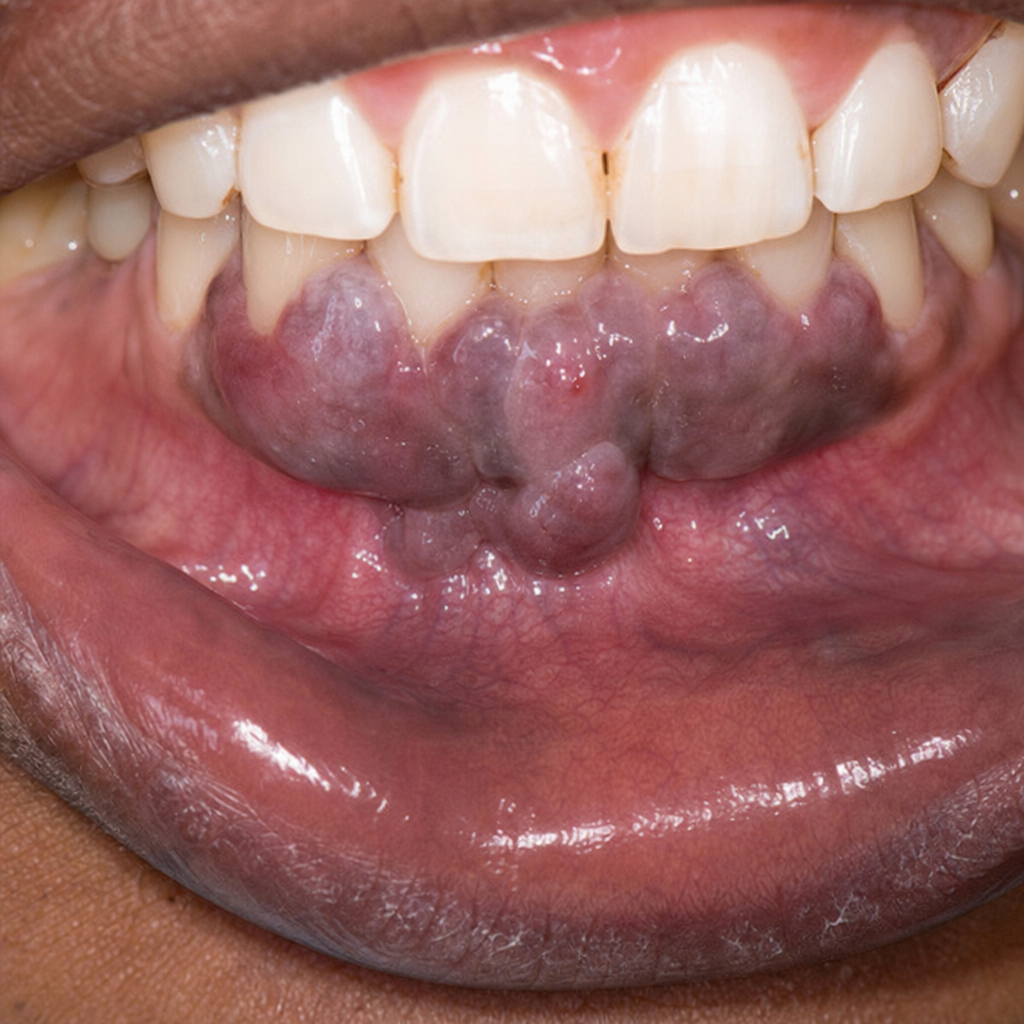
Which of the following is true about pyogenic granuloma?
Explanation: ### Explanation **Correct Option: D. Xeroderma pigmentosum (XP)** **Mechanism:** Xeroderma pigmentosum is an autosomal recessive disorder characterized by a defect in **Nucleotide Excision Repair (NER)**. Normally, NER enzymes identify and repair DNA damage (specifically pyrimidine dimers) caused by Ultraviolet (UV) radiation. In XP, this repair mechanism is deficient, leading to the accumulation of mutations. **Clinical Correlation:** The patient exhibits classic features: * **Photosensitivity:** Hypopigmented and hyperpigmented patches (poikiloderma) in sun-exposed areas. * **Early Malignancy:** A 1000-fold increased risk of skin cancers. Developing **Squamous Cell Carcinoma (SCC)** at age 8 is highly characteristic of XP, as these tumors typically appear in the first decade of life. --- ### Why Other Options are Incorrect: * **A. Ataxia telangiectasia:** Caused by mutations in the *ATM* gene (DNA double-strand break repair). It presents with cerebellar ataxia, oculocutaneous telangiectasia, and immunodeficiency, not early-onset SCC. * **B. Hereditary albinism:** Due to a defect in melanin synthesis (tyrosinase deficiency). While these patients are prone to skin cancer due to lack of photoprotection, they do not have a primary defect in the NER enzyme system. * **C. Li-Fraumeni syndrome:** Caused by germline mutations in the *TP53* tumor suppressor gene. It leads to a broad spectrum of early-onset cancers (sarcomas, breast cancer, brain tumors), but not the specific UV-induced skin phenotype seen here. --- ### NEET-PG High-Yield Pearls: * **Inheritance:** Autosomal Recessive. * **Most common cause of death:** Metastatic Squamous Cell Carcinoma or Melanoma. * **Neurological involvement:** Seen in **De Sanctis-Cacchione syndrome** (a severe variant of XP). * **Key Enzyme Defect:** UV-specific endonuclease (involved in NER). * **Eye findings:** Photophobia, keratitis, and corneal opacities are common.
Explanation: **Explanation:** The correct answer is **Squamous Cell Carcinoma (SCC)**. **Why SCC is correct:** Squamous Cell Carcinoma is the most common malignancy of the **lower lip**. The primary risk factors in this patient—**chronic sun exposure** (due to his occupation as a construction worker) and **tobacco use**—are classic triggers for SCC. In the oral region, SCC typically arises from precursor lesions like actinic cheilitis or leukoplakia. While Basal Cell Carcinoma (BCC) is the most common skin cancer overall, it follows the "rule of the line" (joining the tragus to the angle of the mouth), making it more common on the **upper lip**, whereas SCC dominates the lower lip. **Why other options are incorrect:** * **Basal Cell Carcinoma:** Though common on sun-exposed skin, it rarely affects mucosal surfaces and is significantly more common on the **upper lip**. * **Malignant Melanoma:** While it can occur on the lips (mucosal melanoma), it is much rarer than SCC and usually presents as a pigmented, irregular lesion rather than a standard growth. * **Verrucous Carcinoma:** This is a low-grade variant of SCC (Ackerman’s tumor). While associated with smokeless tobacco (snuff), it is less common than conventional SCC and typically presents as a slow-growing, cauliflower-like warty mass. **NEET-PG High-Yield Pearls:** * **Lip Rule:** Upper Lip = BCC; Lower Lip = SCC. * **Most common site for SCC:** Lower lip (due to UV exposure). * **Most common site for BCC:** Nose (inner canthus). * **Marjolin’s Ulcer:** SCC arising in a chronic cicatrix (scar) or long-standing ulcer. * **Histology:** Look for "Keratin pearls" and "Intercellular bridges" for SCC diagnosis.
Explanation: **Explanation:** **Buschke-Löwenstein tumor (BLT)**, also known as **Giant Condyloma Acuminatum**, is a rare, slow-growing, but locally aggressive tumor. It is considered a form of **Verrucous Carcinoma**, a low-grade squamous cell carcinoma. 1. **Why the correct answer is right:** BLT is primarily associated with **Human Papillomavirus (HPV) types 6 and 11**. It typically arises from long-standing **anogenital warts** (Condyloma Acuminata). While it rarely metastasizes, it is characterized by massive size, deep local infiltration into underlying tissues, and a high rate of recurrence. The transformation from a benign wart to this destructive "cauliflower-like" mass defines its clinical significance. 2. **Why the incorrect options are wrong:** * **Option A & C:** Plantar warts (Verruca plantaris) and common warts (Verruca vulgaris) are caused by different HPV strains (e.g., HPV 1, 2, 4). While they can occasionally undergo malignant change (e.g., Cuniculatum carcinoma on the sole), they are not the origin of Buschke-Löwenstein tumors. * **Option D:** Seborrheic warts (Seborrheic Keratosis) are benign epidermal proliferations not caused by HPV. They are not associated with BLT. 3. **Clinical Pearls for NEET-PG:** * **Histology:** Shows "pushing" rather than "infiltrative" borders. * **Treatment of Choice:** Wide local surgical excision. * **Risk Factors:** Immunosuppression (HIV, organ transplant) and poor hygiene. * **Key Association:** Remember the triad: **HPV 6/11 + Anogenital site + Locally invasive but non-metastasizing.**
Explanation: **Explanation:** **Cock’s Peculiar Tumour** is a clinical entity where a long-standing **sebaceous cyst** (trichilemmal or pilar cyst) on the scalp becomes infected and ulcerates. The resulting lesion is a fungating, exuberant mass of granulation tissue that mimics a **Squamous Cell Carcinoma (SCC)**. 1. **Why Option A is correct:** The "tumour" is not a true neoplasm but a complication of a sebaceous cyst. When the cyst wall ruptures due to infection, the contents evoke a foreign body giant cell reaction. This leads to the formation of vascular granulation tissue that protrudes through the skin, resembling a malignant growth. 2. **Why Options B, C, and D are incorrect:** While the lesion occurs on the scalp and may appear fixed, it is strictly a cutaneous/subcutaneous condition. It does not involve the bone (eliminating Osteomyelitis) and is not a primary bone tumor or a simple intra-osseous cyst. **Clinical Pearls for NEET-PG:** * **Common Site:** Almost exclusively found on the **scalp**. * **Clinical Mimicry:** It is the most common benign lesion to be mistaken for Squamous Cell Carcinoma (SCC) of the scalp. * **Differential Diagnosis:** Must be differentiated from SCC and Keratoacanthoma. * **Key Diagnostic Feature:** Unlike SCC, Cock’s peculiar tumour typically lacks induration at the base and does not show regional lymphadenopathy unless secondary infection is severe. * **Management:** Wide local excision is curative; histopathology is essential to rule out malignancy.
Explanation: **Explanation:** **Squamous Cell Carcinoma (SCC)** is the correct answer because ultraviolet (UV) radiation is its primary environmental risk factor. Chronic exposure to sunlight (specifically UVB rays) leads to DNA damage, specifically the formation of pyrimidine dimers. This results in mutations in the **p53 tumor suppressor gene**, leading to uncontrolled proliferation of keratinocytes. SCC typically arises in sun-exposed areas like the face, lower lip, and dorsum of the hands. **Analysis of Incorrect Options:** * **Melanoma:** While UV radiation is a significant risk factor for melanoma, it is more strongly associated with **intermittent, intense sun exposure** and blistering sunburns rather than cumulative chronic exposure. However, in the context of this specific question and standard dermatological teaching, SCC is the classic example of a malignancy directly linked to cumulative light exposure. * **Kaposi’s Sarcoma:** This is a vascular tumor caused by **Human Herpesvirus 8 (HHV-8)**. It is most commonly seen in immunocompromised individuals (AIDS-related) and is not caused by light or UV exposure. * **None of the above:** Incorrect, as SCC has a well-established causal link with light. **Clinical Pearls for NEET-PG:** * **Precursor Lesion:** Actinic Keratosis is the most common premalignant lesion for SCC caused by sun damage. * **Marjolin’s Ulcer:** This refers to an aggressive SCC arising in areas of chronic scarring, old burn scars, or chronic ulcers. * **Basal Cell Carcinoma (BCC):** Though also caused by sun, it is the most common skin cancer overall, whereas SCC is the most common skin cancer to arise from chronic sun-damaged skin (actinic damage). * **Xeroderma Pigmentosum:** An autosomal recessive condition with defective nucleotide excision repair, leading to a massive increase in SCC and BCC risk at a young age.
Explanation: ### Explanation **Basal Cell Carcinoma (BCC)** is the most common skin cancer, arising from the basal layer of the epidermis. While the "Nodular" type is most frequent, the **Pigmented BCC** variant is common in darker skin types and can clinically mimic melanoma. **1. Why Excision is the Correct Answer:** Surgical excision with predetermined margins (usually 4–5 mm) is the **gold standard treatment** for most BCCs. It allows for histopathological confirmation of clear margins, ensuring the tumor is completely removed. For high-risk areas (the "H-zone" of the face) or recurrent lesions, **Mohs Micrographic Surgery (MMS)** is the treatment of choice as it offers the highest cure rate and maximum tissue preservation. **2. Why Other Options are Incorrect:** * **Chemotherapy (A):** Systemic chemotherapy is rarely used for BCC. Targeted therapy (e.g., Vismodegib, a Hedgehog pathway inhibitor) is reserved only for metastatic or locally advanced cases where surgery is impossible. * **Radiotherapy (B):** This is a secondary option, typically reserved for elderly patients who are poor surgical candidates or for adjuvant treatment in cases with perineural invasion. * **Cryosurgery (C):** While used for very low-risk, superficial lesions, it does not allow for margin control and has a higher recurrence rate compared to excision. **Clinical Pearls for NEET-PG:** * **Most common site:** Face (specifically above the line joining the tragus to the angle of the mouth). * **Classic Description:** Pearly papule with telangiectasia and a "rolled-out" border. * **Histology:** Nests of basaloid cells showing **peripheral palisading** and **retraction artifacts**. * **Metastasis:** Extremely rare; BCC is locally invasive but rarely spreads distantly.
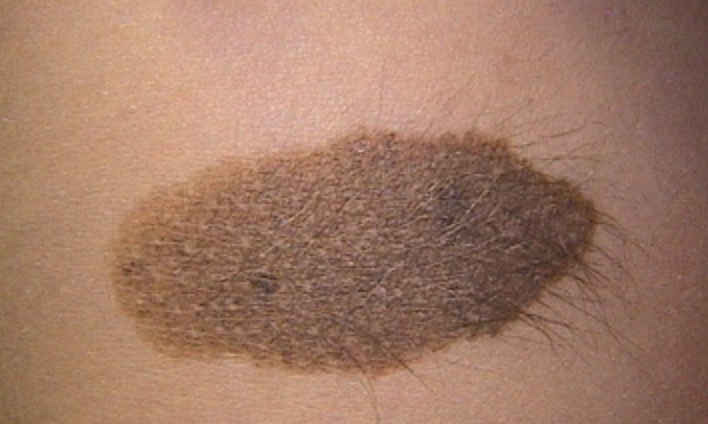
Explanation: **Explanation:** The risk of malignant transformation in melanocytic nevi is primarily determined by the activity and location of melanocytes. **Why Junctional Nevus is the correct answer:** A **junctional nevus** is characterized by nests of melanocytes located strictly at the **dermo-epidermal junction**. These cells are "active" and proliferative. Statistically, most acquired melanomas arise either *de novo* or from a pre-existing junctional nevus (or the junctional component of a compound nevus). The junctional zone is the site of highest metabolic activity and potential for dysplastic change. **Analysis of Incorrect Options:** * **Dermal Nevus:** Here, melanocytes have migrated entirely into the dermis. These are considered "mature" or "quiescent" lesions with virtually zero potential for malignancy. * **Congenital Nevus:** While large/giant congenital melanocytic nevi (GCMN) have a significant risk of melanoma (approx. 5-10%), they are much rarer than junctional nevi. In the context of common acquired nevi, the junctional type is the classic precursor. * **Lentigo Nevus (Lentigo Simplex):** This involves a linear proliferation of melanocytes rather than nest formation. While it can mimic early melanoma, it is a stable, benign lesion with low transformation rates compared to junctional nests. **NEET-PG High-Yield Pearls:** * **Evolution of Nevi:** Nevi typically follow a life cycle: Junctional (childhood) → Compound (adolescence) → Intradermal (adults). * **ABCDE Criteria:** Used to screen for transformation: **A**symmetry, **B**order irregularity, **C**olor variation, **D**iameter >6mm, **E**volving size/shape. * **Most Common Site:** In fair-skinned individuals, the back (men) and legs (women). In Asians/Indians, **Acral Lentiginous Melanoma** (palms, soles, nails) is the most common subtype.
Explanation: **Explanation:** **Bowen’s disease** is a form of **Squamous Cell Carcinoma (SCC) in situ**. The term "in situ" or "intraepithelial" signifies that the malignant keratinocytes are confined to the epidermis and have not breached the dermo-epidermal junction (basement membrane). 1. **Why Option B is correct:** Bowen’s disease represents the full-thickness dysplasia of the epidermis. Histologically, it is characterized by "windblown" appearance (disordered keratinocytes), pleomorphism, and frequent mitoses, but the basement membrane remains intact. If left untreated, it can progress to invasive Squamous Cell Carcinoma. 2. **Why other options are incorrect:** * **Options A & D:** Bowen’s disease is primarily a cutaneous (skin) condition. While it can occur on mucosal surfaces (where it is often termed Erythroplasia of Queyrat when on the glans penis), it is not a primary neoplasm or ulcerative lesion of the Gastrointestinal Tract (G.I.T). * **Option C:** It typically presents as a slow-growing, well-demarcated, erythematous, scaly plaque. It is not a vesiculobullous (blistering) lesion. **High-Yield Clinical Pearls for NEET-PG:** * **Clinical Presentation:** Often mistaken for psoriasis or eczema, but it does not respond to topical steroids. * **Etiology:** Chronic UV exposure, Arsenic ingestion (look for "raindrop pigmentation" on the trunk), and High-risk HPV types (especially HPV 16). * **Erythroplasia of Queyrat:** This is the specific name for Bowen’s disease occurring on the glans penis or prepuce. * **Treatment of Choice:** Surgical excision, though topical 5-Fluorouracil (5-FU), Imiquimod, or Cryotherapy are also used.
Explanation: **Explanation:** **1. Why the Correct Answer is Right:** Basal Cell Carcinoma (BCC) is the most common skin cancer globally. It originates from the **basal layer of the epidermis** and the **outer root sheath of the hair follicle (pilosebaceous unit)**. Because BCC arises from these adnexal structures, it is exclusively found on hair-bearing skin. It is highly associated with chronic ultraviolet (UV) radiation exposure, which damages the DNA of these specific progenitor cells. **2. Why the Incorrect Options are Wrong:** * **Options B and C (Mucosa, Lips, and Tongue):** BCC **never** occurs on mucosal surfaces (like the tongue or inner mouth) because these areas lack the pilosebaceous adnexa (hair follicles and sebaceous glands) from which the tumor originates. In contrast, **Squamous Cell Carcinoma (SCC)** frequently involves the mucosa and the vermilion border of the lips. * **Option D:** Since BCC is restricted to cutaneous surfaces and cannot involve mucous membranes, "All of the above" is incorrect. **3. High-Yield Clinical Pearls for NEET-PG:** * **Most Common Site:** The face, specifically above the line joining the lobe of the ear to the angle of the mouth (the "mask area"). The **nose** is the single most common site. * **Clinical Presentation:** Classically presents as a pearly, translucent papule with **telangiectasia** and a "rolled-out" border. It may undergo central ulceration (known as a **Rodent Ulcer**). * **Behavior:** It is locally invasive but **rarely metastasizes**. * **Genetics:** Associated with mutations in the **PTCH1 gene** (Hedgehog signaling pathway). It is a key feature of **Gorlin Syndrome** (Basal Cell Nevus Syndrome). * **Histopathology:** Characterized by nests of basaloid cells showing **peripheral palisading** and retraction artifacts.
Explanation: **Pyogenic Granuloma (Lobular Capillary Hemangioma)** Pyogenic granuloma is a common, benign **vascular tumor** of the skin and mucous membranes. Despite its name, it is neither "pyogenic" (not caused by infection) nor a true "granuloma" (it is a proliferation of capillaries). **Explanation of Options:** * **Option A (True):** It is a **vascular pathology** characterized by a lobular proliferation of capillaries within an edematous stroma. It typically presents as a rapidly growing, friable, red papule or nodule. * **Option B (False):** Pyogenic granulomas are notorious for **bleeding profusely** even with minor trauma. This is a classic clinical hallmark due to the high density of superficial, fragile blood vessels. * **Option C (True):** There is a significant association with hormonal changes. The incidence increases during **pregnancy**, where it often occurs on the gingiva (gums) and is specifically referred to as **Granuloma Gravidarum** or "pregnancy tumor." **Conclusion:** Since both A and C are correct, **Option D** is the right choice. **High-Yield Clinical Pearls for NEET-PG:** * **Common Sites:** Fingers, face, and gingiva. * **Triggers:** Often preceded by minor trauma or associated with certain drugs (e.g., oral contraceptives, retinoids, indinavir). * **Histopathology:** Shows a "lobular" arrangement of capillaries (Lobular Capillary Hemangioma) with an epidermal "collarette" at the base. * **Treatment of Choice:** Surgical excision or curettage with cautery of the base to prevent recurrence.
Benign Epithelial Tumors
Practice Questions
Premalignant Epidermal Tumors
Practice Questions
Basal Cell Carcinoma
Practice Questions
Squamous Cell Carcinoma
Practice Questions
Melanocytic Nevi
Practice Questions
Melanoma
Practice Questions
Merkel Cell Carcinoma
Practice Questions
Vascular Tumors and Malformations
Practice Questions
Cutaneous Lymphomas
Practice Questions
Soft Tissue Tumors
Practice Questions
Metastatic Skin Tumors
Practice Questions
Skin Cancer Prevention and Screening
Practice Questions
Get full access to all questions, explanations, and performance tracking.
Start For Free