What is the most common primary source of metastatic bone tumors in males?
Which of the following statements about bone metastasis is false?
Clinical examination of a symptomatic patient shows a Sister Mary Joseph nodule. It is most commonly associated with which of the following?
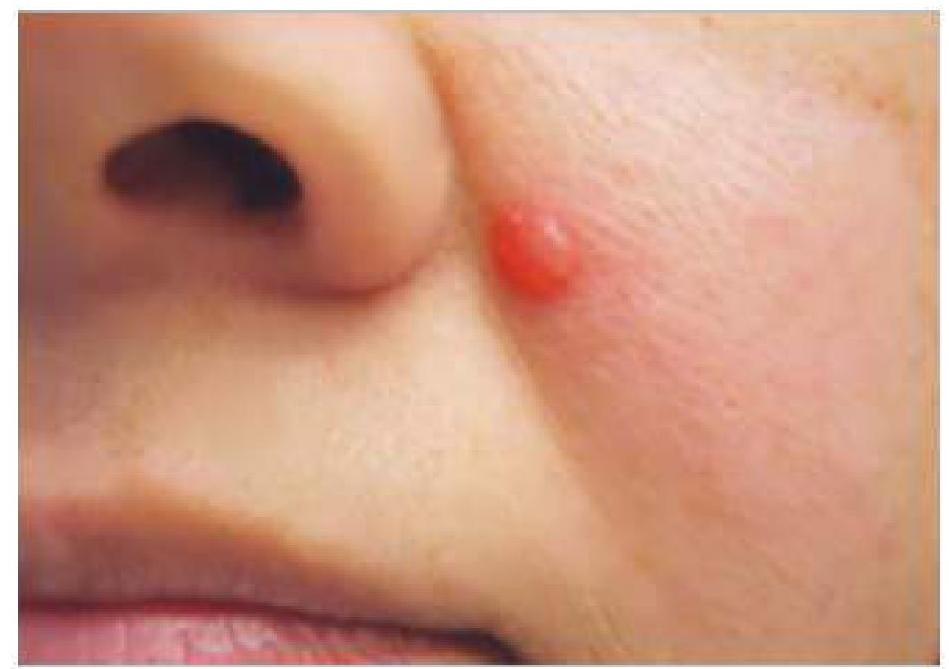
A male patient presented with a 0.3 cm nodule on the left nasolabial fold. A pathological examination revealed a basaloid appearance with peripheral palisading. What is the most likely diagnosis?
Statement 1 - A 59-year-old patient presents with flaccid bullae. Histopathology shows a suprabasal acantholytic split. Statement 2 - The row of tombstones appearance is diagnostic of Pemphigus vulgaris.
Mycosis fungoides primarily involves which type of immune cell?
A patient consults a dermatologist about a skin lesion on her neck. Examination reveals a 1-cm diameter, red, scaly plaque with a rough texture and irregular margins. Biopsy demonstrates epidermal and dermal cells with large, pleomorphic, hyperchromatic nuclei. Which of the following conditions would most likely predispose this patient to the development of this lesion?
All of the following statements are true for keloids EXCEPT:
Elderly man with a long-standing mole on his face that is increasing in size and showing an irregular border. Diagnosis:
Pautrier's microabscess is a histological feature of which disease?
Explanation: ***Prostate*** - **Prostate cancer** is the most common primary source of metastatic bone tumors in males due to its high propensity to **metastasize to bone** and its high prevalence in the male population [1]. - These metastases are typically **osteoblastic**, causing increased bone density visible on imaging. *Liver* - While the **liver** can be a site of metastasis for many cancers, it is not a common primary source for **bone metastases** [2]. - Liver cancer (hepatocellular carcinoma) can metastasize, but bone is not its most frequent distant site. *Bone* - **Bone** itself can be the site of primary bone tumors, such as osteosarcoma or Ewing's sarcoma, but these are **not metastatic bone tumors** in the sense of originating elsewhere [3]. - When cancer originates in the bone, it is a primary bone cancer, not a metastatic one. *Brain* - **Brain tumors** (primary intracranial malignancies) generally have a **low propensity to metastasize** outside of the central nervous system. - While rare cases of brain tumor metastasis to bone can occur, it is not a common event or primary source.
Explanation: ***Soft tissue sarcoma causes bony metastasis.*** - This statement is **false** because **soft tissue sarcomas** rarely metastasize to bone. - They tend to spread via the bloodstream to the lungs, liver, and other soft tissues, but **bony metastases are highly uncommon** [1]. *Uncommon distal to elbow and knee.* - This statement is **true** as bony metastases predominantly affect the **axial skeleton** and proximal long bones due to their rich vascular supply, while the **distal extremities** are less commonly involved. - The **red marrow** in the axial skeleton provides a more favorable environment for tumor cell growth. *Breast secondary may be osteoblastic* - This statement is **true** as while breast cancer metastases are often lytic, they can also cause **osteoblastic (bone-forming)** lesions, or a mix of both [2]. - **Osteoblastic activity** in breast cancer secondary to bone is often related to the stimulation of osteoblasts by tumor cells. *Renal cell carcinoma secondary are expansile* - This statement is **true** as renal cell carcinoma metastases to bone are typically **lytic** and often **expansile**, meaning they can significantly enlarge the affected bone [2]. - These lesions are also known to be highly **vascular**, increasing the risk of pathological fractures. **References:** [1] Kumar V, Abbas AK, et al.. Robbins and Cotran Pathologic Basis of Disease. 9th ed. Neoplasia, p. 282. [2] Cross SS. Underwood's Pathology: A Clinical Approach. 6th ed. Common Clinical Problems From Osteoarticular And Connective Tissue Disease, pp. 671-672.
Explanation: ***Stomach cancer*** - A **Sister Mary Joseph nodule** is a **periumbilical metastatic nodule**, most commonly associated with **gastric adenocarcinoma** due to its propensity for peritoneal spread. - While it can originate from other abdominal malignancies, stomach cancer is statistically the most frequent primary source of this metastatic sign. *Ovarian cancer* - Ovarian cancer can metasatasize to the peritoneum and sometimes cause Sister Mary Joseph nodules, but it is not the most common primary source [1]. - Instead, ovarian cancer more frequently presents with symptoms like **abdominal distension**, **pelvic pain**, or **ascites** [1]. *Colon cancer* - **Colorectal cancer** can also metastasize to the peritoneum, potentially leading to a Sister Mary Joseph nodule, though less commonly than gastric cancer [2]. - It often manifests with changes in **bowel habits**, **rectal bleeding**, or **unexplained weight loss** [2]. *Pancreatic cancer* - Pancreatic cancer can produce a Sister Mary Joseph nodule, particularly in advanced stages with **peritoneal dissemination**. - However, it is primarily known for other metastatic patterns and often presents with **jaundice** (if the head of the pancreas is affected) or **epigastric pain**.
Explanation: ***Basal cell carcinoma*** - The description of a **basaloid appearance with peripheral palisading** on pathological examination is a classic histological feature of basal cell carcinoma (BCC). - BCC commonly presents as a nodule on sun-exposed areas like the **nasolabial fold** and is the most common skin cancer. *Melanoma* - Melanoma is characterized by the **malignant proliferation of melanocytes** and histologically shows atypical melanocytes with pagetoid spread or nest formation. - While it can appear as a nodule, the described **basaloid appearance with peripheral palisading** is not characteristic of melanoma. *Squamous cell carcinoma* - Squamous cell carcinoma typically shows **atypical keratinocytes** with keratinization, intercellular bridges, and sometimes desmoplasia. - It usually presents as an **erythematous, scaly patch** or nodule, often with ulceration, and the described histology does not match. *Nevus* - A nevus (mole) is a benign proliferation of melanocytes, showing **uniform nests of melanocytes** with maturation as they descend into the dermis. - The term **basaloid appearance** refers to cells resembling basal keratinocytes, which is not typical for a nevus.
Explanation: ***Correct: Statements 1 & 2 are correct, 2 is not explaining 1*** **Analysis of Statement 1:** - A 59-year-old patient with **flaccid bullae** and **suprabasal acantholytic split** on histopathology is the classic presentation of **Pemphigus vulgaris** - The flaccid (easily ruptured) nature of bullae distinguishes it from tense bullae seen in bullous pemphigoid - The suprabasal location of the split (just above the basal layer) with acantholysis (loss of cell-to-cell adhesion) is pathognomonic - **Statement 1 is CORRECT** ✓ **Analysis of Statement 2:** - The **"row of tombstones" or "tombstone appearance"** is indeed a diagnostic histopathological feature of Pemphigus vulgaris - This appearance results from basal keratinocytes remaining attached to the basement membrane while suprabasal cells separate due to acantholysis - The intact basal cells standing upright resemble a row of tombstones - **Statement 2 is CORRECT** ✓ **Does Statement 2 explain Statement 1?** - Statement 2 describes a **histopathological appearance** (tombstone pattern) that is a **consequence** of the suprabasal split - However, it does NOT explain the **underlying cause** of the flaccid bullae or the suprabasal split - The true explanation involves **IgG autoantibodies against desmoglein 3 (and desmoglein 1)**, which attack intercellular adhesion structures (desmosomes), causing **acantholysis** - Therefore, **Statement 2 does NOT explain Statement 1** ✗ *Incorrect: Statement 2 is the correct explanation for Statement 1* - While both statements describe features of Pemphigus vulgaris, the tombstone appearance is a descriptive finding, not an explanatory mechanism *Incorrect: Statements 1 and 2 are incorrect* - Both statements are medically accurate descriptions of Pemphigus vulgaris features *Incorrect: Statement 1 is incorrect* - Statement 1 correctly describes the cardinal clinical and histopathological features of Pemphigus vulgaris
Explanation: ***CD4+ T Cells*** - Mycosis fungoides is a type of **cutaneous T-cell lymphoma**, primarily involving **CD4+ T cells** which infiltrate the skin [1][2]. - The disease is characterized by **pleomorphic** skin lesions caused by **malignant T-cell proliferation** [3]. *K Cells (not primarily involved in mycosis fungoides)* - K Cells are involved in **immunological responses** but are not specifically linked to mycosis fungoides. - They do not play a primary role in **cutaneous lymphoproliferative disorders**. *B Cells (involved in humoral immunity)* - B Cells are mainly responsible for **antibody production**, which is not the primary mechanism in mycosis fungoides. - The condition involves **T cell malignancy**, rather than abnormalities in B cell function. *NK Cells (part of innate immunity)* - NK Cells are important for **innate immunity** and target viral and tumor cells but are not primarily involved in this lymphoma. - Mycosis fungoides is characterized by **T cell-mediated responses**, not NK cell activity. **References:** [1] Kumar V, Abbas AK, et al.. Robbins and Cotran Pathologic Basis of Disease. 9th ed. Diseases of White Blood Cells, Lymph Nodes, Spleen, and Thymus, pp. 613-614. [2] Kumar V, Abbas AK, et al.. Robbins and Cotran Pathologic Basis of Disease. 9th ed. The Skin, p. 1162. [3] Cross SS. Underwood's Pathology: A Clinical Approach. 6th ed. Common Clinical Problems From Diseases Of The Urinary And Male Genital Tracts, pp. 564-565.
Explanation: ***Actinic keratosis*** - The skin lesion described (red, scaly plaque with a rough texture and irregular margins) along with the biopsy findings of **pleomorphic, hyperchromatic nuclei** are consistent with **squamous cell carcinoma in situ** or **Bowen's disease**, which often arises from **actinic keratosis**. - **Actinic keratosis** is a premalignant lesion caused by chronic exposure to **ultraviolet (UV) radiation**, leading to atypical keratinocytes. It is a direct precursor to invasive **squamous cell carcinoma**. *Compound nevus* - A **compound nevus** is a benign mole characterized by nests of melanocytes located at both the **dermoepidermal junction** and within the **dermis**. - It typically appears as a raised, pigmented lesion with a smooth surface and does not show the scaly, rough texture or the severe cellular atypia described. *Dermal nevus* - A **dermal nevus** is a benign mole where the melanocytes are exclusively located within the **dermis**. - These lesions are often dome-shaped, flesh-colored or lightly pigmented, and can appear warty or pedunculated, lacking the scaly, irregular features of the described lesion. *Junctional nevus* - A **junctional nevus** is a benign mole characterized by nests of melanocytes located at the **dermoepidermal junction**. - They are typically flat, well-demarcated, and uniformly pigmented, and do not present with the scaly texture, irregular margins, or the severe cellular atypia seen in the biopsy.
Explanation: ***True keloid does not spread into surrounding tissue*** - This statement is **incorrect** as a defining characteristic of keloids is their tendency to **spread beyond the original wound boundaries**, invading surrounding healthy tissue. - This expansive growth differentiates keloids from hypertrophic scars, which remain confined to the site of injury. *The maturation and stabilization of the collagen fibrils is inhibited* - This statement is **true**. In keloids, there is an impairment in the normal maturation process of collagen, leading to an accumulation of **immature, disorganized collagen fibrils**. - This abnormal collagen synthesis and degradation contribute to the excessive and persistent fibrosis characteristic of keloids. *It is rarely seen in white skinned persons and is more common over the sternum* - This statement is **true**. Keloids are more prevalent in individuals with **skin of color (e.g., African, Hispanic, and Asian descent)** and are less common in Caucasians. - Common locations for keloids include the **sternum**, earlobes, shoulders, and upper back, areas under significant skin tension. *True keloid continues to become worse even after one year* - This statement is **true**. Unlike hypertrophic scars which may regress over time, keloids tend to be **persistent and progressive**, often continuing to grow and worsen in size and appearance even years after the initial injury. - They typically do not resolve spontaneously and may even recur after excision.
Explanation: ***Lentigo maligna*** - This type of melanoma commonly affects **elderly individuals** and presents as a **slowly enlarging, irregularly bordered, flat or slightly raised pigmented lesion** on sun-exposed areas like the face. - It often has a **long radial growth phase** before progressing to invasive lentigo maligna melanoma. *Superficial spreading melanoma* - While common, it typically presents on the **trunk or extremities** and has a faster growth rate compared to lentigo maligna. - It often appears as a **flat, asymmetrical lesion with varied colors and irregular borders**, but the age and location details point away from this. *Nodular melanoma* - This is an **aggressive form** that grows vertically from the start, presenting as a **dark, raised, often ulcerated nodule** and typically has a shorter history of rapid growth. - It lacks the characteristic long-standing, flat growth pattern described in the elderly patient's face. *Acral melanoma* - This rare type occurs on the **palms, soles, or under the nails (subungual)**, not typically on the face. - It often appears as a **pigmented streak or patch** in these acral locations.
Explanation: ***Mycosis fungoides*** - **Pautrier's microabscesses** (intraepidermal collections of neoplastic T-lymphocytes) are a characteristic histological hallmark of **mycosis fungoides**, a cutaneous T-cell lymphoma [1]. - These collections are typically seen in the **epidermis**, especially in the patch and plaque stages of the disease, reflecting the **epidermotropism** of the malignant T-cells [1]. *Sarcoidosis* - Characterized by **non-caseating granulomas** in various organs, including the skin. - **Pautrier's microabscesses** are not a feature of sarcoidosis. *Tuberculosis* - Identified by the presence of **caseating granulomas** composed of epithelioid cells, lymphocytes, and Langerhans giant cells. - It does not involve the formation of **intraepidermal microabscesses** of lymphocytes. *Pityriasis lichenoides chronica* - A benign inflammatory skin condition characterized by a **lymphocytic vasculitis** and interface dermatitis. - Histology shows a **wedge-shaped inflammatory infiltrate** in the dermis with interface changes, but not Pautrier's microabscesses. **References:** [1] Cross SS. Underwood's Pathology: A Clinical Approach. 6th ed. Common Clinical Problems From Diseases Of The Urinary And Male Genital Tracts, pp. 564-565.
Get full access to all questions, explanations, and performance tracking.
Start For Free