A 13-year-old boy presents with patchy depigmented skin on the right flank and upper thigh in segmental distribution, as shown in the image. The depigmentation started 1 year back but has been static for last 4 months. Mother reports use of topical steroids which was ineffective. Diagnosis is?

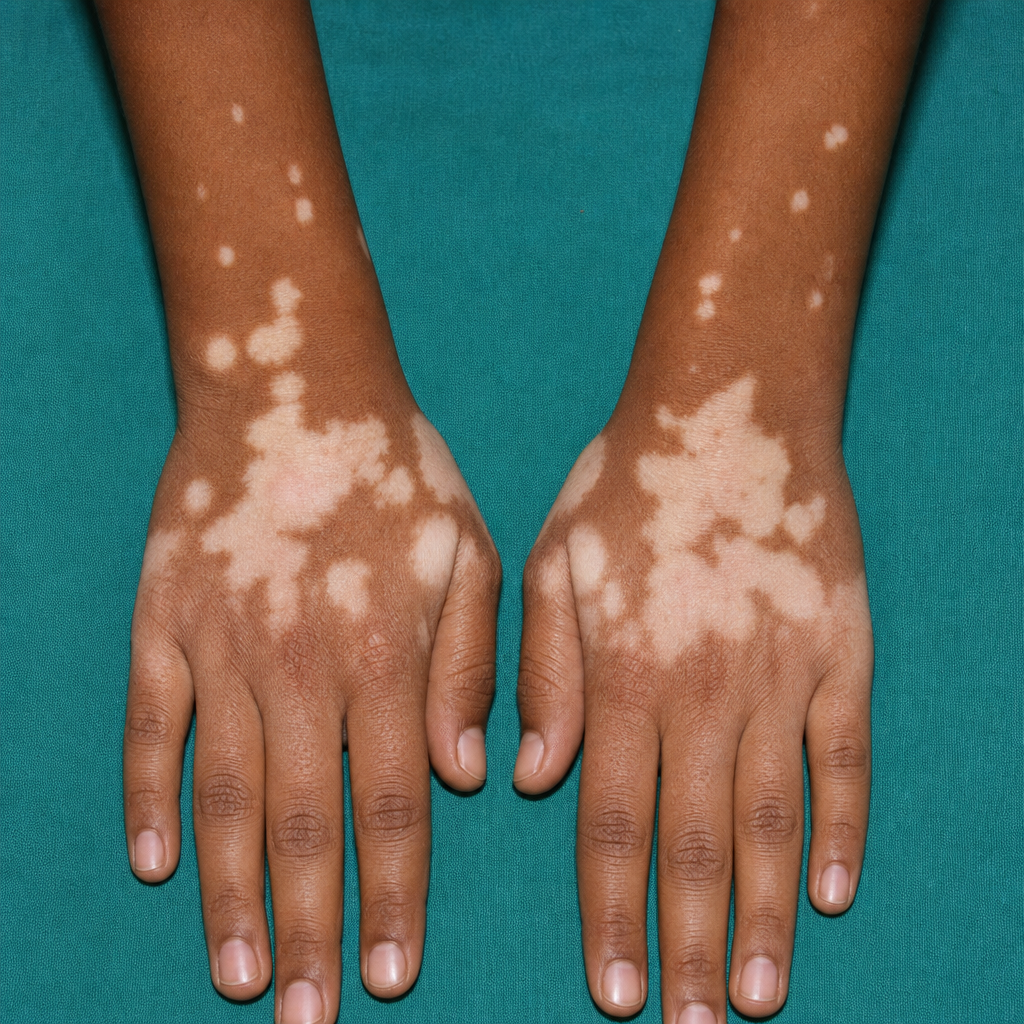
An 18-year-old female presents with hypo-pigmented patches on the dorsal aspect of the foot. Which of the following drugs should not be used in the treatment of this patient? (AIIMS May 2016)

The following skin lesion can be seen in all except:

The given image shows:

The image shows presence of:

The image shows presence of:

The image shows presence of:

The image shows presence of:

The lesion shown below is seen in:

A patient with pancreatic tumor and impaired glucose tolerance is having these lesions on flexural areas. What is the diagnosis?

Explanation: ***Segmental vitiligo*** - The presentation of **depigmented skin** in a **segmental distribution** on one side of the body, starting in childhood at 13 years old, is characteristic of **segmental vitiligo**. - Its **static nature** for four months, unlike progressive widespread vitiligo, and **ineffectiveness of topical steroids** further support this diagnosis. *Piebaldism* - Characterized by a **congenital absence of melanocytes** in affected areas, typically presenting at birth with a **white forelock** and symmetrically distributed patches. - Unlike the described case, piebaldism is **stable throughout life** and does not usually appear at 12 years of age or show a segmental pattern extending along dermatomes. *Hypomelanosis of Ito* - This condition is characterized by **streaky or whorled hypopigmentation** following **Blaschko's lines**, often associated with **neurological, skeletal, or ocular abnormalities**. - While it presents in early childhood in a linear or segmental pattern, the lesions are **hypopigmented (lighter than surrounding skin)**, not completely depigmented like in the clinical image, and its lesions are usually static or mildly progressive which isn't completely consistent *Hypopigmented streaks* - This is a descriptive term rather than a specific diagnosis, and while the lesions might appear streaky, the term doesn't encompass the **complete depigmentation**, **segmental distribution**, and **onset characteristics** detailed in the case. - The term "hypopigmented" refers to *reduced* pigmentation, whereas the image and description suggest *complete absence* of pigment, which is depigmentation.
Explanation: ***Isotretinoin*** - Isotretinoin is a retinoid primarily used for severe **acne vulgaris** and does not have a role in the treatment of post-inflammatory hypopigmentation or vitiligo. - Its mechanism of action involves reducing sebaceous gland size and sebum production, which is unrelated to melanin synthesis or pigment regulation. *Topical tacrolimus* - Topical tacrolimus is a **calcineurin inhibitor** commonly used off-label for **vitiligo**, which can present as hypopigmented patches, especially on sensitive skin areas. - It works by modulating the immune response in the skin, which can help in repigmentation. *Clobetasol* - Clobetasol is a **high-potency topical corticosteroid** often used in regimens for **vitiligo** or other inflammatory dermatoses leading to hypopigmentation. - It helps by suppressing local immune activity that may be contributing to melanocyte destruction or dysfunction. *PUVA* - **Psoralen plus ultraviolet A (PUVA)** is a form of **phototherapy** widely used for generalized vitiligo. - Psoralen sensitizes the skin to UVA light, stimulating melanocytes to produce pigment.
Explanation: ***Normolipidemia*** - The image displays **xanthelasma**, which are soft, yellowish patches of cholesterol deposits, typically found on or around the eyelids. - While xanthelasma are strongly associated with **dyslipidemia**, they can occasionally occur in individuals with otherwise normal lipid levels, but normolipidemia itself does not cause them. - This is the correct answer as xanthelasma is **not typically seen** in normolipidemia. *Type III hyperlipidemia* - **Type III hyperlipidemia**, also known as familial dysbetalipoproteinemia, is characterized by elevated **chylomicron remnants** and **IDL**. - This condition is strongly associated with **xanthelasma** and other cutaneous xanthomas due to accumulation of cholesterol-rich lipoproteins. - Patients typically present with palmar xanthomas and tuberoeruptive xanthomas in addition to xanthelasma. *Diabetes mellitus* - **Diabetes mellitus** can lead to secondary dyslipidemia, increasing the risk of xanthelasma and other cutaneous manifestations of lipid deposition. - Poorly controlled diabetes is associated with elevated **triglycerides** and **VLDL**. - The metabolic dysfunction promotes cholesterol accumulation in tissues including the eyelid skin. *Secondary biliary cirrhosis* - **Secondary biliary cirrhosis** can cause significant **hypercholesterolemia** due to impaired bile acid excretion. - The accumulation of cholesterol can manifest as xanthelasma or other forms of **xanthomas**. - Cholestatic liver disease is a well-recognized cause of secondary hyperlipidemia and xanthelasma formation.
Explanation: ***Xeroderma Pigmentosum*** - The image exhibits severe **photosensitivity** with extensive **erythema**, **scaling**, and numerous **non-melanoma skin cancers** (e.g., basal cell carcinoma, squamous cell carcinoma) on sun-exposed areas, particularly the face. - This condition is characterized by a defect in **DNA repair mechanisms**, leading to extreme vulnerability to UV radiation and a high risk of skin malignancies. *Piebaldism* - Characterized by localized **congenital absence of melanocytes**, resulting in patches of **white skin** and a **white forelock**. - It does not involve sun sensitivity or the development of multiple skin cancers as seen in the image. *Oculo-cutaneous albinism* - This condition involves a generalized reduction or absence of melanin, leading to **pale skin**, **white hair**, and **light-colored eyes**. - While individuals with albinism are photosensitive and at increased risk of skin cancers, the severe, widespread actinic damage and multiple open lesions on the face are more typical of the extreme UV sensitivity seen in xeroderma pigmentosum. *Waardenburg syndrome* - A genetic disorder characterized by varying degrees of **hearing loss**, unusual **eye color** (often brilliant blue or heterochromia), and often a **white forelock**. - It does not primarily involve severe sun sensitivity, extensive actinic damage, or multiple skin cancers as the prominent features.
Explanation: ***Piebaldism*** - The image on the right clearly depicts a man with a **white forelock** (poliosis) and **blue irises**, which are characteristic features of **piebaldism**, a rare autosomal dominant genetic disorder. - Piebaldism is characterized by congenital localized areas of **hypopigmentation** due to the absence of melanocytes, commonly affecting the forehead, trunk, and limbs symmetrically. *Vitiligo* - The image on the left, labeled 'a' as Vitiligo, shows **irregular, acquired depigmented patches** on the trunk, which are typically progressive and can appear anywhere on the body. - Although both conditions involve depigmentation, vitiligo is **acquired** and progressive, and usually lacks the distinct congenital features like a white forelock and specific distribution seen in piebaldism. *Xeroderma pigmentosum* - This is a rare genetic disorder characterized by an extreme sensitivity to **ultraviolet (UV) light** due to defects in DNA repair, leading to severe photosensitivity and a very high risk of skin cancers. - It does not primarily present with localized congenital depigmentation or a white forelock. *Incontinentia pigmenti* - This is an X-linked dominant disorder primarily affecting the skin, presenting with various stages of lesions from vesicular to verrucous and hyperpigmented streaks that typically follow **Blaschko's lines**. - It is not characterized by the congenital patches of depigmentation, white forelock, or ocular abnormalities seen in the presented images; rather, it often involves changes in pigmentation that appear swirled or linear.
Explanation: ***Becker's nevus*** - This image shows a **large, irregular, hyperpigmented patch** on the anterior trunk, which may also be **hypertrichotic** (hairy), a classic presentation of Becker's nevus. - Becker's nevus typically appears in males during **adolescence** and is often found on the **shoulder or upper trunk**. *Nevus of Ota* - **Nevus of Ota** is a **pigmented lesion** characterized by blue-gray patches typically found on the **face**, involving the **ophthalmic and maxillary divisions of the trigeminal nerve**. - It does not present as a large, often hairy, hyperpigmented patch on the trunk. *Nevus spilus* - **Nevus spilus** is a **light brown patch** (macule) with multiple **darker brown or black papules or macules** superimposed within it. - The image does not show superimposed darker lesions within a lighter background. *Giant melanocytic nevus of face* - A **giant melanocytic nevus** is a congenital nevus that is typically **present at birth** and covers a large area, often with varied textures and colors, but the question specifies "**of face**" which is not depicted in the image (the lesion is on the trunk). - The lesion in the image is more consistent with a nevus that *develops* in adolescence, rather than a congenital giant nevus of the face.
Explanation: ***Lentiginosis*** - The image displays numerous **dark brown to black macules and patches** scattered over the trunk and neck, which are characteristic of lentigines. - **Lentiginosis** refers to the presence of multiple lentigines, which are benign pigmented lesions resulting from an increased number of melanocytes at the dermal-epidermal junction. *Freckles* - **Freckles** (ephelides) are typically smaller, lighter brown, and increase in number and darkness with sun exposure, often fading in winter. - They are due to increased melanin production by a normal number of melanocytes, unlike lentigines which involve an increase in melanocyte number. *Shagreen patch* - A **shagreen patch** is an irregular, raised, textured area of skin, often found on the lower back, and is typically associated with tuberous sclerosis. - It is a **flesh-colored or hyperpigmented lesion with a leathery texture**, not diffuse small macules as seen in the image. *Congenital nevus* - A **congenital nevus** (birthmark) is usually present at birth or appears shortly after, and can vary in size and color, but typically presents as one or a few localized lesions. - The image shows **widespread, multiple, discrete pigmented lesions** rather than a single or few larger congenital nevi.
Explanation: - ***Nevus of Ota*** - The image exhibits a characteristic **blue-grey or brownish discoloration** on the face, specifically around the eye (periorbital region) and extending to the temple and cheek. - The presence of **scleral pigmentation** (blue discoloration of the sclera) is a classic finding associated with Nevus of Ota, due to dermal melanocytosis affecting both skin and ocular structures. - *Nevus spilus* - This condition presents as a **light brown patch** with speckles of darker macules or papules within it, resembling "spots on a spot." - It does not typically involve the deep blue-grey coloration or ocular pigmentation seen in the image. - *Giant melanocytic nevus of face* - While also a melanocytic nevus, a giant congenital melanocytic nevus is typically much larger, often covering extensive body areas, and has a more **uniform dark brown to black coloration** with a rugose or hairy surface, differing from the blue-grey hue and distribution shown. - Though it can occur on the face, the overall appearance, particularly the distinct blue-grey color and scleral involvement, is not typical for a giant melanocytic nevus. - *Port wine stain* - A port wine stain is a type of **capillary malformation** characterized by a flat, pink to red vascular lesion that darkens with age to a deep purple. - It blanches under pressure and is due to dilated capillaries, not melanin deposition, and does not cause the blue-grey pigmentation or scleral involvement seen here.
Explanation: ***Scleroderma*** - The image displays **sclerodactyly**, characterized by tight, shiny skin on the fingers, and possible **Raynaud's phenomenon** (seen as bluish discoloration of the digits), which are classic features of scleroderma. - The skin appears indurated and thickened, particularly over the joints, consistent with **systemic sclerosis**. *Guttate psoriasis* - This condition presents with small, **tear-drop shaped**, red, scaly plaques, often appearing suddenly after an infection, which are not depicted in the image. - It typically affects the trunk and proximal extremities, rather than causing the specific hand changes shown. *Dermatomyositis* - Characterized by a distinctive **heliotrope rash** on the eyelids and **Gottron's papules** (red-purple plaques over the knuckles), which are absent here. - **Mechanic's hands**, another feature, involves hyperkeratotic, fissured skin but doesn't typically present with the overall skin tightness and shininess seen. *Pustular psoriasis* - This severe form of psoriasis involves widespread erythema and sterile **pustules**, which coalesce and can lead to systemic symptoms. - The image does not show any pustular lesions, nor the generalized inflammation characteristic of pustular psoriasis.
Explanation: ***Necrolytic migratory erythema*** - This rash is characterized by **migratory, erythematous patches with central blistering, erosion, and crusting**, often seen in the **flexural areas** (groin, perineum, perioral region) and is highly suggestive of **glucagonoma**. - The combination of a **pancreatic tumor** (implying a possible glucagonoma) and **impaired glucose tolerance** (due to glucagon's diabetogenic effects) strongly points to this diagnosis. *Acanthosis Nigricans* - Characterized by **velvety, hyperpigmented plaques** typically found on the neck, axillae, and groin. - While it can be associated with insulin resistance and malignancy, its morphology is distinct from the erosive, migratory lesions shown, and the presence of a pancreatic tumor with impaired glucose tolerance points away from this being the primary diagnosis. *Toxic epidermal necrolysis* - This is a severe, life-threatening drug reaction characterized by **widespread epidermal necrosis and detachment**, resembling a severe burn, not the migratory, less extensive lesions seen here. - It rapidly affects a large body surface area and is typically preceded by drug exposure. *Necrobiosis lipoidica Diabeticorum* - This condition is typically associated with **diabetes mellitus** and presents as **yellowish, atrophic plaques with telangiectasias**, often on the shins. - Its appearance is distinct from the erythematous, migratory, and erosive lesions shown, and the clinical context of a pancreatic tumor points to glucagonoma syndrome.
Melanocyte Biology
Practice Questions
Vitiligo
Practice Questions
Melasma
Practice Questions
Post-inflammatory Hyperpigmentation
Practice Questions
Post-inflammatory Hypopigmentation
Practice Questions
Albinism
Practice Questions
Drug-Induced Pigmentary Changes
Practice Questions
Pityriasis Alba
Practice Questions
Pigmentary Demarcation Lines
Practice Questions
Nevi of Ota and Ito
Practice Questions
Management of Hyperpigmentation
Practice Questions
Management of Hypopigmentation
Practice Questions
Get full access to all questions, explanations, and performance tracking.
Start For Free