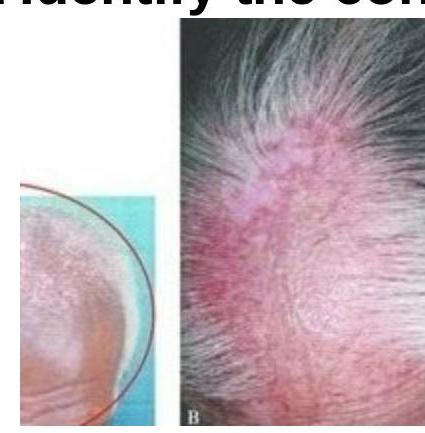
Which of the following is characteristic of Peibaldism?
Which of the following conditions does NOT cause diffuse hyperpigmentation?
Which of the following is the reason for the development of a simple lentigo?
Hypopigmented patches can be seen in which of the following conditions?
Sturge-Weber syndrome is associated with which of the following?
A female developed a brown macule on the cheek, forehead, and nose after exposure to light following delivery of a baby. What is the diagnosis?
Decreased number of melanocytes are seen in:
A 20-year-old patient presents with a non-progressive hypopigmented lesion on the trunk. On Wood's lamp examination, there is white accentuation. Diascopy is negative. What is the most likely diagnosis?
A 45-year-old patient with a history of elevated cholesterol levels presents with nodular swellings over the tendons. The lesion shown in the image is most likely:

A patient presents with violaceous papules over the knuckles and mottled pigmentation on the dorsum of hands. Identify the lesion:

Explanation: **Piebaldism** is a rare autosomal dominant disorder of melanocyte development characterized by congenital stable areas of leukoderma (depigmented patches) and a white forelock. ### **Explanation of Options** * **A. Inheritance pattern is autosomal dominant (Correct):** Piebaldism follows a classic **autosomal dominant** inheritance pattern. It is caused by mutations in the **KIT proto-oncogene** (located on chromosome 4q12), which encodes a tyrosine kinase receptor essential for melanocyte migration and survival during embryogenesis. * **B. Mutations of the KIT ligand:** While the KIT receptor is mutated, mutations in the **KIT ligand (Stem Cell Factor/SCF)** are associated with other conditions but are not the primary cause of Piebaldism. * **C. Is associated with deafness:** This is a classic distractor. **Waardenburg Syndrome** is characterized by pigmentary changes (like a white forelock) *plus* sensorineural deafness and heterochromia iridis. Piebaldism is strictly a cutaneous/hair disorder without systemic involvement. * **D. Is characterized by excess melanocytes:** Piebaldism is characterized by a **complete absence (amelanosis)** of melanocytes in the affected depigmented patches, not an excess. ### **High-Yield Clinical Pearls for NEET-PG** * **White Forelock (Poliosis):** Present in 80-90% of cases; usually triangular or diamond-shaped in the midline of the forehead. * **Distribution:** Depigmented patches typically involve the central forehead, anterior trunk, and mid-extremities, often with a characteristic **rim of hyperpigmentation** or islands of normal pigment within the patches. * **Stability:** Unlike Vitiligo, the patches in Piebaldism are **congenital and static** (they do not change in size or shape throughout life). * **Differential Diagnosis:** Always differentiate from Waardenburg Syndrome (check for hearing loss/dystopia canthorum) and Vitiligo (acquired, progressive).
Explanation: **Explanation:** The correct answer is **Hermansky-Pudlak Syndrome (D)** because it is a form of **oculocutaneous albinism**, which results in **hypopigmentation** (diffuse lightness of skin, hair, and eyes), not hyperpigmentation. It is an autosomal recessive disorder characterized by a triad of tyrosinase-positive albinism, platelet storage pool deficiency (leading to bleeding diathesis), and lysosomal accumulation of ceroid lipofuscin (leading to pulmonary fibrosis and granulomatous colitis). **Why the other options are incorrect:** * **Addison Disease (C):** This is a classic cause of diffuse hyperpigmentation. Low cortisol levels lead to a compensatory increase in ACTH. Since ACTH and Melanocyte-Stimulating Hormone (MSH) share a common precursor (POMC), the excess ACTH stimulates melanocytes, causing generalized bronzing of the skin and mucous membranes. * **Nelson’s Syndrome (B):** This occurs after bilateral adrenalectomy for Cushing's disease. The loss of negative feedback leads to an ACTH-secreting pituitary adenoma, resulting in extremely high ACTH levels and profound diffuse hyperpigmentation. * **Busulfan Administration (A):** Busulfan is a cytotoxic alkylating agent known to cause "busulfan tan," a side effect characterized by diffuse, slate-gray hyperpigmentation in approximately 5-10% of patients. **High-Yield Clinical Pearls for NEET-PG:** * **Drug-induced hyperpigmentation:** Common culprits include Antimalarials (blue-gray), Clofazimine (reddish-brown), Amiodarone (slate-gray), and Minocycline. * **Endocrine causes:** Aside from Addison’s, hyperthyroidism and acromegaly can also cause diffuse hyperpigmentation. * **Hermansky-Pudlak vs. Chédiak-Higashi:** Both involve albinism and bleeding; however, Chédiak-Higashi is distinguished by **giant lysosomal granules** in neutrophils and recurrent infections.
Explanation: **Explanation:** The core pathological feature of **Simple Lentigo** (Lentigo Simplex) is a **linear hyperplasia of melanocytes** at the dermo-epidermal junction. Unlike a freckle, which is a functional change, a lentigo represents a structural change where there is an actual increase in the number of pigment-producing cells. * **Option B (Correct):** In simple lentigo, there is a proliferation of melanocytes along the basal layer. Histologically, this is accompanied by "dirty" elongated rete ridges (club-shaped) and increased melanin in both the melanocytes and basal keratinocytes. * **Option A & C (Incorrect):** While increased melanin and melanosomes are *present* in a lentigo, they are secondary consequences of the increased number of melanocytes. If only melanin or melanosomes were increased without an increase in cell number, the lesion would be classified as an **Ephelis (Freckle)**. **NEET-PG High-Yield Pearls:** 1. **Lentigo vs. Freckle:** * **Lentigo:** Increased number of melanocytes; does **not** darken with sun exposure. * **Freckle (Ephelis):** Normal number of melanocytes but increased melanin production; **does** darken with sun exposure. 2. **Histology:** Look for "club-shaped" elongation of rete ridges and melanocytic hyperplasia without nesting (nesting would indicate a Nevus). 3. **Clinical Associations:** Multiple lentigines are associated with syndromes like **LEOPARD syndrome** (PTPN11 mutation) and **Peutz-Jeghers syndrome** (perioral lentigines). 4. **Lentigo Senilis:** Also known as "liver spots" or solar lentigo; these occur due to chronic UV damage in the elderly.
Explanation: **Explanation:** **Nevus anemicus** is the correct answer because it presents as a congenital, localized **hypopigmented patch**. Unlike other pigmentary disorders, it is not caused by a loss of melanocytes or melanin. Instead, it is a **pharmacological anomaly** where the blood vessels within the patch are hypersensitive to catecholamines, leading to localized vasoconstriction. This reduced blood flow gives the skin a pale/hypopigmented appearance. A key diagnostic feature is that the patch does not redden (erythema) upon rubbing or heat application. **Analysis of Incorrect Options:** * **Becker Nevus:** This is a **hyperpigmented** (dark), hairy hamartomatous patch, typically found on the shoulder or chest of adolescent males. * **Freckles (Ephelides):** These are small, tan-to-brown **hyperpigmented** macules that darken with sun exposure due to increased melanin production (without an increase in melanocyte number). * **Nevus of Ito:** This is a dermal melanocytosis presenting as a bluish-grey **hyperpigmented** patch, typically involving the distribution of the posterior supraclavicular and lateral cutaneous brachial nerves (shoulder/scapular area). **High-Yield Clinical Pearls for NEET-PG:** * **Diascopy Test:** In Nevus anemicus, pressing a glass slide over the border makes the lesion indistinguishable from the surrounding blanched skin. * **Differential Diagnosis:** Must be distinguished from **Nevus depigmentosus** (where melanin is actually decreased) and **Vitiligo** (where melanocytes are absent). * **Association:** Nevus anemicus is frequently associated with **Neurofibromatosis Type 1 (NF-1)** and Phakomatosis pigmentovascularis. * **Wood’s Lamp:** Unlike Vitiligo, Nevus anemicus does not show enhancement under Wood’s lamp because the pigment levels are technically normal.
Explanation: **Explanation:** **Sturge-Weber Syndrome (SWS)**, also known as encephalotrigeminal angiomatosis, is a neurocutaneous disorder characterized by the presence of a **Port-wine stain (PWS)**, also known as Nevus Flammeus. 1. **Why Option A is Correct:** The hallmark of SWS is a congenital capillary malformation (Port-wine stain) typically involving the skin supplied by the **trigeminal nerve** (most commonly the V1 and V2 distributions). Pathophysiologically, it is caused by a somatic mutation in the **GNAQ gene**. This cutaneous lesion is associated with ipsilateral leptomeningeal angiomas and glaucoma. 2. **Why Other Options are Incorrect:** * **B. Cavernous hemangioma:** These are deep vascular malformations (slow-flow) that appear as soft, compressible blue masses. They are not a diagnostic feature of SWS. * **C. Lymphangioma:** These are malformations of the lymphatic system (e.g., cystic hygroma) and are unrelated to the capillary-venous pathology of SWS. * **D. Hemangiosarcoma:** This is a rare, highly malignant neoplasm of the vascular endothelium, whereas SWS involves benign congenital malformations. **High-Yield Clinical Pearls for NEET-PG:** * **The Triad:** 1. Facial Port-wine stain, 2. Leptomeningeal angiomatosis (causing seizures and hemiparesis), 3. Glaucoma. * **Radiology:** Skull X-ray or CT shows characteristic **"Tram-track" calcifications** (gyriform calcifications) due to cortical atrophy and calcification of the underlying angiomas. * **Distribution:** A PWS involving the **upper eyelid** (V1 distribution) carries the highest risk for associated CNS involvement. * **Treatment:** Pulsed Dye Laser (PDL) is the gold standard for treating the Port-wine stain.
Explanation: **Explanation:** The clinical presentation describes **Chloasma** (also known as Melasma), a common acquired hypermelanosis. The diagnosis is based on the classic triad of triggers: **female gender, hormonal changes (post-delivery/pregnancy), and UV light exposure.** **Why Chloasma is correct:** Chloasma typically presents as symmetrical, ill-defined brown macules and patches on sun-exposed areas of the face (malar region, forehead, and bridge of the nose). It is often referred to as the "mask of pregnancy" due to the stimulatory effect of estrogen, progesterone, and melanocyte-stimulating hormone (MSH) on melanocytes. Ultraviolet (UV) radiation further exacerbates the condition by inducing lipid peroxidation and melanogenesis. **Why other options are incorrect:** * **SLE:** While SLE presents with a "malar rash," it is typically an erythematous (red), inflammatory, fixed rash that spares the nasolabial folds. It is not a simple brown pigmentary macule. * **Photodermatitis:** This is an inflammatory skin reaction (eczematous or polymorphic) to sunlight. It usually presents with itching, redness, or vesicles rather than stable brown pigmentation. * **Acne Rosacea:** This presents with flushing, persistent erythema, telangiectasia, and papulopustules. It lacks the primary hyperpigmentation characteristic of Chloasma. **NEET-PG High-Yield Pearls:** * **Patterns:** Malar (most common), Centrofacial, and Mandibular. * **Wood’s Lamp Examination:** Used to determine the depth of pigment. **Epidermal** type enhances under Wood's lamp (better prognosis), while **Dermal** type does not. * **Treatment:** The gold standard is **Kligman’s Formula** (Triple Combination Therapy): Hydroquinone (depigmentation), Tretinoin (exfoliation), and a mild Corticosteroid (anti-inflammatory). * **Prevention:** Strict photoprotection (broad-spectrum sunscreen) is the most critical step in management.
Explanation: ### Explanation The core concept in pigmentary disorders is distinguishing between a **functional defect** (normal number of melanocytes, but they don't work) and a **structural defect** (absence or reduction of the melanocytes themselves). **Why "All of the above" is correct:** While the pathophysiology differs for each, all three conditions involve a quantitative decrease or total absence of melanocytes in the affected skin: * **Vitiligo:** This is an acquired autoimmune destruction of melanocytes. Histopathology shows a **complete absence** of melanocytes in stable lesions. * **Piebaldism:** This is an autosomal dominant condition caused by a mutation in the **c-kit proto-oncogene**. This mutation impairs the migration and survival of melanoblasts from the neural crest to the skin during embryogenesis, resulting in **absence** of melanocytes in the white patches (typically a frontal poliosis/white forelock). * **Albinism (Oculocutaneous Albinism):** Traditionally, Albinism was taught as a defect in melanin synthesis (tyrosinase deficiency) with a normal melanocyte count. However, modern dermatopathology and advanced studies have shown that in many subtypes, there is a **secondary decrease in the number of melanocytes** over time, or they are significantly reduced in specific histological sections. In the context of NEET-PG, these three are often grouped together as "hypomelanotic states with decreased melanocytes." **Clinical Pearls for NEET-PG:** * **Vitiligo:** Associated with other autoimmune disorders (Hashimoto’s, Type 1 DM). * **Piebaldism:** Key feature is a **stable** depigmented patch present since birth, usually on the forehead. * **Albinism:** Increased risk of Squamous Cell Carcinoma (SCC) due to lack of photoprotective melanin. * **Contrast:** In **Post-inflammatory Hypopigmentation** or **Pityriasis Alba**, melanocytes are usually present but have decreased melanin production.
Explanation: ***Nevus depigmentosus*** - This disorder is a congenital, non-progressive **hypopigmentation** (reduced melanin), which remains constant in size and shape, fitting the clinical scenario. - The lesion shows accentuation (brighter white) under **Wood's lamp**, confirming reduced melanin, and **diascopy is negative** as it is a pigmentary, not vascular, change. *Vitiligo* - Vitiligo is characterized by complete **depigmentation** (leukoderma) due to melanocyte destruction, leading to a stark, **chalk-white** appearance under Wood's lamp. - It is typically a **progressive** symmetrical condition, unlike the static, non-progressive lesion described. *Nevus anemicus* - This is a vascular lesion caused by local exquisite sensitivity to catecholamines, causing **localized vasoconstriction**; hence it is not a true pigment disorder. - The defining feature is a **positive diascopy** (the patch disappears when blanched), which contradicts the negative diascopy in the patient. *Indeterminate leprosy* - Leprosy lesions are hypopigmented patches, but the essential diagnostic criterion is **impaired sensation** (anesthesia or hypoaesthesia), a feature absent from the description. - These patches usually do not show the distinct **white accentuation** seen under Wood's lamp typical of true pigmentary nevi.
Explanation: ***Tendon xanthoma*** - The image displays a **firm, subcutaneous nodule** occurring over a tendon, specifically the Achilles tendon or extensor tendons, which is characteristic of tendon xanthomas. - These are typically associated with **hypercholesterolemia**, particularly familial hypercholesterolemia, and are composed of lipid-laden macrophages (foam cells). *Xanthelasma* - Xanthelasma are **yellowish plaques** that typically appear on or around the eyelids, not on tendons. - While also composed of lipid deposits, their location and flatter morphology differentiate them from the lesion shown. *Tuberous xanthoma* - Tuberous xanthomas are **firm, painless nodules** that often occur over pressure points such as knees, elbows, and buttocks, but they are typically located in the dermis or subcutaneous tissue, not specifically within tendons. - They are often larger and more diverse in shape than the well-defined, tendon-associated lesion seen in the image. *Eruptive xanthoma* - Eruptive xanthomas are **small, yellowish-orange papules** with an erythematous base that appear suddenly in crops, primarily on the extensor surfaces of limbs and buttocks. - They are typically associated with very high triglyceride levels and have a distinct, more widespread, and smaller appearance compared to the single, large tendon-associated nodule.
Explanation: ***Dermatomyositis*** - The image exhibits **Gottron's papules**, which are violaceous, erythematous papules over the **dorsal aspects of the interphalangeal joints** (knuckles), a **pathognomonic cutaneous finding** in dermatomyositis - Additionally, the **spotted hyperpigmentation and hypopigmentation** (poikiloderma) on the dorsum of the hands is another common skin manifestation of dermatomyositis, especially in sun-exposed areas - Dermatomyositis is an **idiopathic inflammatory myopathy** with characteristic cutaneous and muscular involvement *Vitiligo* - Vitiligo presents as **well-demarcated depigmented macules or patches** due to destruction of melanocytes, resulting in a stark **white/chalky appearance** - The lesions in the image are **papular and violaceous** with combination of hyper- and hypopigmentation, not uniform complete depigmentation - Lacks the characteristic milky-white patches of vitiligo *Dermatitis herpetiformis* - Characterized by **intensely pruritic, grouped vesicles** on erythematous base, mainly on extensor surfaces (elbows, knees, buttocks) - Associated with **celiac disease** (gluten sensitivity) - The lesions in the image lack the typical **vesicular/blistering** appearance and are located specifically over the knuckles, not the classic distribution *Erythema marginatum* - Presents as **migratory, transient, non-pruritic, erythematous macules** with clear centers forming annular/serpiginous patterns - Classic cutaneous manifestation of **acute rheumatic fever** (Jones criteria) - The lesions in the image are **papular, fixed, and violaceous**, not flat erythematous rings
Melanocyte Biology
Practice Questions
Vitiligo
Practice Questions
Melasma
Practice Questions
Post-inflammatory Hyperpigmentation
Practice Questions
Post-inflammatory Hypopigmentation
Practice Questions
Albinism
Practice Questions
Drug-Induced Pigmentary Changes
Practice Questions
Pityriasis Alba
Practice Questions
Pigmentary Demarcation Lines
Practice Questions
Nevi of Ota and Ito
Practice Questions
Management of Hyperpigmentation
Practice Questions
Management of Hypopigmentation
Practice Questions
Get full access to all questions, explanations, and performance tracking.
Start For Free