A 23-year-old college student has asymptomatic and hyperpigmented macules on both palms for three weeks. What is the most appropriate diagnostic test?
Diffuse hyperpigmentation is seen in all except?
A 30-year-old female presents with light brown lesions involving both her cheeks. The lesions have never been erythematous. Which of the following is the most probable diagnosis?
Acanthosis nigricans is commonly associated with which of the following conditions?
Which of the following is not a ceruloderma?
Decrease in the number of melanocytes is seen in which of the following conditions?
Albinism is associated with which of the following?
Café–au–lait spots are not seen in which of the following conditions?
Characteristic skin lesion in Peutz-Jeghers syndrome is?
A 25-year-old man presents with pigmented macules on his palms, soles, and oral mucosa. He also has anemia and abdominal pain. What is the most likely diagnosis?
Explanation: ### Explanation The clinical presentation of asymptomatic, hyperpigmented macules on the palms (and often soles) in a young adult is a classic hallmark of **Secondary Syphilis**. **1. Why VDRL is the correct answer:** Secondary syphilis is known as the "Great Imitator," but its predilection for the palms and soles is a highly specific diagnostic clue. The lesions typically appear as copper-colored, non-pruritic maculopapular eruptions. Since syphilis is a systemic infection caused by *Treponema pallidum*, the initial screening test of choice is a non-treponemal test like the **VDRL** or **RPR (Rapid Plasma Reagin)**. A positive result would then be confirmed with treponemal-specific tests (e.g., TPHA or FTA-ABS). **2. Why other options are incorrect:** * **Skin Biopsy:** While it might show plasma cell infiltration, it is not the first-line diagnostic test for suspected syphilis when serology is readily available and non-invasive. * **Serum Cortisol:** Low cortisol (Addison’s disease) causes generalized hyperpigmentation, particularly in creases and pressure points, but does not typically present as isolated macules on the palms. * **Arsenic Assay:** Chronic arsenic poisoning causes "raindrop" pigmentation on the trunk and "punctate keratosis" (hard thickening) on the palms/soles, rather than simple asymptomatic macules. **3. Clinical Pearls for NEET-PG:** * **The "Money" Sign:** Palmar and plantar lesions in a young, sexually active patient should always trigger a suspicion of Secondary Syphilis. * **Other features of Secondary Syphilis:** Generalized lymphadenopathy (epitrochlear nodes), Condyloma lata (moist perineal warts), and "moth-eaten" alopecia. * **Differential Diagnosis:** For palmar macules, consider Erythema Multiforme (target lesions) and Hand-Foot-Mouth Disease (vesicles). * **Treatment:** The gold standard remains **Benzathine Penicillin G** (2.4 million units IM, single dose).
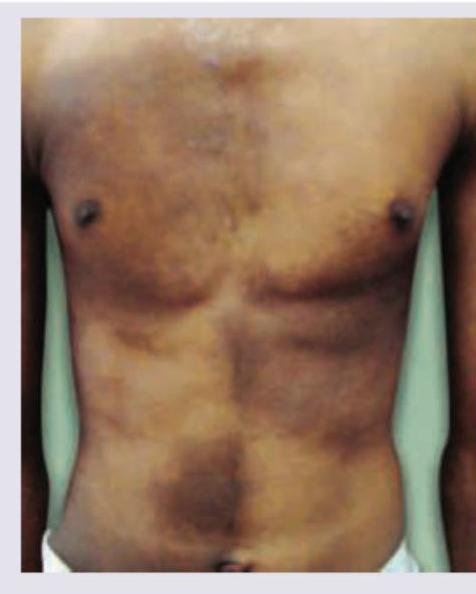
Explanation: **Explanation:** The correct answer is **Phenylketonuria (PKU)** because it is characterized by **hypopigmentation**, not hyperpigmentation. **1. Why Phenylketonuria (PKU) is the correct answer:** PKU is an autosomal recessive disorder caused by a deficiency of the enzyme **phenylalanine hydroxylase**. This leads to an accumulation of phenylalanine and a deficiency of **tyrosine**. Since tyrosine is the essential precursor for melanin synthesis (via the enzyme tyrosinase), patients with PKU exhibit generalized hypopigmentation of the skin, blonde hair, and blue eyes. **2. Analysis of Incorrect Options (Causes of Diffuse Hyperpigmentation):** * **Addison’s Disease:** Low cortisol leads to a compensatory increase in **ACTH** (Adrenocorticotropic hormone). ACTH shares a common precursor with **MSH** (Melanocyte-stimulating hormone); hence, high levels stimulate melanocytes, causing diffuse hyperpigmentation, especially in palmar creases and buccal mucosa. * **Cushing’s Syndrome:** Specifically in **ACTH-dependent** Cushing’s (like Cushing’s disease or ectopic ACTH secretion), the excess ACTH leads to hyperpigmentation via the same mechanism as Addison’s. * **Porphyria Cutanea Tarda (PCT):** This condition causes skin fragility and blistering in sun-exposed areas. Chronic sun exposure in PCT patients, combined with iron overload, often results in diffuse hyperpigmentation and hypertrichosis (excess hair growth). **Clinical Pearls for NEET-PG:** * **Mnemonic for PKU:** **P**ale skin, **P**henylalanine hydroxylase deficiency, **P**sychotic/Intellectual disability, **P**eculiar "mousy" odor. * **Other causes of diffuse hyperpigmentation:** Vitamin B12 deficiency, Hemochromatosis ("Bronze diabetes"), and drugs like Busulfan or Clofazimine. * **Key distinction:** In Addison’s, hyperpigmentation is a hallmark; in Cushing’s, it only occurs if ACTH is elevated (not in adrenal tumors).
Explanation: ### Explanation **Correct Option: B. Chloasma (Melasma)** Chloasma, commonly known as melasma, is an acquired hypermelanosis characterized by symmetric, light-to-dark brown macules and patches on sun-exposed areas, most frequently the cheeks, forehead, and upper lip. * **Key Clinical Feature:** The hallmark of chloasma is that it is a **non-inflammatory** pigmentary disorder. The question specifies that the lesions have "never been erythematous," which points directly toward a primary pigmentary process rather than a post-inflammatory one. It is most common in women of reproductive age and is often associated with hormonal changes (pregnancy, OCPs) and UV exposure. **Why other options are incorrect:** * **A. Systemic Lupus Erythematosus (SLE):** The classic malar rash of SLE is typically **erythematous** (red), edematous, and may be painful or pruritic. It often spares the nasolabial folds, unlike the diffuse pigmentation of chloasma. * **C. Airborne Contact Dermatitis:** This is an inflammatory condition. It presents with **erythema**, scaling, and itching in the initial stages. Chronic cases may show lichenification, but the absence of a preceding red/itchy phase rules it out. * **D. Photosensitive Reaction:** These reactions (like phototoxic or photoallergic dermatitis) typically present with **erythema**, burning, or vesiculation immediately following sun exposure. **NEET-PG High-Yield Pearls:** * **Wood’s Lamp Examination:** Used to determine the depth of melanin. **Epidermal** type shows enhancement under Wood’s lamp, while **Dermal** type does not. * **Treatment Gold Standard:** Kligman’s Formula (Triple Combination Therapy): Hydroquinone + Tretinoin + Topical Steroid. * **Differential:** Unlike SLE, Chloasma often involves the nasolabial folds and lacks systemic symptoms (fever, joint pain).
Explanation: **Explanation:** Acanthosis Nigricans (AN) is a clinical marker characterized by hyperpigmented, velvety plaques typically found in intertriginous areas like the neck and axilla. The underlying pathophysiology involves the stimulation of **Insulin-like Growth Factor (IGF) receptors** on keratinocytes and fibroblasts, leading to epidermal proliferation. * **Diabetes Mellitus (Option A):** This is the most common association. Hyperinsulinemia (seen in Type 2 DM and Obesity) causes excess insulin to bind to IGF-1 receptors, triggering the characteristic skin changes. * **Gastrointestinal Cancers (Option B):** This represents **Malignant Acanthosis Nigricans**. It is a paraneoplastic syndrome most commonly associated with **Gastric Adenocarcinoma**. It is usually sudden in onset, extensive, and involves the palms (tripe palms) or mucous membranes. * **Hypothyroidism (Option C):** AN is frequently associated with various endocrinopathies, including hypothyroidism, PCOS, and Cushing’s syndrome, due to metabolic disturbances and insulin resistance. Since AN can be a manifestation of metabolic, endocrine, or malignant processes, **Option D** is the correct answer. **High-Yield Clinical Pearls for NEET-PG:** 1. **Tripe Palms:** Rugose thickening of the palms; highly suggestive of internal malignancy (usually lung or gastric). 2. **Sign of Leser-Trélat:** Sudden eruption of multiple seborrheic keratoses; often co-exists with malignant AN. 3. **Drug-induced AN:** Can be caused by systemic corticosteroids, nicotinic acid, and oral contraceptives. 4. **Histopathology:** Shows hyperkeratosis and papillomatosis; surprisingly, "acanthosis" (thickening of the stratum spinosum) is often minimal despite the name.
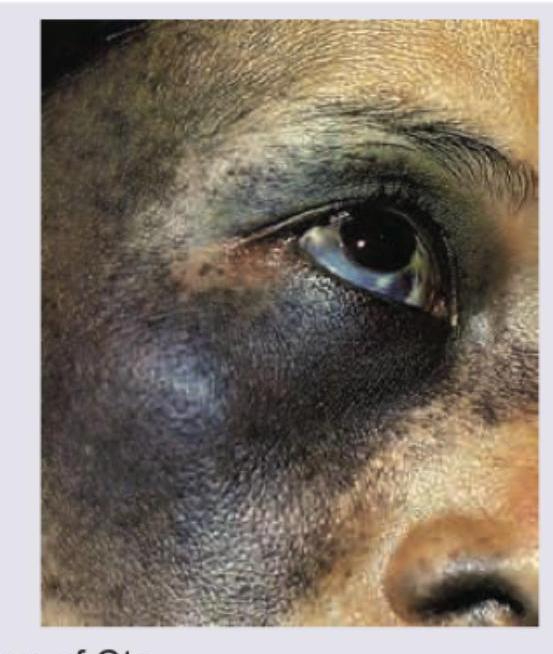
Explanation: **Explanation:** The term **Ceruloderma** (from the Greek *kyaneos* meaning blue) refers to conditions characterized by a **blue-gray skin discoloration**. This occurs due to the **Tyndall effect**, where shorter wavelengths of light (blue) are scattered by melanin pigment located deep within the dermis, while longer wavelengths (red) are absorbed. **Why Cockade Nevus is the correct answer:** A **Cockade nevus** (also known as Nevus en cocarde) is a rare variant of a melanocytic nevus that resembles a target or rosette. It consists of a central pigmented nevus surrounded by a depigmented halo, which is then encircled by a peripheral ring of hyperpigmentation. Unlike cerulodermas, the pigment in a Cockade nevus is located in the **epidermis or dermo-epidermal junction**, resulting in a **brown** appearance rather than blue. **Analysis of incorrect options (Dermal Melanocytoses):** * **Nevus of Ota:** A dermal melanocytosis involving the distribution of the first and second divisions of the **trigeminal nerve**. It typically presents as a blue-gray patch on the face and often involves the sclera. * **Nevus of Ito:** Similar to Nevus of Ota but involves the distribution of the **posterior supraclavicular and lateral cutaneous brachial nerves** (shoulder, side of neck, and scapular area). * **Mongolian spot:** A congenital blue-gray patch usually found in the **lumbosacral region**. It is caused by the failure of melanocytes to migrate from the neural crest to the epidermis, leaving them trapped in the dermis. **High-Yield Pearls for NEET-PG:** * **Tyndall Effect:** Deep melanin = Blue; Superficial melanin = Brown. * **Nevus of Ota:** Most common in Asians; 10% risk of glaucoma; requires periodic intraocular pressure monitoring. * **Blue Nevus:** Another classic example of ceruloderma (dermal melanocytes). * **Mongolian Spots:** Most commonly resolve spontaneously by age 3–5 years.
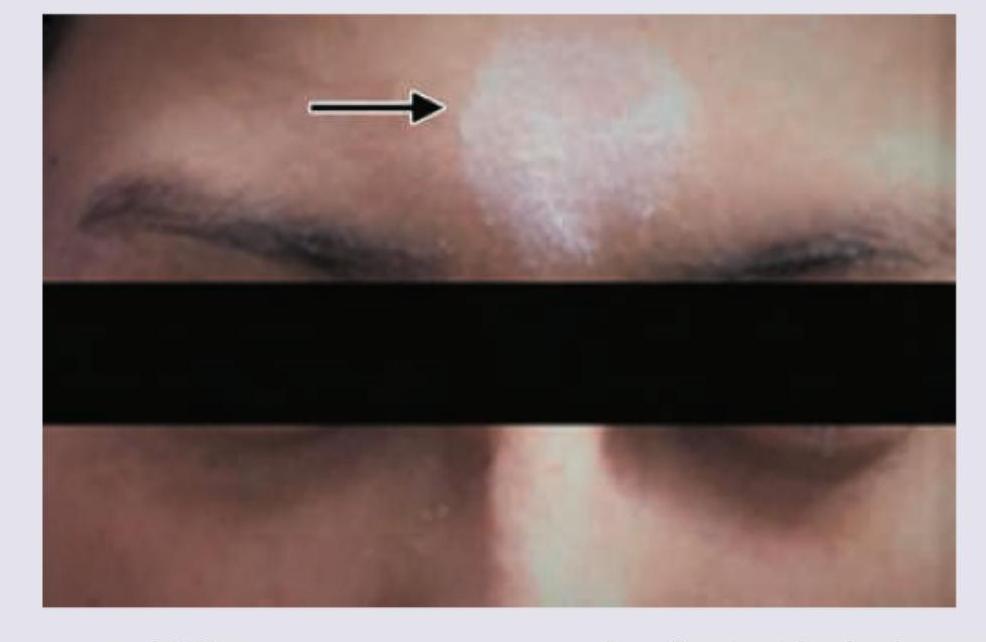
Explanation: **Explanation:** The core concept in pigmentary disorders is distinguishing between a **functional defect** (normal melanocyte count, abnormal melanin production) and a **structural defect** (absence or decrease in the number of melanocytes). **Why Piebaldism is correct:** Piebaldism is an autosomal dominant condition caused by a mutation in the **c-kit proto-oncogene**, which is essential for the migration and survival of melanoblasts. Due to defective migration from the neural crest to the skin during embryogenesis, there is a localized **absence or decrease in the number of melanocytes** in the affected patches. Clinically, it presents as a stable, congenital white forelock and symmetrical depigmented patches on the forehead, trunk, and extremities. **Analysis of Incorrect Options:** * **Albinism:** This is a disorder of melanin synthesis (usually due to a **tyrosinase enzyme deficiency**). The number of melanocytes is **normal**, but they cannot produce melanin. * **Ichthyosis:** This is a disorder of keratinization characterized by dry, scaly skin. It does not primarily involve a change in melanocyte count. * **Chemical Leucoderma:** This occurs due to exposure to phenolic compounds (like adhesives or rubber). While it can lead to melanocyte destruction, it is an acquired condition. In the context of "decrease in number" as a primary pathological hallmark in exams, Piebaldism (congenital absence) is the more classic example. **High-Yield Clinical Pearls for NEET-PG:** * **Vitiligo vs. Piebaldism:** Both show an absence of melanocytes, but Vitiligo is *acquired and progressive*, whereas Piebaldism is *congenital and static*. * **Waardenburg Syndrome:** If Piebaldism is associated with sensorineural deafness and dystopia canthorum, suspect this syndrome. * **Histopathology:** In Albinism, DOPA reaction is negative, but melanocytes are present on silver stains. In Piebaldism/Vitiligo, both are absent.
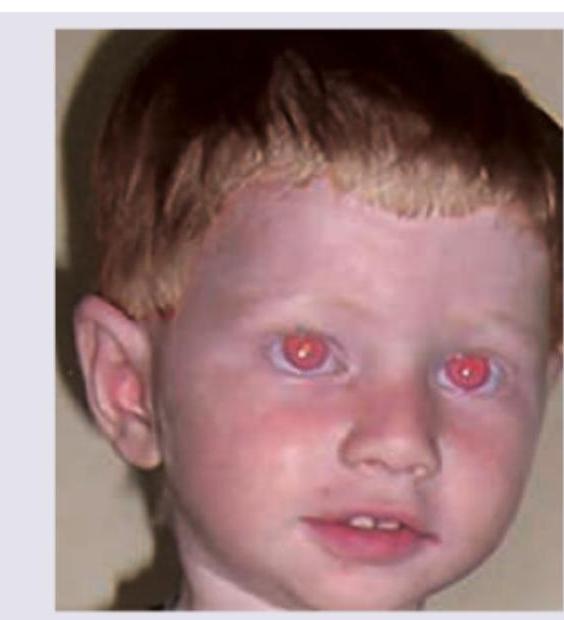
Explanation: **Explanation:** **Albinism** is a group of inherited disorders characterized by a reduction or absence of melanin. The correct answer relates to **Hermansky-Pudlak Syndrome (HPS)**, a specific subtype of oculocutaneous albinism. 1. **Why Option B is Correct:** HPS is characterized by albinism, a bleeding diathesis due to **platelet storage pool deficiency** (lack of dense bodies), and systemic involvement (like pulmonary fibrosis). These patients have prolonged bleeding times despite normal platelet counts. **Aspirin** and other NSAIDs exacerbate this bleeding risk by further inhibiting platelet aggregation, making it a critical clinical consideration. 2. **Analysis of Incorrect Options:** * **Option A:** The hair bulb tyrosinase test can be performed as soon as hair is present. It is used to differentiate between Tyrosinase-positive and Tyrosinase-negative albinism; there is no requirement to wait until age 5. * **Option C:** While albinism involves **misrouting of optic fibers** (increased decussation/crossing at the optic chiasm), it is **not "complete" decussation**. The characteristic finding is a reduction in the proportion of uncrossed fibers, leading to strabismus and loss of stereopsis. * **Option D:** Albinism is associated with a risk of **bleeding**, not thrombosis, under general anesthesia or surgery due to the aforementioned platelet defects in HPS. **High-Yield Clinical Pearls for NEET-PG:** * **Chediak-Higashi Syndrome:** Albinism + Giant lysosomal granules in neutrophils + Recurrent infections. * **Hermansky-Pudlak Syndrome:** Albinism + Platelet defect + Ceroid lipofuscinosis (storage disease). * **Visual Hallmarks:** Nystagmus, photophobia, and iris transillumination are common to all forms of oculocutaneous albinism. * **Inheritance:** Most forms of Oculocutaneous Albinism (OCA) are **Autosomal Recessive**.
Explanation: **Explanation:** Café–au–lait macules (CALMs) are flat, hyperpigmented birthmarks caused by an increased concentration of melanin and melanocytes in the epidermis. While they can occur sporadically in healthy individuals, multiple CALMs are hallmark features of several neurocutaneous and genetic syndromes. **Why Hyperparathyroidism is the Correct Answer:** Hyperparathyroidism is an endocrine disorder characterized by excess parathyroid hormone, leading to hypercalcemia and bone resorption. It does **not** have a primary cutaneous manifestation involving pigmentary macules like CALMs. It is often confused with **McCune-Albright Syndrome**, which features polyostotic fibrous dysplasia (mimicking bone lesions) and endocrine abnormalities, but the two are distinct entities. **Analysis of Incorrect Options:** * **Neurofibromatosis Type 1 (NF1):** The most common association. Diagnostic criteria require $\geq 6$ CALMs ( $>5$ mm in prepubertal and $>15$ mm in postpubertal individuals). * **McCune-Albright Syndrome:** Characterized by the triad of polyostotic fibrous dysplasia, precocious puberty, and large, unilateral CALMs with irregular "Coast of Maine" borders. * **Bloom Syndrome:** An autosomal recessive chromosomal instability disorder. Along with growth retardation and telangiectatic erythema, CALMs are a recognized clinical feature. **High-Yield Clinical Pearls for NEET-PG:** * **Coast of California:** Smooth borders of CALMs seen in **Neurofibromatosis**. * **Coast of Maine:** Jagged, irregular borders of CALMs seen in **McCune-Albright Syndrome**. * **Crowe Sign:** Axillary or inguinal freckling, a pathognomonic sign for NF1. * **Other Associations:** CALMs are also seen in Fanconi Anemia, Tuberous Sclerosis (rarely), Noonan Syndrome, and Ataxia-Telangiectasia.
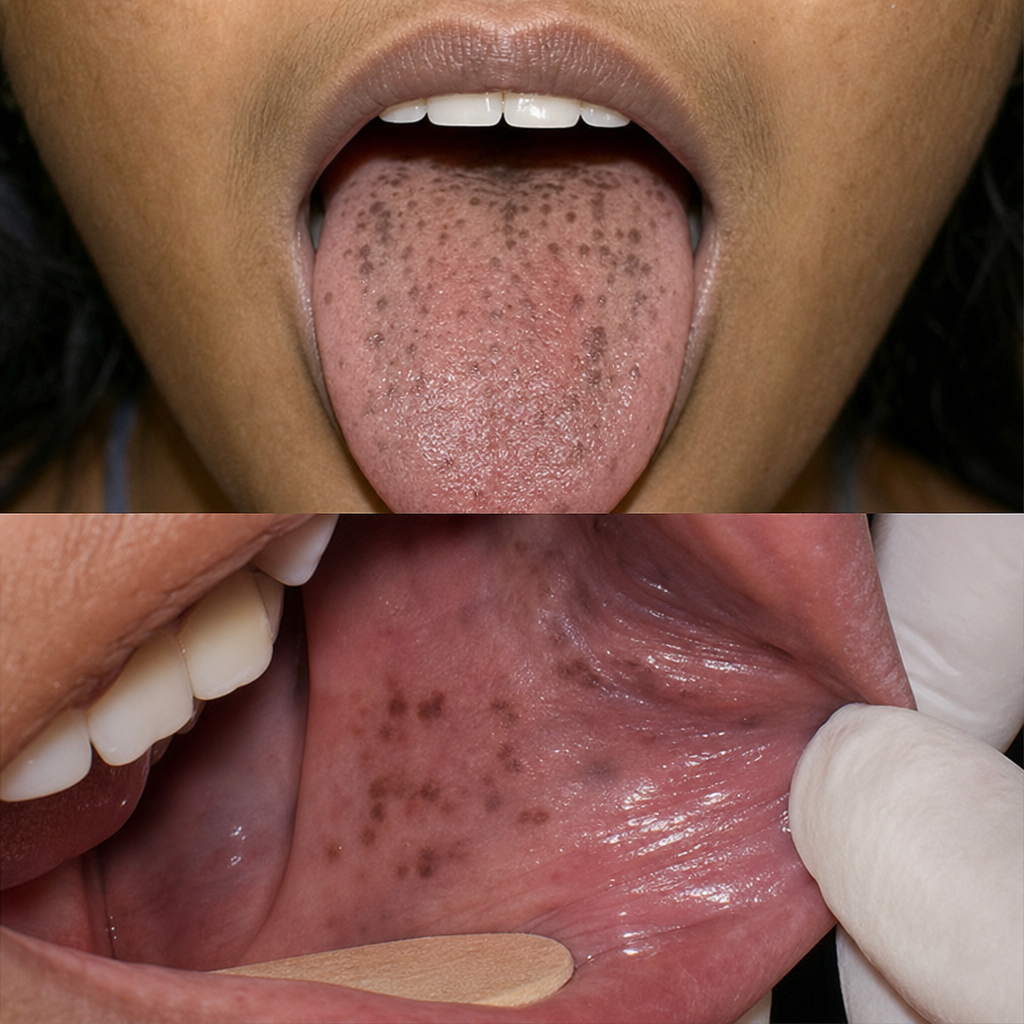
Explanation: **Explanation:** **Peutz-Jeghers Syndrome (PJS)** is an autosomal dominant disorder characterized by the mutation of the **STK11 (LKB1)** gene. The hallmark clinical features are gastrointestinal hamartomatous polyposis and mucocutaneous pigmentation. **Why Lentigines is the correct answer:** The characteristic lesions in PJS are **melanocytic lentigines**. Unlike common freckles, these are small (1–5 mm), dark brown to blue-black macules that typically appear in early childhood. They are most characteristically found on the **lips (especially the lower lip)**, buccal mucosa, perioral area, and digits. Crucially, mucosal lentigines in PJS do not fade with sun exposure, which distinguishes them from freckles. **Analysis of Incorrect Options:** * **A. Freckles (Ephelides):** These darken with sun exposure and fade in winter. They rarely involve the mucosa, whereas PJS lesions characteristically involve the buccal mucosa. * **C. Cafe au lait spots:** These are larger, "coffee-with-milk" colored macules associated primarily with **Neurofibromatosis Type 1 (NF-1)** and McCune-Albright syndrome. * **D. Adenoma sebaceum:** This is a misnomer for **angiofibromas**, which are firm, skin-colored or reddish papules found in a malar distribution in **Tuberous Sclerosis**. **High-Yield Clinical Pearls for NEET-PG:** * **Inheritance:** Autosomal Dominant; Gene: **STK11** on Chromosome 19p. * **Polyps:** Hamartomatous, most common in the **small intestine** (jejunum). * **Complications:** Intussusception (most common surgical complication) and a significantly increased risk of GI and extra-GI malignancies (e.g., breast, pancreas, ovary). * **Dermatology Tip:** While skin lentigines may fade after puberty, **buccal mucosal pigmentation** usually persists into adulthood, serving as a permanent clinical marker.
Explanation: ### Explanation **Correct Answer: C. Peutz-Jeghers Syndrome (PJS)** **Concept:** Peutz-Jeghers Syndrome is an autosomal dominant disorder characterized by the mutation of the **STK11 (LKB1)** gene. The clinical hallmark is the triad of **mucocutaneous lentigines**, **gastrointestinal hamartomatous polyps**, and an increased risk of visceral malignancies. * **Dermatological findings:** Small, dark brown to black macules (lentigines) typically appear in infancy or childhood. They are most characteristic on the **lips and buccal mucosa** (where they do not fade with age) and can also involve the palms and soles. * **Systemic findings:** The patient’s anemia and abdominal pain are due to the GI polyps, which can cause chronic occult bleeding (leading to iron deficiency anemia) or act as lead points for **intussusception**. --- ### Why the other options are incorrect: * **A. Cushing’s Syndrome:** Presents with systemic hypercortisolism features like moon facies, buffalo hump, and purple striae. While hyperpigmentation can occur in ACTH-dependent Cushing’s (Addisonian-like), it does not typically present with localized palm/sole/mucosal lentigines or GI symptoms. * **B. Albright’s Syndrome (McCune-Albright):** Characterized by the triad of **polyostotic fibrous dysplasia**, **precocious puberty**, and large, irregular **Café-au-lait macules** (often described as "Coast of Maine" borders). It does not involve mucosal lentigines or GI polyposis. * **D. Incontinentia Pigmenti:** An X-linked dominant condition that follows the Lines of Blaschko. It progresses through four stages (vesicular, verrucous, hyperpigmented, and atrophic). The pigmentation is "splashed-paint" or whorled in appearance, not discrete mucosal macules. --- ### High-Yield Clinical Pearls for NEET-PG: * **PJS Polyps:** These are **hamartomatous**, not adenomatous, but they carry a high risk of malignant transformation (especially colorectal, pancreatic, and breast cancer). * **Differential Diagnosis:** **Laugier-Hunziker Syndrome** also presents with mucosal and acral pigmentation but lacks the systemic GI polyposis. * **Most common site for PJS macules:** The buccal mucosa (90% of cases).
Melanocyte Biology
Practice Questions
Vitiligo
Practice Questions
Melasma
Practice Questions
Post-inflammatory Hyperpigmentation
Practice Questions
Post-inflammatory Hypopigmentation
Practice Questions
Albinism
Practice Questions
Drug-Induced Pigmentary Changes
Practice Questions
Pityriasis Alba
Practice Questions
Pigmentary Demarcation Lines
Practice Questions
Nevi of Ota and Ito
Practice Questions
Management of Hyperpigmentation
Practice Questions
Management of Hypopigmentation
Practice Questions
Get full access to all questions, explanations, and performance tracking.
Start For Free