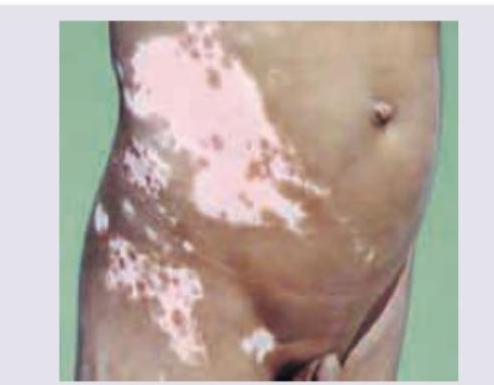
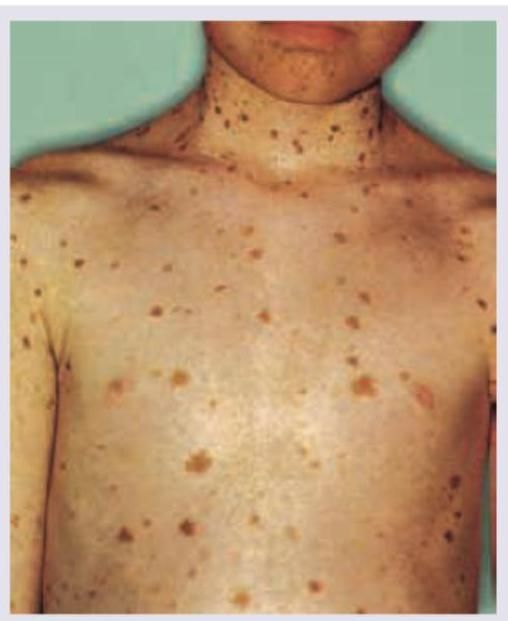
A 5-year-old boy presents with recurrent, multiple, asymptomatic, oval and circular, faintly hypopigmented macules with fine scaling on his face. What is the most probable clinical diagnosis?
Regarding bulbar xanthelasma, all of the following are true, EXCEPT:
A female presents with a hypopigmented lesion on the center of her forehead. What drug is responsible?
Laugier-Hunziker syndrome is associated with which of the following?
A lady presented with complaints of a bluish lesion over the left side of her forehead and left eye, showing an irregular bluish lesion in the left superior conjunctiva and forehead. What is the diagnosis?
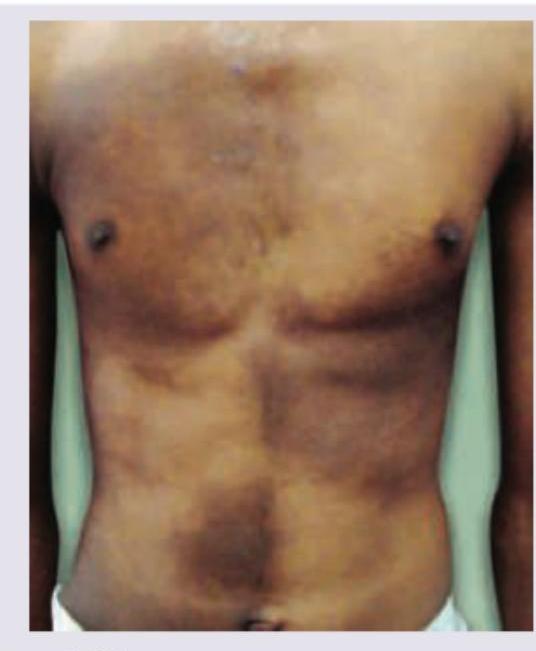
What is the diagnosis for a large, dark patch on the back?
A patient presenting with brownish pigmentation and normal laboratory findings may be suffering from which condition?
Which of the following conditions is NOT typically associated with hyperpigmentation?
Cafe-au-lait spots on the skin are characteristic of which of the following conditions?
A 36-year-old female patient presents with complaints of dark spots on her face over the past few years. She first noticed these lesions after her first childbirth five years ago, and they worsened during her second pregnancy two years ago. She has no other medical problems and is only taking oral contraceptive pills. Her vital signs are within normal limits. Examination reveals multiple, discrete, confluent, well-demarcated patches of brown hyperpigmentation on her forehead, cheeks, and chin. Complete blood count and thyroid profile tests are normal. What is the most appropriate advice regarding her condition?
Explanation: ### Explanation **Pityriasis alba** is the most probable diagnosis based on the classic clinical triad: **faintly hypopigmented macules**, **fine scaling**, and occurrence in a **child** (usually 3–16 years old). It is considered a minor feature of atopic dermatitis. The lesions are typically asymptomatic and most commonly involve the face (cheeks). The scaling is more prominent in winter, while the hypopigmentation becomes more noticeable in summer due to tanning of the surrounding skin. **Why other options are incorrect:** * **Pityriasis versicolor:** Caused by *Malassezia furfur*, it typically affects the trunk (seborrheic areas) in young adults. While it presents with fine scales (Cheadle’s/V-sign), facial involvement is rare in children unless they are immunocompromised. * **Indeterminate leprosy:** Presents as a single or few hypopigmented macules with **loss of sensation** or hair. It lacks the fine "powdery" scaling characteristic of Pityriasis alba. * **Acrofacial vitiligo:** Characterized by **depigmented** (chalky white) macules rather than hypopigmented ones. Vitiligo has well-defined borders, no scaling, and typically involves periorificial areas (mouth, eyes) and fingertips. **High-Yield Clinical Pearls for NEET-PG:** * **Etiology:** Often associated with **Atopy** and xerosis. * **Histopathology:** Shows hyperkeratosis, parakeratosis, and decreased melanin in the basal layer. * **Treatment:** Reassurance, emollients, and sun protection. Low-potency topical steroids or calcineurin inhibitors (Tacrolimus) may be used for inflammation. * **Differentiating Scale:** Pityriasis alba has fine, adherent scales; Pityriasis versicolor has "branny" (furfuraceous) scales visible on scraping.
Explanation: **Explanation:** **Xanthelasma palpebrarum** is the most common clinical variant of xanthoma, characterized by localized lipid deposits in the eyelids. 1. **Why Option A is the Correct Answer (The Exception):** Xanthelasma typically presents as soft, velvety, yellow-orange plaques that classically begin at the **medial (inner) canthus** of the eye, most commonly on the upper eyelid. They tend to spread symmetrically. The statement that they occur on the **lateral side** is clinically incorrect, making it the "except" choice. 2. **Analysis of Other Options:** * **Option B (Middle-aged women):** This is a true clinical demographic. While it can occur at any age, the peak incidence is in the 4th and 5th decades, with a slight female preponderance. * **Option C (Creamy yellow in color):** This is the hallmark appearance. The color is due to the accumulation of "foam cells" (lipid-laden macrophages) in the upper dermis. * **Option D (Associated with diabetes):** This is true. While 50% of patients are normolipemic, xanthelasma is frequently associated with secondary hyperlipidemias seen in **Diabetes Mellitus**, biliary cirrhosis, and hypothyroidism, as well as primary dyslipidemias (Type II and IV). **High-Yield Clinical Pearls for NEET-PG:** * **Histopathology:** Look for **Foam cells** (Touton giant cells are more characteristic of Juvenile Xanthogranuloma but can be seen in other xanthomas). * **Systemic Link:** In young patients, xanthelasma is a strong predictor of underlying hyperlipidemia and increased risk of **atherosclerotic cardiovascular disease**. * **Treatment:** Primarily cosmetic; options include surgical excision, TCA cauterization, or CO2 laser ablation. However, recurrence is common (up to 40%).
Explanation: ### Explanation The clinical presentation describes **Chemical Leucoderma** (contact depigmentation). The forehead is a classic site for this condition due to the use of **bindis** or adhesive tapes. **Why Para-tertiary butylphenol (PTBP) is correct:** PTBP is a phenolic compound commonly used as an adhesive in bindis, watch straps, and footwear. It is structurally similar to **tyrosine**, the precursor of melanin. PTBP acts as a melanocytotoxic agent by competing with tyrosine for the enzyme tyrosinase, leading to the selective destruction of melanocytes and subsequent depigmentation. In India, "Bindi-mark depigmentation" on the forehead is the most common presentation of PTBP-induced leucoderma. **Analysis of Incorrect Options:** * **Hydroquinone (A):** Used therapeutically to treat hyperpigmentation (melasma). While it inhibits tyrosinase, it rarely causes permanent depigmentation unless used in very high concentrations (causing "confetti-like" depigmentation). * **Ether metabolite of hydroquinone (B):** Specifically, Monobenzyl ether of hydroquinone (MBEH) is a potent depigmenting agent, but it is typically used to permanently depigment remaining skin in universal vitiligo, not found in bindi adhesives. * **Para-tertiary butyl catechol (C):** This is a related phenolic compound found in hair dyes and rubber chemicals, but PTBP is the specific culprit associated with bindi adhesives and forehead lesions. **High-Yield Clinical Pearls for NEET-PG:** * **Common Culprits:** PTBP (bindis/adhesives), Monobenzyl ether of hydroquinone (rubber gloves/condoms), and PPD (hair dyes). * **Distinguishing Feature:** Unlike Vitiligo, chemical leucoderma usually lacks the "Koebner phenomenon" and is localized to the site of contact. * **Occupational Link:** Often seen in workers in the rubber, plastic, and leather industries.
Explanation: **Laugier-Hunziker Syndrome (LHS)** is a rare, acquired pigmentary disorder characterized by benign **hyperpigmented macules** on the oral mucosa (lips, buccal mucosa, tongue) and frequently involves longitudinal melanonychia (pigmented streaks on nails). ### Why Option A is Correct: The hallmark of LHS is **mucocutaneous lentiginous pigmentation**. It typically presents in middle-aged adults as flat, brown-to-black spots. The medical significance of recognizing LHS lies in its **benign nature**; unlike Peutz-Jeghers Syndrome, LHS is **not** associated with systemic findings like intestinal polyposis or increased malignancy risk. ### Why Other Options are Incorrect: * **B. Multiple impacted supernumerary teeth:** This is a classic feature of **Gardner Syndrome** (along with osteomas and intestinal polyps). * **C. Ankyloglossia (Tongue-tie):** This is a congenital midline anomaly where a short lingual frenulum restricts tongue movement; it has no association with pigmentary disorders. * **D. Hemifacial atrophy:** Also known as **Parry-Romberg Syndrome**, this involves progressive wasting of soft tissues on one side of the face, often associated with "en coup de sabre" scleroderma. ### High-Yield Clinical Pearls for NEET-PG: * **Differential Diagnosis:** Always differentiate LHS from **Peutz-Jeghers Syndrome** (PJS). PJS presents in childhood with perioral pigmentation AND hamartomatous intestinal polyps (risk of intussusception). * **Nail Involvement:** Longitudinal melanonychia is present in about 50% of LHS cases. * **Management:** No treatment is required except for cosmetic concerns (lasers). It is a diagnosis of exclusion. * **Key Mnemonic:** LHS = **L**ips, **H**ands (palms), and **S**oles pigmentation (without polyps).
Explanation: **Explanation:** The clinical presentation of a unilateral, bluish-grey hyperpigmented macule involving the forehead and the conjunctiva is classic for **Nevus of Ota** (Oculodermal Melanocytosis). **1. Why Nevus of Ota is correct:** Nevus of Ota is a dermal melanocytosis caused by the failure of melanocytes to migrate from the neural crest to the epidermis, leaving them trapped in the dermis. It typically follows the distribution of the **ophthalmic (V1) and maxillary (V2) branches of the trigeminal nerve**. Involvement of the ocular structures (sclera, conjunctiva, or uvea) is a hallmark feature that distinguishes it from other dermal melanocytoses. **2. Why other options are incorrect:** * **Nevus of Ito:** Similar to Nevus of Ota histologically, but it involves the **acromioclavicular region** (shoulder, side of the neck, or scapular area) rather than the face. * **Becker’s Nevus:** This is a hamartoma characterized by a brown, hairy (hypertrichotic) patch, usually on the shoulder or chest of adolescent males. It is not bluish and does not involve the eye. * **Mongolian Spot:** These are congenital bluish-grey patches typically found in the **lumbosacral region**. They usually disappear by early childhood, unlike Nevus of Ota, which is permanent and may darken over time. **High-Yield Clinical Pearls for NEET-PG:** * **Gender Predilection:** More common in females and Asians. * **Bilateralism:** Usually unilateral; bilateral cases are rare (5-10%). * **Complication:** The most serious associated risk is **Glaucoma** (increased intraocular pressure) and, rarely, **Malignant Melanoma** (uveal or leptomeningeal). * **Treatment of Choice:** **Q-switched Nd:YAG laser** (1064 nm) is the gold standard for removing the dermal pigment.
Explanation: **Explanation:** **Becker’s Nevus** (also known as Becker’s melanosis) is the correct diagnosis. It is a type of **organoid hamartoma** that typically presents as a large, unilateral, hyperpigmented patch, most commonly located on the shoulder, upper back, or chest [1]. It is androgen-dependent, which explains why it often appears or darkens during puberty and is frequently associated with **hypertrichosis** (increased hair growth) within the lesion [1]. **Why other options are incorrect:** * **Seborrheic melanosis:** This refers to darkening in the seborrheic areas of the face (like the alar folds or mentolabial sulcus), often associated with seborrheic dermatitis, not large patches on the back. * **Lichen planus pigmentosus (LPP):** This presents as grey-brown macules in a diffuse or reticulate pattern, typically in sun-exposed or intertriginous areas. It is an inflammatory condition, not a hamartomatous patch. * **Pityriasis versicolor:** This fungal infection presents as multiple small, scaly (furfuraceous) macules that can be hypo- or hyperpigmented. It would show a "spaghetti and meatballs" appearance on KOH mount, unlike the stable pigmentation of a nevus. **High-Yield Clinical Pearls for NEET-PG:** * **Becker’s Nevus Syndrome:** When the skin lesion is associated with underlying structural abnormalities, most commonly **ipsilateral breast hypoplasia** or skeletal defects (scoliosis, spina bifida) [1]. * **Histopathology:** Shows acanthosis, hyperkeratosis, and elongation of rete ridges. Crucially, there is an **increase in dermal smooth muscle bundles** (arrector pili hamartoma), but *no* increase in the number of melanocytes (only increased melanin in the basal layer) [1]. * **Inheritance:** It is usually sporadic and follows a mosaic pattern.
Explanation: ### Explanation **Correct Option: C. Neurofibromatosis** Neurofibromatosis Type 1 (NF-1), or von Recklinghausen’s disease, is a multisystem genetic disorder characterized by cutaneous pigmentary changes. The hallmark finding is **Café-au-lait macules (CALMs)**—well-demarcated, brownish "coffee with milk" spots. These are caused by increased melanin content in the epidermis and giant melanosomes (macromelanosomes). Crucially, NF-1 is a clinical diagnosis; unless there is specific systemic involvement (like pheochromocytoma), routine **laboratory findings (blood counts, electrolytes, hormones) are typically normal.** **Why other options are incorrect:** * **A. Addison’s Disease:** While it causes diffuse hyperpigmentation (bronzing), it is characterized by **abnormal laboratory findings**, specifically low serum cortisol, high ACTH, hyponatremia, and hyperkalemia. * **B. Fibrous Dysplasia:** Specifically in McCune-Albright Syndrome, patients present with CALMs (typically with irregular "Coast of Maine" borders). However, this syndrome is associated with **abnormal laboratory findings** due to endocrinopathies (e.g., precocious puberty, hyperthyroidism, or growth hormone excess). **NEET-PG High-Yield Pearls:** * **Crowe’s Sign:** Axillary or inguinal freckling; a pathognomonic sign for NF-1. * **Lisch Nodules:** Iris hamartomas seen on slit-lamp exam (most common ocular finding). * **CALM Borders:** NF-1 spots have smooth "Coast of California" borders, whereas McCune-Albright spots have jagged "Coast of Maine" borders. * **Diagnostic Criteria:** 6 or more CALMs (>5mm in prepubertal, >15mm in postpubertal) are required for NF-1 diagnosis.
Explanation: **Explanation:** The correct answer is **Hypothyroidism (Myxedema)**. In hypothyroidism, the skin is typically characterized by **pallor** (due to dermal mucin and edema) and a yellowish tint (carotenemia), rather than hyperpigmentation. **Why Hypothyroidism is the correct answer:** Hypothyroidism leads to a decrease in metabolic rate. The skin becomes cool, dry, and pale. While **carotenemia** (yellowish discoloration of palms and soles) occurs due to reduced conversion of beta-carotene to Vitamin A, generalized hyperpigmentation is not a feature. **Analysis of Incorrect Options:** * **Addison’s Disease:** Primary adrenal insufficiency leads to high levels of **ACTH**. Since ACTH and Melanocyte-Stimulating Hormone (MSH) share a common precursor (**POMC**), excess ACTH cross-reacts with MC1R receptors, causing diffuse hyperpigmentation, especially in skin creases, scars, and buccal mucosa. * **Cushing’s Disease:** Specifically refers to a pituitary adenoma secreting excess **ACTH**. Similar to Addison’s, the high ACTH levels lead to hyperpigmentation. (Note: Cushing’s *Syndrome* due to adrenal tumors or exogenous steroids usually lacks hyperpigmentation because ACTH is suppressed). * **Graves’ Disease:** Hyperthyroidism is associated with generalized hyperpigmentation in about 10% of cases. It is thought to be due to increased release of ACTH (compensatory to rapid cortisol metabolism) or direct stimulation of melanocytes by thyroid hormones. **NEET-PG High-Yield Pearls:** * **Flag Sign:** Alternating bands of light and dark hair seen in Kwashiorkor (nutritional hyperpigmentation). * **Acanthosis Nigricans:** Velvety hyperpigmentation associated with Insulin Resistance and Gastric Adenocarcinoma. * **Vitamin B12 Deficiency:** A common cause of megaloblastic anemia that presents with knuckle hyperpigmentation.
Explanation: **Explanation:** **1. Why Von Recklinghausen Disease is Correct:** Von Recklinghausen disease, also known as **Neurofibromatosis Type 1 (NF1)**, is an autosomal dominant neurocutaneous syndrome. **Café-au-lait macules (CALMs)** are the earliest clinical sign of NF1, appearing in infancy. These are well-circumscribed, "coffee-with-milk" colored pigmentary patches caused by increased melanin content within melanocytes and keratinocytes. For a diagnosis of NF1, at least **6 or more CALMs** (measuring >5 mm in prepubertal and >15 mm in postpubertal individuals) are required. **2. Why the Other Options are Incorrect:** * **Addison’s Disease:** Characterized by **diffuse hyperpigmentation** (bronzing) of the skin and mucous membranes due to increased ACTH levels, which stimulate melanocytes. It does not present with discrete CALMs. * **Peutz-Jeghers Syndrome:** Presents with **mucocutaneous lentigines** (small, dark brown-to-black macules), typically located on the lips, buccal mucosa, and digits, associated with gastrointestinal hamartomatous polyposis. * **Hyperpituitarism:** Excessive growth hormone (Acromegaly) or ACTH (Cushing’s disease) can cause skin thickening or generalized hyperpigmentation, but not localized CALMs. **3. NEET-PG High-Yield Pearls:** * **Crowe’s Sign:** Axillary or inguinal freckling; a pathognomonic sign for NF1. * **Lisch Nodules:** Iris hamartomas seen on slit-lamp exam in NF1. * **Coast of California vs. Maine:** NF1 spots have smooth borders (California), whereas **McCune-Albright Syndrome** features CALMs with irregular, "jagged" borders (Coast of Maine). * **Other CALM associations:** Tuberous Sclerosis, Fanconi Anemia, and Ataxia-telangiectasia.
Explanation: ### Explanation The clinical presentation of symmetric, well-demarcated brown hyperpigmentation on the face (forehead, cheeks, chin) in a female patient, exacerbated by pregnancy and oral contraceptive pills (OCPs), is classic for **Melasma** (also known as Chloasma or the "mask of pregnancy"). **1. Why Option C is Correct:** Melasma is a dynamic condition influenced by hormonal fluctuations. While it often appears during pregnancy due to increased levels of estrogen, progesterone, and melanocyte-stimulating hormone (MSH), its recurrence is unpredictable. It **may or may not return** or worsen with subsequent pregnancies, though the risk of recurrence is statistically high. **2. Why the Other Options are Incorrect:** * **Option A:** OCPs are a major known trigger for melasma. Estrogen and progesterone stimulate melanogenesis; therefore, discontinuing OCPs is often a primary step in management. * **Option B:** While melasma is associated with hormonal changes (pregnancy, OCPs, HRT), it is **not** typically a sign of systemic endocrine disease. In this case, the patient’s normal thyroid profile and lack of other symptoms rule out disorders like Addison’s disease. * **Option D:** Melasma does not necessarily persist for a lifetime. It often fades postpartum or after stopping hormonal medications, though it can be chronic and require long-term photoprotection. **3. NEET-PG High-Yield Pearls:** * **Patterns:** Centrofacial (most common), Malar, and Mandibular. * **Wood’s Lamp Examination:** Used to determine depth. **Epidermal type** (pigment enhances) responds well to treatment; **Dermal type** (no enhancement) is resistant. * **Treatment Gold Standard:** **Kligman’s Formula** (Triple Combination Therapy): Hydroquinone (4%), Tretinoin (0.05%), and Fluocinolone acetonide (0.01%). * **Key Trigger:** UV radiation is the most significant exacerbating factor; broad-spectrum sunscreen is mandatory.
Melanocyte Biology
Practice Questions
Vitiligo
Practice Questions
Melasma
Practice Questions
Post-inflammatory Hyperpigmentation
Practice Questions
Post-inflammatory Hypopigmentation
Practice Questions
Albinism
Practice Questions
Drug-Induced Pigmentary Changes
Practice Questions
Pityriasis Alba
Practice Questions
Pigmentary Demarcation Lines
Practice Questions
Nevi of Ota and Ito
Practice Questions
Management of Hyperpigmentation
Practice Questions
Management of Hypopigmentation
Practice Questions
Get full access to all questions, explanations, and performance tracking.
Start For Free