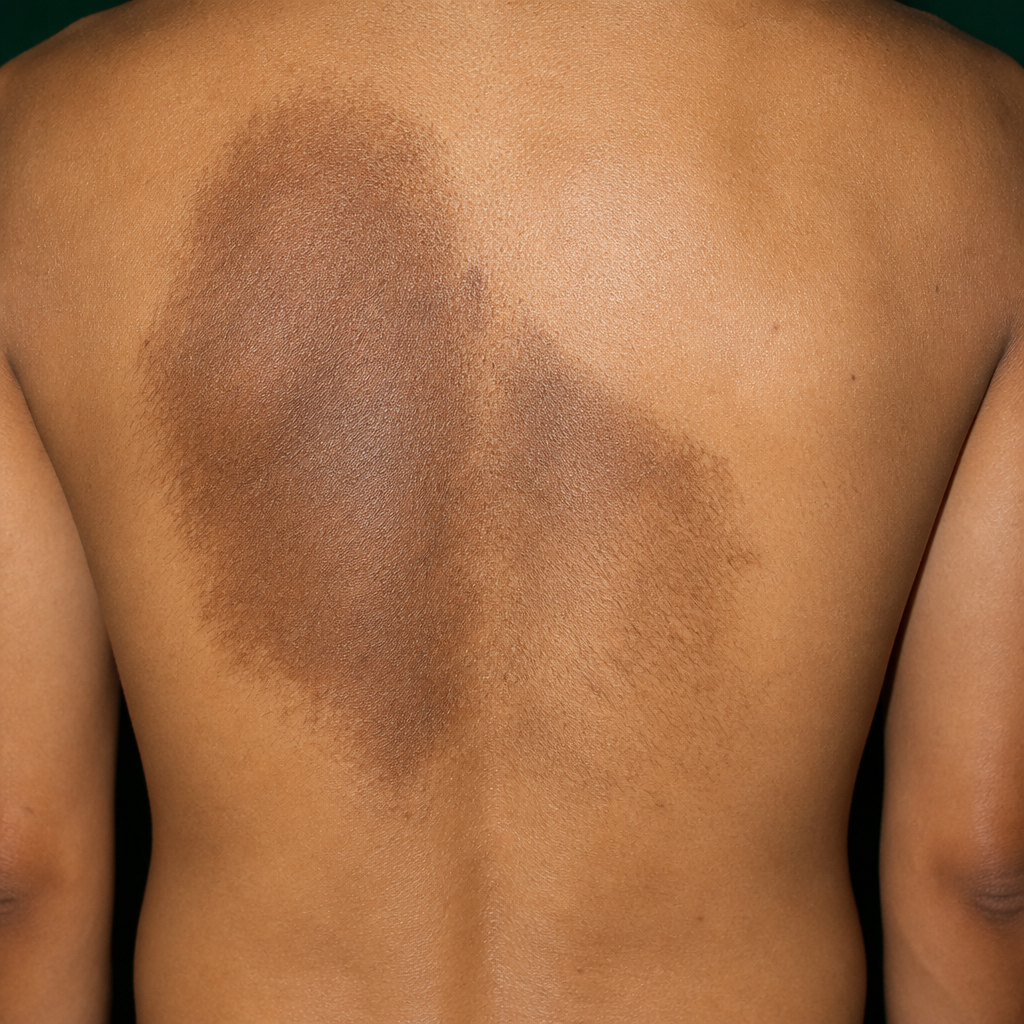
Which of the following conditions presents with a hypo-depigmented lesion?
Peutz-Jeghers syndrome is characterized by which of the following findings?
Xanthomas are associated with which of the following conditions?
Hyperpigmentation is seen in all except?
Psoralen 'A' is used in the treatment of which condition?

A newborn child presents with a solitary white well-defined hypopigmented patch on their right thigh. What is the diagnosis?
Psoralen-A is used in the treatment of:
Acquired symmetric hyperpigmentation of the sun-exposed skin of the face and neck, strongly associated with pregnancy and oral contraceptive use, is called:
A 39-year-old woman presents with a thickened, hyperpigmented, velvety lesion over the axillae. This condition is associated with which of the following?
Melasma, during pregnancy is typically seen on which part of the body?
Explanation: ### Explanation **Nevus depigmentosus** is the correct answer because it is a congenital, non-progressive **hypopigmented** (not truly depigmented) macule or patch. The underlying medical concept is a functional defect in melanocytes; while the number of melanocytes is usually normal, there is a decrease in the synthesis and transfer of melanosomes to keratinocytes. Clinically, it presents as a "stable" pale patch that does not change in size relative to body growth and does not have the chalky-white appearance of vitiligo. **Why the other options are incorrect:** * **Nevus of Ota:** This is a dermal melanocytosis characterized by **hyperpigmentation**. It presents as a blue-grey patch typically following the distribution of the ophthalmic (V1) and maxillary (V2) branches of the trigeminal nerve. It often involves the sclera. * **Nevus of Ito:** Similar to Nevus of Ota, this is a **hyperpigmented** blue-grey lesion, but it occurs in the distribution of the posterior supraclavicular and lateral cutaneous brachial nerves (shoulder, supraclavicular, and scapular areas). * **All of the above:** This is incorrect because Ota and Ito are hyperpigmentary disorders, whereas the question asks for a hypo-depigmented lesion. **NEET-PG High-Yield Pearls:** * **Wood’s Lamp:** Nevus depigmentosus shows an "off-white" fluorescence, whereas Vitiligo shows a "bright, chalky-white" fluorescence. * **Differential Diagnosis:** Unlike **Nevus anemicus** (a vascular anomaly), Nevus depigmentosus does *not* show erythema when rubbed (negative Darier-like sign) and remains pale under diascopy. * **Stability:** Nevus depigmentosus is permanent and stable, unlike **Tinea versicolor** (fungal) or **Pityriasis alba** (eczematous), which are transient.
Explanation: **Explanation:** **Peutz-Jeghers Syndrome (PJS)** is an autosomal dominant disorder caused by a mutation in the **STK11 (LKB1)** gene. It is classically characterized by the triad of mucocutaneous hyperpigmentation, gastrointestinal hamartomatous polyposis, and an increased risk of visceral malignancies. 1. **Why Option A is Correct:** The hallmark dermatological finding is **multiple brown to bluish-black macules** (lentigines). These are typically 1–5 mm in size and occur most characteristically on the **lips and buccal mucosa** (90% of cases). They also appear on the palms, soles, and periorbital areas. Unlike common freckles, these mucosal lesions do not fade with sun exposure. 2. **Why Incorrect Options are Wrong:** * **Option B:** "Coffee-colored" (Café-au-lait) spots are characteristic of Neurofibromatosis Type 1 or McCune-Albright syndrome, not PJS. * **Option C:** Creamy or hypopigmented patches (like ash-leaf spots) are seen in Tuberous Sclerosis. * **Option D:** The pigmentation in PJS is never solitary; it is always multifocal and widespread across the affected mucosal and cutaneous surfaces. **High-Yield Clinical Pearls for NEET-PG:** * **Inheritance:** Autosomal Dominant; Gene: **STK11** on Chromosome 19p. * **GI Findings:** Multiple **hamartomatous polyps** (most common in the small intestine). These can lead to **intussusception** (lead point) or GI bleeding. * **Malignancy Risk:** Significantly increased risk of colorectal, pancreatic, breast, and ovarian (Sertoli cell tumors) cancers. * **Differentiating Point:** Freckles (Ephelides) spare the mucosa; PJS lentigines involve the **buccal mucosa**.
Explanation: **Explanation:** **Xanthomas** are localized deposits of lipids (primarily cholesterol) within the skin, tendons, or subcutaneous tissues. They occur when circulating lipids leak from capillaries into the dermis and are subsequently engulfed by dermal macrophages, transforming them into characteristic **foam cells**. **Why Hyperlipidemia is correct:** The primary underlying cause of xanthomas is an alteration in lipid metabolism. They are most commonly associated with **Hyperlipidemias** (both primary/familial and secondary). When serum lipid levels are chronically elevated, lipids accumulate in the extravascular space, leading to the clinical manifestation of various types of xanthomas (e.g., Eruptive, Tuberous, Tendinous, or Xanthelasma). **Why other options are incorrect:** * **Diabetes:** While uncontrolled diabetes can lead to *secondary* hypertriglyceridemia (which then causes eruptive xanthomas), diabetes itself is not the direct pathophysiological cause of the lipid deposits. * **Hypertension:** There is no direct causal link between high blood pressure and the deposition of lipids in the skin. * **Immunoglobulins:** While Plane Xanthomas can rarely be associated with monoclonal gammopathies (multiple myeloma), hyperlipidemia remains the classic and most frequent association tested in exams. **High-Yield Clinical Pearls for NEET-PG:** 1. **Xanthelasma Palpebrarum:** The most common type; occurs on eyelids. 50% of patients have normal lipid levels. 2. **Eruptive Xanthomas:** Associated with severe **Hypertriglyceridemia** (Types I, IV, V). Appear as sudden crops of yellow papules on an erythematous base. 3. **Tendinous Xanthomas:** Most commonly involve the **Achilles tendon**; strongly associated with Familial Hypercholesterolemia (Type IIa). 4. **Palmar Xanthomas (Xanthoma Striatum Palmare):** Pathognomonic for **Dysbetalipoproteinemia (Type III)**.
Explanation: ### Explanation The correct answer is **Cushing’s Syndrome**. **1. Why Cushing’s Syndrome is the correct answer:** Hyperpigmentation in endocrine disorders is primarily driven by an excess of **ACTH (Adrenocorticotropic Hormone)**. ACTH shares a common precursor molecule with **alpha-MSH (Melanocyte Stimulating Hormone)** called Pro-opiomelanocortin (POMC). In **Cushing’s Syndrome** (specifically the adrenal-dependent type), there is an excess of cortisol which provides negative feedback to the pituitary, leading to **decreased ACTH levels**. Therefore, hyperpigmentation is typically absent. *Note:* In Cushing’s *Disease* (pituitary tumor), ACTH is high, but the term "Cushing’s Syndrome" in exams generally refers to the clinical state of hypercortisolism where skin thinning and striae are more prominent than pigmentation. **2. Analysis of Incorrect Options:** * **Addison’s Disease:** Primary adrenal insufficiency leads to a loss of negative feedback, causing a massive compensatory increase in **ACTH/POMC**, resulting in characteristic generalized hyperpigmentation (especially in palmar creases and buccal mucosa). * **Peutz-Jeghers Syndrome:** An autosomal dominant condition characterized by hamartomatous GI polyps and **mucocutaneous lentigines** (hyperpigmented macules) on the lips and oral mucosa. * **Albright Syndrome (McCune-Albright):** Characterized by the triad of polyostotic fibrous dysplasia, precocious puberty, and **Café-au-lait macules**. These macules are classic examples of localized hyperpigmentation (often described as having "Coast of Maine" borders). **3. Clinical Pearls for NEET-PG:** * **Nelson’s Syndrome:** Rapidly progressive hyperpigmentation following bilateral adrenalectomy due to an enlarging ACTH-secreting pituitary adenoma. * **Coast of Maine vs. Coast of California:** McCune-Albright has irregular borders (Maine), while Neurofibromatosis Type 1 has smooth borders (California). * **Laugier-Hunziker Syndrome:** A key differential for Peutz-Jeghers; it presents with similar mucosal pigmentation but **without** systemic polyposis.
Explanation: ***Vitiligo*** - **Psoralen A** is a photosensitizing agent derived from the **babchi plant** (Psoralea corylifolia) used in **PUVA therapy** (Psoralen + UVA) to stimulate melanocyte activity and repigmentation in vitiligo patches. - It works by increasing **melanin synthesis** when combined with **ultraviolet A radiation**, making it the standard treatment for localized vitiligo lesions. *Pemphigus* - This is an **autoimmune blistering disease** affecting the skin and mucous membranes, treated with **corticosteroids** and **immunosuppressants**. - **Psoralen** has no role in treating **intraepidermal blistering** or controlling autoimmune antibodies against desmogleins. *Pityriasis alba* - This is a **mild eczematous condition** causing hypopigmented patches, typically in children, that resolves spontaneously or with **moisturizers**. - **Psoralen therapy** is not indicated as these patches are **temporary** and **self-limiting**, unlike the permanent depigmentation in vitiligo. *Ichthyosis* - This is a **genetic disorder** characterized by **dry, scaly skin** due to defective keratinization, treated with **emollients** and **keratolytics**. - **Psoralen** has no effect on **skin scaling** or **barrier function** and is not used for keratinization disorders.
Explanation: **Explanation:** The correct diagnosis is **Nevus achromicus** (also known as Nevus depigmentosus). **1. Why Nevus achromicus is correct:** Nevus achromicus is a congenital, non-progressive pigmentary anomaly characterized by a **solitary, well-defined hypopigmented patch**. It is typically present at birth or appears in early infancy. The underlying pathology is not a loss of melanocytes, but rather **functional defects in melanocytes** or a failure in the transfer of melanosomes to keratinocytes. A key diagnostic feature is that the patch remains stable in size relative to the child's growth and does not disappear spontaneously. **2. Why other options are incorrect:** * **Piebaldism:** This is an autosomal dominant condition characterized by a **white forelock** (poliosis) and stable, symmetrical **depigmented** (not hypopigmented) patches, usually on the forehead, trunk, or extremities. It is caused by mutations in the *KIT* proto-oncogene. * **Albinism:** This is a genetic disorder resulting in a generalized lack of pigment in the skin, hair, and eyes (Oculocutaneous Albinism). It is **diffuse**, not a solitary patch. * **Acral vitiligo:** Vitiligo is an acquired autoimmune destruction of melanocytes. It typically presents later in life (rarely at birth) as "chalky white" **depigmented** macules, specifically involving the distal fingers and periorificial areas in the acral variant. **Clinical Pearls for NEET-PG:** * **Wood’s Lamp:** In Nevus achromicus, the patch is hypopigmented (off-white), whereas in Vitiligo, it shows "bright blue-white" fluorescence due to total depigmentation. * **Nevus Anemicus vs. Achromicus:** To differentiate, stroke the lesion. Nevus achromicus will show a red flush (erythema), whereas **Nevus anemicus** (a vascular anomaly) will not redden because the pale appearance is due to localized hypersensitivity to catecholamines, not a lack of pigment. * **Vogt-Koyanagi-Harada Syndrome:** Often tested alongside pigmentary disorders; it involves vitiligo, poliosis, uveitis, and auditory symptoms.
Explanation: **Explanation:** **Vitiligo** is the correct answer because Psoralens (such as 8-Methoxypsoralen or Trimethylpsoralen) are the mainstay of **PUVA therapy** (Psoralen + Ultraviolet A). Psoralens are photosensitizing agents that, when activated by UVA light, stimulate melanocyte proliferation and migration from the hair follicle reservoir to the depigmented skin, leading to repigmentation. **Analysis of Options:** * **Pemphigus:** This is an autoimmune blistering disorder treated primarily with systemic corticosteroids and immunosuppressants (e.g., Azathioprine, Rituximab). Phototherapy is generally avoided as it can occasionally trigger flares. * **Pityriasis alba:** This is a mild form of eczematous dermatitis characterized by hypopigmented patches, usually in children. It is self-limiting and treated with emollients or low-potency topical steroids, not systemic phototherapy. * **Ichthyosis:** This refers to a group of genetic keratinization disorders (e.g., Ichthyosis vulgaris). Treatment focuses on keratolytics (salicylic acid), emollients, and oral retinoids (Acitretin), rather than psoralens. **High-Yield Clinical Pearls for NEET-PG:** * **Mechanism of Action:** Psoralens intercalate into DNA; upon UVA exposure, they form DNA adducts (monoadducts and cross-links), inhibiting DNA synthesis and modulating the local immune response. * **PUVA vs. NBUVB:** While PUVA was the gold standard, **Narrowband UVB (311 nm)** is now the first-line phototherapy for vitiligo due to its better safety profile and lack of need for systemic psoralens. * **Side Effects:** Acute side effects of PUVA include nausea, erythema (burns), and pruritus. Long-term risks include premature skin aging and an increased risk of Non-Melanoma Skin Cancer (NMSC).
Explanation: ### Explanation **Correct Answer: D. Melasma** **Why it is correct:** Melasma (also known as chloasma or the "mask of pregnancy") is a common acquired pigmentary disorder characterized by symmetric, light-to-dark brown macules and patches on sun-exposed areas, most commonly the face (malar, centrofacial, and mandibular patterns). The pathogenesis involves a combination of **genetic predisposition, UV radiation, and hormonal influences**. Estrogen and progesterone (found in pregnancy and oral contraceptives) stimulate melanocytes to produce excess melanin, leading to the characteristic hyperpigmentation. **Why the other options are incorrect:** * **A. Melanoma:** This is a malignant neoplasm of melanocytes. It typically presents as an asymmetrical, irregular lesion with variegated colors (ABCDE criteria), rather than symmetric facial patches. * **B. Cafe-au-lait spots:** These are well-demarcated, tan-colored birthmarks. They are usually congenital or appear in early childhood and are strongly associated with genetic syndromes like Neurofibromatosis Type 1, not hormonal changes in adulthood. * **C. Freckle (Ephelis):** These are small (1–2 mm), tan-to-brown macules that darken with sun exposure but are not typically associated with pregnancy or OCP use. Histologically, they show increased melanin but a *normal* number of melanocytes, whereas melasma often shows increased melanocyte activity. **High-Yield Clinical Pearls for NEET-PG:** * **Wood’s Lamp Examination:** Used to determine the depth of pigment. **Epidermal melasma** (most common) accentuates under Wood’s lamp, while **dermal melasma** does not. * **Treatment Gold Standard:** **Kligman’s Formula** (Triple Combination Therapy) consisting of Hydroquinone (4%), Tretinoin (0.05%), and a mild corticosteroid (e.g., Fluocinolone acetonide). * **Prevention:** Strict photoprotection (broad-spectrum sunscreen) is the most critical step in management.
Explanation: ### Explanation The clinical presentation of **thickened, hyperpigmented, velvety lesions** in intertriginous areas like the axillae and neck is the hallmark of **Acanthosis Nigricans (AN)**. **Why Insulin Resistance is Correct:** The primary underlying mechanism for benign AN is **hyperinsulinemia** associated with **Insulin Resistance**. High levels of circulating insulin cross-react with **Insulin-like Growth Factor-1 (IGF-1) receptors** on keratinocytes and dermal fibroblasts. This stimulates cellular proliferation, leading to the characteristic epidermal thickening (acanthosis) and velvety texture. It is commonly seen in Type 2 Diabetes Mellitus, PCOS, and obesity. **Why Other Options are Incorrect:** * **A. Frequent wearing of velvet clothes:** This is a distractor. The term "velvety" describes the clinical texture of the skin due to papillomatosis and acanthosis; it is not caused by external fabric contact. * **B. Systemic lupus erythematosus (SLE):** SLE typically presents with photosensitive rashes (malar rash) or discoid plaques, not velvety hyperpigmentation. * **C. Tuberculosis:** While some dermatological conditions like Lupus Vulgaris are associated with TB, Acanthosis Nigricans has no direct etiologic link to mycobacterial infections. **High-Yield Clinical Pearls for NEET-PG:** * **Malignant Acanthosis Nigricans:** If AN appears suddenly, is very extensive, or involves the palms ("Tripe palms") and oral mucosa, it is highly suggestive of an internal malignancy, most commonly **Gastric Adenocarcinoma**. * **Common Sites:** Posterior neck (most common), axillae, groin, and knuckles. * **Histopathology:** Shows hyperkeratosis and papillomatosis. Interestingly, despite the dark appearance, there is minimal increase in melanocytes; the color is due to the thickened epidermis. * **Drug-induced AN:** Can be caused by Nicotinic acid, systemic corticosteroids, and OCPs.
Explanation: **Explanation:** **Melasma** (also known as chloasma or the "mask of pregnancy") is an acquired hypermelanosis characterized by symmetric, brown-to-grayish macules and patches. It is most commonly seen on the **face**, which is the correct answer. The underlying medical concept involves a combination of **genetic predisposition**, **hormonal influences** (increased estrogen, progesterone, and melanocyte-stimulating hormone during pregnancy), and **UV radiation**. The face is the primary site because it has a higher density of melanocytes and receives the most chronic sun exposure, which triggers melanogenesis. **Analysis of Options:** * **A. Breast & C. Abdomen:** While pregnancy causes physiological hyperpigmentation in these areas (e.g., darkening of the areola/nipples and the formation of **Linea Nigra** on the abdomen), this is distinct from Melasma. * **D. Limbs:** Extrafacial melasma (e.g., on the forearms) is rare and usually occurs in postmenopausal women rather than during pregnancy. **Clinical Pearls for NEET-PG:** * **Patterns of Melasma:** The most common pattern is **Centrofacial** (forehead, nose, cheeks, upper lip), followed by Malar and Mandibular. * **Wood’s Lamp Examination:** Used to determine the depth of pigment. **Epidermal** melasma enhances under Wood's lamp (easier to treat), while **Dermal** melasma does not. * **Treatment:** The gold standard is **Kligman’s Formula** (Triple Combination Therapy: Hydroquinone + Tretinoin + Fluocinolone acetonide). * **Differential Diagnosis:** Must be distinguished from *Acanthosis Nigricans* (velvety plaques on the neck/axilla) and *Lichen Planus Pigmentosus*.
Melanocyte Biology
Practice Questions
Vitiligo
Practice Questions
Melasma
Practice Questions
Post-inflammatory Hyperpigmentation
Practice Questions
Post-inflammatory Hypopigmentation
Practice Questions
Albinism
Practice Questions
Drug-Induced Pigmentary Changes
Practice Questions
Pityriasis Alba
Practice Questions
Pigmentary Demarcation Lines
Practice Questions
Nevi of Ota and Ito
Practice Questions
Management of Hyperpigmentation
Practice Questions
Management of Hypopigmentation
Practice Questions
Get full access to all questions, explanations, and performance tracking.
Start For Free