A patient presents with asymptomatic hyperpigmented macules showing accentuation under Wood's lamp. Most likely diagnosis:
All of the following are true about vitiligo EXCEPT:
Which condition is specifically known as the 'mask of pregnancy' due to pregnancy-related hormonal changes?
Which of the following is the most characteristic feature of porphyria cutanea tarda (PCT)?
A 45-year-old woman presents with progressive depigmented macules on her face and hands. Which autoimmune disease is most commonly associated with vitiligo?
A patient presents with multiple hyperpigmented macules on the trunk and extremities. A biopsy shows increased melanin in the basal layer with no increase in melanocytes. What is the most likely diagnosis?
A 50-year-old woman presents with a well-demarcated depigmented patch on her hand. Which of the following conditions is most likely?
A 55-year-old man with a history of vitiligo presents with several new hypopigmented macules on his trunk and extremities. What is the most likely diagnosis?
A 25-year-old female presents with brown macular lesions on her face that appeared after sun exposure. What is the most likely diagnosis?
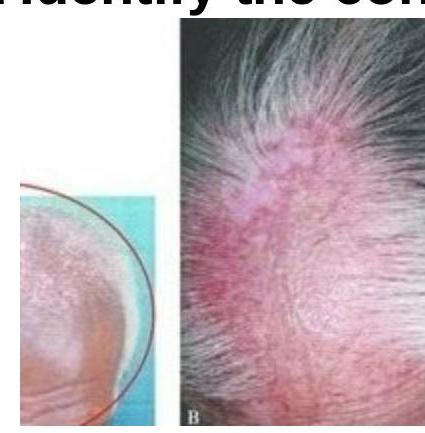
Identify the condition in the image
Explanation: ***Melasma*** - Presents as **asymptomatic hyperpigmented macules** typically on sun-exposed areas like the face, and these lesions are known to show **accentuation under Wood's lamp** due to increased epidermal melanin deposition. - It is frequently associated with **hormonal changes**, such as pregnancy or oral contraceptive use, and sun exposure. *Tinea versicolor* - Caused by the yeast *Malassezia globosa*, presenting as **hypopigmented or hyperpigmented patches** with fine scale, often on the trunk. - Under Wood's lamp, tinea versicolor typically shows a characteristic **yellow-green fluorescence**, not accentuation of brown pigmentation. *Post-inflammatory hyperpigmentation* - Occurs as a result of **inflammation or injury to the skin**, leading to increased melanin production in the affected area. - While it can manifest as hyperpigmented macules, it generally does **not show significant accentuation under Wood's lamp** if the melanin is in the dermis, and its distribution follows sites of previous inflammation rather than sun-exposed patterns. *Café au lait macules* - These are **uniformly hyperpigmented, well-defined macules** that are typically present from birth or early childhood. - While they are hyperpigmented, they generally **do not show accentuation under Wood's lamp** as the melanin is usually distributed evenly within the epidermis and not subject to the same optical properties as melasma.
Explanation: ***Dermatomal distribution is common*** - Vitiligo is characterized by **patches of depigmentation** that result from the destruction of melanocytes. Its distribution is typically **generalized**, focal, segmental (unilateral and non-dermatomal), or localized, but not dermatomal. - A **dermatomal distribution** would imply a pattern corresponding to a single spinal nerve root, which is characteristic of conditions like **herpes zoster**, not vitiligo. *Koebner phenomenon may occur* - The **Koebner phenomenon**, or isomorphic response, is indeed observed in vitiligo, where new lesions appear at sites of trauma to previously unaffected skin. - This phenomenon is also seen in other dermatological conditions like **psoriasis** and **lichen planus**. *Associated with autoimmune thyroiditis* - Vitiligo is strongly associated with various **autoimmune diseases**, with **autoimmune thyroiditis** (Hashimoto's thyroiditis or Graves' disease) being one of the most common co-morbidities. - Other associated autoimmune conditions include **pernicious anemia**, **diabetes mellitus type 1**, and **Addison's disease**. *NBUVB is effective treatment* - **Narrowband ultraviolet B (NBUVB)** phototherapy is a highly effective treatment for vitiligo, particularly for generalized forms. - It works by stimulating residual melanocytes to proliferate and migrate, leading to **re-pigmentation** of the affected areas.
Explanation: ***Melasma*** - **Melasma** (also historically called chloasma) specifically refers to the **symmetrical hyperpigmentation** of the face, commonly known as the **"mask of pregnancy"**. - During pregnancy, it is called **melasma gravidarum** and is triggered by elevated levels of **estrogen and progesterone**, which stimulate melanocyte activity. - Appears as **brown or gray-brown patches** typically on the cheeks, forehead, upper lip, nose, and chin. - Besides pregnancy, melasma can be triggered by **oral contraceptives**, **sun exposure**, or be idiopathic. *Vitiligo* - **Vitiligo** is a **depigmentation disorder** characterized by loss of melanocytes, resulting in white patches on the skin. - It is an **autoimmune condition**, not related to pregnancy or hormonal changes. - Presents with **depigmented (white) patches**, not hyperpigmentation like melasma. *Linea nigra* - **Linea nigra** is a dark vertical line that appears on the abdomen during pregnancy, extending from the umbilicus to the pubic symphysis. - While it is pregnancy-related pigmentation, it affects the **abdomen**, not the face. - Therefore, it is **not** referred to as the "mask of pregnancy". *Lentigo* - **Lentigo** (plural: lentigines) refers to small, well-circumscribed pigmented macules, commonly called **liver spots** or **age spots**. - Caused primarily by **chronic sun exposure** and aging, not hormonal changes. - Not associated with pregnancy and does not present as the characteristic facial pattern seen in melasma.
Explanation: ***Is the most common type of human porphyria*** - **Porphyria cutanea tarda (PCT)** is indeed the **most prevalent** type of porphyria, accounting for approximately 80% of all cases. - It is often acquired, triggered by factors such as **alcohol consumption** and **hepatitis C infection**, leading to its high incidence. *Is treated primarily with high-dose antimalarial drugs* - While antimalarial drugs like **hydroxychloroquine** or **chloroquine** are used for treatment, they are given in **low doses** to avoid exacerbating symptoms. - The primary treatment involves **phlebotomy** to reduce iron stores, which contribute to the disease. *Is caused by increased activity of uroporphyrinogen decarboxylase* - **PCT** is caused by a **deficiency** (decreased activity) of the enzyme **uroporphyrinogen decarboxylase (UROD)**, not increased activity. - This enzyme deficiency leads to the accumulation of **porphyrinogens**, which are then oxidized to photoactive porphyrins. *Is more common in children than adults* - **PCT** predominantly affects **adults**, typically presenting in the fourth to sixth decades of life. - Childhood cases are rare and usually associated with the familial form of the disease.
Explanation: ***Hashimoto's thyroiditis*** - **Hashimoto's thyroiditis** is the autoimmune disease most commonly associated with **vitiligo**, both conditions sharing a genetic predisposition and mechanisms involving the immune system attacking specific cells (melanocytes in vitiligo, thyroid cells in Hashimoto's). - The co-occurrence suggests a broader autoimmune diathesis, making thyroid function testing important in patients with vitiligo. *Addison's disease* - While **Addison's disease** (adrenal insufficiency) can be associated with vitiligo, it is less common than the association with thyroid autoimmune diseases. - Addison's disease involves autoimmune destruction of the adrenal glands, leading to symptoms like fatigue, weight loss, and hyperpigmentation (paradoxically, in some areas, or generalized), though vitiligo can also occur. *Graves' disease* - **Graves' disease** is an autoimmune hyperthyroid condition that can also be associated with vitiligo, but the prevalence of this association is lower compared to **Hashimoto's thyroiditis**. - Both conditions represent organ-specific autoimmune diseases, but Hashimoto's, an organ-specific autoimmune disease affecting the thyroid, has a stronger epidemiological link with vitiligo. *Systemic lupus erythematosus* - While **systemic lupus erythematosus (SLE)** is a systemic autoimmune disease that can affect various organs and present with diverse dermatological manifestations, including photosensitivity and discoid lupus, it is not primarily or most commonly associated with **vitiligo**. - SLE is characterized by autoantibodies against nuclear antigens, and its skin involvement typically presents as rashes or lesions, rather than generalized depigmentation.
Explanation: ***Post-inflammatory hyperpigmentation*** - This is the **most likely diagnosis** given the combination of clinical presentation (multiple hyperpigmented macules on trunk and extremities) and characteristic histological findings. - Histologically, post-inflammatory hyperpigmentation shows increased melanin deposition in the basal layer **without an increase in melanocyte number**, which exactly matches the biopsy description. - This condition commonly occurs following inflammation, injury, or dermatological conditions affecting the trunk and extremities. - The hyperpigmentation may fade over time as melanin is gradually cleared. *Lentigo* - While lentigines present as hyperpigmented macules, they show a characteristic **increase in melanocyte number** along the basal layer, which contradicts the biopsy finding of "no increase in melanocytes." - Lentigines are persistent lesions that do not spontaneously resolve, unlike post-inflammatory hyperpigmentation. - Histologically: increased melanin + increased melanocytes (key differentiator). *Melasma* - Melasma typically presents as symmetric hyperpigmented **patches on the face** (especially cheeks, forehead, upper lip), not multiple macules on trunk and extremities. - Strongly associated with **hormonal changes** (pregnancy, oral contraceptives) and sun exposure. - Histologically, melasma shows increased melanin in the basal layer, similar to PIH, but the clinical distribution pattern is distinctly different. - The trunk and extremities are not typical sites for melasma. *Addison's disease* - Addison's disease causes **diffuse generalized hyperpigmentation** due to elevated ACTH (which has melanocyte-stimulating hormone activity). - Characteristic distribution: sun-exposed areas, pressure points, skin creases, and **mucous membranes** (oral mucosa - a key clinical clue). - The presentation is systemic hyperpigmentation, not focal "multiple macules" as described. - This is a systemic endocrine disorder requiring additional clinical features (weakness, weight loss, hypotension) for diagnosis, not explained by isolated histological findings.
Explanation: ***Vitiligo*** - **Vitiligo** is characterized by the presence of **well-demarcated** patches of complete **depigmentation** due to the destruction of melanocytes. - The appearance of such a patch on the hand is a classic presentation of this autoimmune skin condition. *Melasma* - **Melasma** presents as **hyperpigmented** macules and patches, typically on sun-exposed areas like the face, not hypopigmented lesions. - It is associated with hormonal changes, such as pregnancy or oral contraceptive use. *Pityriasis alba* - **Pityriasis alba** causes **hypopigmented** (lighter, but not completely depigmented) patches with fine scale, often on the face and arms of children. - Unlike vitiligo, the lesions are not typically as starkly white and usually resolve spontaneously over time. *Addison's disease* - **Addison's disease** is characterized by **hyperpigmentation**, especially in areas of friction or sun exposure, due to increased ACTH and MSH. - While it can cause skin changes, it does not typically present with singular, well-demarcated depigmented patches like vitiligo.
Explanation: ***Vitiligo (Progressive Disease)*** - The patient has a **history of vitiligo**, and new **hypopigmented macules** are consistent with **disease progression**. - Vitiligo is an **autoimmune disorder** characterized by the destruction of **melanocytes**, leading to progressive depigmentation of the skin with characteristic **well-demarcated, chalk-white patches**. - In patients with established vitiligo, **new lesions typically represent extension of the same disease** rather than a new diagnosis, especially when presenting with similar morphology. *Pityriasis alba* - This condition typically presents as **faintly erythematous patches** that resolve to leave **hypopigmented areas**, often with fine scaling, and is more common in children. - It does not usually present with the **sharp, well-demarcated depigmentation** seen in vitiligo, and a history of vitiligo makes this diagnosis less likely. - The lesions are usually **ill-defined** and show **incomplete depigmentation**, unlike the complete depigmentation of vitiligo. *Tinea versicolor* - Caused by a **yeast infection (Malassezia species)**, it typically presents with **hypopigmented OR hyperpigmented patches** with fine scale, often on the trunk. - While it causes hypopigmentation, the patches are usually **superficial with fine scaling** and respond to antifungal treatment. - The patient's existing history of an autoimmune disease like vitiligo and the **well-demarcated nature** of the lesions point away from this fungal etiology. *Leprosy* - Leprosy can cause **hypopigmented patches**, but these lesions are typically associated with **diminished sensation** (anesthesia) and nerve involvement. - The absence of neurological symptoms and the presence of a prior vitiligo diagnosis make leprosy a less probable diagnosis in this context. - Leprosy patches show **loss of sensation, anhidrosis, and loss of hair** within the patch, which would be key differentiating features.
Explanation: ***Chloasma*** - **Chloasma**, also known as **melasma**, presents as brown macular lesions (hyperpigmentation) on the face, often exacerbated by **sun exposure** and hormonal changes (e.g., pregnancy, oral contraceptives). - This condition is common in women and directly aligns with the patient's presentation of **facial brown macules** appearing after sun exposure. *Photodermatitis* - **Photodermatitis** is an inflammatory reaction of the skin caused by exposure to light, often manifesting as **redness, itching, and blistering**, not typically as brown macules. - It usually presents as an acute eczematous or bullous response, which is inconsistent with the patient's description of persistent brown lesions. *Systemic lupus erythematosus* - **Systemic lupus erythematosus (SLE)** is an autoimmune disease with diverse cutaneous manifestations, but a classic finding is the **malar rash** (butterfly rash), which is red and often affects the nose and cheeks, not brown macules. - Other skin manifestations of SLE include discoid lesions or photosensitivity with erythema and scaling, not the diffuse facial hyperpigmentation described. *Acne rosacea* - **Acne rosacea** is a chronic inflammatory skin condition characterized by **facial redness, papules, pustules**, and prominent blood vessels (telangiectasias), primarily affecting the central face. - While rosacea can be triggered by sun exposure, it presents with **erythema and inflammatory lesions**, not the brown macular hyperpigmentation seen in this patient.
Explanation: ***Correct: Vitiligo*** - This image shows **patches of depigmented skin** (white areas) characteristic of vitiligo, often seen in a **segmental or generalized pattern**. - Vitiligo is an **autoimmune condition** where melanocytes are destroyed, leading to loss of skin color. - Patches typically have a **progressive course** and can appear at any age. *Incorrect: Leukoderma* - Leukoderma is a **general term** for any condition causing white patches on the skin due to reduced or lost pigmentation. - While vitiligo is a type of leukoderma, this answer is too broad and not the **most specific diagnosis** for the pattern shown. - In clinical practice, we diagnose the specific type (vitiligo) rather than using the generic term. *Incorrect: Piebaldism* - Piebaldism is a **rare genetic disorder** characterized by a **stable white forelock** (unpigmented hair) and often a congenital white patch on the forehead. - Unlike vitiligo, these patches are usually **present at birth** and do not progress. - The distribution pattern is typically **midline** with characteristic forehead involvement. *Incorrect: DLE* - DLE stands for **Discoid Lupus Erythematosus**, which is a chronic autoimmune condition affecting the skin. - It typically presents as **red, scaly, disk-shaped plaques** that can lead to scarring, atrophy, and permanent hair loss. - Would show **erythema, scaling, and scarring** rather than pure depigmentation as seen here.
Melanocyte Biology
Practice Questions
Vitiligo
Practice Questions
Melasma
Practice Questions
Post-inflammatory Hyperpigmentation
Practice Questions
Post-inflammatory Hypopigmentation
Practice Questions
Albinism
Practice Questions
Drug-Induced Pigmentary Changes
Practice Questions
Pityriasis Alba
Practice Questions
Pigmentary Demarcation Lines
Practice Questions
Nevi of Ota and Ito
Practice Questions
Management of Hyperpigmentation
Practice Questions
Management of Hypopigmentation
Practice Questions
Get full access to all questions, explanations, and performance tracking.
Start For Free