Elderly man with a long-standing mole on his face that is increasing in size and showing an irregular border. Diagnosis:
All are predisposing factors of Deep Vein thrombosis, EXCEPT :
PUVA therapy is used in all except:
Which of the following is not true about hydroquinone?
Which of the following is an example of a barrier method of contraception?
A 15cm hyperpigmented macule on an adolescent male undergoes changes such as coarseness, growth of hair & acne. Diagnosis is?
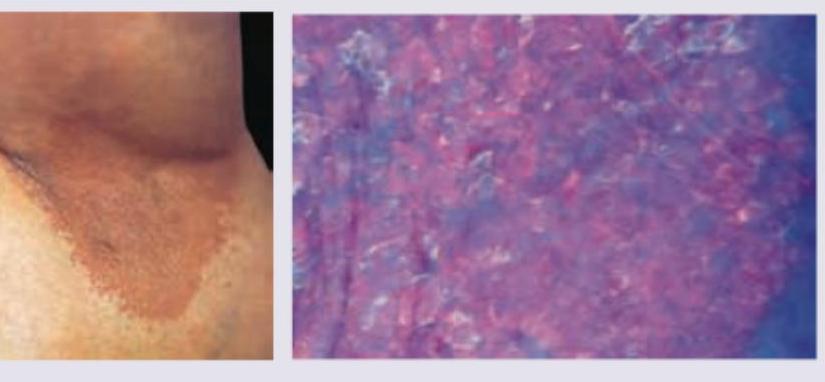
A 35-year-old obese woman presents with recurrent lesions in both axilla in summer season. Wood lamp examination is shown. The diagnosis is:
What is the most common association with Acanthosis nigricans?
Defect seen in Vitiligo is:
An increased incidence of vitiligo is found in association with which of the following conditions?
Explanation: ***Lentigo maligna*** - This type of melanoma commonly affects **elderly individuals** and presents as a **slowly enlarging, irregularly bordered, flat or slightly raised pigmented lesion** on sun-exposed areas like the face. - It often has a **long radial growth phase** before progressing to invasive lentigo maligna melanoma. *Superficial spreading melanoma* - While common, it typically presents on the **trunk or extremities** and has a faster growth rate compared to lentigo maligna. - It often appears as a **flat, asymmetrical lesion with varied colors and irregular borders**, but the age and location details point away from this. *Nodular melanoma* - This is an **aggressive form** that grows vertically from the start, presenting as a **dark, raised, often ulcerated nodule** and typically has a shorter history of rapid growth. - It lacks the characteristic long-standing, flat growth pattern described in the elderly patient's face. *Acral melanoma* - This rare type occurs on the **palms, soles, or under the nails (subungual)**, not typically on the face. - It often appears as a **pigmented streak or patch** in these acral locations.
Explanation: ***Subungual melanoma*** - This is a rare form of melanoma that develops under the nail, and while serious, it is **not a recognized predisposing factor for deep vein thrombosis (DVT)**. Its primary concerns are local invasion and metastasis. - Unlike conditions affecting blood clotting or endothelium, **subungual melanoma does not directly promote hypercoagulability, venous stasis, or endothelial damage** that contribute to DVT. *Lower limb trauma* - **Trauma to the lower limb** can cause **endothelial damage** to blood vessels and **venous stasis** due to immobility or swelling, both key components of **Virchow's triad** for DVT [1]. - **Fractures or severe soft tissue injuries** often necessitate immobilization and can lead to inflammation, further increasing the risk of clot formation [1]. *Cushing's syndrome* - **Cushing's syndrome** is associated with **hypercoagulability** due to increased levels of clotting factors, such as **factor VIII** and **fibrinogen**, and decreased fibrinolytic activity. - The **elevated cortisol levels** seen in Cushing's syndrome [2] can directly contribute to a prothrombotic state, significantly increasing DVT risk. *Hip surgery* - **Major orthopedic surgeries**, especially hip surgery [1], are well-known to cause significant **venous stasis** and **endothelial damage**. - **Post-operative immobility** and a generalized **inflammatory response** following surgery contribute to a high risk of DVT formation [1].
Explanation: ***Melasma*** - **PUVA (Psoralen plus UVA) therapy** is contraindicated in melasma due to its potential to worsen hyperpigmentation and cause paradoxical darkening. - Melasma is best managed with topical agents like **hydroquinone**, **tretinoin**, and chemical peels, along with strict **sun protection**. *Psoriasis* - **PUVA therapy** is a well-established and effective treatment for moderate to severe psoriasis, especially for patients with widespread plaques. - It works by inhibiting DNA synthesis and cell proliferation in rapidly dividing keratinocytes, leading to a reduction in psoriatic lesions. *Vitiligo* - **PUVA therapy** is a common treatment for vitiligo, stimulating melanocyte activity and promoting repigmentation in affected areas. - Psoralen sensitizes melanocytes to UVA light, which then encourages melanin production. *Mycosis fungoides* - In its early stages, **mycosis fungoides**, a cutaneous T-cell lymphoma, can be effectively treated with **PUVA therapy**. - PUVA induces apoptosis of malignant T-cells in the skin, leading to remission of skin lesions.
Explanation: ***It should not be used for melasma or chloasma of pregnancy*** - This statement is **NOT TRUE** - hydroquinone is actually a **first-line treatment for melasma** including chloasma (melasma of pregnancy) - Hydroquinone 2-4% is one of the **most effective topical agents** for treating melasma and is widely recommended in dermatological guidelines - While hydroquinone use during **active pregnancy** is approached with caution (FDA Category C), it is definitely indicated for treating melasma/chloasma **after pregnancy** and for general melasma in non-pregnant patients - The condition (melasma/chloasma) is appropriately treated with hydroquinone; only the **timing during pregnancy** requires consideration *Response is incomplete and pigmentation may recur* - This is a **TRUE statement** about hydroquinone therapy - Treatment response is often **incomplete** with partial lightening of hyperpigmentation - **Recurrence is common** after discontinuation, especially with continued sun exposure or hormonal triggers - Maintenance therapy is often needed to sustain results *It inhibits tyrosinase* - This is a **TRUE statement** - hydroquinone's primary mechanism of action - Acts as a **competitive inhibitor of tyrosinase**, the rate-limiting enzyme in melanin synthesis - This inhibition reduces melanin production in melanocytes, leading to depigmentation *It requires prescription strength concentrations above 2%* - This is a **TRUE statement** in most countries including India and the USA - Hydroquinone concentrations **≤2%** are available over-the-counter (OTC) - Concentrations **>2% (typically 3-4%)** require a prescription - Higher concentrations provide greater efficacy but also increased risk of side effects like ochronosis
Explanation: ***Condom*** - A **condom** acts as a physical barrier, preventing sperm from reaching the egg. - Both male and female condoms are examples of **barrier contraception**. *Hormonal contraceptive* - **Hormonal contraceptives** work by preventing ovulation, thickening cervical mucus, or altering the uterine lining, not by physically blocking sperm. - Examples include oral contraceptive pills, patches, and vaginal rings. *IUD* - An **intrauterine device (IUD)**, whether hormonal or copper, primarily prevents conception by creating an inhospitable environment for sperm or by preventing implantation. - It is a long-acting reversible contraceptive, not a barrier method. *Sterilization* - **Sterilization** (e.g., tubal ligation or vasectomy) is a permanent method of contraception that prevents the transport of eggs or sperm, respectively. - It does not involve a physical barrier to block sperm during intercourse.
Explanation: ***Becker nevus*** - A Becker nevus is a **hyperpigmented patch** that typically appears during adolescence in males, often on the shoulder or upper trunk. - It characteristically becomes **hairy (hypertrichosis)**, more coarse, and can develop acne within the lesion, particularly during puberty due to androgen sensitivity. *Melanocytic nevus* - While melanocytic nevi are hyperpigmented, they generally do not show the characteristic changes of **coarseness, significant hair growth, or acne** within the lesion during adolescence. - They are typically stable in size and texture after initial development, with changes raising concern for **melanoma**. *Sebaceous nevus* - A sebaceous nevus is a **congenital lesion** often appearing as a yellowish-orange, waxy, or bumpy patch, usually on the scalp or face. - It does not typically present as a large, flat hyperpigmented macule that develops hair and acne in adolescence; instead, it may become verrucous or develop tumors in adulthood. *Sebaceous adenoma* - A sebaceous adenoma is a **benign tumor** of the sebaceous glands, usually appearing as a small, solitary, flesh-colored to yellowish papule or nodule, especially on the face. - It is not typically seen as a large, hyperpigmented macule that grows hair and acne over a broad area, as described in the question.
Explanation: ***Erythrasma*** - Erythrasma is a superficial bacterial infection caused by **Corynebacterium minutissimum**, which commonly presents as red-brown patches in intertriginous areas like the axilla, especially in obese individuals and warm, humid conditions (summer season). - The distinctive **coral-red fluorescence under Wood's lamp** is due to porphyrin production by the bacteria, which is a classic diagnostic feature of erythrasma, as shown in the image. *Ecthyma* - Ecthyma is a deeper form of impetigo characterized by **ulcerative lesions with a thick, adherent crust** that extend into the dermis. - It is typically caused by *Streptococcus pyogenes* and sometimes *Staphylococcus aureus*, and would not exhibit coral-red fluorescence under Wood's lamp. *Impetigo contagiosa* - Impetigo contagiosa (non-bullous impetigo) presents with **honey-colored crusted lesions**, usually on the face and extremities. - While also a bacterial skin infection, it is typically caused by *Staphylococcus aureus* or *Streptococcus pyogenes* and does not show coral-red fluorescence under Wood's lamp. *Bullous impetigo* - Bullous impetigo is characterized by **flaccid bullae** (blisters) that rupture to form thin, varnish-like crusts, primarily caused by *Staphylococcus aureus* producing exfoliative toxins. - Similar to other forms of impetigo, it does not produce the coral-red fluorescence under Wood's lamp.
Explanation: **Explanation:** **Acanthosis Nigricans (AN)** is a common dermatological condition characterized by hyperpigmented, velvety plaques, typically found in intertriginous areas like the axilla and neck. **Why Obesity is the Correct Answer:** Obesity is the **most common** association and cause of Acanthosis Nigricans (Pseudo-acanthosis nigricans). The underlying mechanism is **Insulin Resistance**. In obese individuals, high levels of circulating insulin bind to **Insulin-like Growth Factor-1 (IGF-1) receptors** on keratinocytes and fibroblasts. This stimulates excessive proliferation of these cells, leading to the characteristic epidermal thickening and hyperpigmentation. **Analysis of Incorrect Options:** * **Diabetes Mellitus (B):** While AN is a strong cutaneous marker for Type 2 Diabetes, it usually precedes the clinical onset of diabetes. Obesity remains the primary driver and more frequent association. * **Hypertension (A) & Hypothyroidism (D):** These are often part of the "Metabolic Syndrome" or associated endocrinopathies (like PCOS), but they are not the primary or most common cause of the skin changes seen in AN. **High-Yield Clinical Pearls for NEET-PG:** * **Malignant Acanthosis Nigricans:** If AN appears suddenly, is very extensive, or involves the palms (**Tripe Palms**) and oral mucosa, it is highly suggestive of internal malignancy, most commonly **Gastric Adenocarcinoma**. * **Histopathology:** Shows hyperkeratosis and papillomatosis. Note that "acanthosis" (thickening of the stratum spinosum) is actually minimal despite the name. * **Common Sites:** Neck (most common), axilla, groins, and knuckles. * **Drug-induced AN:** Can be caused by Nicotinic acid, systemic corticosteroids, and OCPs.
Explanation: **Explanation:** **Vitiligo** is an acquired, chronic pigmentary disorder characterized by the selective destruction of melanocytes. **1. Why Option B is correct:** The hallmark of vitiligo is the **complete absence of functional melanocytes** in the affected skin. This is primarily due to an autoimmune-mediated destruction where T-cells target melanocyte-specific antigens. Histopathologically, a skin biopsy of a stable vitiligo lesion shows a total lack of melanocytes (DOPA-negative) and a consequent absence of melanin in the epidermis. **2. Why other options are incorrect:** * **Option A (Absent melanosomes):** This is seen in **Chediak-Higashi syndrome** or specific trafficking defects. In vitiligo, the "factory" (melanocyte) is gone, so melanosomes are naturally absent, but the primary defect is the cell loss itself. * **Option C (Reduction in melanin synthesis):** This describes **Albinism**, where melanocytes are present in normal numbers, but there is a genetic defect in the enzyme tyrosinase, leading to decreased melanin production. * **Option D (Reduction in number of melanocytes):** This describes **Nevus Depigmentosus** or **Pityriasis Alba**, where melanocytes are present but decreased in number or activity. In vitiligo, the loss is absolute in the lesion. **High-Yield Clinical Pearls for NEET-PG:** * **Most common association:** Autoimmune thyroid disease (Hashimoto’s). * **Koebner Phenomenon:** Vitiligo is Koebner positive (new lesions at sites of trauma). * **Segmental Vitiligo:** Does not follow the Koebner phenomenon and has a dermatomal distribution. * **Treatment of Choice:** Narrowband UVB (NB-UVB) is the gold standard for generalized vitiligo. * **Wood’s Lamp:** Lesions show a characteristic **"milky white"** fluorescence.
Explanation: **Explanation:** **Vitiligo** is a chronic autoimmune skin disorder characterized by the destruction of melanocytes. The key medical concept to understand for NEET-PG is that vitiligo is frequently associated with other **organ-specific autoimmune disorders**. **1. Why Diabetes Mellitus is correct:** Vitiligo is part of a spectrum of autoimmune polyendocrine syndromes. There is a statistically significant association between vitiligo and **Type 1 Diabetes Mellitus** (and occasionally Type 2) due to shared genetic susceptibility and autoimmune pathways. Other common associations include: * **Thyroid disorders** (most common association, especially Hashimoto’s thyroiditis). * Pernicious anemia. * Addison’s disease. * Alopecia areata. **2. Why the other options are incorrect:** * **Psoriasis (A):** While both are T-cell mediated inflammatory skin diseases, psoriasis is not classically associated with the systemic autoimmune cluster seen in vitiligo. * **Nutritional deficiency (B):** Vitiligo is an autoimmune process, not a nutritional one. While some studies suggest low Vitamin B12 or Vitamin D levels in vitiligo patients, deficiency is not a causative or strongly associated factor. * **Old age (C):** Vitiligo typically has an early onset; 50% of cases begin before age 20. It is not a degenerative condition of aging. **High-Yield Clinical Pearls for NEET-PG:** * **Most common association:** Thyroid dysfunction (check TSH in vitiligo patients). * **Koebner Phenomenon:** Vitiligo shows positivity (depigmentation at sites of trauma). * **Vogt-Koyanagi-Harada Syndrome:** Vitiligo associated with uveitis, meningitis, and auditory symptoms. * **Treatment of choice:** Narrowband UVB (NB-UVB) is the gold standard for generalized vitiligo.
Get full access to all questions, explanations, and performance tracking.
Start For Free