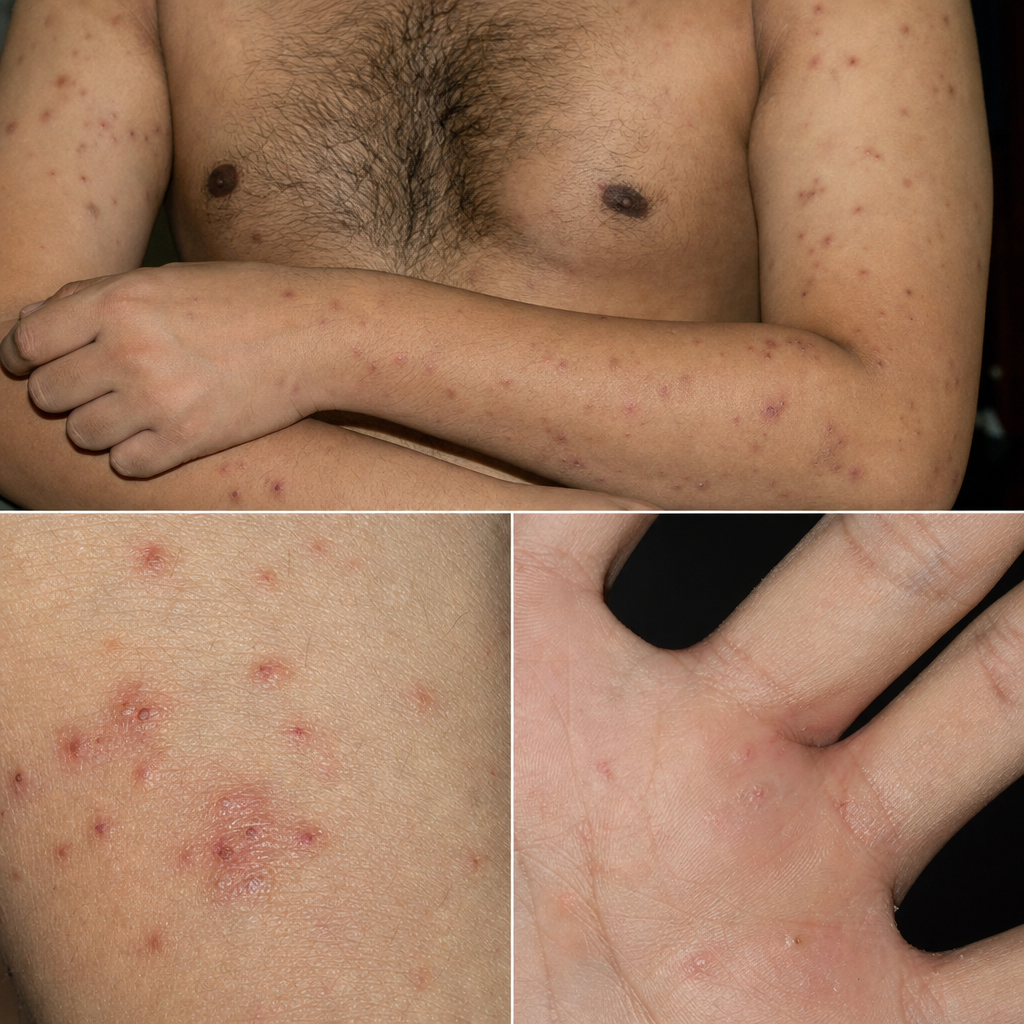
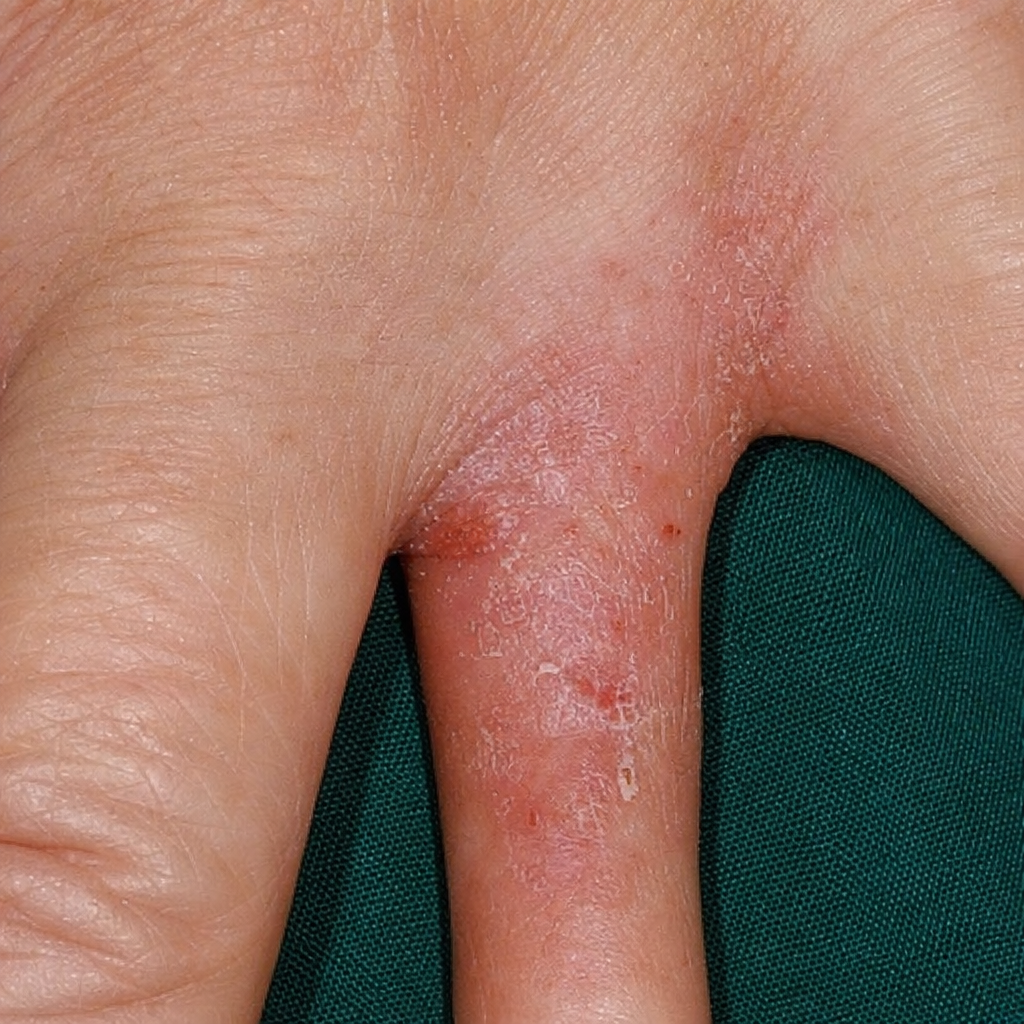
Not a feature of scabies -
Characteristic lesion of scabies is-
Scalp and face are involved in-
What is the average number of mites found on the body in a person suffering from regular scabies?
All of the following are true regarding Norwegian scabies except
Which is TRUE about scabies?
What is the primary causative agent of scabies?
A 5-year-old child presents with burrows on the hands and wrists, particularly between the fingers. What is the first-line treatment to eradicate the causative organism?
In which condition is the 'volcano sign' typically observed?
Oral treatment of choice for scabies is?
Explanation: ***Fever is a common finding (Correct Answer)*** - **Fever is NOT a typical feature** of uncomplicated scabies. This makes it the correct answer to this negation question. - Scabies is a parasitic infestation causing intense itching and skin lesions, not systemic fever. - While severe scratching can lead to **secondary bacterial infections** which may cause localized fever or warmth, a generalized fever is not a direct feature of the scabies infestation itself. *Itching is more severe at night (Incorrect)* - The **itching in scabies is characteristically worse at night**, a phenomenon believed to be due to the mites' increased activity in warmer conditions under bedding or a decreased distraction from other stimuli. - This nocturnal pruritus is a **hallmark symptom** and a key diagnostic clue for scabies. *Family history is found (Incorrect)* - Scabies is **highly contagious** and spreads through direct, prolonged skin-to-skin contact, making it common for multiple family members or close contacts to be affected. - Therefore, a **family history or outbreak in a household** is a very common finding and helps in diagnosis. *Burrows are seen in Stratum Corneum (Incorrect)* - The female scabies mite burrows into the **stratum corneum** (the outermost layer of the epidermis) to lay eggs, creating characteristic linear or serpiginous lesions. - These **mite burrows** are the pathognomonic physical sign of scabies, although they can be difficult to find due to scratching and secondary skin changes.
Explanation: ***Burrow*** - The **burrow** is the path created by the female **scabies mite (Sarcoptes scabiei)** as it tunnels into the superficial layer of the epidermis to lay eggs. - It appears as a fine, wavy, thread-like line, often grayish or skin-colored, and is considered the **pathognomonic lesion** of scabies. *Papule* - While **papules** can be present in scabies, often as a result of an immune reaction to the mites and their products, they are not the characteristic, diagnostic lesion itself. - Papules are more general skin findings and can be associated with many different dermatological conditions. *Vesicle* - **Vesicles** (small blisters) may occasionally be seen in scabies, particularly in infants or in severe cases, but they are not the primary or most characteristic lesion. - Vesicles are more commonly associated with conditions like viral infections (e.g., herpes) or allergic contact dermatitis. *Fissure* - **Fissures** are linear cracks in the skin, often caused by extreme dryness or inflammation, and they are not a characteristic primary lesion of scabies. - While scratching from intense itching in scabies could potentially lead to secondary skin changes like excoriations or, in severe cases, fissures, they are not directly formed by the mite.
Explanation: ***Infantile scabies*** - In **infants** and young children, scabies can present with widespread lesions, often involving the **head, neck, face, palms, and soles**, unlike in adults. - The immune system in infants is less developed, leading to more generalized and severe manifestations. - This is the characteristic distribution pattern that distinguishes infantile scabies. *Nodular scabies* - Characterized by persistent red-brown **nodules**, typically located in the axillae, groin, and scrotum. - While a variant of scabies, it does not specifically involve the scalp and face as a primary distinguishing feature. - These nodules can persist even after treatment. *Norwegian scabies* - Also called **crusted scabies**, this severe form occurs in immunocompromised patients. - Characterized by **thick, crusted lesions** with millions of mites, highly contagious. - While it can involve extensive body areas including face in immunocompromised hosts, the typical presenting feature is thick crusts, not the predilection for scalp/face seen in infantile scabies. *Adult scabies* - In adults, scabies typically spares the **head and neck** area, affecting interdigital spaces, wrists, elbows, axillae, and groin. - Involvement of the face and scalp is rare in adults, unless they are immunocompromised. - This distribution pattern is the key differentiating feature from infantile scabies.
Explanation: ***10 to 15*** - In **classic scabies**, the average number of **Sarcoptes scabiei** mites present on the host's body typically ranges from 10 to 15. - This relatively low number of mites is responsible for the intense **pruritus** and characteristic rash due to the host's immune response to mite antigens and waste products. *1 to 5* - While a very small number of mites might be present in the **early stages** of infestation, an average of 1 to 5 is generally too low for a full-blown symptomatic case of **classic scabies**. - A lower mite count is more typical of **atypical presentations** or infestations in partially treated individuals. *15 - 20* - This range is slightly higher than the typical average reported for **classic scabies**, though still within a reasonable, albeit less common, variation. - A significantly higher number of mites, into the thousands or millions, is characteristic of **crusted (Norwegian) scabies**, a much more severe form of the disease. *3* - Three mites represent a very low burden for a person with **classic scabies**. - Although the total number of mites is often small, an average of three significantly underestimates the typical infestation load that causes widespread itching and rash.
Explanation: ***Children commonly affected*** - **Norwegian scabies** (also known as **crusted scabies**) primarily affects individuals with **immunocompromise**, **neurological impairment**, or the **elderly**. - While scabies can affect children, the crusted form is **uncommon** in healthy children. *Large number of parasites present* - This statement is true; **crusted scabies** is characterized by an **exceedingly high mite burden**, sometimes numbering in the millions. - The large number of mites leads to the characteristic **crusting and hyperkeratosis**. *Psoriasiform plaques common* - This statement is true; the extensive **hyperkeratosis** and **crusting** in Norwegian scabies often manifest as **thick, scaly plaques** that can resemble **psoriasis**. - These lesions are typically found on the **extremities**, **trunk**, and often involve the **nails** and **scalp**. *Itching is mild or absent* - This statement is true; despite the massive mite load, patients with crusted scabies often experience **surprisingly little or no pruritus**. - This reduced or absent itching is thought to be due to an impaired immune response that also prevents the typical inflammatory reaction to the mites.
Explanation: ***Treatment includes treating contacts*** - **Scabies** is highly contagious and spreads easily through close physical contact, so treating all close contacts, even if asymptomatic, is crucial to prevent re-infestation and control outbreaks. - This approach helps break the cycle of transmission and effectively eradicates the **mite infestation** from a household or community setting. *Burrows commonly affect face* - **Scabies burrows** are typically found in skin folds and warm areas, such as between fingers, wrists, armpits, and groin, but rarely affect the face in adults. - In infants and young children, however, **facial involvement** can occur due to their underdeveloped immune systems. *Ivermectin is contraindicated* - **Ivermectin** is an effective oral treatment for scabies, particularly in cases of resistant or crusted scabies. - It is **not contraindicated** in most patients, though it should be used with caution in pregnant or breastfeeding women and young children. *Single application is sufficient* - A single application of topical treatments like **permethrin cream** is often insufficient to eradicate all mites and eggs, necessitating a second application 7 to 14 days later. - This two-dose regimen ensures that any newly hatched mites from eggs that survived the initial treatment are also eliminated, preventing treatment failure.
Explanation: ***Sarcoptes scabiei*** - _Sarcoptes scabiei_ var. _hominis_ is the **mite** responsible for causing scabies in humans - These mites burrow into the superficial layer of the **epidermis**, leading to intense itching and characteristic skin lesions - Scabies is transmitted through **prolonged skin-to-skin contact** and causes **nocturnal pruritus** *Pediculus humanus* - _Pediculus humanus_ refers to human lice, specifically head lice (_P. humanus capitis_) and body lice (_P. humanus humanus_) - While they cause pruritus and skin irritation (pediculosis), they are ectoparasites that do not burrow into the skin like scabies mites *Pthirus pubis* - _Pthirus pubis_, commonly known as the **pubic louse** or "crab louse," infests the coarse hair of the human body, primarily the pubic region - It causes intense itching in affected areas but does not burrow into the skin like the scabies mite *Demodex folliculorum* - _Demodex folliculorum_ are mites that commonly reside in or near **hair follicles** of mammals, including humans - While often asymptomatic, they can contribute to skin conditions such as **rosacea** and **demodicosis**, but they are not the cause of scabies
Explanation: **Topical permethrin** - **Permethrin cream (5%)** is the **first-line treatment** for **scabies** in children aged 2 months and older, applied to all skin surfaces from the neck down. - It works as a **neurotoxin** to the **Sarcoptes scabiei mite**, effectively killing both the mites and their eggs. *Oral ivermectin* - **Oral ivermectin** is used for **crusted scabies**, in immunocompromised patients, or when topical treatments fail or are not tolerated. - It is generally **not recommended as first-line** for uncomplicated scabies due to potential side effects and limited data in young children. *Topical corticosteroids* - **Topical corticosteroids** are used to reduce the **inflammation** and **itching** associated with scabies, but they do **not kill the mites** or treat the underlying infestation. - Their primary role is symptomatic relief, usually prescribed **after or in conjunction with** a miticide. *Oral antihistamines* - **Oral antihistamines** are used to alleviate severe **pruritus (itching)** caused by scabies by blocking histamine release. - Similar to corticosteroids, they provide **symptomatic relief** but do not eradicate the *Sarcoptes scabiei* mites.
Explanation: ***Correct: Leishmaniasis*** - The **volcano sign** is a classic dermatoscopic feature described in **cutaneous leishmaniasis**, characterized by a central **yellowish-white amorphous area** (representing a keratin plug or scales) surrounded by a reddish-to-violaceous halo. - This sign is attributed to the presence of **inflammatory infiltrate** and **parasites** in the dermis, which causes the specific morphological changes observed under dermoscopy. *Incorrect: Leprosy* - While leprosy can cause various skin lesions, such as **macules, papules, nodules, or plaques**, the "volcano sign" is **not a characteristic dermatoscopic finding** for this condition. - Dermatoscopic features of leprosy often include vascular changes, follicular plugs, and granulomas, but not the specific volcano-like appearance. *Incorrect: Lupus vulgaris* - This is a form of **cutaneous tuberculosis** presenting as red-brown plaques with an "apple-jelly" nodule appearance on diascopy. - The dermatoscopic findings typically include **yellowish-brown globules**, telangiectasias, and sometimes ulceration, but not the "volcano sign." *Incorrect: DLE* - **Discoid lupus erythematosus (DLE)** is a chronic inflammatory skin condition characterized by well-demarcated, erythematous plaques with follicular plugging, scaling, and atrophy. - Dermatoscopic features of DLE often include **follicular plugs**, prominent perifollicular scale, **keratotic plugs**, and dilated vessels, which differ from the "volcano sign."
Explanation: ***Ivermectin*** - **Ivermectin** is the oral treatment of choice for **scabies**, especially in cases of crusted scabies or when topical treatments fail or are impractical. - It works by paralyzing and killing the **Sarcoptes scabiei mites**, disrupting their nervous system. *Albendazole* - **Albendazole** is an **anthelmintic drug** primarily used to treat a variety of parasitic worm infections, such as hookworm, roundworm, and tapeworm. - It is **not effective** against **Sarcoptes scabiei mites** and is therefore not indicated for scabies treatment. *Itraconazole* - **Itraconazole** is an **antifungal medication** used to treat fungal infections such as aspergillosis, blastomycosis, and histoplasmosis. - It has **no activity** against **parasites** like the scabies mite. *Sulphur* - **Sulfur-containing preparations**, such as sulfur ointment (usually 6-10%), are **topical treatments** for scabies. - While effective, it is not an **oral treatment**, and its strong odor and potential for skin irritation limit its use, especially in children.
Scabies
Practice Questions
Pediculosis
Practice Questions
Cutaneous Larva Migrans
Practice Questions
Leishmaniasis
Practice Questions
Onchocerciasis
Practice Questions
Myiasis
Practice Questions
Tungiasis
Practice Questions
Cutaneous Amebiasis
Practice Questions
Cutaneous Manifestations of Malaria
Practice Questions
Ectoparasitic Infestations
Practice Questions
Diagnosis of Parasitic Infestations
Practice Questions
Antiparasitic Therapy
Practice Questions
Get full access to all questions, explanations, and performance tracking.
Start For Free