A child has a rash. His family history is positive for asthma. What could be the most probable diagnosis?
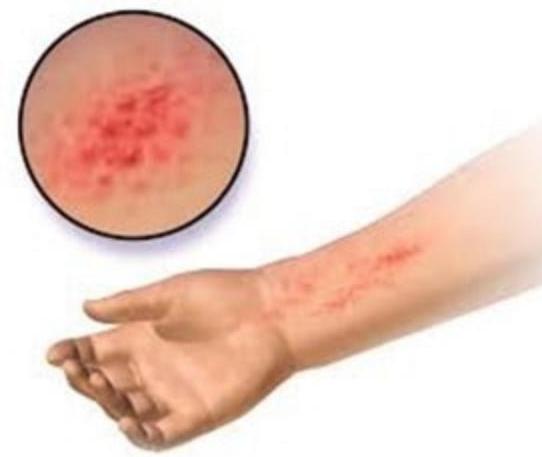
A patient comes to you with skin reactions after visiting the hair dresser. What will you do to confirm the diagnosis of contact dermatitis?
What is the diagnosis if a patient can only see 3 green dots on the Worth 4 Dot test?
Cover test and prism testing are used to diagnose which ocular condition?
Which test is essential in a patient with suspected Cushing's syndrome for diagnosis confirmation?
Most sensitive test for carpal tunnel syndrome -
A 52 year old lady presents with constant leakage of urine and dysuria two weeks after a complicated total abdominal hysterectomy. A diagnosis of Vesicovaginal fistula is suspected. The most important test for the diagnosis is:
Most sensitive test for myaesthenia gravis
A patient presents with fever and retro-orbital pain. Which investigation should be conducted next for confirmation of dengue fever?
Best provocative test for diagnosis of Gastrinoma is:
Explanation: ***Atopic dermatitis*** - The presence of a rash in a child with a family history of **asthma** strongly suggests atopic dermatitis, as it is part of the **atopic triad** (eczema, asthma, allergic rhinitis). - Atopic dermatitis often presents with **erythematous, pruritic patches** and plaques, commonly affecting flexural areas like the antecubital and popliteal fossae, as well as the face and neck in younger children. *Seborrheic dermatitis* - This condition typically presents with **greasy, yellowish scales** on an erythematous base, often affecting areas rich in sebaceous glands such as the scalp, face (nasolabial folds), and chest. - While it can occur in infants, it does not have the strong association with a family history of asthma seen in atopic dermatitis. *Allergic contact dermatitis* - This rash results from an **exposure to an allergen**, leading to a localized, erythematous, and pruritic eruption, often with vesicles or bullae, at the site of contact. - The history does not provide information about a specific allergen exposure, and while it could produce a similar-looking rash, the family history of asthma points more strongly to atopic diathesis. *Erysipelas* - Erysipelas is a superficial skin infection, usually caused by *Streptococcus pyogenes*, presenting as a **well-demarcated, intensely erythematous, warm, and painful rash** with a raised border. - This is an **acute bacterial infection** and would typically be accompanied by systemic symptoms like fever and chills, which are not mentioned in the child's presentation.
Explanation: ***Patch Test*** - A **patch test** is the gold standard for diagnosing **allergic contact dermatitis** by directly applying suspected allergens to the skin. - This test identifies specific substances that cause a delayed hypersensitivity reaction, which is characteristic of contact dermatitis. *S IgE* - **Serum IgE** levels are primarily indicative of **Type I hypersensitivity** reactions, such as allergic rhinitis or asthma. - Contact dermatitis is a **Type IV delayed hypersensitivity reaction**, not mediated by IgE antibodies. *Allergy Test* - The term "allergy test" is broad and can refer to various methods including skin prick tests, IgE blood tests, or patch tests. - Without specifying **patch testing**, other forms of allergy tests are less appropriate for diagnosing contact dermatitis, as they target different immune mechanisms. *VDRL* - **VDRL (Venereal Disease Research Laboratory)** test is used to screen for **syphilis**, a sexually transmitted infection. - It has no relevance to the diagnosis of contact dermatitis, which is an inflammatory skin condition caused by contact with an allergen or irritant.
Explanation: ***Right eye suppression*** - Seeing **three green dots** exclusively indicates that the patient is only perceiving input from the **left eye**. - In the Worth 4 Dot test, the **left eye** (viewing through a green filter) sees **three green dots**: the white dot at the top (which appears green through the filter) plus the two lateral green dots. - The **right eye** (viewing through a red filter) normally sees **two red dots**: the white dot at the top (which appears red) plus the red dot at the bottom. - Since the patient sees only **three green dots**, the visual input from the **right eye is being suppressed**. *Crossed diplopia* - **Crossed diplopia** (heteronymous diplopia) occurs when the image from the right eye is perceived to the left of the image from the left eye. - This typically occurs with **exotropia** (divergent strabismus) and would result in seeing **five or more dots** (patient perceives both eyes' images but misaligned), not just three green. *Uncrossed diplopia* - **Uncrossed diplopia** (homonymous diplopia) occurs when the image from the right eye is perceived to the right of the image from the left eye. - This is usually associated with **esotropia** (convergent strabismus) and would also lead to the perception of **five or more dots** (both eyes' images perceived but misaligned), not only three green dots. *Left eye suppression* - If there were **left eye suppression**, the patient would see **two red dots** from the right eye only (the white dot appearing red plus the red dot at the bottom). - Seeing **three green dots** confirms the **left eye input is dominant** and the **right eye is suppressed**.
Explanation: ***Both A & B*** - The **cover test** and **prism testing** are fundamental diagnostic tools used to detect and quantify **both manifest and latent ocular deviations**. - **Cover-uncover test** detects **strabismus (heterotropia)** - a manifest deviation present even with both eyes open. - **Alternate cover test** reveals the **total deviation**, including both manifest strabismus and latent heterophoria. - **Prism testing** is used to **quantify both conditions** - measuring the angle of deviation in both tropias and phorias. - These tests work together to diagnose the full spectrum of ocular misalignment disorders. *Strabismus (alone)* - While partially correct, this option is incomplete. - Cover test and prism testing are indeed used for strabismus, but they also diagnose heterophoria. - Selecting only strabismus ignores the heterophoria component. *Heterophoria (alone)* - While partially correct, this option is incomplete. - Cover test (especially alternate cover test) and prism testing do diagnose heterophoria, but they equally diagnose manifest strabismus. - The cover-uncover test is the **primary clinical test for detecting manifest strabismus**. - Selecting only heterophoria ignores the strabismus component. *None of the options* - Incorrect, as both strabismus and heterophoria are correctly diagnosed using these tests.
Explanation: ***24-hour urine cortisol*** - This test directly measures the total amount of **free cortisol excreted over a 24-hour period**, reflecting the body's overall cortisol production [1]. - An elevated **24-hour urine free cortisol** is a primary diagnostic test used to confirm the presence of **hypercortisolism**, a hallmark of Cushing's syndrome [1]. *Plasma ACTH* - While important for determining the **etiology of Cushing's syndrome** (ACTH-dependent vs. ACTH-independent), it does not confirm the diagnosis of Cushing's syndrome itself [1]. - A normal or high ACTH would suggest an ACTH-dependent cause (e.g., pituitary adenoma or ectopic ACTH production), whereas a low ACTH would suggest an ACTH-independent cause (e.g., adrenal adenoma) [1]. *Serum aldosterone* - This hormone is primarily involved in **fluid and electrolyte balance** and is relevant in diagnosing conditions like primary aldosteronism, not Cushing's syndrome. - Cushing's syndrome is characterized by **excess cortisol**, not typically by primary abnormalities in aldosterone secretion. *Serum renin* - **Renin** is an enzyme released by the kidneys that plays a crucial role in the **renin-angiotensin-aldosterone system**, regulating blood pressure. - It is not directly involved in the diagnosis or confirmation of **Cushing's syndrome**, which concerns cortisol excess.
Explanation: ***Phalen's test*** - **Phalen's test** is performed by having the patient forcefully flex their wrists together for 60 seconds. - The appearance of **paresthesias** (tingling or numbness) in the median nerve distribution is considered a positive and highly **sensitive** result for carpal tunnel syndrome. *Tinel's sign* - **Tinel's sign** involves gently tapping over the median nerve at the wrist. - While it can reveal a positive result in some cases, its **sensitivity** for carpal tunnel syndrome is generally **lower** than Phalen's test. *Tourniquet test* - The **tourniquet test** (or **pressure provocation test**) involves applying a blood pressure cuff to the arm and inflating it above systolic pressure. - This test is designed to reproduce symptoms by increasing pressure within the carpal tunnel, but it is **less sensitive** compared to Phalen's test for initial screening. *None of the options* - This option is incorrect, as **Phalen's test** is widely recognized as having the highest sensitivity among the listed clinical tests for carpal tunnel syndrome. - While **nerve conduction studies** are the gold standard for definitive diagnosis, among the physical examination tests, Phalen's is most sensitive.
Explanation: ***Triple Swab Test*** - The **Triple Swab Test** (also known as the **dye test** or **tampon test**) is the **gold standard diagnostic test** for confirming vesicovaginal fistula. - **Methylene blue** or indigo carmine dye is instilled into the bladder via a catheter, and tampons are placed in the vagina. - If the tampon stains blue, it **confirms the diagnosis** of vesicovaginal fistula by demonstrating direct communication between bladder and vagina. - This is a **simple, non-invasive, and definitive diagnostic test** that directly proves the presence of a fistula. *Cystoscopy* - **Cystoscopy** is important for **evaluation and surgical planning** rather than initial diagnosis. - It allows direct visualization of the **fistula site, size, and proximity to ureteral orifices**, which is crucial for planning repair. - While it can identify the fistula, it is an **invasive procedure** and is typically performed after diagnosis is confirmed, to characterize the fistula before surgical intervention. *Urine culture* - A **urine culture** identifies bacterial infections and guides antibiotic treatment for urinary tract infections. - While UTIs commonly accompany vesicovaginal fistula and cause dysuria, urine culture **does not diagnose the fistula itself**. - It is useful for managing concurrent infection but not for confirming the anatomical defect. *IVP* - **Intravenous Pyelogram (IVP)** is primarily used to assess **upper urinary tract pathology** and ureteral integrity. - It may show contrast leakage but is **not specific for vesicovaginal fistula** and does not provide direct confirmation. - IVP is more useful for ruling out ureteral injury or ureterovaginal fistula rather than diagnosing vesicovaginal fistula.
Explanation: ***Single fibre Electromyography (EMG)*** - This is the **most sensitive test** for myasthenia gravis, detecting abnormalities in neuromuscular transmission even in subclinical cases [1]. - It measures the variability in the **inter-potential interval** (jitter) between two muscle fibers innervated by the same motor neuron, showing increased jitter or blocking in affected individuals [1]. *Edrophonium test (Tensilon test)* - While historically used, its sensitivity is lower than SFEMG, and it carries risks of **cholinergic crisis** or bradycardia. - It involves administering a short-acting **acetylcholinesterase inhibitor** and observing for temporary improvement in muscle weakness. *Multiple fibre EMG* - This technique samples multiple muscle fibers but is less precise than single fiber EMG and may not detect subtle neuromuscular transmission defects. - It is more commonly used to assess the **architecture of motor units** in neuropathic or myopathic conditions [1]. *Repetitive nerve stimulation* - This test involves stimulating a nerve at low frequencies (2-3 Hz) and looking for a **decremental response** (a >10% drop in amplitude) in the compound muscle action potential. - Its sensitivity is good for generalized myasthenia gravis but lower for ocular or mild forms, making it less sensitive overall than SFEMG.
Explanation: ***NS1 antigen test*** - The **NS1 antigen test** is highly sensitive and specific for dengue in the **early stages** of infection (typically 0-7 days after symptom onset), which is when a patient with fever and retro-orbital pain would likely present. - It detects a non-structural protein of the dengue virus, indicating **active viral replication**. *Viral culture* - **Viral culture** for dengue is time-consuming and technically demanding, making it impractical for rapid diagnosis in clinical settings, especially when an urgent confirmation is needed for patient management. - It is primarily used for research purposes rather than routine clinical diagnosis [2]. *IgM ELISA* - **IgM ELISA** detects antibodies produced in response to dengue infection, which typically become detectable **5-7 days after symptom onset**. - While useful for confirming dengue in later stages of illness, it may yield a **false negative** result if performed too early in the course of the disease [2]. *PCR* - **PCR (Polymerase Chain Reaction)** detects dengue viral RNA and is highly sensitive and specific in the **early acute phase** of infection (first 5 days) [1]. - However, it is generally more expensive, requires specialized laboratory equipment, and has a longer turnaround time compared to the NS1 antigen test, making NS1 a more accessible initial diagnostic choice.
Explanation: ***Secretin injection test*** - The **secretin injection test** is the most reliable provocative test for gastrinoma, leading to a paradoxical increase in gastrin levels [1]. - In normal individuals, secretin suppresses gastrin release, but in gastrinoma, it stimulates **gastrin secretion** [1]. *Ca++ infusion test* - The **calcium infusion test** can also stimulate gastrin release in gastrinoma patients, but it is less specific and potentially more risky than the secretin test due to potential side effects like cardiac arrhythmias. - It involves infusing calcium gluconate to observe any uncharacteristic rise in gastrin. *ACTH stimulation test* - The **ACTH stimulation test** is used to evaluate adrenal gland function, particularly in suspected cases of adrenal insufficiency or hypercortisolism [2]. - It does not have any direct relevance to the diagnosis of **gastrinoma**. *Steroid assay* - **Steroid assays** measure levels of various steroid hormones (e.g., cortisol, aldosterone) in the body to assess adrenal or gonadal function. - This test is not used for diagnosing **gastrinoma**.
Get full access to all questions, explanations, and performance tracking.
Start For Free