HR-180, BP-60/40, temp-39.5°C, ETCO2-65 post induction. Most likely diagnosis:
A 22-year-old woman presents with diffuse hair loss for 1 month. She had a past history of enteric fever 4 months ago. What is the likely cause?
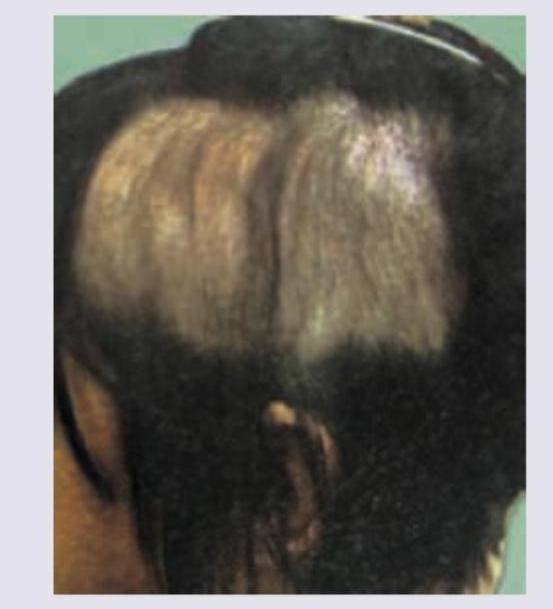
The following patient presented to the OPD with history of hair loss. There was no erythema, scarring or scratching. Diagnosis is:
Rapid, diffuse, excessive hair loss occurring 3 months after childbirth is due to?
A male presents with alopecia and exclamation mark hairs. Diagnosis?
A female presented with complaints of hair fall. Her delivery was 2 months ago. Physician diagnosed her condition as Telogen Effluvium. All of the following are true regarding telogen effluvium, EXCEPT:
A male presents with alopecia and exclamation mark hairs. Diagnosis?
Swarm of bees appearance seen in?
Non-scarring alopecia is associated with all except?
Consider the following causes of alopecia: 1. Androgenetic alopecia 2. Alopecia areata 3. Telogen effluvium 4. Lichen planopilaris. Which among the following causes non-scarring alopecia?
Explanation: ***Malignant hyperthermia*** - The rapid onset of **tachycardia (HR-180)**, **hyperthermia (temp-39.5°C)**, and profoundly elevated **ETCO2 (65 mmHg)** immediately following anesthetic induction is the classic presentation of malignant hyperthermia. - This condition is a pharmacogenetic disorder, triggered by volatile anesthetics (e.g., isoflurane) and succinylcholine, leading to uncontrolled skeletal muscle metabolism and hypercapnia. *Thyroid storm* - While thyroid storm can cause **tachycardia** and **hyperthermia**, the sudden and dramatic rise in **ETCO2** is not a characteristic feature. - Onset is typically less abrupt and often associated with pre-existing hyperthyroidism or a precipitating event like surgery or infection, rather than immediate post-induction. *Anaphylaxis* - Anaphylaxis typically presents with **hypotension (BP-60/40)**, **tachycardia**, and often features like **bronchospasm**, **rash**, or **angioedema**. - Although it can cause **bronchospasm** leading to increased ETCO2, the extreme elevation to 65 mmHg is less typical, and **profound hyperthermia** is not a primary symptom. *Septic shock* - **Septic shock** is characterized by **hypotension** and **tachycardia**, often accompanied by **fever**, but its onset is usually prolonged over hours to days. - A sudden increase in **ETCO2** to 65 mmHg immediately post-induction is uncharacteristic for sepsis, which relates to an exaggerated, systemic inflammatory response to infection.
Explanation: ***Telogen effluvium*** - **Telogen effluvium** is characterized by diffuse hair shedding, often occurring 2-4 months after a significant physiological or psychological stressor, such as **enteric fever**. - The stress prematurely shifts a large number of hair follicles from the **anagen (growth)** phase into the **telogen (resting)** phase, leading to synchronized shedding. *Androgenic alopecia* - This condition presents as a gradual, patterned hair loss, typically characterized by **receding hairline** and thinning at the crown in men. - In women, it often appears as **diffuse thinning** over the crown, but it's not usually acute or triggered by an infection in the manner described. *Alopecia areata* - **Alopecia areata** is an autoimmune condition causing **sudden, well-demarcated patches of hair loss**, not diffuse shedding. - It is frequently associated with other autoimmune diseases, and the hair loss pattern is distinct from the patient's presentation. *Anagen effluvium* - **Anagen effluvium** causes rapid, diffuse hair loss during the **anagen (growth)** phase, often triggered by chemotherapy or radiation. - The onset is typically much faster (days to weeks) after the trigger, unlike the delayed onset seen in this case.
Explanation: ***Alopecia areata*** - The image shows **well-demarcated patches of hair loss** with no signs of inflammation or scarring, which is characteristic of alopecia areata. - This condition is an **autoimmune disorder** where the immune system attacks hair follicles, leading to patchy hair loss. - Classic presentation includes **smooth, round patches** with no erythema or scarring. *Trichotillomania* - This condition involves **compulsive hair pulling**, which typically results in **irregularly shaped patches of hair loss** with hairs of varying lengths. - Hair loss in trichotillomania often shows **broken hair shafts** and may be associated with signs of trauma or follicular damage. - The absence of scratching/pulling behavior and the well-defined patches make this less likely. *Telogen effluvium* - Telogen effluvium presents as **diffuse hair shedding** (increased shedding of resting phase hairs) rather than the distinct, localized patches seen in the image. - It usually follows a **stressful event** (e.g., illness, surgery, childbirth) and there's no visible inflammation or scarring. - Would not present as well-demarcated patches. *Tinea infection* - Tinea capitis (ringworm of the scalp) would typically present with **erythema, scaling, inflammation**, and sometimes pustules or kerion formation within the patches of hair loss. - The patches of hair loss in tinea infections often show **broken hairs** or "black dots" where hairs have broken off at the scalp surface. - The **absence of erythema** in this case rules out tinea infection.
Explanation: ***Telogen effluvium*** - This condition is characterized by an excessive shedding of **club hairs** from the hair follicle, typically occurring 2-4 months after a significant stressor such as **pregnancy and childbirth**. - During pregnancy, high estrogen levels increase the number of follicles in the anagen (growth) phase; after delivery, estrogen drops, and many follicles simultaneously enter the **telogen (resting) phase**, leading to synchronized shedding. *Anagen effluvium* - This type of hair loss is rapid and severe, occurring when a significant percentage of **hair follicles** in the **anagen phase** are abruptly stopped from growing. - It is often seen with **chemotherapy, radiation therapy**, or exposure to toxins, which damage actively dividing hair matrix cells. *Alopecia areata* - This is an **autoimmune condition** where the body's immune system attacks hair follicles, leading to distinct, typically **round patches of hair loss**. - It can affect any hair-bearing area and is not directly linked to hormonal changes post-pregnancy. *Androgenetic alopecia* - Commonly known as **male or female pattern baldness**, this is a genetic condition influenced by androgens, characterized by a progressive **miniaturization of hair follicles**. - It presents as a characteristic pattern of thinning, such as a receding hairline or thinning at the crown, and is not typically a rapid, diffuse postpartum event.
Explanation: ***Alopecia areata*** - This condition is an **autoimmune disorder** that causes non-scarring hair loss, which can range from small patches to complete hair loss on the scalp (**alopecia totalis**) or entire body (**alopecia universalis**). - The presence of **exclamation mark hairs** (short hairs that are narrower at the base near the scalp and wider at the tip), along with sudden, patchy hair loss, is a classic diagnostic sign. *Telogen effluvium* - This type of hair loss is characterized by **diffuse shedding** of resting (telogen) hairs across the scalp, often triggered by a significant stressor like childbirth, severe illness, or medications. - While it causes widespread hair thinning, it does not typically present with the focal patches or distinct **exclamation mark hairs** characteristic of alopecia areata. *Androgenic alopecia* - Also known as **male-pattern baldness**, this is a common form of progressive hair thinning that typically presents with a receding hairline and thinning at the crown. - It is a **hereditary condition** influenced by androgens and does not involve inflammation or the presence of exclamation mark hairs. *Tinea capitis* - This is a **fungal infection of the scalp** that can cause patches of scaling, inflammation, broken hairs, and sometimes pustules or kerion. - Unlike alopecia areata, it is an infectious process, and while it causes hair breakage, it does not specifically produce **exclamation mark hairs**; rather, it often shows black dots where hairs have broken off at the scalp surface.
Explanation: ***Scarring*** - **Telogen effluvium** is a **non-scarring alopecia**, meaning it does not cause permanent damage to the hair follicles or lead to scar tissue formation. - The hair loss is temporary and reversible, as the follicles remain intact and capable of regrowth. *Diffuse hair thinning* - Telogen effluvium typically presents as **generalized or diffuse hair thinning** across the scalp, rather than localized patches of baldness. - This thinning is because a large number of hair follicles prematurely enter the **telogen (resting) phase**, leading to increased shedding. *Metabolic stress* - **Metabolic stressors** such as childbirth, severe illness, surgery, significant weight loss, or nutritional deficiencies are common triggers for telogen effluvium. - These stressors disrupt the normal hair growth cycle, causing a greater proportion of hairs to shift into the resting phase. *Recovery within 6 months* - Telogen effluvium is usually a **self-limiting condition**, with hair regrowth typically occurring within 3 to 6 months after the inciting event has passed and the body has recovered. - Complete recovery of hair density may take longer, but significant improvement is often seen within this timeframe.
Explanation: ***Alopecia areata*** - **Exclamation mark hairs**, which are short, broken hairs that taper near the scalp, are a **pathognomonic sign** of alopecia areata. - This condition presents with **non-scarring hair loss**, often in **well-demarcated patches**, consistent with the general term "alopecia." *Telogen effluvium (hair shedding due to stress or other factors)* - Characterized by **diffuse hair shedding** predominantly in the **telogen (resting)** phase, not specifically focal patches or exclamation mark hairs. - Often triggered by significant physical or emotional stress, illness, or medications, and **lacks the characteristic exclamation mark hairs**. *Tinea capitis (fungal infection of the scalp)* - Presents with patches of **scaling, redness, and inflammation**, sometimes with **black dots** (broken hairs at the scalp surface), but not exclamation mark hairs. - Often associated with **lymphadenopathy** and can be diagnosed by **KOH preparation** or fungal culture. *Androgenic alopecia (pattern hair loss)* - Involves a **gradual miniaturization of hair follicles** leading to a receding hairline and/or thinning crown in men, and diffuse thinning in women, following a specific pattern. - It does **not typically feature exclamation mark hairs** or discrete patches of complete hair loss.
Explanation: ***Alopecia areata*** - The "swarm of bees" appearance refers to the characteristic **peribulbar lymphocytic inflammation** seen on scalp biopsy in active alopecia areata. - This finding represents an **immune response targeting the hair follicles**, leading to non-scarring hair loss. *Telogen effluvium* - Histologically, telogen effluvium is characterized by a high proportion of **telogen hairs** in the hair counts and **no significant inflammation** around the follicles. - The "swarm of bees" peribulbar infiltrate is not a feature of telogen effluvium, which is typically a reaction to a systemic stressor. *Androgenetic alopecia* - Androgenetic alopecia is characterized by **follicular miniaturization**, where vellus hairs replace terminal hairs, and a **decrease in the number of hair follicles**. - It does not show the "swarm of bees" peribulbar lymphocytic infiltrate; instead, there might be subtle inflammation or fibrosis in advanced stages but not the dense peribulbar type. *Anagen effluvium* - Anagen effluvium is characterized by the **sudden shedding of hairs in the anagen phase** due to a toxic or inflammatory insult disrupting hair matrix keratinocyte proliferation. - Histology often shows **dystrophic anagen hairs** and damaged hair shafts, but not the specific "swarm of bees" lymphocytic infiltrate seen in alopecia areata.
Explanation: ***Frontal fibrosing alopecia*** - This condition is a form of **lichen planopilaris**, which causes **scarring alopecia** due to destruction of hair follicles and replacement with fibrous tissue. - It results in a **receding hairline** and eyebrow loss, with irreversible hair loss. *Telogen effluvium* - This is a common cause of **non-scarring alopecia**, characterized by diffuse hair shedding triggered by various stressors like illness, stress, or medications. - The hair follicles enter the **telogen phase** prematurely, leading to increased shedding but typically regrowth once the trigger is removed. *Androgenetic alopecia* - Often referred to as **male or female pattern baldness**, this is a form of **non-scarring alopecia** driven by genetic predisposition and androgens. - It causes a progressive miniaturization of hair follicles, leading to thinning hair, but the follicles remain present and capable of producing hair. *Alopecia areata* - This is an **autoimmune condition** that causes **non-scarring hair loss** in patches on the scalp or other parts of the body. - The hair follicles are attacked by the immune system but are not permanently destroyed, allowing for potential regrowth.
Explanation: **1, 2, and 3** - **Androgenetic alopecia**, **alopecia areata**, and **telogen effluvium** are all forms of **non-scarring alopecia**, meaning the hair follicles are primarily affected without permanent destruction. - In these conditions, there is potential for hair regrowth as the follicular structures remain intact. *Only 4* - **Lichen planopilaris** is a type of **scarring alopecia**, characterized by permanent destruction of hair follicles and replacement with fibrous tissue. - This leads to irreversible hair loss in the affected areas. *3 and 4* - While **telogen effluvium** causes non-scarring alopecia, **lichen planopilaris** is a scarring alopecia. - Therefore, this option incorrectly groups a non-scarring and a scarring condition. *2, 3, and 4* - This option correctly identifies **alopecia areata** and **telogen effluvium** as non-scarring but incorrectly includes **lichen planopilaris**, which results in scarring alopecia. - **Lichen planopilaris** has inflammatory infiltrates that lead to permanent follicular damage.
Get full access to all questions, explanations, and performance tracking.
Start For Free