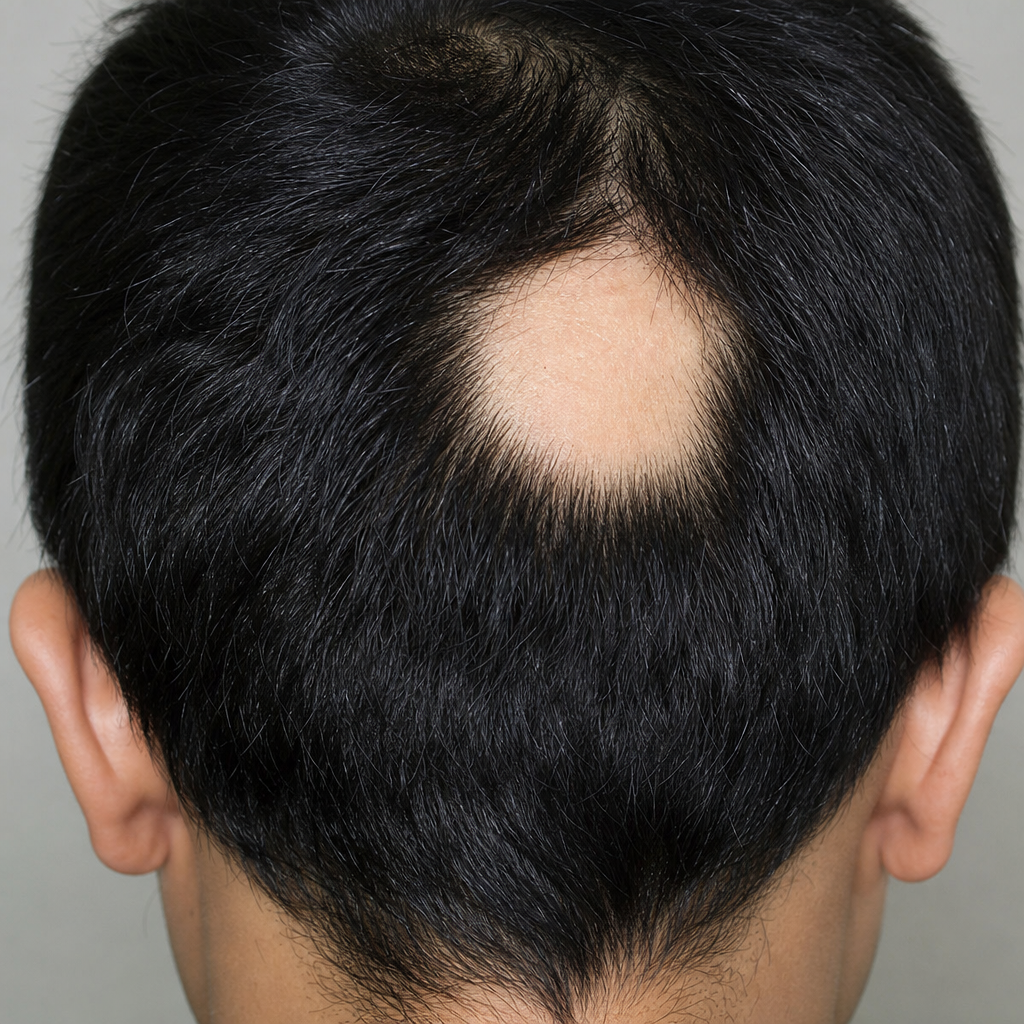
In a patient with the following lesion on scalp, what changes are seen in the nails?

Consider the following regarding the human hair growth cycle : I. Anagen is a phase of active hair growth II. Telogen is a transitional phase III. Catagen is a resting phase Which of the statements given above is/are correct?
Which one of the following is the correct description of Mee's lines, seen in chronic arsenic poisoning?
Consider the following causes of alopecia: 1. Androgenetic alopecia 2. Alopecia areata 3. Telogen effluvium 4. Lichen planopilaris. Which among the following causes non-scarring alopecia?
Non-scarring alopecia is associated with all except?
Nails are involved in all except:
Scarring alopecia is seen in:
'Exclamation mark' hair is a feature of -
Nail involvement is not a feature of –
Which of the following conditions causes alopecia without scarring -
Explanation: ***Pitting of nails*** - The image shows a patch of **alopecia areata** on the scalp. **Nail pitting** is the most common and characteristic nail change associated with alopecia areata, occurring in **10-66% of cases**. - Pitting appears as small depressions or **"ice-pick" marks** on the nail surface, resulting from defective nail matrix keratinization. - Other nail changes in alopecia areata include **trachyonychia (rough nails), red spotted lunulae, onycholysis**, and **Beau's lines**. *Dorsal pterygium of nails* - **Dorsal pterygium** occurs when the proximal nail fold fuses with and extends over the nail plate, creating a wing-like scar. - This is classically associated with **lichen planus, trauma, burns, vasculitis**, and **graft-versus-host disease** — **NOT alopecia areata**. - It can lead to permanent nail dystrophy or nail loss. *Azure nails* - **Azure nails** (blue nails) are typically associated with **Wilson's disease** (copper accumulation) or **minocycline use**, not alopecia areata. - They represent a blue-gray discoloration of the nail bed or lunula. *Yellow nail discolouration* - **Yellow nail syndrome** is a rare condition characterized by slow-growing, thickened, yellow nails, often associated with **lymphedema** and **respiratory problems** (pleural effusions, chronic bronchitis). - It is not linked to alopecia areata.
Explanation: ***I only*** - Statement I is **correct**: **Anagen is the active growth phase** of the hair cycle where hair follicle cells in the matrix rapidly divide and differentiate - The hair shaft actively grows during this phase, which typically lasts **2-7 years** and determines the maximum length of hair - **Only statement I is accurate**, making this the correct answer *III only* - This option is incorrect because statement III claims **Catagen is a resting phase**, which is medically inaccurate - **Catagen is actually the transitional/regression phase** (lasting 2-3 weeks) where hair growth stops and the follicle shrinks - The **resting phase is Telogen**, not Catagen *I, II and III* - This option is incorrect because **both statements II and III contain errors** - Statement II incorrectly identifies **Telogen as a transitional phase** when it is actually the **resting phase** (2-4 months) - Statement III incorrectly identifies **Catagen as a resting phase** when it is actually the **transitional phase** - Only statement I is correct *I and II only* - This option is incorrect because **statement II is inaccurate** - Statement II claims **Telogen is a transitional phase**, but Telogen is actually the **resting phase** where the hair remains in the follicle before shedding - The **transitional phase is Catagen**, not Telogen - Only statement I is correct, not both I and II
Explanation: ***Transverse white lines on nails of fingers and toes*** - **Mee's lines** are characteristic **white transverse bands** seen specifically on the **nails** of the fingers and toes. - They are typically associated with **arsenic poisoning** but can also be seen in other systemic illnesses. *Transverse white lines on the skin of palms and soles* - While chronic arsenic poisoning can cause **skin pigmentation changes** (melanosis) and **hyperkeratosis** on the palms and soles, it does not typically manifest as distinct white transverse lines on the skin. - Mee's lines are exclusively a **nail finding**. *Transverse red lines on the nails of fingers and toes* - **Red lines on nails** are not characteristic of Mee's lines; Mee's lines are described as **white**. - Red nail changes, such as splinter hemorrhages, are often associated with other conditions, like **endocarditis**. *Transverse red lines on the skin of palms and soles* - This description does not correspond to Mee's lines, which are **white nail changes**, nor is it a typical manifestation of chronic arsenic poisoning on the skin in this specific pattern. - Skin manifestations of arsenic poisoning on palms and soles are usually **hyperpigmentation** and **hyperkeratosis**.
Explanation: **1, 2, and 3** - **Androgenetic alopecia**, **alopecia areata**, and **telogen effluvium** are all forms of **non-scarring alopecia**, meaning the hair follicles are primarily affected without permanent destruction. - In these conditions, there is potential for hair regrowth as the follicular structures remain intact. *Only 4* - **Lichen planopilaris** is a type of **scarring alopecia**, characterized by permanent destruction of hair follicles and replacement with fibrous tissue. - This leads to irreversible hair loss in the affected areas. *3 and 4* - While **telogen effluvium** causes non-scarring alopecia, **lichen planopilaris** is a scarring alopecia. - Therefore, this option incorrectly groups a non-scarring and a scarring condition. *2, 3, and 4* - This option correctly identifies **alopecia areata** and **telogen effluvium** as non-scarring but incorrectly includes **lichen planopilaris**, which results in scarring alopecia. - **Lichen planopilaris** has inflammatory infiltrates that lead to permanent follicular damage.
Explanation: ***Frontal fibrosing alopecia*** - This condition is a form of **lichen planopilaris**, which causes **scarring alopecia** due to destruction of hair follicles and replacement with fibrous tissue. - It results in a **receding hairline** and eyebrow loss, with irreversible hair loss. *Telogen effluvium* - This is a common cause of **non-scarring alopecia**, characterized by diffuse hair shedding triggered by various stressors like illness, stress, or medications. - The hair follicles enter the **telogen phase** prematurely, leading to increased shedding but typically regrowth once the trigger is removed. *Androgenetic alopecia* - Often referred to as **male or female pattern baldness**, this is a form of **non-scarring alopecia** driven by genetic predisposition and androgens. - It causes a progressive miniaturization of hair follicles, leading to thinning hair, but the follicles remain present and capable of producing hair. *Alopecia areata* - This is an **autoimmune condition** that causes **non-scarring hair loss** in patches on the scalp or other parts of the body. - The hair follicles are attacked by the immune system but are not permanently destroyed, allowing for potential regrowth.
Explanation: ***DLE (Discoid Lupus Erythematosus)*** - **DLE** primarily affects the skin, causing scarring and pigmentary changes, with **minimal and least prominent nail involvement** compared to the other conditions listed. - While nail changes like red lunulae or periungual telangiectasia can occasionally occur, **DLE** is a chronic cutaneous form of lupus where nail manifestations are **uncommon and not a defining feature**. - Among the given options, DLE has the **least clinically significant nail involvement**. *Lichen planus* - **Nail involvement** in lichen planus is common and can be severe, manifesting as longitudinal ridging, thinning, splitting, and pterygium formation. - It results from inflammation affecting the **nail matrix** and nail bed, often leading to permanent nail damage. *Psoriasis* - **Nail psoriasis** is very common (occurs in ~50% of patients), presenting with pitting, onycholysis, subungual hyperkeratosis, and oil drop spots. - It signifies immune-mediated inflammation within the **nail unit** and is a characteristic feature. *Tinea* - **Tinea (onychomycosis)** is a common fungal infection of the nails, causing discoloration, thickening, and brittleness. - It is diagnosed by microscopic examination and culture of **nail clippings**.
Explanation: ***Lichen planus*** - **Lichen planopilaris**, a follicular variant of lichen planus, is a common cause of **scarring (cicatricial) alopecia**. - It involves lymphohistiocytic inflammation targeting the **hair follicle epithelium**, leading to destruction and permanent hair loss. *T. capitis* - **Tinea capitis** is a fungal infection of the scalp that typically causes **non-scarring alopecia**, usually appearing as broken hairs, scales, and erythema. - While severe, untreated cases can rarely lead to scarring (e.g., in kerion), it is not the primary presentation for scarring alopecia. *Alopecia areata* - **Alopecia areata** is an autoimmune condition causing **non-scarring hair loss** in patches, often with characteristic "exclamation mark" hairs. - The hair follicles are preserved and hair regrowth is possible, which differentiates it from scarring alopecias. *Androgenic alopecia* - **Androgenic alopecia** (male and female pattern baldness) is the most common form of hair loss and is characteristically **non-scarring**. - It is due to the miniaturization of hair follicles under the influence of androgens, but the follicles remain intact.
Explanation: ***Alopecia areata*** - **Exclamation mark hairs** are a classic trichoscopic finding in alopecia areata, characterized by short hairs that are wider at the top and narrow towards the scalp. - This morphology indicates active hair shaft breakage and miniaturization at the follicular opening, typical of the inflammatory process in **alopecia areata**. *Alopecia mucinosa* - This condition is characterized by follicular inflammation and mucin deposition in the hair follicles, rather than specific hair morphology like exclamation mark hairs. - It often presents as **erythematous plaques** or papules with associated hair loss, without the distinctive exclamation mark pattern. *Telogen effluvium* - Telogen effluvium involves a diffuse shedding of **club hairs** (telogen hairs) due to a premature shift of follicles into the telogen phase, often triggered by stress or illness. - The shed hairs are typically uniform in appearance with a **club-shaped root**, and "exclamation mark hairs" are not a feature. *Androgenetic alopecia* - This common form of hair loss is characterized by progressive **miniaturization** of hair follicles, leading to vellus transformation of terminal hairs. - While it features varying hair shaft diameters, it does not typically present with the distinct **exclamation mark hair** morphology seen in alopecia areata.
Explanation: ***DLE (Discoid Lupus Erythematosus)*** - **DLE** primarily affects the skin, causing **coin-shaped (discoid) lesions**, scarring, and changes in pigmentation. - While other forms of lupus (e.g., systemic lupus erythematosus) can have nail involvement, **DLE itself typically does not** manifest with primary nail changes. *Psoriasis* - **Psoriasis** frequently affects the nails, causing various changes such as **pitting, onycholysis, subungual hyperkeratosis, and oil spots**. - Nail involvement can occur in up to 50% of patients with chronic plaque psoriasis and 90% of those with psoriatic arthritis. *Lichen planus* - **Lichen planus** can affect the nails in about 10% of cases, leading to characteristic findings like **longitudinal ridging, pterygium formation, and nail thinning or shedding**. - **Twenty-nail dystrophy** is a severe form of nail lichen planus affecting all 20 nails. *Dermatophytosis* - **Dermatophytosis**, specifically **onychomycosis**, is a common fungal infection of the nails. - It causes thickening, discoloration (yellow-brown), and crumbling of the nails, often starting at the distal or lateral nail plate.
Explanation: ***Alopecia areata*** - This condition is an **autoimmune disorder** that causes non-scarring hair loss, appearing as well-demarcated, circular patches. - The hair follicles are not permanently damaged, allowing for **potential regrowth** of hair. - Classic example of **non-cicatricial (non-scarring) alopecia**. *DLE* - **Discoid Lupus Erythematosus** (DLE) is a chronic inflammatory skin condition that typically leads to **scarring alopecia**. - The inflammatory process causes permanent damage to the hair follicles, resulting in **irreversible hair loss** and scarring. - Classic example of **cicatricial (scarring) alopecia**. *Lichen planus pilaris* - This is a form of **lichen planus** that affects hair follicles, leading to **follicular inflammation** and eventual destruction. - It results in **scarring alopecia** with noticeable follicular plugs and often leaves shiny, atrophic skin. - Another example of **cicatricial (scarring) alopecia**. *Herpes Zoster* - **Herpes Zoster** (shingles) is a viral infection caused by reactivation of varicella-zoster virus, presenting with painful vesicular eruption along a dermatome. - **Not a typical cause of alopecia** (either scarring or non-scarring). - While temporary hair loss may rarely occur in severely affected areas, herpes zoster is not classified as a primary cause of alopecia in standard dermatology literature.
Hair Growth Cycle and Anatomy
Practice Questions
Alopecia Areata
Practice Questions
Androgenetic Alopecia
Practice Questions
Telogen Effluvium
Practice Questions
Scarring Alopecias
Practice Questions
Hair Shaft Abnormalities
Practice Questions
Hirsutism and Hypertrichosis
Practice Questions
Nail Anatomy and Growth
Practice Questions
Nail Infections
Practice Questions
Nail Psoriasis and Other Inflammatory Nail Disorders
Practice Questions
Nail Tumors
Practice Questions
Management of Hair and Nail Disorders
Practice Questions
Get full access to all questions, explanations, and performance tracking.
Start For Free