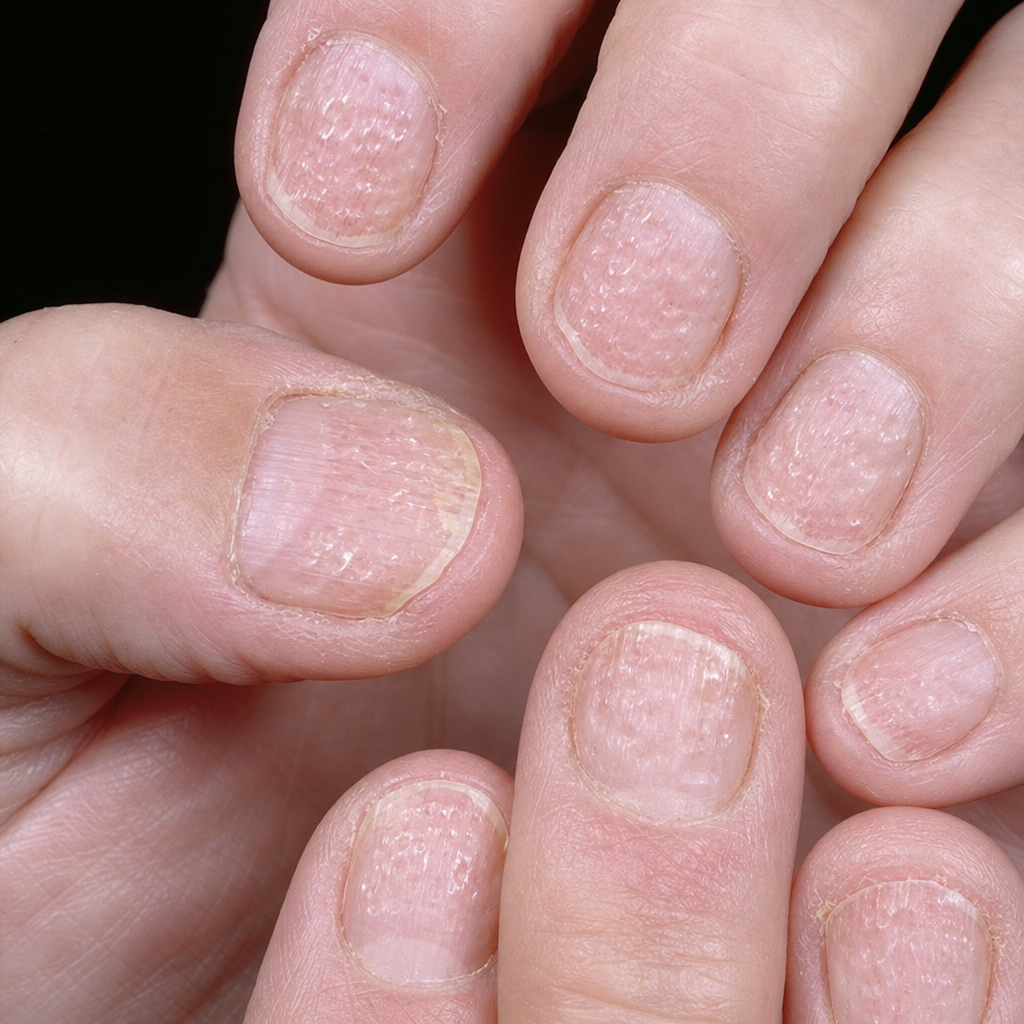
Nail involvement is seen in which of the following conditions?
A 35-year-old male presents with bald patches and no scars. The patches are well demarcated with broken hair at the edges. What is the diagnosis?
Which of the following drugs does NOT cause hirsutism?
Androgenic alopecia in females is caused by which of the following conditions?
Cicatricial alopecia is seen in which of the following conditions?
An elderly female undergoing chemotherapy for breast cancer is experiencing significant hair loss. What is the most likely cause of her condition?
Which of the following statements regarding the condition shown is false?

The image shows presence of:

The following patient presented to the OPD with history of hair loss. There was no erythema, scarring or scratching. Diagnosis is:

The nail lesion shown in the image is known as?

Explanation: **Explanation:** Nail involvement is a common clinical feature in several dermatological conditions, as the nail unit is an appendage of the skin. 1. **Psoriasis:** Nail changes occur in up to 50% of patients. High-yield findings include **pitting** (deep, irregular), **onycholysis** (separation of the nail plate), **oil spots** (salmon patches), and subungual hyperkeratosis. Pitting in psoriasis is due to focal parakeratosis of the proximal nail matrix. 2. **Lichen Planus (LP):** Classic nail LP involves the matrix, leading to thinning, longitudinal ridging, and fissuring. The hallmark high-yield sign is **Pterygium formation** (V-shaped scarring of the proximal nail fold onto the bed), which can lead to permanent scarring and anonychia. 3. **Fungal Infection (Onychomycosis):** This is the most common cause of nail dystrophy. It typically presents with subungual hyperkeratosis, distal onycholysis, and yellowish-white discoloration. *Trichophyton rubrum* is the most common causative agent. **Clinical Pearls for NEET-PG:** * **Pitting:** Fine, regular pits are seen in **Alopecia Areata**; coarse, irregular pits are seen in **Psoriasis**. * **Twenty-nail dystrophy (Trachyonychia):** Characterized by "sandpaper nails," it can be idiopathic or associated with Alopecia Areata, Psoriasis, or Lichen Planus. * **Darier Disease:** Look for "V-shaped" notches at the distal margin and longitudinal red/white streaks. * **Beau’s Lines:** Transverse grooves indicating temporary arrest of nail matrix mitosis (seen in high fever or systemic illness).
Explanation: ### Explanation **Correct Answer: A. Alopecia Areata** The clinical presentation of **well-demarcated, non-scarring bald patches** is classic for Alopecia Areata. The hallmark sign mentioned—**broken hair at the edges**—refers to **"Exclamation mark hairs"** (pathognomonic). These are short, fractured hairs where the proximal shaft is thinner than the distal end. It is an autoimmune condition where T-cells attack the hair bulb (anagen phase), leading to sudden hair loss without follicular destruction (non-scarring). **Why other options are incorrect:** * **Androgenic Alopecia:** Presents as progressive thinning in a patterned distribution (receding hairline or vertex thinning) rather than discrete patches. It is driven by dihydrotestosterone (DHT). * **Discoid Lupus Erythematosus (DLE):** This is a form of **cicatricial (scarring) alopecia**. It presents with erythematous plaques, scaling, and permanent loss of follicular ostia, unlike the smooth, non-scarring patches seen here. * **Telogen Effluvium:** Characterized by **diffuse** thinning of hair across the entire scalp, usually triggered by stress, pregnancy, or illness. It does not present with localized patches or exclamation mark hairs. **High-Yield Clinical Pearls for NEET-PG:** * **Trichoscopy:** Look for "Exclamation mark hairs," yellow dots (sebum in follicular openings), and black dots (cadaverized hairs). * **Nail Findings:** "Geometric pitting" (regular, fine pits) is a common association in 10-20% of cases. * **Prognosis:** Poor prognostic factors include **Ophiasis pattern** (hair loss along the temporal/occipital hairline), nail involvement, and early age of onset. * **Treatment:** First-line for localized patches is **Intralesional Triamcinolone acetonide**.
Explanation: **Explanation:** The correct answer is **Penicillamine**. To answer this question, it is essential to distinguish between **Hirsutism** (excessive terminal hair growth in women in a male-pattern distribution due to increased androgens) and **Hypertrichosis** (generalized excessive hair growth not localized to androgen-dependent areas). **1. Why Penicillamine is the correct answer:** Penicillamine is actually associated with **Hypertrichosis**, not hirsutism. It is a chelating agent used in Wilson’s disease. While it causes excessive hair growth, it does not involve the androgenic pathways required to define the condition as hirsutism. **2. Analysis of Incorrect Options:** The other three options are known to cause **Hirsutism** primarily through the induction of **Hyperprolactinemia**. Prolactin stimulates the adrenal cortex to produce dehydroepiandrosterone sulfate (DHEAS), an androgen that leads to male-pattern hair growth. * **Methyldopa:** An antihypertensive that acts as a centrally acting alpha-2 agonist; it inhibits dopamine, leading to increased prolactin. * **Phenothiazines:** Antipsychotics that block dopamine (D2) receptors in the tuberoinfundibular pathway, causing a rise in prolactin levels. * **Metoclopramide:** A prokinetic/antiemetic that also acts as a dopamine antagonist, resulting in hyperprolactinemia-induced hirsutism. **High-Yield Clinical Pearls for NEET-PG:** * **Common Drugs causing Hirsutism:** Anabolic steroids, Danazol, Progestins, and drugs causing Hyperprolactinemia (Antipsychotics, Metoclopramide, Methyldopa). * **Common Drugs causing Hypertrichosis:** Minoxidil, Cyclosporine, Phenytoin, Psoralens, and Penicillamine. * **Mnemonic for Hypertrichosis:** **"P**enicillamine, **P**henytoin, **P**soralens, **C**yclosporine, **M**inoxidil" (**P-P-P-C-M**). * **Key Distinction:** Hirsutism is **Androgen-dependent**; Hypertrichosis is **Androgen-independent**.
Explanation: **Explanation:** **Stein-Leventhal Syndrome (Polycystic Ovary Syndrome - PCOS)** is the correct answer because it is the most common cause of hyperandrogenism in females. Female Pattern Hair Loss (FPHL) or androgenic alopecia is driven by the sensitivity of hair follicles to circulating androgens. In PCOS, there is an excess of ovarian androgens (androstenedione and testosterone), which are converted to **Dihydrotestosterone (DHT)** by the enzyme 5-alpha reductase. DHT causes the miniaturization of hair follicles, leading to thinning, typically in a diffuse pattern over the mid-frontal scalp with preservation of the frontal hairline (Ludwig classification). **Analysis of Incorrect Options:** * **Myxedema (Hypothyroidism):** Characterized by dry, brittle hair and a classic sign called **Hertoghe’s sign** (loss of the outer third of the eyebrows), but it does not cause androgen-mediated alopecia. * **Cushing Disease:** While it involves excess cortisol and can lead to hirsutism (excess terminal hair in a male distribution), the primary clinical feature is not typically androgenic alopecia, but rather "moon facies," "buffalo hump," and striae. * **Addison’s Disease:** This is primary adrenal insufficiency (low cortisol/aldosterone). It typically presents with hyperpigmentation and loss of axillary/pubic hair in females due to decreased adrenal androgens, the opposite of androgenic alopecia. **High-Yield Clinical Pearls for NEET-PG:** * **Ludwig Classification:** Used to grade the severity of female pattern hair loss (Stages I, II, and III). * **Hamilton-Norwood Scale:** Used for male pattern baldness. * **Treatment of Choice:** Topical **Minoxidil (2% or 5%)** is the first-line treatment for FPHL. Anti-androgens like Spironolactone or Finasteride are used if PCOS is the underlying cause. * **Key Lab Finding:** Elevated **LH:FSH ratio (>2:1)** is often seen in Stein-Leventhal syndrome.
Explanation: **Explanation:** **Cicatricial (scarring) alopecia** is characterized by the permanent destruction of hair follicles and their replacement by fibrous tissue. This leads to irreversible hair loss and the clinical disappearance of follicular orifices. **1. Why Discoid Lupus Erythematosus (DLE) is correct:** DLE is a classic cause of primary cicatricial alopecia. The underlying pathology involves a dense lymphocytic infiltrate at the dermo-epidermal junction that attacks the follicular stem cells in the "bulge" region. Clinically, it presents as well-demarcated erythematous plaques with follicular plugging, atrophy, and telangiectasia, eventually leading to a smooth, scarred scalp. **2. Why the other options are incorrect:** * **Tinea Capitis:** Generally causes **non-cicatricial** alopecia (e.g., Grey patch or Black dot). While *Kerion* (an inflammatory variant) can rarely cause secondary scarring if untreated, Tinea capitis as a whole is classified under non-scarring types. * **Psoriasis:** Typically does not cause hair loss. Even in severe "sebopsoriasis," the hair follicles remain intact, and hair regrowth occurs once the scales are cleared. * **Alopecia Areata:** An autoimmune, **non-cicatricial** condition where the hair follicle is "hibernating" but not destroyed. It is characterized by "exclamation mark hairs" and potential for complete regrowth. **Clinical Pearls for NEET-PG:** * **Mnemonic for Cicatricial Alopecia:** "L-P-S" (Lichen Planopilaris, Pseudopelade of Brocq, Sarcoidosis/Scleroderma) and **DLE**. * **Key Histology for DLE:** Vacuolar degeneration of the basal layer and basement membrane thickening. * **High-Yield Distinction:** If the follicular orifices are **absent**, it is cicatricial; if **present**, it is non-cicatricial.
Explanation: ***Anagen Effluvium***- This condition is the abrupt cessation of cell division in the rapidly proliferating hair matrix, directly caused by cytotoxic agents (chemotherapy) used to treat **breast cancer**.- It results in the hair shaft narrowing and fracturing, leading to massive, acute hair shedding (often non-scarring) that occurs within days to weeks of starting the **chemotherapy treatment**.*Telogen Effluvium*- This type of hair loss involves premature shifting of hairs from the growth (anagen) to the resting (telogen) phase due to a major stressor (e.g., severe illness, childbirth).- The shedding typically appears **2 to 4 months after** the initial precipitating event, which is too delayed for the immediate hair loss associated with most chemotherapy regimens.*Trichotillomania*- This is a psychological disorder characterized by recurrent, irresistible urges to **pull out one's hair**, leading to hair loss.- The resulting alopecia is typically patchy, irregular, and features hairs of different lengths due to continuous pulling, contrasting sharply with the diffuse loss from chemotherapy.*Alopecia Areata*- This is an **autoimmune** disorder where T-lymphocytes attack the anagen hair follicles, resulting in distinct, usually circular or oval, non-scarring patches of hair loss.- It classically presents with "exclamation mark" hairs (hairs that are narrower near the scalp) and is not directly induced by cytotoxic chemotherapy.
Explanation: ***Usually causes ectothrix infection*** - The image shown depicts **tinea capitis**, specifically **black dot tinea capitis**, which is commonly caused by *T. tonsurans*. - *T. tonsurans* typically causes **endothrix infection**, where fungal spores invade the hair shaft *inside* the follicle, leading to hairs breaking off at the scalp surface, appearing as "black dots." *Can be transmitted from child to child* - **Tinea capitis** is highly contagious and is frequently transmitted among **children** through direct contact with infected individuals or indirectly via contaminated fomites such as combs, hats, and pillowcases. - This mode of transmission makes it a common public health concern in schools and daycares. *Patchy hair loss* - The image clearly shows **patches of hair loss** on the scalp, which is a hallmark symptom of **tinea capitis**. - These patches can be associated with scaling, inflammation, and broken hairs, contributing to the characteristic appearance. *Most commonly caused by T. tonsurans* - In many parts of the world, especially in the United States, **Trichophyton tonsurans** is the predominant cause of **tinea capitis**. - This fungus often results in the **endothrix type** of infection and can lead to the "black dot" appearance observed when hairs break at the surface of the scalp.
Explanation: ***Muehrcke's nails*** - The image clearly displays characteristic **paired white transverse bands** separated by normal vascular nail tissue. - These lines are caused by **edema of the nail bed** affecting capillary blood perfusion, rather than abnormalities of the nail plate itself, and do not move with nail growth. *Lindsay nails* - Also known as **"half-and-half" nails**, these present with the **proximal half of the nail bed being white** and the **distal half being red, pink, or brown**. - They are typically associated with **chronic renal failure** and would show a clear demarcation between the two colors, which is not seen here. *Leukonychia* - This is a general term for **whitening of the nail plate** and can be total (entire nail), partial (portions), or punctate (small spots). - While Muehrcke's nails involve white bands, the specific pattern of **paired transverse bands** makes "Muehrcke's nails" a more precise diagnosis than the general term "leukonychia." *Beau's lines* - These are **transverse depressions or grooves** in the nail plate, reflecting a temporary arrest of nail matrix growth. - They are typically caused by **severe illness** or trauma and move distally with nail growth, appearing as depressions rather than discolored bands.
Explanation: ***Alopecia areata*** - The image shows **well-demarcated patches of hair loss** with no signs of inflammation or scarring, which is characteristic of alopecia areata. - This condition is an **autoimmune disorder** where the immune system attacks hair follicles, leading to patchy hair loss. - Classic presentation includes **smooth, round patches** with no erythema or scarring. *Trichotillomania* - This condition involves **compulsive hair pulling**, which typically results in **irregularly shaped patches of hair loss** with hairs of varying lengths. - Hair loss in trichotillomania often shows **broken hair shafts** and may be associated with signs of trauma or follicular damage. - The absence of scratching/pulling behavior and the well-defined patches make this less likely. *Telogen effluvium* - Telogen effluvium presents as **diffuse hair shedding** (increased shedding of resting phase hairs) rather than the distinct, localized patches seen in the image. - It usually follows a **stressful event** (e.g., illness, surgery, childbirth) and there's no visible inflammation or scarring. - Would not present as well-demarcated patches. *Tinea infection* - Tinea capitis (ringworm of the scalp) would typically present with **erythema, scaling, inflammation**, and sometimes pustules or kerion formation within the patches of hair loss. - The patches of hair loss in tinea infections often show **broken hairs** or "black dots" where hairs have broken off at the scalp surface. - The **absence of erythema** in this case rules out tinea infection.
Explanation: ***Ventral pterygium*** - This image shows the **adhesion of the distal nail plate to the hyponychium**, creating an extension of the cuticle from the nail bed. This is characteristic of **ventral pterygium**. - It is often associated with conditions causing **distal matrix atrophy**, resulting in the fusion of the nail bed and hyponychium. *Dorsal pterygium* - This condition involves the **proximal nail fold fusing with the nail matrix and nail plate**, leading to a V-shaped defect or splitting of the nail. - It is typically seen in conditions like **lichen planus**, **scleroderma**, or **trauma** to the nail matrix. *Tinea unguium* - This is a fungal infection of the nail, clinically known as **onychomycosis**. - It presents with various morphologies like **subungual hyperkeratosis**, discoloration, and thickening of the nail, which are not the primary features shown. *Onchomycosis* - **Onychomycosis** is a general term for fungal infection of the nail, covering various types from distal subungual to total dystrophic onychomycosis. - While it can cause nail dystrophy, the distinct **adhesion and extension of the hyponychium** seen in the image are not *specific* features of onychomycosis.
Hair Growth Cycle and Anatomy
Practice Questions
Alopecia Areata
Practice Questions
Androgenetic Alopecia
Practice Questions
Telogen Effluvium
Practice Questions
Scarring Alopecias
Practice Questions
Hair Shaft Abnormalities
Practice Questions
Hirsutism and Hypertrichosis
Practice Questions
Nail Anatomy and Growth
Practice Questions
Nail Infections
Practice Questions
Nail Psoriasis and Other Inflammatory Nail Disorders
Practice Questions
Nail Tumors
Practice Questions
Management of Hair and Nail Disorders
Practice Questions
Get full access to all questions, explanations, and performance tracking.
Start For Free