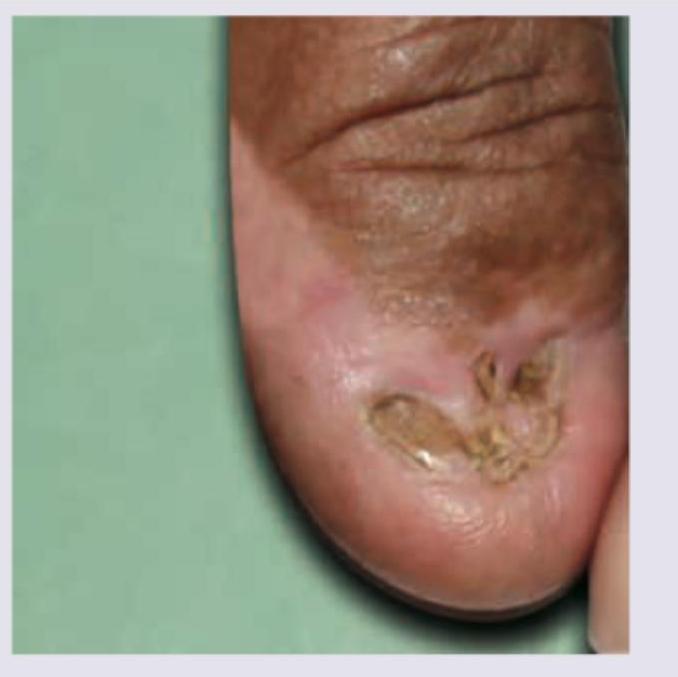
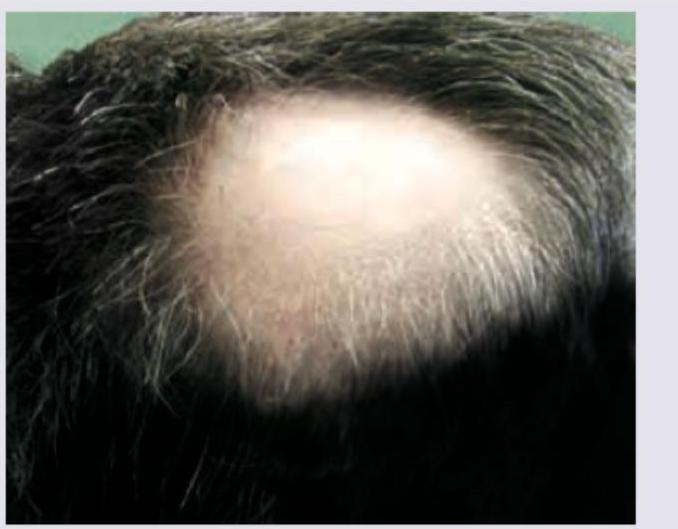
Exclamation mark hairs are seen in which condition?
What is the recommended duration of griseofulvin treatment for fingernail dermatophytosis?
Alopecia areata is presumed to be:
What is Harvey's sign?
Patchy hair loss with velvety skin points to which diagnosis?
Cicatrising alopecia with perifollicular blue-gray patches of hyperpigmentation is most commonly associated with which of the following clinical findings?
Pterygium of the nail is seen in which of the following conditions?
Nail pitting is associated with all of the following conditions except?
A patient presents with scarring alopecia, thinned nails, and hypopigmented macular lesions over the trunk and oral mucosa. What is the diagnosis?
Trichology is the study of:
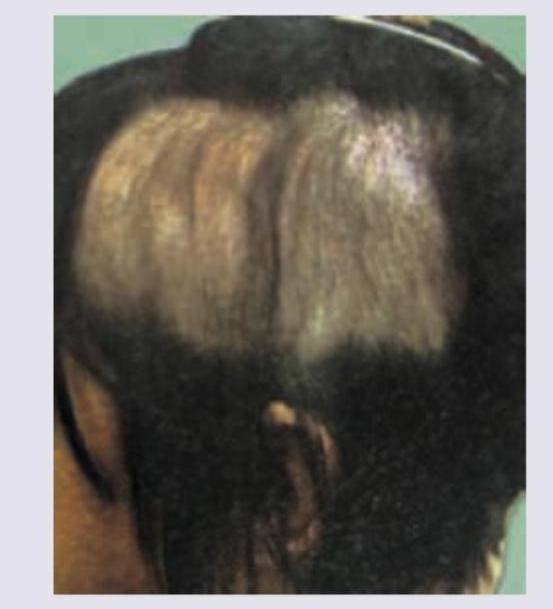
Explanation: **Explanation:** **Alopecia Areata (Option A)** is an autoimmune, non-scarring type of hair loss. **Exclamation mark hairs** are the pathognomonic clinical sign of this condition. They are short (3–4 mm), broken hairs that are thicker at the distal end and narrower at the proximal base (near the scalp). This occurs because the inflammatory infiltrate (the "swarm of bees" around the hair bulb) causes sudden attenuation of the hair shaft, leading to structural weakness and breakage. Their presence indicates **active disease** and peripheral expansion of the bald patch. **Why other options are incorrect:** * **Traumatic Alopecia (Option B):** This includes conditions like Trichotillomania. Here, one typically sees hairs of varying lengths and "broken-off" hairs, but they lack the specific proximal tapering seen in exclamation mark hairs. * **Lichen Planus (Option C):** Specifically Lichen Planopilaris, this is a **cicatricial (scarring)** alopecia. It is characterized by perifollicular erythema, scaling, and permanent destruction of the follicle, rather than the specific shaft morphology seen in areata. **High-Yield Clinical Pearls for NEET-PG:** * **Dermoscopy:** Shows "yellow dots" (follicular plugs), "black dots" (cadaveric hairs), and exclamation mark hairs. * **Nail changes:** The most common nail finding in Alopecia Areata is **fine, geometric pitting** (regularly spaced pits). * **Histopathology:** Characterized by a **peribulbar lymphocytic infiltrate**, famously described as a **"swarm of bees."** * **Treatment of choice:** Intralesional corticosteroids (e.g., Triamcinolone acetonide) for localized patches.
Explanation: **Explanation:** The correct answer is **3 months (Option D)**. Griseofulvin is a fungistatic antibiotic that works by binding to tubulin and interfering with microtubule function, thereby inhibiting mitosis. Its efficacy in treating onychomycosis (dermatophytosis of the nails) depends on the drug being incorporated into the keratin precursor cells. Because the drug only prevents new infection and does not kill fungi in existing keratin, treatment must continue until the infected nail is completely replaced by healthy growth. * **Fingernails** grow at an average rate of 3 mm/month and typically require **4–6 months** for complete replacement; however, the standard pharmacological recommendation for Griseofulvin is a minimum of **3–6 months** to ensure clinical cure. * **Toenails** grow much slower (1 mm/month) and require a longer duration of **6–12 months**. **Why other options are incorrect:** * **Options A & B (4–6 weeks):** This duration is sufficient for Tinea corporis or Tinea capitis, but inadequate for nail infections due to the slow turnover of keratin in the nail plate. * **Option C (2 months):** While improvement may be seen, 2 months is generally insufficient to ensure the entire infected fingernail plate has been shed and replaced, leading to high relapse rates. **High-Yield Clinical Pearls for NEET-PG:** * **Drug of Choice:** While Griseofulvin was the historical standard, **Terbinafine** (Allylamine) is now the DOC for onychomycosis due to higher cure rates and shorter duration (6 weeks for fingernails, 12 weeks for toenails). * **Absorption:** Griseofulvin absorption is significantly increased when taken with a **fatty meal**. * **Side Effects:** Most common is headache; it is also a potent **cytochrome P450 inducer** (interacts with warfarin and OCPs). * **Contraindication:** It is strictly contraindicated in **Porphyria** and pregnancy.
Explanation: ### Explanation **Correct Answer: B. Autoimmune in etiology** Alopecia Areata (AA) is a chronic inflammatory disease characterized by non-scarring hair loss. It is considered an **autoimmune disorder** mediated by T-cells. The underlying pathophysiology involves the **collapse of the "immune privilege"** of the hair follicle. Normally, hair follicles in the anagen (growth) phase are protected from immune recognition. In AA, this privilege is lost, leading to a lymphocytic infiltration (described as a **"swarm of bees"** appearance on histology) around the hair bulb, causing the hair to enter the telogen (resting) phase prematurely. **Why other options are incorrect:** * **A. Androgenic in nature:** This refers to Androgenetic Alopecia (pattern baldness), which is driven by genetic predisposition and the effects of dihydrotestosterone (DHT) on follicles, not an immune response. * **C. Infective in etiology:** AA is not caused by fungi (like Tinea capitis), bacteria, or viruses. It is an endogenous inflammatory process. * **D. Part of the lichenoid spectrum:** Lichen planopilaris is a lichenoid disorder that causes *scarring* (cicatricial) alopecia. AA is strictly *non-scarring*. **Clinical Pearls for NEET-PG:** * **Clinical Hallmark:** Sudden onset of smooth, circumscribed, non-scarring patches of hair loss. * **Pathognomonic Sign:** **Exclamation mark hairs** (short broken hairs that are narrower at the base) seen at the periphery of expanding patches. * **Nail Changes:** **Geometric pitting** (fine, uniform pits) is the most common nail finding in AA. * **Associations:** Frequently associated with other autoimmune conditions like **Vitiligo** and **Hashimoto’s thyroiditis**. * **Treatment:** First-line treatment for localized patches is **intralesional corticosteroids** (e.g., Triamcinolone acetonide).
Explanation: **Explanation:** **Harvey’s Sign** is a clinical test used to assess the direction of blood flow and the competency of valves in the peripheral veins. It is performed by emptying a segment of a vein (usually on the dorsum of the hand or forearm) by compressing it with two fingers and sliding one finger away to express the blood. The clinician then observes the **venous filling** from the periphery toward the center. If the vein fills rapidly from the distal end, it indicates normal valvular function and flow direction. **Analysis of Options:** * **Option B (Correct):** Harvey’s sign specifically relates to the observation of venous filling after a segment of the vein has been manually emptied. It is a classic bedside maneuver to demonstrate the presence of valves in the venous system. * **Option A (Incorrect):** This describes a "cough impulse" or "thrill," often associated with conditions like **Saphena Varix** (Kelly’s sign), where a transmitted pressure wave is felt over the great saphenous vein upon coughing. * **Option C (Incorrect):** Loss of the outer third of the eyebrows is known as **Hertoghe’s sign** (Queen Anne’s sign), commonly seen in hypothyroidism or atopic dermatitis. While this is a dermatology/endocrinology pearl, it is unrelated to Harvey’s sign. **NEET-PG High-Yield Pearls:** * **Harvey’s Sign** was originally described by William Harvey to prove the circular motion of blood. * Do not confuse this with **Hertoghe’s sign** (eyebrows) or **Homans’ sign** (DVT - pain on dorsiflexion of the foot). * In Dermatology, nail and hair signs are frequent examiners' favorites; however, Harvey's sign is a fundamental cardiovascular/physical examination sign that occasionally appears in "General Medicine" sections of the exam.
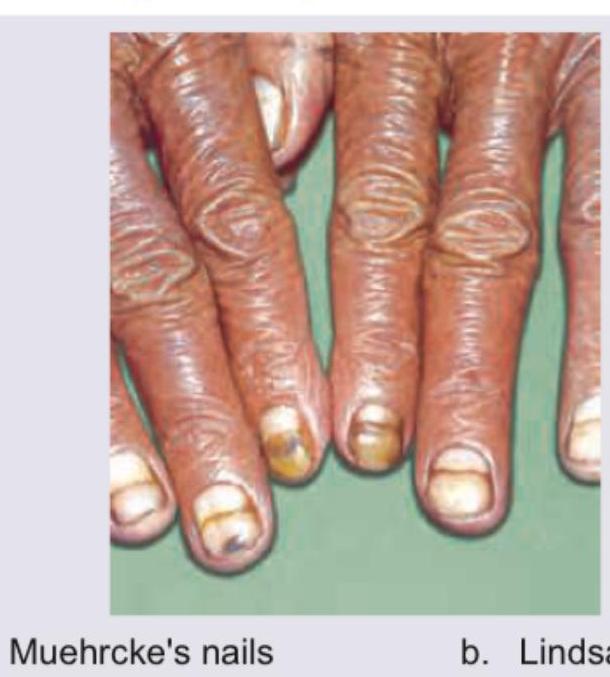
Explanation: **Explanation:** The correct answer is **Hyperthyroidism**. In patients with thyrotoxicosis, the skin often becomes thin, warm, moist, and classically described as **"velvety"** in texture. This is due to increased cutaneous blood flow and sweat gland activity. The associated hair loss is typically a diffuse thinning (Telogen effluvium), but it can also present as **patchy alopecia**. Additionally, hyperthyroidism is frequently associated with autoimmune conditions like **Alopecia areata**, which presents with well-demarcated patches of hair loss. **Analysis of Incorrect Options:** * **Alopecia areata:** While this causes patchy hair loss (non-scarring, "exclamation mark" hairs), it does not typically cause a change in the overall skin texture to "velvety." * **Trichotillomania:** This is a psychiatric impulse-control disorder characterized by the urge to pull out one's hair. It presents with irregular patches of hair loss with broken hairs of varying lengths, but the underlying skin remains normal. * **Adenoma sebaceum:** This is a misnomer for **angiofibromas** seen in Tuberous Sclerosis. These are firm, reddish papules in a butterfly distribution on the face, not associated with patchy hair loss or velvety skin. **NEET-PG High-Yield Pearls:** * **Plummer’s Nail:** Distal onycholysis (separation of the nail bed) specifically associated with hyperthyroidism. * **Pretibial Myxedema:** Non-pitting edema with a "peau d'orange" appearance, seen in Graves' disease. * **Hypothyroidism:** Conversely, presents with **dry, coarse, "sandpaper" skin** and loss of the outer third of the eyebrows (Madarosis/Queen Anne’s sign).
Explanation: The clinical presentation described—**cicatricial (scarring) alopecia** associated with **perifollicular blue-gray hyperpigmentation**—is a classic description of **Lichen Planopilaris (LPP)**, specifically the variant known as **Frontal Fibrosing Alopecia (FFA)** or LPP with **Lichen Planus Pigmentosus**. ### 1. Why the Correct Answer is Right **Lichen Planopilaris (LPP)** is a follicular form of **Lichen Planus (LP)**. Since LP is a systemic mucocutaneous disease, patients with LPP frequently exhibit other manifestations of the disease. **Whitish lesions in the buccal mucosa** (Wickham striae) are a hallmark of oral lichen planus. The blue-gray perifollicular pigmentation (often called "perifollicular casts" or associated with Lichen Planus Pigmentosus) is a key diagnostic clue pointing toward the Lichen Planus spectrum. ### 2. Why the Incorrect Options are Wrong * **A. Pitting of nails:** This is most commonly associated with **Psoriasis** or **Alopecia Areata**. While LP can cause nail changes (like pterygium), fine pitting is not its characteristic feature. * **C. Alopecia areata:** This is a **non-cicatricial** (non-scarring) alopecia characterized by "exclamation mark" hairs, not scarring or blue-gray pigmentation. * **D. Discoid plaques on the face:** This suggests **Discoid Lupus Erythematosus (DLE)**. While DLE also causes cicatricial alopecia, it typically presents with follicular plugging, telangiectasia, and atrophy, rather than the specific blue-gray perifollicular pigmentation of LPP. ### 3. Clinical Pearls for NEET-PG * **Graham-Little-Piccardi-Lassueur Syndrome:** A triad of (1) Cicatricial alopecia of the scalp, (2) Non-cicatricial alopecia of axilla/pubis, and (3) Lichen planus follicular (Lichen spinulosus). * **Trichoscopy of LPP:** Look for peripilar casts and perifollicular erythema in early stages. * **Lichen Planus Pigmentosus (LPPig):** Often co-exists with Frontal Fibrosing Alopecia in dark-skinned individuals (Graham-Little Syndrome variant).
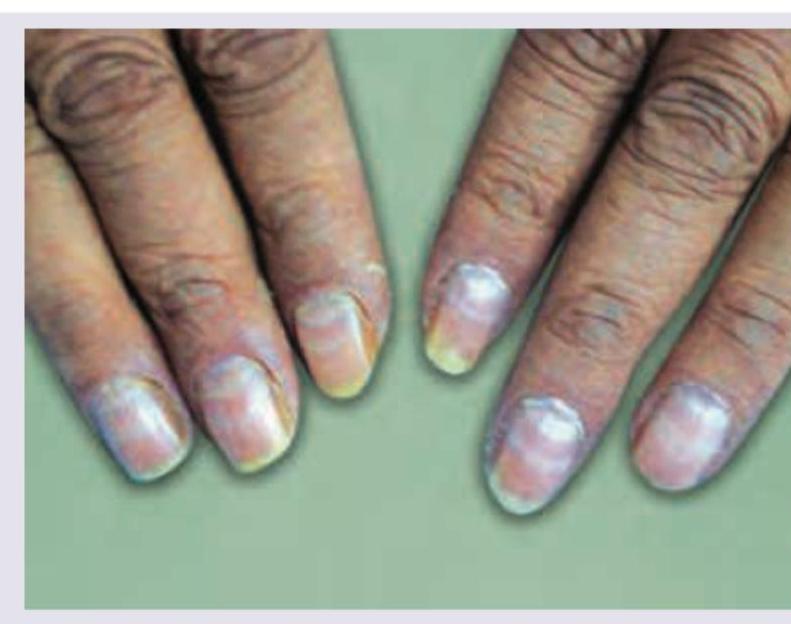
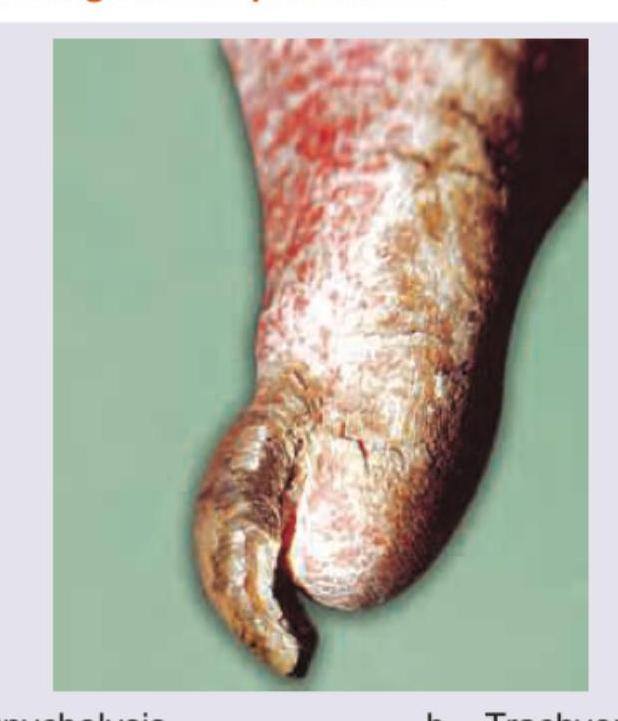
Explanation: **Explanation:** **Pterygium of the nail** (specifically dorsal pterygium) is a classic hallmark of **Lichen Planus (LP)**. It occurs due to scarring and inflammation of the nail matrix, leading to the fusion of the proximal nail fold to the nail bed. This results in a characteristic V-shaped extension of the skin over the nail plate, eventually causing irreversible destruction and splitting of the nail. **Analysis of Options:** * **Lichen Planus (Correct):** Approximately 10% of LP cases involve nails. The "classic triad" includes thinning of the nail plate, longitudinal ridging, and **dorsal pterygium**. * **Psoriasis:** Characterized by **pitting** (deep, irregular), onycholysis (separation of the nail from the bed), "oil spots" (salmon patches), and subungual hyperkeratosis. Pterygium is not a feature. * **Tinea Unguium:** A fungal infection typically presenting with distal subungual hyperkeratosis, yellow-white discoloration, and crumbling of the nail plate. * **Alopecia Areata:** Classically associated with **geometric pitting** (shallow, regularly spaced pits in a grid-like pattern) and "trachyonychia" (rough, sandpaper-like nails). **High-Yield Clinical Pearls for NEET-PG:** 1. **Dorsal Pterygium:** Seen in Lichen Planus (scarring/destructive). 2. **Ventral Pterygium (Pterygium Inversum Unguis):** Seen in **Scleroderma**, SLE, and Leprosy (fusion of the hyponychium to the underside of the nail plate). 3. **Trachyonychia (Twenty-nail dystrophy):** Can be seen in Lichen Planus, Psoriasis, Alopecia Areata, and Eczema. 4. **Nail Pitting:** Psoriasis (deep/irregular) vs. Alopecia Areata (shallow/geometric).
Explanation: **Explanation:** **Nail pitting** is a common clinical finding caused by defective keratinization of the **proximal nail matrix**. This results in focal areas of parakeratotic cells that are easily shed, leaving behind small punctate depressions (pits) on the nail plate surface. **Why Pityriasis Rosea is the Correct Answer:** Pityriasis rosea is an acute, self-limiting inflammatory skin disease characterized by a "herald patch" and a "Christmas tree" distribution of scaly plaques. Crucially, it **does not involve the nail matrix**. Therefore, nail changes, including pitting, are not a feature of this condition. **Analysis of Incorrect Options:** * **Lichen Planus:** While more commonly associated with pterygium formation and longitudinal ridging, Lichen Planus can involve the nail matrix, leading to thinning, brittleness, and occasionally **fine, shallow pitting**. * **Hyperthyroidism:** Systemic endocrine disorders can affect nail growth. Hyperthyroidism is associated with various nail changes, including **Plummer’s nails** (onycholysis) and occasionally pitting or ridging due to altered metabolic states affecting the matrix. * **Fungal Infection (Onychomycosis):** While subungual hyperkeratosis and discoloration are more typical, fungal invasion of the nail plate and matrix can lead to structural irregularities, including **irregular pitting**. **NEET-PG High-Yield Pearls:** 1. **Psoriasis:** The most common cause of nail pitting. Pits are typically **deep, large, and irregularly distributed** ("thimble pitting"). 2. **Alopecia Areata:** Characterized by **fine, geometric, "grid-like" pitting**. 3. **Eczema:** Often presents with **coarse, irregular pitting** and transverse ridging (Beau’s lines). 4. **Reiter’s Syndrome:** Can present with pits similar to psoriasis.
Explanation: ### Explanation The correct diagnosis is **Lichen Planus (LP)**, a chronic inflammatory condition that affects the skin, mucous membranes, hair, and nails. **1. Why Lichen Planus is correct:** Lichen planus is characterized by the "Ps" (Planar, Purple, Polygonal, Pruritic, Papules). However, it frequently involves adnexal structures: * **Hair:** It causes **Lichen Planopilaris**, which leads to **scarring (cicatricial) alopecia** due to the destruction of hair follicles. * **Nails:** Classic nail changes include **thinning of the nail plate**, longitudinal ridging, and the pathognomonic **Pterygium formation** (fusing of the proximal nail fold to the nail bed). * **Mucosa:** Oral involvement often presents as a reticulate pattern (Wickham striae) or hypopigmented/erosive lesions. * **Skin:** While typically violaceous, resolving lesions often leave **post-inflammatory hyperpigmentation** or, less commonly, hypopigmented macules. **2. Why the other options are wrong:** * **Psoriasis:** Characterized by well-demarcated erythematous plaques with silvery scales. Nail changes include **pitting, oil spots, and subungual hyperkeratosis**, but it causes **non-scarring** alopecia (psoriatic alopecia). * **Leprosy:** While it presents with hypopigmented patches and can cause eyebrow hair loss (madarosis), it does not typically cause generalized scarring alopecia or the specific nail thinning seen in LP. * **Pemphigus:** An autoimmune blistering disorder. While Pemphigus Vulgaris involves the oral mucosa (erosions), it does not typically present with scarring alopecia or the specific nail dystrophy described. **3. NEET-PG High-Yield Pearls:** * **Pterygium:** If it's "Dorsal Pterygium," think Lichen Planus. If it's "Ventral Pterygium" (hyponychium attached to nail plate), think Scleroderma or Leprosy. * **Civatte Bodies:** Histopathological hallmark of LP (apoptotic keratinocytes in the basal layer). * **Koebner Phenomenon:** Positive in Lichen Planus, Psoriasis, and Vitiligo. * **Grinspan Syndrome:** Triad of Lichen Planus, Diabetes Mellitus, and Hypertension.
Explanation: **Explanation:** **Trichology** is the specialized branch of dermatology that deals with the scientific study of the health of the **hair** and scalp. The term is derived from the Greek word *'trikhos'* (hair). It encompasses the anatomy, physiology, and pathology of human hair, including disorders like alopecia, hirsutism, and hair shaft abnormalities. **Analysis of Options:** * **A. Hair (Correct):** Trichology focuses on the hair follicle and shaft. In NEET-PG, understanding the hair cycle (Anagen, Catagen, Telogen) is fundamental to this field. * **B. Nail:** The study of nails is known as **Onychology**. Nail disorders (e.g., lichen planus, psoriasis, or onychomycosis) are frequent topics in dermatology. * **C. Skin:** The study of skin is **Dermatology**. While trichology is a sub-specialty of dermatology, the term specifically refers to hair. * **D. Bones:** The study of bones is **Osteology**, a branch of anatomy and orthopedics. **Clinical Pearls for NEET-PG:** * **Hair Cycle Ratios:** In a normal scalp, approximately 85-90% of hairs are in the **Anagen** (growth) phase, while 10-15% are in the **Telogen** (resting) phase. * **Exogen:** This is the specific phase of the hair cycle where the hair shaft is actively shed. * **Trichoscopy:** A high-yield diagnostic tool (dermoscopy of the hair/scalp) used to differentiate between conditions like Alopecia Areata (exclamation mark hairs) and Trichotillomania (broken hairs of varying lengths). * **Club Hair:** A fully keratinized, dead hair formed at the end of the Telogen phase.
Hair Growth Cycle and Anatomy
Practice Questions
Alopecia Areata
Practice Questions
Androgenetic Alopecia
Practice Questions
Telogen Effluvium
Practice Questions
Scarring Alopecias
Practice Questions
Hair Shaft Abnormalities
Practice Questions
Hirsutism and Hypertrichosis
Practice Questions
Nail Anatomy and Growth
Practice Questions
Nail Infections
Practice Questions
Nail Psoriasis and Other Inflammatory Nail Disorders
Practice Questions
Nail Tumors
Practice Questions
Management of Hair and Nail Disorders
Practice Questions
Get full access to all questions, explanations, and performance tracking.
Start For Free